

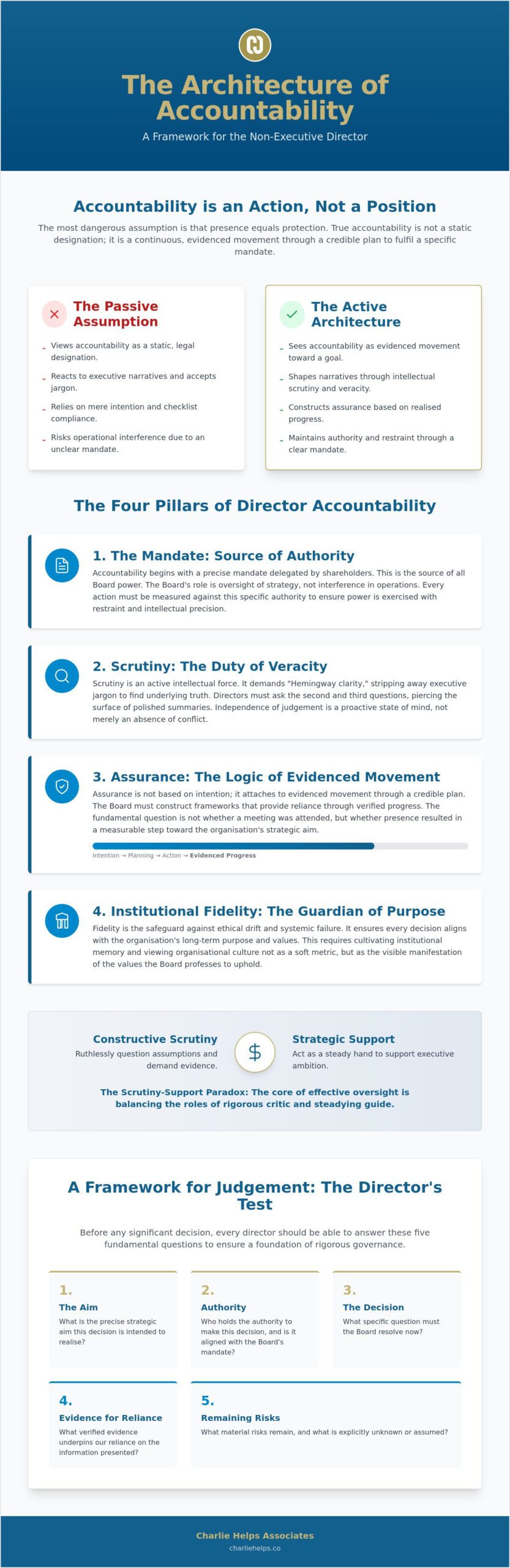
The most dangerous assumption a Non-Executive Director can make is that presence equals protection. True NED accountability is not a static designation; it is a continuous, evidenced movement through a credible plan to fulfil a specific mandate. You likely find yourself navigating the precarious boundary between constructive scrutiny and operational interference, whilst the weight of personal liability grows under the UK Corporate Governance Code 2024. This tension is often exacerbated by the information asymmetry that leaves Boards reacting to executive narratives rather than shaping them with intellectual force.
This article provides a rigorous examination of how Boards architect accountability through intellectual scrutiny, institutional fidelity, and the systematic verification of veracity. We shall establish a clear framework for maintaining independence of judgement and provide practical methods for evidencing the assurance that regulators now demand. By the conclusion, you will possess a structured approach to realise your mandate with both authority and restraint. We will move beyond the theory of oversight to the practical implementation of institutional memory and evidenced movement.
Key Takeaways
- View NED accountability as a continuous, evidenced movement towards a defined mandate rather than a static legal designation.
- Exercise scrutiny as an active intellectual force, employing precise inquiry to establish the veracity of information and strip away executive jargon.
- Construct assurance frameworks that provide reliance through evidenced progress, ensuring that the Board remains focused on realised movement over mere intention.
- Protect the organisation from systemic failure by cultivating institutional memory and maintaining a rigorous standard of institutional fidelity.
- Utilise professional advisory to architect institutional excellence, providing directors with the strategic tools necessary to maintain independence and authority.
Defining the Mandate: NED Accountability as an Active Architecture
Accountability is not a passive container or a checklist to be completed during a quarterly meeting. It is the active, evidenced movement of directors toward a defined mandate. Whilst many observers treat “governance” as an abstract agent that acts upon an organisation, we recognise that only people—directors, committees, and boards—possess the agency to decide or constrain. Consequently, NED accountability requires a rigorous architecture where every action is measured against the specific authority granted to the Board. This mandate serves as the primary source of all Board power. Without a clear mandate, oversight risks becoming mere interference.
The Authority of the Non-Executive Director
A Non-executive director (NED) derives authority from the shareholders or stakeholders who delegate the stewardship of the organisation to the Board. This delegation is not a blank cheque; it’s a precise mandate that requires directors to exercise power with restraint and intellectual precision. We must distinguish this mandate from executive management responsibilities. Executives implement operations and manage day-to-day functions, whilst the Board ensures those actions align with the agreed strategic path. Exercising this authority requires moral depth. Directors must possess the courage to challenge management whilst maintaining the intellectual humility to stay within their non-executive bounds.
Fidelity to Purpose: The Core of Accountability
Institutional fidelity ensures that every decision aligns with the long-term value and purpose of the organisation. It’s the safeguard against ethical drift and the repetition of systemic failures. To achieve this, the Board must maintain a clear-eyed view of organisational behaviour and culture. Culture is not a “soft” metric; it’s the visible manifestation of the values the Board claims to uphold. The Chair plays a critical role in this dynamic. By fostering a culture of veracity, the Chair allows for open challenge without the fear of social friction. This environment makes workable the difficult conversations required to verify that management’s actions match their stated intentions. Accountability, in this sense, is the active pursuit of truth through the lens of institutional purpose.
To realise this architecture, Boards must move beyond the rhetoric of “compliance” and embrace a standard of fidelity that demands evidence of movement. This movement is the only credible basis for assurance. When a Board can demonstrate that its decisions were rooted in the mandate and supported by verified data, it fulfils its duty to the organisation and its stakeholders alike. The question for every director is not whether they attended the meeting, but whether their presence resulted in an evidenced step toward the organisation’s strategic aim.
Scrutiny as a Verb: The Director’s Duty of Veracity
Scrutiny is an active intellectual force. It’s not a reactive critique or a polite request for clarification. True NED accountability manifests when a director refuses to accept management jargon as a substitute for evidence. We call this “Hemingway clarity.” It requires stripping away hollow phrases like “strategic alignment” or “optimised synergies” to find the underlying truth of a situation. When directors remain silent in the face of ambiguity, they don’t just concede; they fail in their fundamental duty of veracity. Silence in the boardroom is often the first sign of institutional decay.
Independence of Judgement and Intellectual Force
Independence is more than the absence of conflict. It’s a proactive state of mind. Directors must exercise an intellectual force that allows them to maintain their mandate even when faced with dominant executive personalities. This requires aphoristic precision. One must ask the second and third questions that pierce the surface of a polished executive summary. A director’s value lies in their ability to see what isn’t being said. By fulfilling the duties of a non-executive director, individuals ensure that the Board’s authority remains rooted in independent thought rather than executive consensus.
The Scrutiny-Support Paradox
The Board must act as a steady hand whilst remaining a rigorous critic. This paradox is the heart of effective oversight. You must support the executive team’s ambition whilst ruthlessly questioning their assumptions. To achieve this balance, many Boards utilise a board effectiveness review as a diagnostic tool. This process identifies whether the Board has drifted into “groupthink,” a state where the desire for social harmony overrides the duty to challenge. Diverse perspectives are not a luxury; they’re a requirement for veracity. If you find your Board is struggling to maintain this tension, you might seek expert mentoring to restore intellectual rigour to your proceedings.
Effective NED accountability rests on the courage to be the dissenting voice. It’s about ensuring that every decision is backed by verified data and logical rigour. When a director provides this level of scrutiny, they don’t just protect the organisation; they elevate the entire executive team. They force a higher standard of preparation and a deeper level of thinking. This is how a Board moves from being a passive observer to an active architect of institutional excellence.
Constructing Frameworks for Evidenced Assurance
Assurance is the byproduct of evidence. It is not found in the optimistic projections of a management report or the sincere intentions of a CEO. For a Board to realise true NED accountability, it must architect frameworks that prioritise verified movement over stated ambition. These structures act as the bridge between the Board’s mandate and the organisation’s reality. Many leaders engage corporate governance consultants UK to audit these frameworks, ensuring they remain rigorous enough to withstand regulatory scrutiny. Reliance should never be a matter of faith; it must be a matter of fact.
Information Flow and Institutional Memory
The Board holds the authority to demand high-quality, timely, and relevant information. Information asymmetry is the enemy of oversight. Without diverse data sources, directors become captives of the executive narrative. Institutional memory provides the necessary context to identify strategic drift, acting as a safeguard against the short-termism that often precedes systemic failure. Modern Boards utilise workflow optimisation software to capture process evidence and maintain a digital audit trail. This technology ensures that decisions are rooted in a clear understanding of past behaviours and current capabilities.
Risk Oversight and the Mandate for Assurance
The mandate for assurance is the cornerstone of NED accountability. Assurance attaches to evidenced movement through a credible plan; it is not a static state achieved by signing off on a risk register. Directors must ensure that the organisation’s risk appetite is not merely a document, but a living constraint reflected in daily operations. This requires a deep understanding of corporate governance and the intellectual courage to probe for “unknown unknowns.” By verifying that management has implemented workable controls, the Board fulfils its duty to protect long-term value.
If your current assurance framework relies more on trust than evidence, you may wish to commission a diagnostic review to identify systemic gaps in your oversight. True accountability requires a shift from “trusting” executive reports to “verifying” through diverse data sources. Only then can a Board provide the steady hand required to navigate a complex environment with confidence and clarity.
Realising Accountability through Strategic Governance Advisory
Gravitas is not an inherent trait; it is a professional standard maintained through rigorous architecture. For a modern Board to maintain its standing, professional advisory is essential. It provides the external intellectual force required to challenge internal assumptions and ensure that NED accountability remains a lived reality rather than a dormant policy. By utilising specialised corporate advisory services UK, directors can bridge the gap between abstract oversight and evidenced action. This partnership allows the Board to architect institutional excellence with a level of precision that internal resources alone rarely achieve.
The Role of the Board Effectiveness Review
A professional review serves as a diagnostic mirror. It identifies the precise points where a Board’s stated intentions diverge from its actual behaviour. Whilst internal assessments often suffer from the blind spots of social friction, an external review provides the clarity required to challenge entrenched dynamics. These reviews are the primary tool for diagnostic assurance, helping directors to implement a more workable and resilient architecture. By focusing on the intersection of human behaviour and structural systems, the review ensures that every director possesses a clear understanding of their mandate and the evidence required to fulfil it.
Mentoring for Strategic Fidelity
High-stakes leadership requires a specific moral depth. Transitioning from a managerial mindset to a governance mindset is a significant shift, particularly for new directors who are accustomed to operational control. Through executive leadership coaching UK, directors develop the capability for independent judgement and the restraint necessary to avoid operational encroachment. This mentoring is human-centric, recognising that even the most sophisticated data systems require a steady, ethical hand to interpret them. It builds the intellectual force needed to ask the difficult questions that ensure institutional fidelity.
Accountability is the final measure of a Board’s fidelity to its mandate. It is the visible proof that directors have moved beyond the theatre of compliance to achieve genuine stewardship. The central question for any organisation is not whether its systems are robust, but whether its people possess the authority and veracity to act when those systems fail. To realise this standard, the Board must decide to move beyond intention and towards evidenced movement. What risks remain in your current governance architecture, and what evidence supports your reliance on the current plan? The answer to these questions defines the true state of your NED accountability.
Architecting a Culture of Veracity and Institutional Fidelity
The standard of organisational oversight is set by the people who exercise it. True NED accountability is not a static legal designation; it is a continuous, evidenced movement toward a defined mandate. By stripping away management jargon and architecting frameworks that prioritise verified data over stated intention, Boards maintain the intellectual force required for effective stewardship. We have established that this requires both a rigorous standard of veracity and the moral depth to challenge entrenched boardroom dynamics. Reliance is never a matter of faith; it is a matter of fact.
Charlie Helps Associates provides specialists in integrated governance frameworks with expertise across UK public and private sector governance. We offer lucid, evidence-based advisory to help you realise Board-level excellence and implement workable systems that capture institutional memory. If you seek to move beyond the theatre of compliance and achieve a culture of institutional fidelity, contact Charlie Helps Associates to architect your Board’s governance framework. Better leadership begins with the decision to verify movement through a credible plan.
Frequently Asked Questions
What is the primary difference between executive and non-executive accountability?
Executive accountability attaches to the management of daily operations and the implementation of specific tasks. Non-executive NED accountability, however, involves the strategic oversight of those actions to ensure they remain within the organisation’s risk appetite and mandate. Executives act; directors ensure those actions are the right ones. This distinction is critical to prevent operational encroachment whilst maintaining the independence required for objective scrutiny.
How can a Non-Executive Director evidence their scrutiny for regulatory purposes?
Directors evidence scrutiny by ensuring that boardroom minutes reflect the intellectual force of their inquiry and the veracity of the information provided. It’s not enough to attend; one must document the “second and third” questions that challenge executive assumptions. This evidenced movement through a credible plan provides the assurance that regulators, such as the FRC, require under the UK Corporate Governance Code 2024.
What role does institutional memory play in Board-level accountability?
Institutional memory acts as a structural safeguard against short-termism and the repetition of systemic failures. It provides the historical context needed to evaluate whether current executive proposals align with the organisation’s long-term purpose. Without this memory, a Board risks strategic drift, as it lacks the anchor of past experience to weigh against the novelty of new management narratives.
Can a Board delegate its mandate for accountability to a committee?
A Board cannot delegate its ultimate mandate for accountability, although it may delegate authority for specific tasks to committees. The collective Board remains the final authority for all decisions and the realised movement of the organisation. Committees provide focused scrutiny and recommendations, but the Board must exercise its own independent judgement to verify that the committee’s work fulfils the broader institutional fidelity required.
How does a Board Effectiveness Review improve individual director accountability?
A Board Effectiveness Review identifies specific gaps between a director’s stated intentions and their evidenced actions. It serves as a diagnostic tool that highlights where individual contributions may lack the necessary intellectual rigour or independence. By addressing these findings, directors can refine their approach to scrutiny, ensuring their behaviour aligns with the high standards of NED accountability expected in modern governance.
What are the risks of a Board focusing on compliance over institutional fidelity?
Focusing on compliance alone creates a “tick-box” culture that often masks strategic drift and ethical decay. Institutional fidelity requires a Board to look beyond the minimum legal requirements to ensure that every decision serves the organisation’s core purpose. When compliance is the only goal, directors may miss “unknown unknowns” and systemic risks that do not fit into a standard regulatory checklist.
Disclaimer
The articles published on CharlieHelps.co are provided for general information, reflection, and commentary. They draw on professional experience, research, and interpretation, but they do not constitute legal, regulatory, financial, clinical, governance, risk, compliance, assurance, or other professional advice. Nothing published on this site should be relied upon as practice guidance, formal instruction, or a substitute for proper professional consultation. Readers should seek advice from suitably qualified advisers before acting on, applying, or relying upon any material in relation to their own organisation, Board, duties, circumstances, or decisions. Although reasonable care is taken to ensure that articles are accurate and current at the time of publication, no warranty is given as to completeness, accuracy, timeliness, or fitness for any particular purpose. Law, regulation, policy, standards, and recognised practice may change, and context matters. References to external sources, organisations, products, services, or third-party materials are included for information only. They do not imply endorsement unless expressly stated. Where an article contains affiliate links, sponsored references, or commercial relationships, these will be disclosed where relevant. The views expressed are those of the author unless otherwise stated. Reading, sharing, or responding to material on this site does not create a client, adviser, fiduciary, or professional relationship with Charlie Helps FRSA, CharlieHelps.co, or any associated entity. Readers remain responsible for their own judgement, decisions, and actions.
