

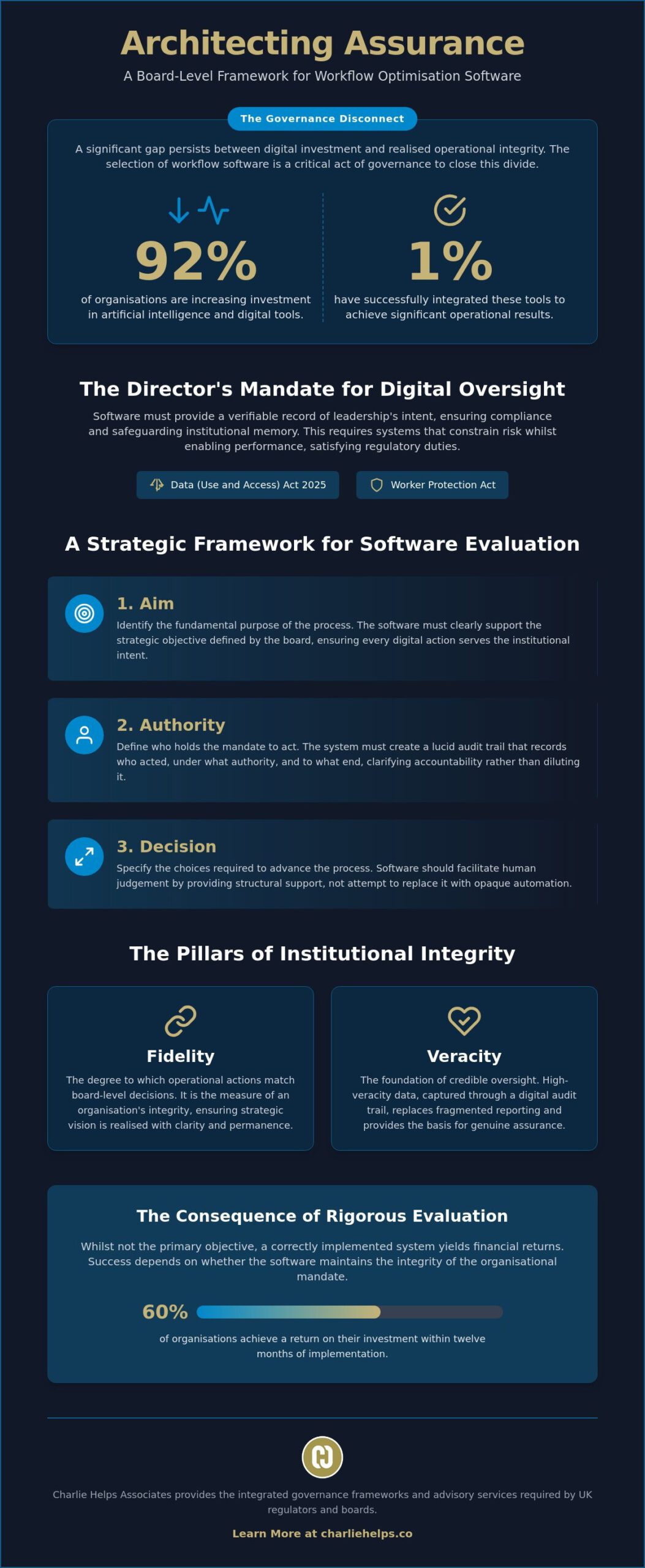
The most sophisticated digital tools often fail not through technical inadequacy, but because they remain untethered from the board’s strategic intent. Whilst ninety-two per cent of companies are increasing their investment in artificial intelligence this year, barely one per cent have successfully integrated these tools into their core operations to achieve significant results. This disconnect creates a dangerous gap between institutional mandate and operational reality. For the modern director, selecting workflow optimisation software is no longer a mere procurement exercise; it is a critical act of governance that determines whether an organisation can fulfil its promises to stakeholders and regulators alike.
You likely recognise the friction that arises when process fidelity vanishes into the shadows of fragmented spreadsheets and opaque manual tasks. This guide offers a rigorous framework for C-suite leaders to evaluate and implement systems that provide genuine institutional assurance. We shall examine how to align your digital architecture with the stringent requirements of the Data (Use and Access) Act 2025 and the Worker Protection Act, ensuring your software serves as a verifiable record of your leadership’s intent.
Key Takeaways
- Understand why selecting software is a fundamental act of leadership that allows directors to realise their mandate for operational oversight.
- Apply a rigorous framework based on Aim, Authority, and Decision to ensure your chosen workflow optimisation software aligns with institutional intent.
- Learn to manage the digital transition as a strategic movement that safeguards institutional memory and maintains process fidelity across the organisation.
- Identify how integrated governance frameworks and advisory services provide the verifiable assurance required by UK regulators and boards.
- Discover the methodology for architecting efficiency to ensure digital tools remain subservient to the organisational mandate and strategic objectives.
Beyond Mere Efficiency: The Governance Mandate for Workflow Optimisation Software
Efficiency is a baseline requirement, not a strategic triumph. For a board of directors, the true value of digital transformation lies in the realisation of institutional intent through disciplined execution. When leadership selects workflow optimisation software, they are not merely purchasing a utility; they are architecting a system of assurance. The central challenge for any C-suite remains the persistent gap between the board’s mandates and the opaque reality of daily operations. Closing this gap requires more than “consultancy theatre” or slogans; it demands a system that provides credible evidence of movement through a defined plan.
The Board’s Responsibility for Operational Oversight
Directors must ensure that the organisation possesses a reliable institutional memory. Without digital systems that capture and constrain process, knowledge remains trapped in the ephemeral habits of individuals. A Workflow serves as the structural expression of authority, ensuring that every action taken by staff aligns with the broader corporate governance framework in the UK. Under the Data (Use and Access) Act 2025, boards now face heightened requirements for formal complaints procedures and data veracity. Systems must therefore be designed to constrain risk whilst enabling performance, providing directors with the clarity needed to fulfil their legal obligations. In this context, software is the lens through which leadership observes and corrects the path of the enterprise.
Veracity and Fidelity in Digital Systems
Fidelity is the degree to which operational actions match board-level decisions. It is the measure of an organisation’s integrity. High fidelity cannot exist without veracity in data; if the information reaching the boardroom is filtered through manual spreadsheets or fragmented reporting, assurance is a fiction. Professional workflow optimisation software creates a digital audit trail that records who acted, under what authority, and to what end. However, technology must always remain subservient to the people within the system. It should not aim to replace human judgement, but rather to provide the structural support that allows professionals to act with precision and accountability. Veracity is the only foundation upon which a board can build a credible claim of oversight.
The implementation of such systems is an act of leadership that transcends technical adjustment. It is a decision to make the organisational mandate workable at every level. By prioritising fidelity over mere speed, boards ensure that their strategic vision is not lost in the friction of execution, but is instead realised with clarity and permanence.
Architecting Assurance: A Strategic Framework for Software Evaluation
Assurance is not a passive state. It is the result of a rigorous evaluation process that ensures digital tools remain subservient to the board’s intent. When selecting workflow optimisation software, directors should apply a framework built on three pillars: Aim, Authority, and Decision. This approach identifies the purpose of the process, who holds the mandate to act, and the specific choices required to move the organisation forward. Systems that obscure these elements behind complex interfaces introduce risk; they hide the very details directors must verify to fulfil their oversight duties.
Evaluation must prioritise systems that offer lucid reporting over ungrounded futurism. Whilst sixty per cent of organisations achieve a return on their investment within twelve months of implementation, success depends on whether the software maintains the integrity of the organisational mandate. A Digital Workflow should clarify accountability rather than dilute it. If a platform cannot demonstrate how it records the movement of authority, it cannot provide the veracity required for institutional assurance.
Criteria for Board-Level Software Selection
Directors should assess how tools facilitate operational friction reduction without sacrificing control. The software must allow for the explicit definition of who has the mandate for specific actions. This ensures that every task performed is an evidenced movement through a credible plan. If you require assistance in aligning your technology with these standards, our advisory services can help you architect a framework that ensures compliance and performance.
Avoiding the Trap of Nominalisation
We must reject software that claims to “optimise” as if the system itself were the agent of change. Optimisation is an action performed by people. Directors should favour workflow optimisation software that highlights the decisions of individuals rather than the “output” of the system. Active verbs in workflow design remind the user that they are exercising authority on behalf of the board. This focus on human agency prevents the erosion of accountability that often accompanies digital transitions. A system that acts on its own is a system without a master; leadership must ensure that every automated trigger remains rooted in a human decision.
Realising Institutional Fidelity: Managing the Digital Workflow Transition
The implementation of workflow optimisation software represents a moral and strategic transition rather than a mere technical installation. For the board, this period is a test of institutional fidelity. Directors must recognise that assurance attaches to evidenced movement through a credible plan; it does not reside within the software itself. Executive leadership plays a decisive role in architecting efficiency during this shift, ensuring that new digital structures remain subservient to the organisational mandate. Without this active oversight, even the most advanced systems risk becoming hollow shells that fail to capture the reality of operational behaviour.
The Human Element in Digital Transformation
Leadership behaviour dictates the success of workflow automation for business. If senior teams view the transition as a secondary concern for the IT department, the resulting system will lack the authority required to govern complex tasks. Mentoring is essential. Managers must learn to use these tools to achieve strategic goals whilst maintaining the integrity of institutional memory. When shifting to automated workflow solutions UK, the board must ensure that the human actors remain the primary agents of decision. Technology should constrain the path of action, but it must never obscure the individual responsibility that underpins corporate governance.
Evidence-Based Reliance
A board should never assume that software-generated data is inherently reliable. Directors must test the utility of a new workflow system by seeking specific evidence of process fidelity. Before relying on digital reports, leadership should ask what evidence supports the veracity of the data and what risks remain hidden within the interface. Research from Gartner Peer Insights on Business Process Management Platforms indicates that sixty per cent of organisations achieve a return on investment within twelve months, yet this success is contingent on the quality of the underlying processes. Incomplete evidence in digital process management creates a false sense of security. Boards must demand transparency, ensuring that workflow optimisation software serves as a clear window into the enterprise rather than a tinted lens. To ensure your leadership team possesses the skills to navigate this transition with precision, consider our mentoring services for executive boards.
Aligning Systems with Authority: The Charlie Helps Perspective
Software remains inert without the animating force of leadership. At Charlie Helps Associates, we recognise that workflow optimisation software is only as effective as the authority that mandates its use. Our methodology treats technology as a structural extension of the board’s will, ensuring that digital processes remain subservient to the organisational mandate. This alignment prevents the erosion of accountability that often occurs when technical efficiency is pursued in isolation from strategic intent.
A Governance-First SaaS Methodology
Our Workflow Optimisation SaaS Solution is built specifically for governance professionals who require more than a task manager. It provides the tools necessary to ensure that enterprise workflow management aligns strictly with corporate ethics and regulatory requirements. By incorporating features that record the chain of authority and map decision-making paths, the platform fulfils the board’s need for lucid, evidence-based process tracking. This approach safeguards institutional memory, ensuring that the rationale behind every action is preserved and remains verifiable for future audits.
Strategic Advisory and Implementation Support
Successful implementation requires more than a software licence; it demands a shift in leadership culture. Our coaching and mentoring programmes support senior teams as they adopt these new digital structures, ensuring that the transition strengthens rather than weakens the governance framework. We invite leaders to contact us to discuss how we can help you architect a resilient system that prioritises practical judgement and institutional excellence. Our advisory services provide the steady hand needed to move from mere intention to evidenced movement through a credible plan.
The ultimate test of any system is the assurance it provides to those who bear the weight of responsibility. If your current tools offer visibility without veracity, they are failing their primary purpose. Does your existing operational architecture provide the evidence you need to rely on the fidelity of your processes, or are you leading through a fog of unverified assumptions?
Realising Operational Certainty Through Strategic Oversight
The selection of workflow optimisation software is a high-stakes decision that defines the future of institutional oversight. Directors must look beyond the veneer of technical features to ensure that digital processes remain subservient to the board’s mandate. By applying a framework rooted in Aim, Authority, and Decision, leadership can close the gap between strategic intent and operational reality. This disciplined approach ensures that every automated trigger is an evidenced movement through a credible plan, safeguarding institutional memory against the risks of fragmentation and opaque reporting.
True assurance requires more than a software installation; it demands a synergy between sophisticated tools and refined leadership behaviour. Our expert corporate governance consultants provide the guidance necessary to integrate our proprietary SaaS solution into your existing governance architecture. Through tailored mentoring for UK boards, we help you cultivate the practical judgement required to maintain process fidelity in an increasingly complex regulatory environment. We invite you to take the next step in architecting a system that serves your organisational mandate with precision and veracity.
Request a Strategic Consultation to Realise Organisational Excellence and begin the movement towards a more resilient, transparent enterprise.
Frequently Asked Questions
How does workflow optimisation software improve board-level assurance?
Workflow optimisation software improves board-level assurance by creating a transparent, digital record of how strategic decisions are realised across the enterprise. It moves beyond mere intention, providing directors with the veracity of data required to confirm that operational actions align strictly with the institutional mandate. This evidenced movement through a credible plan allows the board to fulfil its oversight duties with certainty, ensuring that no process remains obscured by manual fragmentation or fragmented reporting.
What is the difference between task management and governance-led workflow optimisation?
Task management systems focus on the completion of individual activities, whereas governance-led workflow optimisation software prioritises the chain of authority and process fidelity. A governance approach ensures that every task remains subservient to the organisational mandate and the specific decisions of the board. It clarifies who holds the mandate for action, preventing the dilution of accountability that often occurs when digital tools are implemented without a clear governance framework.
Can workflow software replace the need for manual board effectiveness reviews?
Software provides the evidence required for a review, but it cannot replace the qualitative judgement inherent in manual board effectiveness assessments. Directors use digital systems to verify process veracity and institutional memory, yet the moral depth and strategic alignment of leadership still require human interpretation. Digital tools make the review process more workable by providing a foundation of evidenced fact rather than ungrounded assumption or anecdote.
How should a board evaluate the risk of ‘digital workers’ in automated workflows?
Boards must evaluate automated agents by determining who holds the ultimate authority for the decisions these systems execute. Risk arises when complex digital interfaces obscure the logic behind an automated action, potentially eroding the chain of accountability. Directors should ensure that every “digital worker” operates within a framework of restraint, where human oversight remains the primary constraint on automated performance to ensure institutional fidelity.
What role does institutional memory play in the selection of workflow tools?
Institutional memory is the structural preservation of knowledge and rationale, which remains a critical criterion when selecting digital tools. A system should not only record the output of a process but also the context and authority behind the decisions made by individuals. Effective software ensures that the enterprise does not lose its operational wisdom during staff transitions, maintaining a continuous and verifiable record of how the organisational mandate is fulfilled.
How can senior leaders ensure that software implementation achieves institutional fidelity?
Senior leaders achieve institutional fidelity by treating the implementation of software as a strategic movement rather than a technical installation. Whilst sixty per cent of organisations achieve a return on investment within twelve months of adopting such systems, success depends on mentoring senior teams to prioritise accountability and process integrity. Leadership behaviour must demonstrate that the software is a tool for realising the board’s intent, ensuring that digital efficiency never replaces professional judgement.
Disclaimer
The articles published on CharlieHelps.co are provided for general information, reflection, and commentary. They draw on professional experience, research, and interpretation, but they do not constitute legal, regulatory, financial, clinical, governance, risk, compliance, assurance, or other professional advice.Nothing published on this site should be relied upon as practice guidance, formal instruction, or a substitute for proper professional consultation. Readers should seek advice from suitably qualified advisers before acting on, applying, or relying upon any material in relation to their own organisation, Board, duties, circumstances, or decisions.Although reasonable care is taken to ensure that articles are accurate and current at the time of publication, no warranty is given as to completeness, accuracy, timeliness, or fitness for any particular purpose. Law, regulation, policy, standards, and recognised practice may change, and context matters.References to external sources, organisations, products, services, or third-party materials are included for information only. They do not imply endorsement unless expressly stated. Where an article contains affiliate links, sponsored references, or commercial relationships, these will be disclosed where relevant.The views expressed are those of the author unless otherwise stated. Reading, sharing, or responding to material on this site does not create a client, adviser, fiduciary, or professional relationship with Charlie Helps FRSA, CharlieHelps.co, or any associated entity.Readers remain responsible for their own judgement, decisions, and actions.
