

A Board’s authority remains theoretical if it cannot see the movement of work beneath it. You likely recognise the frustration of operational friction hindering strategic execution; it’s the inevitable result of fragmented systems that fail to provide board-level assurance. As the UK’s Admin Burden Reduction Programme pushes for digitised compliance by March 2026, the necessity for transparent systems has moved from a technical preference to a governance mandate. This article provides a strategic roundup of enterprise workflow management, offering a framework to architect rigorous organisational flow through the lens of governance, risk, and professional advisory. We’ll evaluate the leading mechanisms required to realise improved performance, implement streamlined actions, and enhance the fidelity of your institutional memory. By moving from passive oversight to active, governed flow, leaders can ensure that every action within the firm serves the central mandate.
Key Takeaways
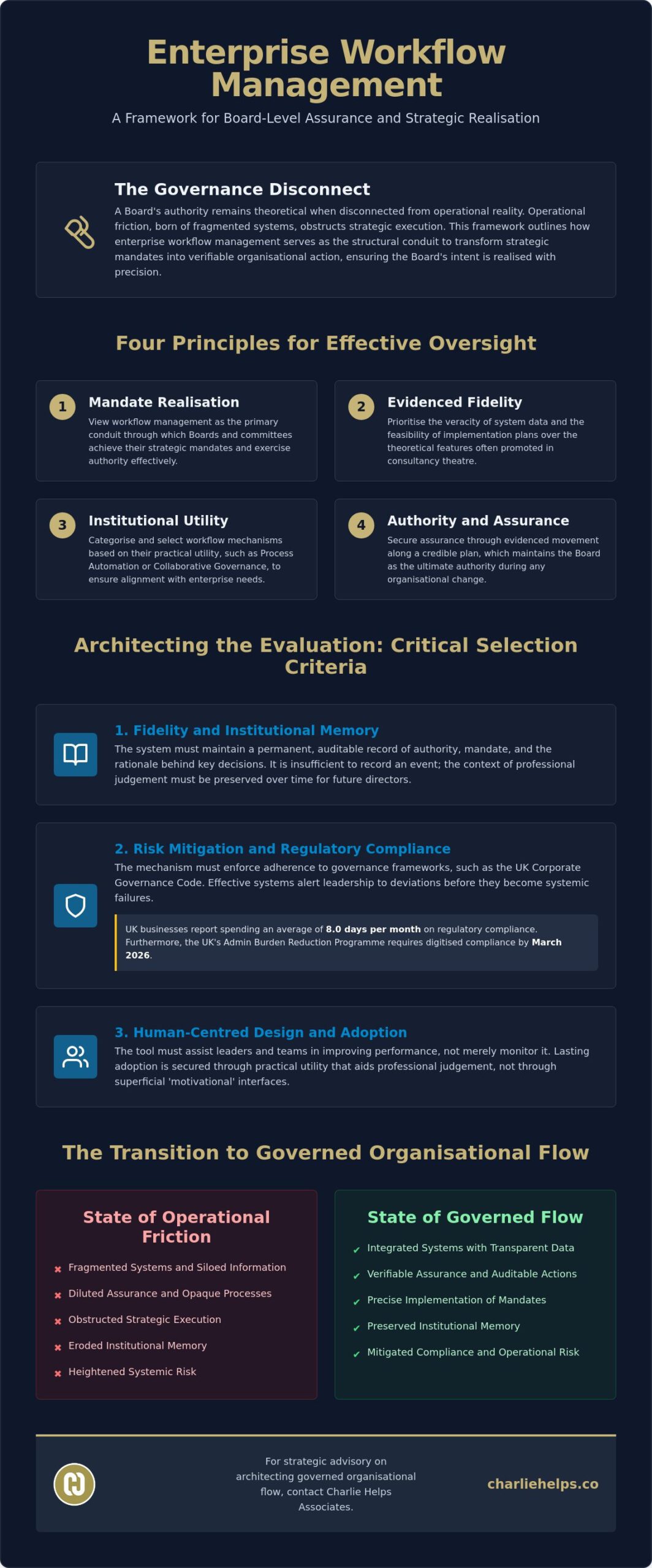
- Recognise that enterprise workflow management serves as the structural conduit through which Boards and committees realise their strategic mandates.
- Prioritise the veracity of system data and the feasibility of implementation plans over the theoretical features often found in consultancy theatre.
- Categorise workflow mechanisms by institutional utility, such as Process Automation or Collaborative Governance, to ensure alignment with enterprise-scale planning.
- Secure assurance through evidenced movement along a credible plan, maintaining the Board as the ultimate authority during any organisational change.
Defining Enterprise Workflow Management as a Governance Mandate
Governance is not a static state; it is a series of actions performed by people. Boards, directors, and committees exercise authority through specific decisions that must ripple through the organisation to be realised. At its core, enterprise workflow management represents the systematic organisation of tasks, information, and authority required to fulfil organisational objectives. It serves as the structural conduit through which the Board’s mandate becomes a tangible reality. By defining these pathways, leaders ensure that strategic intent is not lost in the layers of management but is instead implemented with precision.
A sophisticated Workflow Management System does more than track tasks. It encodes the rules of engagement, ensuring that every action taken by an employee aligns with the risk appetite, and ethical standards set at the summit. When systems are designed with this level of fidelity, they protect the organisation’s institutional memory, ensuring that the rationale behind critical decisions remains accessible and clear. This transparency is essential for providing the Board with the assurance it needs to verify that the organisation is acting within its prescribed boundaries.
The Intersection of Human Behaviour and Structural Systems
Digital constraints should never extinguish individual agency. Instead, they must guide human behaviour toward compliant outcomes while leaving room for professional judgement to supersede automated logic when necessary. Boards must specify how these systems act, decide, and constrain, ensuring that the technology remains a servant to the mandate rather than an opaque master. Transparency in how decisions are reached and recorded is vital, as it allows for the veracity of actions to be audited and verified by those with the authority to oversee them.
Moving Beyond Administrative Friction to Governed Flow
Operational friction is the visible gap between strategic intent and evidenced movement. When workflows are fragmented, they erode institutional memory and dilute the board-level assurance required for sound oversight. Transitioning to a state of governed flow requires a shift in perspective; leaders must view enterprise workflow management as a tool for reducing systemic risk rather than a mere pursuit of speed. By streamlining how information flows and how authority is delegated, organisations can implement their strategies with greater precision, fulfilling their obligations to shareholders, and regulators alike.
Architecting the Evaluation: Critical Criteria for Executive Selection
Selection processes often descend into consultancy theatre. Executives must resist the allure of aesthetic dashboards to focus on the veracity of the data provided by the system. A credible plan for implementation is more significant than the theoretical features of the software; assurance attaches to evidenced movement, not mere intention. When evaluating enterprise workflow management, the Board’s fiduciary duties must remain the primary filter. Rigour in selection prevents the adoption of tools that fail to align with local governance frameworks.
Establishing Fidelity and Institutional Memory
The system must accurately capture the narrative and interpretation behind key decisions. It is insufficient to record merely that a decision occurred; the tool must maintain a permanent, auditable record of authority, mandate, and institutional memory. Executives should assess how easily they can extract meaningful insights for board-level oversight. Fidelity depends on the system’s ability to preserve the context of professional judgement over time, ensuring that the rationale for actions remains clear to future directors.
Assessing Risk Mitigation and Regulatory Compliance
Regulatory burdens are increasing. According to the UK Government’s Regulation Action Plan, businesses reported spending an average of 8.0 days per month on regulatory compliance in 2024. Leaders should determine how the workflow system enforces adherence to the UK Corporate Governance Code. Effective mechanisms should alert leadership to deviations from the established framework before they escalate into systemic failures. Adhering to enterprise workflow management best practices ensures that compliance remains a baked-in feature of the organisational flow rather than an afterthought.
Evaluating Human Centred Design and Adoption
The tool must assist leaders and teams in improving performance, rather than just monitoring it. Systems that prioritise “motivational” UI over practical judgement often fail to secure long-term adoption. Professional advisory and mentoring services can facilitate a successful digital transition by aligning human behaviour with structural systems. This alignment ensures that the workforce uses the system to realise the Board’s mandate effectively. Ultimately, the system should empower the human element to exercise better judgement through clearer data.
A Roundup of Strategic Workflow Mechanisms for UK Enterprises
Tools must be categorised by their institutional utility. We distinguish between Process Automation, Collaborative Governance, and Bespoke Advisory. While leading platforms such as Wrike and Monday.com provide utility for high-volume tasks, they often lack the depth required for enterprise-scale strategic planning. Leaders must select a mechanism that supports the specific mandate of their organisation, ensuring that structural systems don’t obscure the human element of oversight. Selecting the wrong tool risks creating a veneer of efficiency that hides systemic gaps in accountability. For a rigorous framework to evaluate your options, our workflow optimisation software buying guide for UK Boards provides the criteria required to align your digital architecture with institutional mandate.
General Enterprise Process Automation Platforms
These platforms excel at organising repeatable actions across large, distributed teams. They reduce operational friction by standardising task sequences and providing visible timelines. However, they rarely capture the complex, board-level reasoning that underpins critical decisions. In this context, enterprise workflow management focuses on throughput rather than the fidelity of the mandate. These tools are useful for administrative efficiency but may fail to maintain the institutional memory required for rigorous governance.
Collaborative Governance and Board Oversight Tools
Specific software now exists to facilitate board dynamics and effectiveness reviews. These tools prioritise transparency and ethical oversight, ensuring that every director’s contribution is recorded with veracity. They move beyond simple task lists to provide a framework for accountability and decision-making. For a deeper analysis of how to structure these flows, consult our guide on Architecting Efficiency: A Strategic Guide to Streamline Business Workflows.
Tailored Workflow Optimisation SaaS for Professional Advisory
Professional advisory requires a higher degree of nuance than general-purpose software provides. A Workflow Optimisation SaaS Solution designed for governance aligns structural systems with the specific requirements of UK leadership. These bespoke mechanisms support executive coaching and mentoring by providing clear, evidenced performance data. They ensure that assurance attaches to movement through a credible plan, rather than mere intention. To align your organisational flow with your strategic mandate, consider seeking specialist advisory and consulting services.
Realising Operational Flow through Rigorous Implementation and Oversight
Assurance attaches to evidenced movement through a credible plan, not mere intention to improve. In the context of enterprise workflow management, the Board must remain the ultimate authority during any organisational transformation. Realising success requires leaders to specify clear milestones, decision points, and risk assessments before any software is deployed. A Board that fails to oversee the architecture of its workflows risks losing control over the very mechanisms it relies upon for assurance. Implementation is not the conclusion of the journey; it is the commencement of sustained performance excellence. When the Board treats governance as an active verb, the workflow becomes the medium through which excellence is realised.
Transitioning from Intent to Evidenced Movement
Evidenced movement constitutes the objective verification that people are utilising the system to fulfil their mandates. It is the shift from intent to action that can be audited, measured, and verified. Cultural resistance often stems from a perceived loss of agency, yet professional mentoring services can help leaders navigate this friction by reframing the system as a support for professional judgement. For a deeper analysis of these dynamics, see our work on Operational Friction Reduction: A Governance Perspective on Organisational Flow. By aligning human behaviour with digital constraints, firms can realise a state of governed flow that protects both the individual and the institution.
Sustaining Performance through Continuous Board Assurance
The Board’s ongoing role involves monitoring the fidelity of enterprise workflows to ensure they remain aligned with the strategic mandate. This oversight ensures that the veracity of organisational data remains high and that the institutional memory is preserved. Data extracted from these systems should be integrated into the annual Board Effectiveness Review to provide a factual basis for performance assessment. This integration transforms the review from a subjective exercise into a rigorous evaluation of how authority is exercised across the firm. We must ultimately ask: Who has the authority to ensure this system fulfils its strategic mandate?
Architecting Your Organisational Flow
The rigour of your oversight is only as effective as the systems that fulfil it. We’ve established that enterprise workflow management is not a mere administrative concern; it’s the structural manifestation of the Board’s authority. By prioritising fidelity, institutional memory, and evidenced movement, leaders ensure that strategic intent translates into compliant, high-performance action. The transition from operational friction to governed flow requires a clear-eyed evaluation of both digital mechanisms and human behaviour.
Success depends on moving beyond the veneer of efficiency to secure genuine board-level assurance. As expert Corporate Governance Consultants, we provide the practical judgement required to implement these complex systems across the UK public and private sectors. Whether through our Bespoke Workflow Optimisation SaaS Solution or dedicated advisory, we help you align structural constraints with individual agency.
Consult with Charlie Helps Associates to architect your governance framework and ensure your organisation remains a model of integrity and purpose. With a steady hand and a clear plan, you can realise the full potential of your leadership mandate.
Frequently Asked Questions
What is the primary aim of enterprise workflow management in a UK governance context?
The primary aim is to architect a structural conduit through which the Board’s mandate becomes a tangible reality. It allows directors to observe the movement of work beneath them, ensuring that strategic intent is realised with precision and fidelity. By organising tasks and authority, enterprise workflow management protects the organisation’s institutional memory and reduces administrative friction.
Who has the ultimate authority for deciding which workflow system to implement?
The Board of Directors retains the ultimate authority for the implementation of systems that affect organisational oversight. Whilst executives manage the technical evaluation, the Board must decide if the system provides sufficient assurance to fulfil their fiduciary duties. This decision requires a credible plan for implementation rather than a mere reliance on theoretical software features.
What evidence supports the reliance on automated workflow data for board reporting?
Reliance on automated data is supported by the creation of a permanent, auditable record of authority and mandate. When a system accurately captures the narrative behind key decisions, it provides the veracity required for sound board-level reporting. This evidence allows for a more rigorous Board Effectiveness Review, moving away from subjective interpretation toward evidenced movement.
How does enterprise workflow management assist in fulfilling fiduciary duties?
These systems assist directors in fulfilling their fiduciary duties by enforcing compliance with the UK Corporate Governance Code. By streamlining how information flows and how authority is delegated, the organisation can implement its strategy with greater precision. This transparency enables the Board to identify and mitigate systemic risks before they escalate into failures of oversight.
What risks remain when transitioning to a digital workflow management tool?
Risks remain in the form of cultural resistance and the potential for consultancy theatre, where aesthetic dashboards mask a lack of true operational flow. There is also the risk that automated logic might supersede professional judgement if the Board does not specify the system’s constraints. Without rigorous oversight, the transition may fail to achieve the intended reduction in administrative burden.
How can coaching and mentoring improve the implementation of a new workflow SaaS?
Coaching and mentoring services facilitate the alignment of individual agency with new digital constraints. These interventions help teams understand that the system is a servant to the organisational mandate rather than an opaque master. By focusing on human behaviour, mentors ensure that the workforce uses the SaaS solution to improve performance and enhance the fidelity of the decision-making record.
Disclaimer
The articles published on CharlieHelps.co are provided for general information, reflection, and commentary. They draw on professional experience, research, and interpretation, but they do not constitute legal, regulatory, financial, clinical, governance, risk, compliance, assurance, or other professional advice.Nothing published on this site should be relied upon as practice guidance, formal instruction, or a substitute for proper professional consultation. Readers should seek advice from suitably qualified advisers before acting on, applying, or relying upon any material in relation to their own organisation, Board, duties, circumstances, or decisions.Although reasonable care is taken to ensure that articles are accurate and current at the time of publication, no warranty is given as to completeness, accuracy, timeliness, or fitness for any particular purpose. Law, regulation, policy, standards, and recognised practice may change, and context matters.References to external sources, organisations, products, services, or third-party materials are included for information only. They do not imply endorsement unless expressly stated. Where an article contains affiliate links, sponsored references, or commercial relationships, these will be disclosed where relevant.The views expressed are those of the author unless otherwise stated. Reading, sharing, or responding to material on this site does not create a client, adviser, fiduciary, or professional relationship with Charlie Helps FRSA, CharlieHelps.co, or any associated entity.Readers remain responsible for their own judgement, decisions, and actions.
