

A board’s mandate is not a static document; it is a live performance of institutional fidelity. Too often, the pursuit of oversight dissolves into consultancy theatre, where glossy reports offer aesthetic comfort whilst the gap between strategic intention and organisational reality widens. You likely recognise the frustration of receiving a review that satisfies a regulator’s checklist but fails to illuminate the actual behaviour of your leadership. Effective corporate governance review services must move beyond these superficial rituals to examine the human systems that either uphold or erode your institution’s purpose.
We agree that the current UK regulatory landscape demands more than mere compliance; it requires a demonstrable link between board decisions and evidenced movement. This article provides a rigorous evaluation of how boards and leaders realise their mandates through precise frameworks, and grounded action. You will discover how to architect a credible plan for institutional fidelity, turning abstract intentions into clear evidence of board effectiveness that satisfies stakeholders, and sharpens strategic decision-making for the complexities of 2026.
Key Takeaways
- Recognise governance as a verb performed by people; boards and committees must move beyond ritualistic compliance to achieve genuine institutional fidelity.
- Identify the essential components of rigorous corporate governance review services, including the evaluation of delegated authority and the veracity of board-level documentation.
- Transition from identifying systemic gaps to architecting a workable plan for improvement; prioritise actions based on organisational capacity and strategic risk.
- Secure a credible basis for stakeholder assurance by linking board intentions to evidenced action and precise governance frameworks.
Beyond Consultancy Theatre: The Necessity of a Rigorous Corporate Governance Review
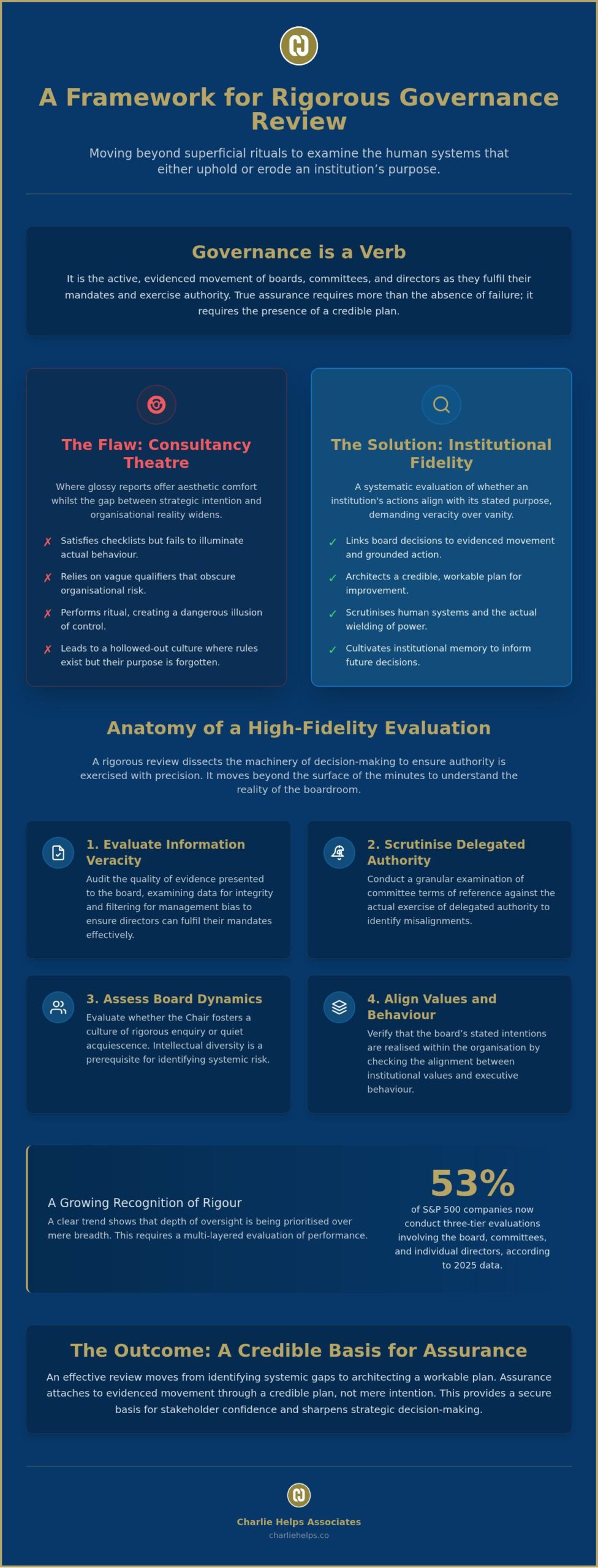
Governance is a verb. It is the active, evidenced movement of boards, committees, and directors as they fulfil their mandates and exercise authority. Engaging professional corporate governance review services should not be confused with a passive audit of structures. Instead, it is a systematic evaluation of institutional fidelity. By scrutinising the corporate governance mechanisms used by an organisation, leaders can determine if their actions align with their stated purpose. This process demands veracity over vanity, replacing the comforting scripts of consultancy theatre with a clear-eyed assessment of how power is actually wielded.
True assurance requires more than the absence of failure; it requires the presence of a credible plan. Boards must cultivate institutional memory to ensure that past errors inform future decisions. Without this, the organisation risks a hollowed-out culture where rules exist but nobody remembers why. A rigorous review identifies whether committees are acting as intended or merely performing a ritual. It asks whether the board possesses the information necessary to make workable decisions or if it is drowning in data that lacks strategic depth.
The Limitations of Traditional Compliance Audits
Reporting is not oversight. Many organisations fall into the trap of “rinse and repeat” governance, where last year’s report serves as the template for the next. This creates a dangerous illusion of control. Vague qualifiers in annual reports often obscure actual organisational risks, using language designed to soothe rather than inform. A board’s reliance on these superficial metrics represents an abdication of duty. Through rigorous corporate governance review services, an organisation can replace these hollow rituals with a credible plan for institutional fidelity that strips away linguistic shields to reveal the structural weaknesses beneath.
Governance as a Human Action
Systems do not make decisions; people do. Boards exercise authority through specific mandates that define what is required and who is responsible. Individual directors must maintain the fidelity of this system through constant vigilance and professional judgement. Board-level mentoring supports this by providing leaders with the intellectual tools to question assumptions and verify evidence. When directors understand that their role is an active performance of duty, they can better realise the strategic aims of the institution. If you require a partner to architect this level of excellence, you may contact us to discuss your specific needs.
The Anatomy of a High-Fidelity Governance Evaluation
A high-fidelity evaluation dissects the machinery of decision-making to ensure that authority is exercised with precision. It begins with the veracity of the evidence presented to the board. If the data is filtered through layers of management bias, directors cannot fulfil their mandates effectively. Professional corporate governance review services must therefore audit the quality of information as rigorously as the decisions themselves. This involves a granular examination of committee terms of reference, the actual exercise of delegated authority, and the alignment between stated values and executive behaviour. Statistics from 2025 indicate that 53% of S&P 500 companies now conduct three-tier evaluations involving the board, committees, and individual directors; this reflects a growing recognition that oversight requires depth rather than breadth.
Institutional fidelity rests upon the board’s ability to verify that its intentions are realised within the organisation. This requires a systematic check of the conduits through which instructions flow. When a board sets a strategic direction, it must have the assurance that the executive team possesses both the capability and the ethical framework to implement it. A rigorous review identifies where these conduits are blocked by inertia or misaligned incentives. It moves beyond the surface of the minutes to understand the reality of the boardroom.
Evaluating Board Dynamics and Performance
The interaction between the Chair, CEO, and non-executive directors (NEDs) forms the psychological core of the institution. A review must assess whether the Chair fosters a culture of enquiry or one of quiet acquiescence. Intellectual diversity is not a cosmetic goal; it is a prerequisite for identifying systemic risk. By engaging in board dynamics consulting, organisations can reveal the unspoken tensions that stifle dissent. True fidelity requires a board that encourages challenge whilst remaining united in its strategic aim. This balance ensures that decisions are tested by fire before they become policy.
Assessing Regulatory and Ethical Fidelity
Compliance with the UK Corporate Governance Code remains the baseline, but the 2026 landscape demands deeper adherence to international standards for corporate governance. Boards must now integrate corporate ethics and governance into the daily behaviour of the executive team. This includes addressing the growing necessity for AI governance and board-level digital literacy. If the board remains ignorant of the algorithms shaping its operations, it cannot claim to have oversight. If you wish to assess your board’s readiness for these complexities, you may request a preliminary consultation to explore our comprehensive corporate governance review services.
From Assurance to Action: Implementing Review Findings with Precision
A diagnosis without a prescription is an exercise in futility. Once professional corporate governance review services identify systemic misalignments, the board must pivot from observation to architecture. This transition requires a methodical approach to prioritising actions based on risk, mandate, and the actual capacity of the organisation. True assurance does not reside in the intention to change; it attaches to the evidenced movement of the board through a credible, workable plan. Leaders must ensure that the five pillars of good corporate governance, transparency, accountability, responsibility, fairness, and social responsibility, are not merely discussed but implemented with precision.
Implementing these findings requires a shift in how the board views its own operations. It is not enough to update a policy; the board must ensure that the policy is made workable for the workforce. This involves stripping away the layers of consultancy theatre that often follow a review and replacing them with clear instructions and measurable outcomes. When a board decides on a path, it must verify that the executive team has the necessary authority and resources to realise the intended change. The focus must remain on the intersection of human behaviour and structural systems to ensure that the mandate is fulfilled at every level.
Optimising Workflows for Governance Success
Structural friction is the enemy of oversight. To reduce operational drag, boards are increasingly turning to workflow optimisation software to standardise the flow of information. These automated solutions integrate risk tracking and board reporting into a singular, transparent system. By removing manual bottlenecks, these tools enhance institutional memory and ensure that the veracity of data is maintained from the shop floor to the boardroom. This digital architecture provides the steady hand required to manage complex environments without losing strategic focus or ethical clarity.
Leadership Capability and Succession
The fidelity of a governance framework depends entirely on the capability of those who operate it. Boards must align review findings with executive leadership coaching UK to address specific skill gaps identified during the evaluation. High-performance leadership is not a static trait; it is a discipline refined through professional mentoring programmes. Robust succession planning ensures that governance continuity is maintained even during periods of leadership transition. By investing in the human element, boards ensure that their strategic decisions are implemented by individuals who possess the necessary ethical force and intellectual depth.
Securing the Mandate: Why Boards Choose Charlie Helps Associates
Institutional excellence is not an accident of history; it is the result of deliberate architecture. Boards choose Charlie Helps Associates because they require a strategic partner who understands the human element behind the data. We provide corporate governance review services that move beyond the superficial, focusing on the veracity of board-level information and the fidelity of leadership actions. Our methodology combines intellectual force with practical problem-solving, ensuring that every review provides a clear basis for reliance. By prioritising clarity and restraint, we help leaders move past the distractions of the present to focus on the long-term health of their organisation.
We position ourselves as a steady hand in a complex environment, offering a sense of calm expertise that allows boards to think deeply rather than react impulsively. Our approach treats every review as a collaborative path forward, moving from the philosophical to the practical without losing its sophisticated edge. We understand that the high stakes of organisational oversight require a partner who values integrity and purpose. This commitment ensures that the findings of our reviews are not merely recorded but are implemented to achieve strategic aims.
Tailored Frameworks for the UK Landscape
We possess deep expertise in both public and private sector governance, navigating the UK landscape with restraint and authority. Our 24/7 emergency response consulting provides a steady hand during periods of systemic instability, offering immediate assurance when the stakes are highest. We ensure that our clients remain compliant with evolving regulations whilst maintaining the strategic flexibility required to thrive. This unique trust builder allows leaders to exercise their authority with confidence, knowing they have access to expert advisory services at the moment of greatest need. Our corporate governance review services are designed to be as dynamic as the environments in which our clients operate.
A Commitment to Realising Strategic Value
We reject the slogan-heavy claims of consultancy theatre in favour of lucid, evidenced analysis. Our unique blend of advisory expertise, executive mentoring, and our proprietary Workflow Optimisation SaaS solution allows us to architect frameworks that are truly workable. By integrating AI for Corporate Governance, we help boards prepare for the digital complexities of 2026 and beyond. The goal is always to fulfil the organisational mandate through precise frameworks and grounded action, ensuring that every decision is backed by evidence. We invite you to discuss your specific challenges and discover how we can help you achieve institutional fidelity.
Architecting Institutional Fidelity for the 2026 Mandate
The performance of a board is the final measure of an organisation’s integrity. We have examined how rigorous corporate governance review services remove the veil of consultancy theatre to expose the actual movement of human systems. Institutional fidelity requires a synthesis of authoritative board-level mentoring, precise technological infrastructure, and a steadfast commitment to UK Corporate Governance Code compliance. By utilising tools like our proprietary Workflow Optimisation SaaS, boards ensure that mandates are fulfilled with veracity and strategic focus.
Leaders must move beyond the safety of intention to the clarity of evidenced action. This approach ensures that strategic decisions are implemented by capable individuals who possess the ethical force required for the complexities of 2026. Your board’s mandate is a living commitment to excellence; it deserves a framework that is both lucid and workable.
We stand ready to guide you through the high stakes of organisational oversight with the restraint, clarity, and professional judgement your institution requires.
Frequently Asked Questions
How often should a UK organisation conduct a formal corporate governance review?
UK listed companies should facilitate an externally facilitated review at least every three years according to the UK Corporate Governance Code. Smaller or private entities often adopt this rhythm as a benchmark for institutional fidelity. Annual internal evaluations serve as a bridge to ensure that the board continues to fulfil its mandate between formal external cycles. These regular checkpoints prevent the drift into consultancy theatre by maintaining a constant focus on evidenced action.
What is the difference between a board effectiveness review and a governance audit?
A board effectiveness review focuses on the performance and behaviour of the people in the room, whereas a governance audit typically examines the static structures and rules. Effective corporate governance review services synthesise both by evaluating how directors use their authority to realise strategic aims. One examines the machinery; the other assesses the skill and ethics of the operators. True assurance requires an understanding of how these human and structural systems intersect.
Who has the authority to initiate and oversee the governance review process?
The Chair holds the primary authority to initiate a review, often acting through the nomination committee to ensure independence. However, the entire board must agree to the scope and the decision to appoint external advisors. This collective commitment ensures that the resulting plan is workable and that every director accepts responsibility for implementing the findings. Oversight remains a shared duty, rooted in the board’s collective mandate to protect the long-term health of the institution.
What evidence is required to provide the Board with genuine assurance?
Genuine assurance requires verifiable evidence of movement through a credible plan, rather than mere statements of intent. This includes the veracity of information reaching the board, clear records of dissent, and the systematic tracking of decision outcomes. Boards should rely on institutional memory and precise data logs to verify that executive behaviour aligns with strategic direction. Without this level of evidenced action, reporting becomes a hollow exercise that fails to satisfy sophisticated stakeholders.
How does a governance review address the risks associated with AI and emerging technology?
A review assesses whether the board possesses the digital literacy and oversight frameworks required for AI governance. It examines the conduits through which the board monitors algorithmic decision-making and ethical alignment. By identifying gaps in technical expertise, the review allows the board to implement board-level mentoring or targeted recruitment. This ensures that emerging technologies are constrained by human judgement and remain subordinate to the organisational purpose.
What are the key implications of failing to implement review findings?
Failing to implement findings signals a breakdown in institutional fidelity and exposes the board to significant regulatory and reputational risk. It suggests that the evaluation was a performative ritual rather than a sincere effort to improve performance. This lack of movement erodes stakeholder trust and can lead to strategic drift, as the gap between board intentions and organisational reality widens. A review is only successful when it results in a workable plan that directors actually fulfil.
Disclaimer
The articles published on CharlieHelps.co are provided for general information, reflection, and commentary. They draw on professional experience, research, and interpretation, but they do not constitute legal, regulatory, financial, clinical, governance, risk, compliance, assurance, or other professional advice.
Nothing published on this site should be relied upon as practice guidance, formal instruction, or a substitute for proper professional consultation. Readers should seek advice from suitably qualified advisers before acting on, applying, or relying upon any material in relation to their own organisation, Board, duties, circumstances, or decisions.
Although reasonable care is taken to ensure that articles are accurate and current at the time of publication, no warranty is given as to completeness, accuracy, timeliness, or fitness for any particular purpose. Law, regulation, policy, standards, and recognised practice may change, and context matters.
References to external sources, organisations, products, services, or third-party materials are included for information only. They do not imply endorsement unless expressly stated. Where an article contains affiliate links, sponsored references, or commercial relationships, these will be disclosed where relevant.
The views expressed are those of the author unless otherwise stated. Reading, sharing, or responding to material on this site does not create a client, adviser, fiduciary, or professional relationship with Charlie Helps FRSA, CharlieHelps.co, or any associated entity.
Readers remain responsible for their own judgement, decisions, and actions.
