

A risk register is not a shield; it is frequently little more than a script for administrative theatre. For many Trust leaders, the burden of compliance often masks a profound disconnect between the data presented in the boardroom and the clinical reality on the wards. You likely recognise the frustration of reviewing static reports that offer the appearance of oversight without the substance of genuine insight. Effective NHS Board Assurance requires more than a passive observation of potential failures; it demands a disciplined transition toward active, evidenced assurance, where Directors exercise practical judgement to track movement through a credible plan rather than merely documenting intent.
This article provides a strategic examination of how Boards can move beyond the ritual of monitoring to achieve a state of credible, informed reliance. We shall explore the framework required to support robust decision-making, ensure the golden thread of accountability remains intact across complex structures, and build institutional memory that persists beyond individual tenures. By treating oversight as a rigorous human action rather than a bureaucratic requirement, leaders can realise a governance architecture that serves both the patient and the public interest with absolute fidelity.
Key Takeaways
- Redefine NHS Board Assurance as an active human behaviour rather than a static administrative exercise, focusing on evidenced movement through strategic plans.
- Architect a Board Assurance Framework that establishes a clear ‘golden thread’ of accountability, connecting high-level missions to front-line clinical risks.
- Move beyond the limitations of Red-Amber-Green ratings by applying disciplined, professional judgement to interpret the complex reality of healthcare performance.
- Embed governance as a continuous action that secures institutional memory and maintains fidelity to the organisation’s core mandate during leadership transitions.
- Prepare for the 2026 regulatory landscape by implementing a framework that supports credible decision-making through the verification of data and systemic alignment.
Defining NHS Board Assurance as an Active Discipline
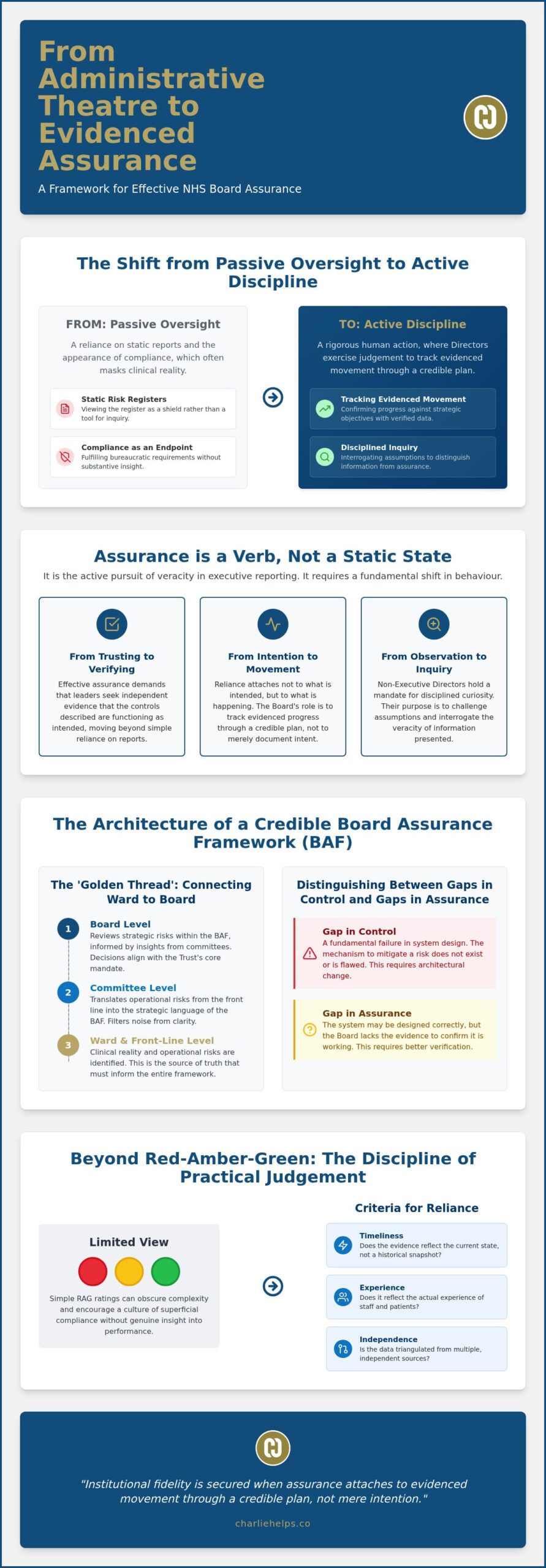
Assurance is not a static state of compliance; it is a verb. Too often, Boards treat the Board Assurance Framework (BAF) as a periodic filing requirement, an administrative ritual that satisfies the regulator but fails the patient. Genuine NHS Board Assurance resides in the evidenced movement through a credible plan. It is the active pursuit of veracity in executive reporting. When Directors merely observe a risk register, they remain passive. When they interrogate the distance between a strategic objective and the clinical reality on the ward, they practise assurance as a disciplined behaviour.
Hoping for a positive outcome is not a valid governance strategy. NHS Trusts operate within a landscape of high stakes and finite resources; consequently, the Board carries a moral depth of responsibility for clinical and operational safety. This duty requires a shift from trusting to verifying. Effective NHS Board Assurance requires that leaders seek institutional fidelity, ensuring that the organisation’s actions align with its stated ethical and strategic mandates. Directors must remember that assurance attaches to what is happening, not what is intended.
The Distinction Between Information and Assurance
Data is abundant; insight is rare. Boards frequently suffer from information overload, receiving voluminous reports that provide noise rather than clarity. Reliance on a report requires more than just high-quality data; it requires evidence that the controls described are actually functioning. To filter administrative noise, Directors must identify the criteria for reliance: is the evidence independent, is it timely, and does it reflect the actual experience of staff and patients? Practical judgement allows a Board to distinguish between a report that merely documents a process and one that confirms a result.
Authority and the Mandate for Inquiry
Non-Executive Directors hold a specific mandate for inquiry. Their role is to challenge executive assumptions, not out of distrust, but to satisfy the Board’s collective duty of curiosity. This curiosity must be disciplined. Within the Clinical Governance Framework, the Board’s authority is not to manage clinical decisions, but to ensure the systems governing those decisions are reliable. They must ask how they know a statement is true. This intellectual force prevents institutional memory from fading and ensures that accountability remains a lived behaviour rather than a theoretical concept.
The Architecture of the Board Assurance Framework (BAF)
A robust BAF serves as the skeleton of NHS Board Assurance, providing the structural integrity required to sustain complex healthcare operations. It must function as more than a repository for risks; it is a mechanism for mapping controls to specific, evidenced actions that fulfil strategic objectives. By utilising the Board Governance Assurance Framework as a foundation, Trusts can architect a system that identifies exactly where authority resides and where reliance is earned. For the 2026 regulatory environment, this architecture must explicitly bridge the gap between limited and substantial assurance through rigorous triangulation. Proper NHS Board Assurance requires this architecture to be dynamic, responding to clinical shifts in real-time.
Identifying Gaps in Control vs Gaps in Assurance
A gap in control represents a fundamental failure in system design, where the mechanism to mitigate a risk simply does not exist. Conversely, a gap in assurance occurs when the system may be designed correctly, but the Board lacks the evidence to confirm it is working. Distinguishing between these two is vital for resource allocation. Closing a control gap requires architectural change; closing an assurance gap requires better verification and institutional memory. Boards must prioritise resources to address control failures first, as no amount of assurance can rectify a fundamentally broken system.
The Golden Thread: From Ward to Board
The golden thread connects strategic missions to front-line risks, ensuring that the Integrated Performance Report (IPR) reflects clinical reality rather than executive optimism. This requires a disciplined process of escalation, where operational risks are not buried in sub-committees but are translated into the strategic language of the BAF. When this thread is taut, the Board can see the direct impact of their decisions on patient safety. This alignment ensures that strategic risks are grounded in the lived experience of the clinical environment.
Triangulation: The Three Lines of Defence
Reliability is realised through three distinct layers of scrutiny. The first line consists of management controls and internal oversight within clinical directorates. The second line involves corporate functions, such as risk management and compliance, which provide a broader perspective on systemic health. The third line is independent assurance, typically fulfilled by internal and external audit. This final layer provides the objective veracity needed to support Board-level reliance. Organisations seeking to refine these structures may benefit from expert governance advisory to ensure their framework is both lucid and workable.
Beyond the Red-Amber-Green: Exercising Practical Judgement
Red-Amber-Green (RAG) ratings often provide a seductive but false sense of security. They reduce complex, multi-faceted clinical risks to a simplistic spectrum of colour; however, genuine NHS Board Assurance requires the application of intellectual force to interpret what lies beneath the pigment. A green rating may signal a functioning process, but it does not inherently prove a safe outcome. Directors must possess the professional weight to look beyond these administrative summaries, exercising practical judgement to identify where data might be masking a systemic fragility. Reliance is not found in the colour of a chart, but in the veracity of the underlying evidence.
We must reject “consultancy theatre”, where polished presentations and slogan-heavy reports replace rigorous inquiry. When a Board accepts an executive summary without questioning the assumptions behind it, they abdicate their mandate. Effective oversight requires a steady hand and a sceptical mind. It involves asking how a specific metric relates to the clinical reality on the wards, ensuring that strategic logic remains grounded in human behaviour. This level of scrutiny prevents the Board from becoming a passive container for information, transforming it into an active agent of organisational fidelity.
The Psychology of Board Oversight
Groupthink remains a significant threat to effective risk assessment. When a Board prioritises consensus over clarity, they risk overlooking critical failures in clinical governance. Cultivating a culture of healthy challenge is not an act of hostility; it is a moral requirement for patient safety. The Chair carries the authority to ensure all voices are heard, specifically encouraging dissent that tests the strength of executive plans. This intellectual friction is necessary to refine strategy and ensure that decisions are based on a clear-eyed view of organisational performance.
Assurance as a Human Behaviour
Assurance is a human action performed by individuals who possess the courage to seek the truth. It is not an abstract byproduct of a system, but a deliberate behaviour that secures institutional memory. When Directors engage in the act of assurance, they ensure that the rationale for strategic movement persists beyond their own tenure. To achieve this level of stewardship, many leaders utilise executive leadership coaching UK to refine their ability to challenge with precision and lead with intellectual force. This coaching helps embed governance as a lived experience rather than a quarterly administrative burden.
Implementing a Framework of Institutional Fidelity
Institutional fidelity is the ultimate measure of a Board’s success; it represents the alignment between what is promised and what is realised. To prepare for the regulatory landscape of 2026, Trusts must refresh their BAF not as a paperwork exercise, but as a calibration of their collective behaviour. This process requires a rigorous review of every strategic risk to ensure the controls remain workable in a shifting clinical environment. Engaging corporate governance consultants UK provides the objective distance required to verify whether internal systems are truly functional or merely theoretical. Effective NHS Board Assurance ensures that governance becomes a daily action, where every director understands their mandate to protect the organisation’s core purpose.
Moving from a “limited” to a “substantial” assurance rating is not a matter of luck; it is a result of disciplined evidence gathering and the verification of movement through a credible plan. Boards must transition from a state of passive monitoring to one of active interrogation. This shift requires a commitment to veracity in all reporting, ensuring that the evidence supporting reliance is both timely and independent. When a Board can demonstrate that its decisions are rooted in the reality of clinical performance, it establishes a state of substantial assurance that satisfies both the regulator and the public interest. The central question for every leader remains: what decision is required today to improve the fidelity of our oversight?
The Board Effectiveness Review as a Catalyst
A professional board effectiveness review acts as a vital catalyst for identifying hidden governance friction. It moves the conversation beyond simple compliance, focusing instead on strategy-led oversight and the quality of Board dynamics. By auditing the human element of governance, Trusts can uncover where groupthink or administrative noise may be obscuring strategic truth. The expected outcome is a more lucid governance architecture, where authority is clearly defined and the Board operates with the intellectual force necessary to achieve long-term clinical excellence.
Achieving Sustainable Value through Governance
Sustainable value in the NHS is the preservation of clinical quality, financial stability, and public trust across generations. Robust NHS Board Assurance protects the Trust’s long-term viability by ensuring that strategic risks are managed with foresight and restraint. This stewardship requires a deep commitment to institutional memory, ensuring that the wisdom of the Board survives leadership transitions and remains focused on the organisation’s mandate. By architecting a framework that values depth over speed, leaders can realise an environment where excellence is a sustained behaviour rather than a fleeting achievement.
For bespoke advice on architecting your framework, contact Charlie Helps Associates.
Architecting the Future of Trust Oversight
Effective NHS Board Assurance is not found in the volume of a board pack but in the veracity of the inquiry. It requires a fundamental shift from the passive observation of risks to the active verification of movement through a credible plan. By architecting an integrated governance framework, directors ensure that the golden thread of accountability remains taut from the ward to the boardroom. This discipline secures institutional memory, maintains fidelity to the organisation’s moral mandate, and provides the evidence required for credible decision-making.
Leadership teams must move beyond the safety of colour-coded ratings to exercise the intellectual force required for genuine oversight. This transition relies on a human-centric approach to structural systems, where practical judgement consistently outweighs administrative theatre. With decades of experience in UK public sector governance, Charlie Helps Associates specialises in architecting institutional fidelity for organisations navigating complex regulatory landscapes. We act as a steady hand, helping Boards realise a state of substantial assurance through disciplined leadership, refined governance architecture, and a commitment to strategic truth.
The path toward excellence is a guided conversation that values depth over speed. By treating oversight as a lived behaviour, you can ensure your organisation remains both resilient and purposeful.
Frequently Asked Questions
What is the primary purpose of an NHS Board Assurance Framework?
The primary purpose of an NHS Board Assurance Framework is to provide Directors with a structured mechanism to monitor strategic risks and verify that controls are functioning as intended. It establishes a clear connection between organisational objectives and the evidence required to support credible decision-making. By utilising this framework, the Board can move beyond the passive observation of risks to achieve a state of informed reliance.
How does Board Assurance differ from simple risk management?
Risk management focuses on the identification and mitigation of threats; conversely, NHS Board Assurance provides the evidence that those mitigations are actually working. While risk registers document what might happen, assurance tracks the evidenced movement through a credible plan. It requires Directors to exercise practical judgement over data to ensure that organisational actions align with strategic intent. This distinction ensures that governance remains an active pursuit of truth rather than a bureaucratic exercise.
What are the three lines of defence in NHS governance?
The three lines of defence constitute a hierarchical system of scrutiny designed to ensure organisational fidelity. The first line resides in management controls and front-line oversight within clinical directorates. Corporate functions like risk management form the second line, whilst the third line provides independent veracity through internal and external audit. This structure ensures that reliance is earned through multiple layers of verification and professional challenge.
How often should an NHS Board review its Assurance Framework?
An NHS Board should treat its Assurance Framework as a dynamic behaviour rather than a static document, reviewing it at every formal Board meeting. Whilst the full framework is often scrutinised quarterly, specific strategic risks require more frequent attention within relevant sub-committees. This ensures that the Board remains responsive to clinical shifts and maintains a continuous thread of accountability across the Trust, securing institutional memory during periods of change.
Can a Board Assurance Framework be used to demonstrate CQC ‘Well-Led’ compliance?
A robust NHS Board Assurance process is a fundamental requirement for demonstrating compliance with the CQC Well-Led framework. It provides regulators with tangible evidence that the Board maintains rigorous oversight of clinical quality and operational safety. By showing how data informs strategic decisions, the Board proves that its governance architecture is both workable and effective in protecting patient interests and fulfilling its public mandate.
What are the common pitfalls in NHS Board Assurance reporting?
Common pitfalls include an over-reliance on Red-Amber-Green ratings and the accumulation of administrative noise that obscures strategic truth. Many Trusts fail when they allow a disconnect to form between board-level reports and the clinical reality on the wards. Treating the framework as a quarterly filing requirement rather than a lived behaviour also prevents the Board from achieving genuine institutional memory or making informed judgements on systemic health.
Disclaimer
The articles published on CharlieHelps.co are provided for general information, reflection, and commentary. They draw on professional experience, research, and interpretation, but they do not constitute legal, regulatory, financial, clinical, governance, risk, compliance, assurance, or other professional advice.
Nothing published on this site should be relied upon as practice guidance, formal instruction, or a substitute for proper professional consultation. Readers should seek advice from suitably qualified advisers before acting on, applying, or relying upon any material in relation to their own organisation, Board, duties, circumstances, or decisions.
Although reasonable care is taken to ensure that articles are accurate and current at the time of publication, no warranty is given as to completeness, accuracy, timeliness, or fitness for any particular purpose. Law, regulation, policy, standards, and recognised practice may change, and context matters.
References to external sources, organisations, products, services, or third-party materials are included for information only. They do not imply endorsement unless expressly stated. Where an article contains affiliate links, sponsored references, or commercial relationships, these will be disclosed where relevant.
The views expressed are those of the author unless otherwise stated. Reading, sharing, or responding to material on this site does not create a client, adviser, fiduciary, or professional relationship with Charlie Helps FRSA, CharlieHelps.co, or any associated entity.
Readers remain responsible for their own judgement, decisions, and actions.
