

Governance is an action performed by Boards to maintain institutional fidelity. It is not a static framework to be admired from a distance. Within the shifting landscape of the 2026 Code of Governance, many leaders find themselves exhausted by the relentless cycle of compliance and the blurring lines between Integrated Care Boards and Provider Trusts. Mastering NHS Corporate Governance requires more than a passive adherence to mandates; it demands a rigorous commitment to the triple aim duty of better health, quality care, and sustainable resource use. Boards must act with authority to ensure that institutional memory informs future strategy.
You likely feel the weight of regulatory scrutiny and the friction of integrating digital workflows whilst striving for clinical safety. This guide provides a strategic examination of how NHS Boards and leaders can achieve clinical safety and financial veracity through structured oversight and clear mandates. We shall explore the practical steps to reduce regulatory friction and foster a culture of accountability that supports institutional excellence. True assurance attaches to evidenced movement through a credible plan, rather than mere intention, allowing you to realise a state of professional integrity that satisfies both the regulator and the community.
Key Takeaways
- Boards must move beyond passive compliance to actively uphold the latest Code of Governance, ensuring all actions serve the interests of patients, the public, and the taxpayer.
- Directors and Governors must treat NHS Corporate Governance as a series of deliberate actions rather than a static framework, rejecting “consultancy theatre” in favour of practical judgement.
- Leadership must exercise its authority to set ethical boundaries for AI, ensuring automated systems support clinical safety and institutional fidelity.
- Boards should view effectiveness reviews as a strategic tool to verify their collective capability to fulfil their mandate and realise evidenced movement through credible plans.
The Statutory Mandate and the Code of Governance for NHS Trusts
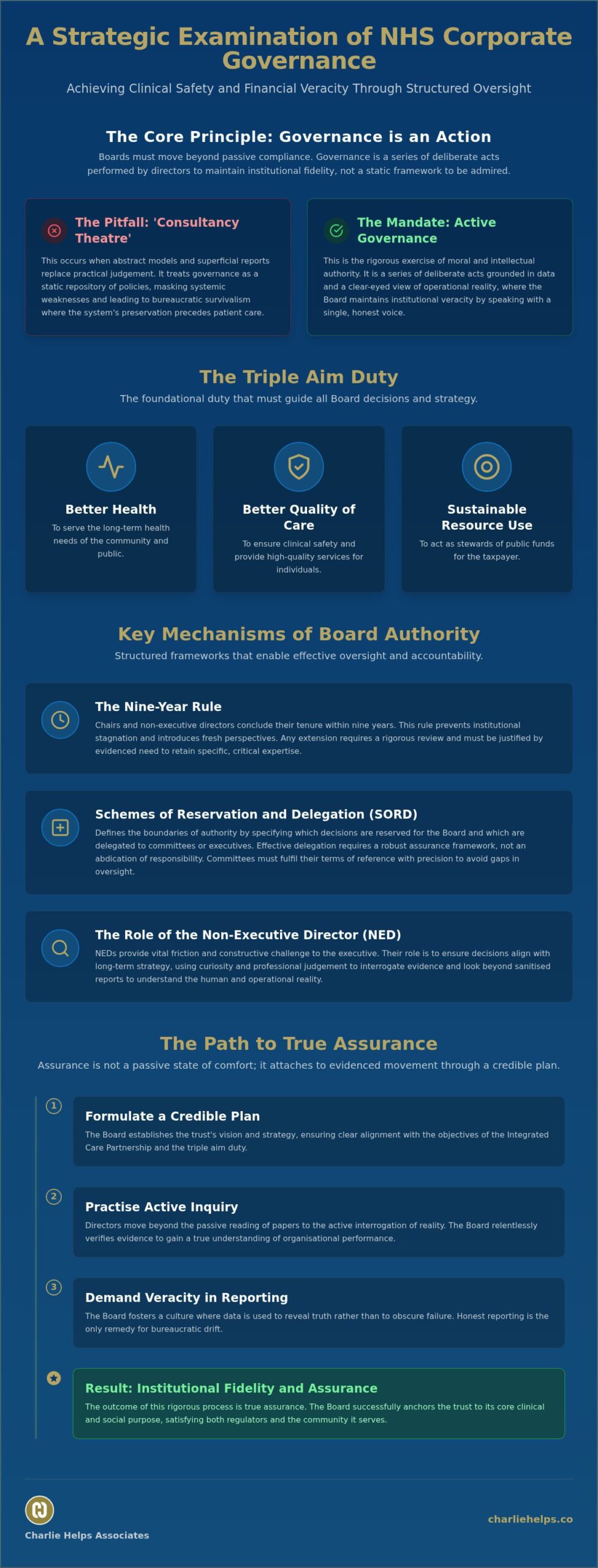
The 2023 Code of Governance for NHS provider trusts demands more than administrative compliance; it requires the active exercise of moral and intellectual authority. NHS England expects Boards to act as the ultimate stewards of the public interest, prioritising patients, the taxpayer, and the long-term health of the community. In this context, NHS Corporate Governance is a series of deliberate acts performed by Directors to maintain institutional veracity. Institutional veracity requires a Board to speak with a single, honest voice, grounded in data and a clear-eyed view of operational reality. It is the antithesis of “consultancy theatre”, where superficial reports mask systemic weaknesses.
Whilst many organisations focus on meeting the Care Quality Commission’s “Well-led” criteria, true excellence emerges when the Board moves beyond these baseline requirements to implement a rigorous Clinical Governance Framework. This framework ensures that accountability structures are not merely theoretical but are active mechanisms for achieving clinical safety. Boards must establish the trust’s vision and strategy in alignment with the Integrated Care Partnership’s objectives, fulfilling the “triple aim” duty of better health, better quality of care, and sustainable resource use. Success is not a status to be reached, but a discipline to be maintained through constant vigilance and practical judgement.
The Nine-Year Rule and Succession Planning
Chairs and non-executive directors must generally conclude their tenure within nine years. This constraint prevents institutional stagnation and ensures that the Board benefits from fresh perspectives. However, the Board must decide how to balance the need for new insight with the preservation of institutional memory. Any extension beyond six years requires a rigorous review of board composition and balance. Directors must justify such extensions through evidenced need, ensuring the organisation retains the specific expertise required to fulfil its mandate without succumbing to inertia.
Schemes of Reservation and Delegation (SORD)
The Scheme of Reservation and Delegation (SORD) defines the boundaries of Board authority. It specifies which decisions the Board reserves for itself and which it delegates to committees or executive leads. Effective delegation is not an abdication of responsibility. Instead, it creates a framework of assurance where the Board receives evidenced movement on key strategic plans. Committees must fulfil their terms of reference with absolute precision to avoid duplication of effort or dangerous gaps in oversight. When a committee fails to challenge the evidence presented, it compromises the entire architecture of oversight.
Beyond Compliance Theatre: Performing Governance as a Human Action
Governance is not a container. It is a series of deliberate actions performed by people who hold the mandate of public trust. When Boards treat NHS Corporate Governance as a static repository of policies, they risk falling into “consultancy theatre”. This occurs when complex diagrams and abstract models replace actual judgement and oversight. Directors and Governors must inhabit their roles with intellectual rigour, moving beyond the passive reading of papers to the active interrogation of reality. Within the NHS Code of Governance for Provider Trusts, the emphasis lies on leadership behaviour rather than mere procedural adherence.
Assurance is not a passive state of comfort. It is the hard-won result of active inquiry and the relentless verification of evidence. The Board’s primary task is to maintain institutional fidelity, ensuring the Trust remains anchored to its clinical and social purpose. Without this anchor, organisations drift into bureaucratic survivalism, where the preservation of the system takes precedence over the care of the patient. Veracity in reporting is the only remedy for such drift; it requires a culture where data is used to reveal truth rather than to obscure failure.
The Role of the Non-Executive Director (NED)
Non-executive directors act as the vital friction within the corporate machinery. They provide the necessary challenge to ensure executive decisions align with long-term strategic aims. A successful NED relies on curiosity, professional judgement, and the ability to interpret complex data sets without losing sight of the human element. They must look past the sanitised version of performance to see the operational reality. For those navigating the unique tension between clinical priorities and financial constraints, specialist mentoring can provide the steady hand needed to fulfil this demanding mandate.
Fidelity, Veracity, and Institutional Memory
Fidelity requires the Board to implement plans that are consistent with the Trust’s core mandate. This is impossible without veracity, the commitment to seeing clinical performance as it truly is, not as we wish it to be. Similarly, the Board must protect institutional memory during leadership transitions. When a Board fails to preserve its history, it risks repeating past failures. Effective NHS Corporate Governance is the act of remembering what worked and why, ensuring that institutional wisdom is not lost to the churn of executive turnover. Each decision must be an evidenced movement through a credible plan, rooted in the collective experience of the organisation.
Integrating AI Governance and Workflow Optimisation in the NHS
The contemporary exercise of NHS Corporate Governance must now encompass the oversight of artificial intelligence and automated decision systems. This is not merely a technical adjustment; it is a strategic necessity for the Board to maintain institutional fidelity. Directors possess the authority to define the ethical and operational boundaries for AI deployment within clinical settings. Without such constraints, the speed of digital adoption risks outpacing the Board’s ability to ensure clinical safety. Leadership must decide how these systems behave before they are integrated into the clinical workflow.
Boardroom AI: Enhancing Decision Support
Boardroom AI serves as a mechanism for enhancing decision support rather than a replacement for human oversight. These systems can assist Boards in identifying patterns in patient safety data that human analysis might miss. However, the Board remains responsible for every decision made with the assistance of automated tools. Governance frameworks must be updated to include specific protocols for AI veracity and bias mitigation to prevent the erosion of professional judgement. Professional assurance attaches to evidenced movement through a credible plan, and AI can help verify that movement.
Reducing Operational Friction through SaaS
Workflow optimisation is required to reduce the administrative friction that often impedes clinical safety. Digital tools should be used to improve the accuracy of board papers and the speed of information flow between departments. Automation can help realise the 2% annual productivity improvement required by the 2026/27 Financial Framework, provided it does not obscure the nuances of operational reality. For more on streamlining board processes, see our workflow optimisation software guide.
Modern NHS Corporate Governance requires a steady hand to manage these digital shifts with restraint and practical judgement. The Board must ensure that technology serves the clinical mandate rather than dictating it.
Evaluating Board Effectiveness: A Strategic Path to Assurance
A Board effectiveness review is a strategic necessity, not a periodic chore. It identifies if the Board has the collective capability to fulfil its mandate and preserve institutional memory. External advisory support provides an objective lens that internal reviews often lack, revealing the subtle biases that can compromise oversight. Evidence of effectiveness is not found in the volume of papers produced; it is found in the quality of debate, the clarity of decisions, and the resulting organisational performance. Effective NHS Corporate Governance requires a Board to be as rigorous with its own conduct as it is with the Trust’s clinical outcomes.
Assurance is the result of evidenced movement through a credible plan. To achieve this, the Board must move beyond the “compliance theatre” discussed previously and focus on the practical utility of its oversight. This requires a shift from passive receiving to active inquiry. When a Board evaluates its own performance, it must ask whether its interventions actually improve clinical safety or merely satisfy a regulatory checklist. The goal is institutional fidelity, ensuring the organisation remains true to its mandate whilst adapting to the pressures of a system-wide collaborative model.
The Five Tests of Governance Utility
The first test is the Aim. Directors must ask if they clearly understand the primary objective of every agenda item. Without a defined purpose, the Board wastes its intellectual capital. The second test concerns Authority. It must be clear who has the power to decide and who has the duty to act; ambiguity in authority leads to institutional paralysis. The third test is Evidence. Boards must determine what specific data supports their reliance on executive reports. Finally, the Risk test identifies what residual threats remain after the proposed actions are implemented. This structured inquiry ensures that NHS Corporate Governance remains a practical tool for institutional safety.
Mentoring for High-Performance Leadership
Individual director performance is the foundation of collective board effectiveness. A Board is only as capable as the people who sit at the table. Coaching and mentoring programmes can accelerate the development of leadership capability in complex systems, helping directors move beyond technical expertise to strategic wisdom. You can explore how our executive leadership coaching supports NHS board development by focusing on the intersection of human behaviour and structural fidelity. This investment ensures that the Board possesses the resilience required to manage the high stakes of healthcare oversight.
A Call to Action for NHS Leaders
Boards must decide today how they will prepare for the governance challenges of 2027 and beyond. The shift towards system-wide collaboration and digital integration requires a level of oversight that many current frameworks cannot support. For expert support in architecting your framework, contact us for a confidential discussion. The aim is to move from mere intention to evidenced movement through a credible plan.
Architecting the Future of Institutional Fidelity
Mastering NHS Corporate Governance requires a transition from administrative adherence to the active performance of oversight. Boards must decide to protect institutional memory whilst simultaneously defining the ethical boundaries of AI and digital workflow optimisation. It’s a discipline that ensures every decision represents evidenced movement through a credible plan, fulfilling the mandate granted by patients and the public. Success is not a static destination; it is the practice of maintaining veracity in every report and fidelity in every action.
Leadership can reduce regulatory friction and realise clinical excellence by implementing Integrated Governance Frameworks and engaging with specialist NHS Board mentoring. Our proprietary Workflow Optimisation SaaS supports this transition by removing the administrative noise that often obscures operational reality. Such tools allow the Board to focus its intellectual capital on the high-stakes decisions that determine institutional safety.
A Board that acts with authority, restraint, and practical judgement today secures the health of its community for the years to follow.
Frequently Asked Questions
What is the primary purpose of the NHS Code of Governance?
The primary purpose of the Code is to establish a framework for Board leadership that prioritises the interests of patients, the public, and the taxpayer. It codifies the statutory duty to collaborate within Integrated Care Systems, shifting the focus from institutional competition to system-wide health outcomes. By adhering to these principles, Boards ensure that NHS Corporate Governance remains an active discipline rather than a passive compliance exercise.
How should an NHS Board manage the nine-year limit for non-executive directors?
Boards should manage this limit by implementing rigorous succession plans that balance fresh perspective with the need for institutional memory. Whilst chairs and non-executive directors typically conclude their tenure after nine years, any extension beyond six years requires a rigorous review and formal agreement with NHS England. Directors must decide how to transition roles to ensure the Board retains the specific expertise required to fulfil its mandate.
What is the difference between ICB governance and Provider Trust governance?
ICB governance focuses on system-wide strategy and the “triple aim” duty, whereas Provider Trust governance centres on institutional oversight and clinical safety. Integrated Care Boards hold the authority for population health and resource allocation across a region. In contrast, Provider Trusts maintain the mandate for the specific implementation of care, the veracity of clinical reporting, and the direct accountability for patient outcomes within their own organisations.
How can AI be safely integrated into NHS corporate governance frameworks?
Boards safely integrate AI by establishing precise ethical and operational boundaries within their existing oversight frameworks. Directors must ensure that automated systems possess the veracity required for clinical decision support, whilst implementing protocols to mitigate algorithmic bias. Leadership remains accountable for every decision reached with the assistance of AI, ensuring that technology serves the clinical mandate rather than dictating it.
What are the essential components of a Board effectiveness review in the NHS?
An effective review must assess the Board’s collective capability to fulfil its mandate through a qualitative examination of debate and decision-making. Essential components include an evaluation of the quality of information flow, the clarity of delegated authority, and the Board’s ability to verify executive assurance. External advisory support provides the objective lens necessary to identify residual risks and institutional weaknesses that internal assessments might overlook.
Why is institutional memory important for NHS Board succession planning?
Institutional memory is the anchor for institutional fidelity, preventing the repetition of past failures during leadership transitions. It allows a Board to interpret current data through the lens of historical experience, ensuring that strategic decisions remain consistent with the Trust’s core purpose. Effective NHS Corporate Governance requires the preservation of this wisdom to maintain a steady hand amidst the churn of executive turnover.
Disclaimer
The articles published on CharlieHelps.co are provided for general information, reflection, and commentary. They draw on professional experience, research, and interpretation, but they do not constitute legal, regulatory, financial, clinical, governance, risk, compliance, assurance, or other professional advice.
Nothing published on this site should be relied upon as practice guidance, formal instruction, or a substitute for proper professional consultation. Readers should seek advice from suitably qualified advisers before acting on, applying, or relying upon any material in relation to their own organisation, Board, duties, circumstances, or decisions.
Although reasonable care is taken to ensure that articles are accurate and current at the time of publication, no warranty is given as to completeness, accuracy, timeliness, or fitness for any particular purpose. Law, regulation, policy, standards, and recognised practice may change, and context matters.
References to external sources, organisations, products, services, or third-party materials are included for information only. They do not imply endorsement unless expressly stated. Where an article contains affiliate links, sponsored references, or commercial relationships, these will be disclosed where relevant.
The views expressed are those of the author unless otherwise stated. Reading, sharing, or responding to material on this site does not create a client, adviser, fiduciary, or professional relationship with Charlie Helps FRSA, CharlieHelps.co, or any associated entity.
Readers remain responsible for their own judgement, decisions, and actions.
