

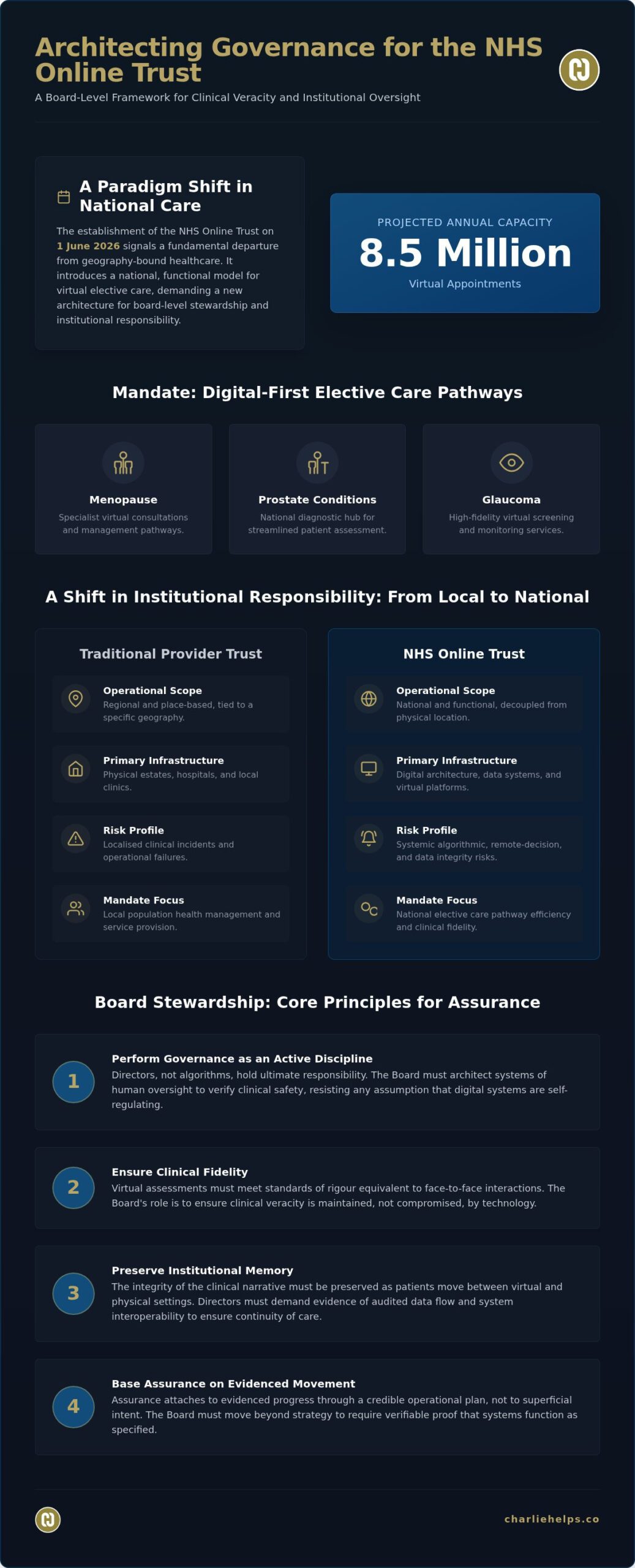
Digital health is not a software deployment. The establishment of the NHS Online Trust on 1 June 2026 signals a more profound shift in institutional responsibility, requiring the Board to architect a system where clinical safety is verified by human oversight rather than assumed by technology. You likely recognise that whilst the projected 8.5 million virtual appointments offer a partial solution to elective backlogs, the ambiguity regarding clinical risk in digital-first settings creates a precarious environment for directors.
This article provides a strategic analysis of the governance architecture and board-level stewardship required to maintain clinical veracity within this new national entity. We examine the specific mandate of the NHS Online Trust, establish a framework for directors to implement board-level assurance, and explore how to manage national elective care through virtual institutional oversight. By treating governance as an active discipline performed by people rather than a static set of rules, leaders can ensure this transition achieves its intended purpose without compromising patient safety.
Key Takeaways
- Understand the 1 June 2026 establishment of the NHS Online Trust, its mandate to centralise elective care, and the resulting shift in national institutional responsibility.
- Recognise that boards must perform governance as an active, human-led discipline, rather than treating digital systems as autonomous agents.
- Learn how to achieve clinical fidelity by ensuring virtual assessments meet the same rigorous standards as face-to-face interactions.
- Identify the specific governance architecture required to manage the clinical and operational risks inherent in a national, digital-first institution.
- Move beyond superficial intent to provide board-level assurance through evidenced movement, credible operational plans, and practical judgement.
The Genesis of the NHS Online Trust: A Paradigm Shift in National Care
The creation of the NHS Online Trust on 1 June 2026 marks a fundamental departure from the traditional, geography-bound structure of the National Health Service. It functions as a national healthcare provider specifically architected to fulfil virtual elective care requirements across England. By decoupling specialist consultation from local physical infrastructure, the Trust aims to realise a significant reduction in regional waiting times. This is not a digital layer added to existing services; it is a new institutional paradigm that shifts the focus from place-based care to a functional, national model.
The Mandate for Digital-First Elective Care
The Trust functions as a national diagnostic and surgical hub that bypasses the friction of local geography. By focusing on specific clinical areas such as menopause, prostate conditions, and glaucoma, the Board can ensure high clinical fidelity in pathways that clinicians have demonstrated are suited to virtual assessment. Success depends on the Board’s ability to make these pathways workable for both clinicians and patients. Because GP referrals to the NHS Online Trust are optional, the institution must prove its value through superior access and clinical outcomes to secure its place in the patient journey.
Institutional Memory in a Virtual Environment
Maintaining institutional memory in a virtual setting requires more than a central database; it demands a system that preserves the integrity of the clinical narrative. When a patient moves from a virtual consultation to a local physical hospital for surgery, the Board must ensure the clinical record remains coherent and accessible. Directors cannot treat data flow as an automated certainty. Instead, they must demand evidence of audited movement and system interoperability. True assurance arises when the Board can verify that the digital architecture supports, rather than hinders, the continuity of care.
The Board’s primary task is to move beyond the theatre of digital transformation and address the practicalities of national oversight. This requires a shift in how directors perceive their authority, moving from regional stewardship to national accountability. If your board requires assistance in architecting these frameworks, our Advisory Services provide strategic clarity. As this new entity matures, the focus must remain on the human actions that constitute governance: the decisions made by committees, the constraints set by clinical leads, and the veracity of the data presented to the Board.
Architecting Governance for Digital-First Institutional Structures
Governance is an active verb. For the NHS Online Trust, the Board must resist the temptation to view digital systems as self-regulating entities. Directors, not algorithms, hold the ultimate responsibility for clinical outcomes. This requires a specific architecture designed to mitigate the risks of remote decision-making. When clinical assessments occur in a virtual environment, the distance between the patient and the clinician introduces unique variables that the Board must account for through rigorous oversight mechanisms.
| Governance Feature | Traditional Provider Trust | NHS Online Trust |
|---|---|---|
| Operational Scope | Regional and place-based. | National and functional. |
| Primary Infrastructure | Physical estates and local clinics. | Digital architecture and virtual platforms. |
| Risk Profile | Localised clinical incidents. | Systemic algorithmic and remote risks. |
| Mandate Focus | Local population health management. | National elective care pathways. |
A digital-first Trust demands a shift in how leaders perceive institutional boundaries. Boards must establish clear lines of authority for clinicians who may be based in London whilst treating a patient in Newcastle. This cross-regional operation requires a framework that ensures clinical fidelity remains consistent, regardless of the clinician’s physical location. Without this clarity, the institution risks fragmented care and diluted accountability.
Authority and Mandate in a National Context
Directors must determine who holds the authority to implement clinical protocol changes that affect patients across the entire country. This national mandate must be carefully reconciled with local Integrated Care Boards (ICBs) to prevent friction or the creation of clinical silos. Integrated governance frameworks ensure that the virtual provision of care aligns with regional recovery plans. If the Board fails to synchronise these efforts, they risk undermining the very efficiency the Trust was established to achieve.
Board Oversight of Algorithmic and Digital Systems
Active oversight of the Federated Data Platform is essential for maintaining the veracity of patient records and ensuring clinical safety. The Board must seek constant assurance that digital tools support, rather than replace, human clinical judgement. Engaging expert public sector governance advisory ensures these oversight mechanisms are robust, legally sound, and focused on patient welfare. When the stakes involve national elective care, the Board’s ability to interrogate the data determines the institution’s success. If you require a steady hand to navigate these complex requirements, our Advisory Services can help you architect a framework for excellence.
Ensuring Clinical Fidelity and Operational Assurance
Clinical fidelity is not a digital aspiration. It’s the requirement that virtual consultations meet or exceed the rigorous standards of face-to-face interactions. For the NHS Online Trust, achieving this parity requires the Board to move beyond statements of intent. Assurance, in a professional governance context, is evidenced movement through a credible operational plan. Directors must specify how they will realise clinical safety targets when the traditional safety net of physical oversight is absent. This requires a shift from passive reporting to the active auditing of digital workflows in real-time.
Veracity and Reliability in Patient Data
The Single Patient Record serves as the ultimate source of truth for the entire NHS network. Board members must understand the technical limitations of current digital medicines programmes to manage clinical risk effectively. Fidelity to the patient experience requires that digital prescriptions and test bookings occur without operational friction. If the digital architecture fails to sync with local pharmacy systems, the clinical pathway collapses. Directors must therefore demand evidence that the data remains accurate as it moves across institutional boundaries, ensuring that the virtual record reflects the patient’s true clinical state.
Risk Accountability for Remote Clinicians
Accountability frameworks must specify how directors oversee specialists who are not physically co-located. The Trust must implement high-calibre executive leadership coaching UK to support clinicians in these isolated remote environments. Governance is an action performed by people; therefore, the Board must determine what evidence supports their reliance on remote clinical outcomes. This involves more than reviewing outcome data. It requires an understanding of the human behaviour behind the screen. Directors must ask what constraints exist to prevent fatigue or diagnostic drift in a purely virtual setting. Reliance is only justifiable when the Board can verify that clinicians have the tools and the culture required to maintain excellence.
Establishing a Mandate for Excellence: Strategic Board Actions
The successful implementation of the NHS Online Trust depends on the Board’s capacity to make governance workable. Directors must move beyond consultancy theatre, where superficial compliance masks structural weakness, to address the hard questions of regulatory fidelity and board dynamics. Strategic value is realised only when the governance framework supports the long-term vision of a digital-first NHS. This requires a shift from viewing technology as a separate entity to seeing it as the primary medium through which clinicians act and decisions are made.
To implement a robust governance framework, boards should follow these five strategic steps:
- Define Authority: Establish clear lines of clinical authority for national remote assessments to prevent regional ambiguity.
- Verify Veracity: Implement a data veracity protocol to ensure the Single Patient Record remains a source of truth across all NHS interfaces.
- Synchronise Mandates: Reconcile the national digital mandate with regional Integrated Care Board recovery plans to avoid clinical silos.
- Audit Workflows: Move to real-time auditing of digital workflows to provide evidenced assurance of clinical safety.
- Assess Literacy: Regularly evaluate the Board’s technical and digital literacy to ensure directors can interrogate the systems they oversee.
Conducting a Board Effectiveness Review
A board effectiveness review is essential to assess if the current leadership can manage national digital risks. This process must identify what remains unknown about the virtual care model and what assumptions are being made regarding patient safety. Fidelity to the mission requires a board that is both technically literate and strategically aligned. Directors must possess the intellectual force to challenge technical experts, ensuring that the human element of care remains the central focus of the institutional strategy.
Implementing Workflow Optimisation
Boards should consider workflow optimisation software to automate compliance and reduce operational friction. The aim is to create a transparent system where every decision is supported by evidenced data, moving away from anecdotal assurance. Whilst digital tools assist in managing the scale of national elective care, the Board remains the ultimate authority. These systems must serve the mandate to provide safe, national care, providing the veracity required for directors to fulfil their statutory duties with confidence.
The establishment of the NHS Online Trust presents an opportunity to redefine the relationship between leadership and digital infrastructure. Will the Board choose to lead through active, human-led oversight, or will they allow the complexity of a national system to obscure their accountability? The decision rests on their willingness to treat governance as a continuous action rather than a periodic report.
Securing Institutional Fidelity in a Digital-First Era
The NHS Online Trust is a test of leadership rather than a technical milestone. Directors must decide whether to treat this transition as a passive shift in platform or an active re-assertion of clinical accountability. By architecting frameworks that prioritise institutional memory and clinical fidelity, boards can ensure that national elective care remains safe and responsive. This institutional transformation is achievable through rigorous board effectiveness reviews and the implementation of workflow optimisation systems that provide operational veracity.
Success requires more than a credible plan; it demands a board that possesses the technical literacy to interrogate digital systems and the moral depth to protect the patient narrative. As specialists in architecting integrated governance frameworks for the UK public sector, we provide the authoritative advisory necessary for NHS boards navigating this shift. The goal is to realise a system where digital tools serve the human mandate for excellence, ensuring that every decision is supported by evidenced movement through an audited plan.
The transition to national virtual care represents an invitation to excellence. It asks whether our institutions can maintain their moral weight when the physical clinic vanishes. The answer lies in the hands of the directors who choose to act with authority, restraint, and practical judgement.
Frequently Asked Questions
What is the legal status of the NHS Online Trust?
The NHS Online Trust is a national healthcare provider established on 1 June 2026 under the same statutory framework as regional provider trusts. It holds a distinct legal mandate to realise elective care pathways across England without the constraints of local geography. This status allows the institution to employ clinicians nationwide and manage patient care through national digital infrastructure, including the NHS App.
How does the NHS Online Trust maintain clinical accountability across different regions?
The Board maintains accountability by architecting national clinical protocols that ensure consistency regardless of the clinician’s physical location. This involves the active oversight of virtual assessment fidelity and the implementation of a national clinical senate to monitor outcomes. Directors must ensure that lines of authority remain clear and that every remote clinician adheres to the Trust’s specific safety standards.
Can patients choose to remain with their local Trust instead of the Online NHS Trust?
Patients retain the right to choose their provider and may remain with their local physical Trust if they prefer face-to-face interactions. GP referrals to the NHS Online Trust are entirely optional, ensuring that patient choice remains central to the implementation of the service. The virtual model exists to provide an alternative for those who prioritise rapid access for specific conditions such as menopause or prostate issues.
What role does the Board play in overseeing the NHS Federated Data Platform?
The Board acts as the steward of data veracity, ensuring that the Federated Data Platform preserves the integrity of the Single Patient Record. Directors must move beyond reviewing technical reports to demand evidence of system interoperability and audited data movement. Their role is to verify that the digital architecture supports clinical judgement rather than creating silos that obscure the patient’s history.
How is clinical risk managed when a physical examination is required?
Clinicians refer patients back to local physical providers or their GP when a virtual assessment identifies the requirement for a physical examination. The governance framework specifies clear thresholds for these referrals to ensure clinical safety is never compromised. The Board must verify that these transition points are workable and that the patient’s clinical narrative remains coherent during the transfer between virtual and physical care.
What are the governance implications for specialists working for the Online NHS Trust?
Specialists typically operate under a flexible workforce model, often maintaining their primary roles in regional hospitals whilst contributing to the national service. This requires a governance structure that manages dual accountability and ensures fidelity to the national Trust’s clinical protocols. The Board must oversee the integration of these specialists, ensuring their remote practice meets the same rigorous standards as their in-person work.
Disclaimer
The articles published on CharlieHelps.co are provided for general information, reflection, and commentary. They draw on professional experience, research, and interpretation, but they do not constitute legal, regulatory, financial, clinical, governance, risk, compliance, assurance, or other professional advice.
Nothing published on this site should be relied upon as practice guidance, formal instruction, or a substitute for proper professional consultation. Readers should seek advice from suitably qualified advisers before acting on, applying, or relying upon any material in relation to their own organisation, Board, duties, circumstances, or decisions.
Although reasonable care is taken to ensure that articles are accurate and current at the time of publication, no warranty is given as to completeness, accuracy, timeliness, or fitness for any particular purpose. Law, regulation, policy, standards, and recognised practice may change, and context matters.
References to external sources, organisations, products, services, or third-party materials are included for information only. They do not imply endorsement unless expressly stated. Where an article contains affiliate links, sponsored references, or commercial relationships, these will be disclosed where relevant.
The views expressed are those of the author unless otherwise stated. Reading, sharing, or responding to material on this site does not create a client, adviser, fiduciary, or professional relationship with Charlie Helps FRSA, CharlieHelps.co, or any associated entity.
Readers remain responsible for their own judgement, decisions, and actions.
