

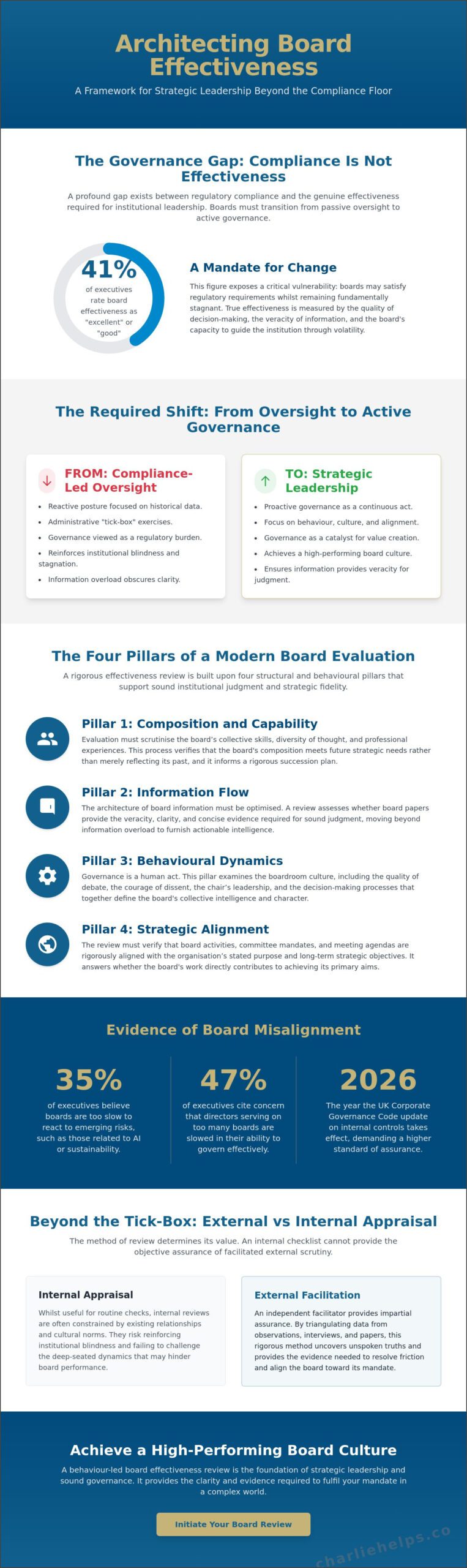
Compliance serves as the floor, not the ceiling, of institutional integrity. Whilst the 2024 revision of the UK Corporate Governance Code mandates new declarations on internal controls for financial years beginning on or after 1 January 2026, many boards remain trapped in a cycle of reactive oversight. Recent data indicates that only 41% of executives rated their boards’ effectiveness as excellent or good in 2025, a figure that exposes a profound gap between structural compliance and actual leadership. A rigorous board effectiveness review must transcend the administrative checklist to address the human behaviours, misaligned dynamics, and information silos that stifle strategic movement.
Directors often experience the friction of boardroom misalignment, where information overload obscures clarity and the three-year external review deadline feels like a regulatory burden. You understand that true governance requires more than mere attendance; it demands a commitment to veracity, accountability, and the preservation of institutional memory. This guide offers a behaviour-led framework to help your board move from compliance-driven oversight to strategic leadership.
Mastery of these dynamics allows a board to achieve a high-performing culture, clearer strategic alignment, and streamlined processes. The following analysis examines the essential shifts required to fulfil your mandate in a complex global landscape, ensuring your board functions as a reliable basis for institutional decision-making.
Key Takeaways
- Transition from a compliance-led mindset to a strategic framework where directors perform governance as a deliberate, continuous act of leadership.
- Execute a board effectiveness review that scrutinises behavioural dynamics and structural integrity to resolve friction amongst directors and align the board with organisational purpose.
- Refine information architecture through workflow optimisation to ensure board papers provide the veracity, clarity, and evidence required for sound institutional judgment.
- Recognise the limitations of internal appraisals by employing external facilitation to uncover deep-seated institutional blindness and misaligned dynamics.
- Apply a rigorous evidence-gathering methodology to triangulate data from observations, interviews, and papers to realise a board culture rooted in accountability.
The Strategic Imperative: What is a Board Effectiveness Review in 2026?
Governance is an active pursuit. It is the exercise of collective intelligence to steer an institution through volatility. A board effectiveness review in 2026 serves as more than a periodic obligation; it is a catalyst for sustainable value creation. This process examines how directors wield authority, fulfil their mandate, and maintain the fidelity of the organisation’s purpose. It identifies the precise points where boardroom dynamics either support or obstruct the realisation of strategic objectives.
Modern Corporate Governance requires a shift from passive oversight to a model where the board functions as a strategic architect. The 2026 landscape, defined by rapid technological integration and heightened scrutiny, demands that boards synchronise high-level strategy with operational reality. A review provides the evidence needed to verify if the board possesses the requisite skills to oversee emerging risks. It asks whether the board possesses the agility to react to market volatility or if it is slowed by directors serving on too many boards, a concern cited by 47% of executives in 2025.
The Evolution of the UK Corporate Governance Code
The Financial Reporting Council (FRC) has recalibrated the standards of leadership. The 2024 revision of the UK Corporate Governance Code, specifically Provision 29 regarding material internal controls, applies to financial years beginning on or after 1 January 2026. Whilst FTSE 350 companies must conduct externally facilitated reviews every three years, smaller organisations increasingly adopt these standards to provide assurance to investors. These updates prioritise board culture, requiring directors to demonstrate how they engage with stakeholders, manage emerging tech disruption, and preserve institutional memory.
The Distinction Between Compliance and Effectiveness
Compliance is the skeleton of governance; effectiveness is its vitality. A board may satisfy every regulatory requirement whilst remaining fundamentally stagnant. Effectiveness resides in the qualitative domain of boardroom behaviour, where the veracity of information and the courage of dissent determine the quality of decisions. Moving beyond a tick-box exercise requires boards to measure their collective intelligence and the clarity of their strategic alignment. Directors must move from the comfort of checklists to the rigour of self-examination, ensuring the board remains a reliable basis for institutional decision-making. Does the current composition of the board reflect the future needs of the organisation, or does it merely mirror its past?
Architecting Oversight: The Four Pillars of a Modern Board Evaluation
A board effectiveness review must begin with the architecture of the board itself. Governance remains a human act performed by directors; therefore, the evaluation must scrutinise the structural and behavioural foundations that enable these individuals to fulfil their mandate. Four distinct pillars support this architecture: structural integrity, information flow, behavioural dynamics, and strategic alignment. Each pillar provides a specific lens through which the board can assess its capacity to achieve long-term objectives.
Pillar 1: Composition and Capability
Composition determines the range of perspectives available for decision-making. Boards often rely on static skills matrices that fail to account for emerging technical requirements, such as AI governance or sustainability reporting. A Harvard Law School Forum on Corporate Governance survey reveals that 35% of executives believe boards are too slow to react to emerging risks. Realising diversity of thought requires moving beyond demographic quotas to include varied professional experiences that challenge institutional norms. Succession planning should function as a continuous cycle of renewal rather than an emergency response to vacancies, ensuring the board maintains its institutional memory whilst integrating fresh expertise.
Pillar 2: Information Architecture and Workflows
Information serves as the lifeblood of accountability. Boards frequently suffer from data obesity whilst starving for actual intelligence. The veracity and clarity of board papers dictate whether directors spend their time debating historical data or shaping future strategy. Operational friction in reporting often stems from fragmented legacy systems that obscure the truth and delay the distribution of critical materials. Refined workflow optimisation solutions enable management to provide directors with concise, evidence-led summaries that support reliance. When information flows with precision, the board can fulfil its mandate with greater confidence and less administrative burden.
Pillar 3: The Human Element and Boardroom Culture
The human element remains the most volatile component of governance. Even the most qualified directors can succumb to groupthink if the Chair fails to facilitate inclusive debate or suppress dominant voices. Behavioural dynamics involve the invisible psychological forces that dictate how power is exercised amongst peers. Identifying these patterns requires an unsentimental look at the relationship between executive and non-executive directors. Friction often arises when the boundary between oversight and management becomes blurred, leading to operational interference rather than strategic guidance. A high-performing board culture values dissent as a tool for rigorous assurance rather than a threat to harmony.
Strategic alignment bridges the gap between the boardroom and the front line. It requires the board to verify that its vision is realised through organisational performance and that every committee operates with clear authority. Effective governance ensures that strategic priorities are not merely stated but implemented with fidelity across the institution. The final pillar of a board effectiveness review asks a fundamental question: does the board’s presence actually result in a better-led organisation?
Beyond the Compliance Tick-Box: External Facilitation vs Internal Appraisal
Self-perception is a mirror that often flatters. Boards that rely exclusively on internal appraisals risk succumbing to institutional blindness; they fail to see the subtle erosion of accountability or the gradual drift from their strategic mandate. Whilst internal reviews provide a baseline, a formal board effectiveness review facilitated by an external advisor introduces the necessary friction to test assumptions. It moves the board beyond the administrative “tick-box” toward a rigorous examination of how directors actually perform governance. External perspectives provide the assurance that internal processes remain robust and that decision-making rests on a foundation of veracity rather than consensus.
Selecting the appropriate depth for an external review requires a clear understanding of the board’s current maturity. Approaches typically fall into three categories: a “light” desk-top review of papers and surveys, a “standard” engagement involving interviews and meeting observations, and a “comprehensive” deep-dive into culture audits and committee-level effectiveness. The aim is to appoint a facilitator who functions as a strategic mentor rather than a mere auditor. This individual must possess the intellectual force to challenge the Chair whilst maintaining the professional weight to guide the board toward a more sophisticated level of leadership.
The Case for External Facilitation
External facilitators create a safe space for unvarnished feedback. Directors often hesitate to challenge a dominant peer or a long-standing boardroom tradition within the confines of a self-led survey. An independent expert acts as a steady hand, benchmarking board performance against international best practices and identifying behavioural patterns that internal eyes might miss. This process helps the board realise its full strategic potential by uncovering deep-seated issues that hinder collective intelligence. It ensures that the board remains a reliable basis for institutional decision-making in high-stakes environments.
Maximising the Value of Internal Appraisals
Internal reviews remain essential during the intervening years between external evaluations. They allow the board to track progress on action plans and maintain the momentum of reform initiated by external advisors. Developing internal governance frameworks that support continuous improvement ensures that accountability remains a habit rather than an annual event. Integrating workflow optimisation SaaS solutions enables committees to monitor governance KPIs throughout the year, preserving institutional memory and reducing operational friction. These tools help boards organise their work with precision, ensuring that every director fulfils their mandate with clarity and evidence.
The choice between internal and external review is not a binary one; it is a cycle of continuous refinement. A board that embraces external scrutiny whilst maintaining rigorous internal standards demonstrates a commitment to excellence that transcends mere compliance. How does your current review process distinguish between the appearance of governance and the actual performance of it?
The Methodology of Transformation: Executing a Value-Driven Board Review
A board effectiveness review serves as an architectural intervention. It requires a methodical approach that moves beyond the collection of data toward the synthesis of wisdom. Transformation begins with scoping, where the board defines the Aim and identifies who holds the authority to act upon the findings. This phase ensures the review addresses specific systemic challenges, such as the digital transformation lag cited by 34% of executives in 2025, rather than generic governance principles. Evidence gathering must then triangulate insights from board papers, individual interviews, and meeting observations to provide a reliable basis for judgment.
Step-by-Step Execution: From Scoping to Reporting
Drafting the brief requires directors to identify the precise tensions within their sector. Interviews provide the most fertile ground for discovery, allowing a facilitator to ask the difficult questions that reveal how power is exercised and where accountability falters. Observing board meetings in real-time exposes the “theatre” of the boardroom, where non-verbal cues and the facilitation of debate by the Chair often speak louder than the minutes. Analysis then synthesises these observations into a cohesive strategic narrative, identifying the risks to fidelity and the controls required to realise the board’s mandate.
Turning Insights into ROI
Most evaluations fail when the final report becomes “shelf-ware,” a static document that gathers dust whilst old behaviours persist. To avoid this trap, the board must develop an actionable blueprint that links recommendations to specific leadership development goals. This roadmap should include tailored mentoring and advisory services for individual directors to ensure they possess the skills to oversee complex emerging risks. Sustained implementation requires the board to treat the review as a catalyst for a permanent shift in culture rather than a one-off event.
Measuring the success of an intervention involves quantifying improvements in board dynamics and decision-making speed. Boards can track the veracity of information flow and the reduction of operational friction as clear indicators of progress. When directors commit to this level of rigour, they fulfil their mandate with greater precision and achieve a higher standard of organisational oversight. Does your board possess the institutional courage to act upon the unvarnished truths revealed by an external perspective, or will the findings remain mere intentions?
Integrating Governance and Workflow: The Charlie Helps Perspective
Governance requires the synthesis of human intention and systemic precision. Charlie Helps Associates recognises that a board effectiveness review often identifies cultural friction that stems from poorly designed workflows. We bridge the gap between high-level Advisory Services and the technical realities of institutional oversight. Our methodology treats governance as a verb; it is an action performed by directors who require both the intellectual capacity to lead and the structural tools to verify progress. By aligning human behaviour with operational systems, we help boards move from passive compliance to active, strategic leadership.
A Human-Centric Approach to Board Mentoring
Reports alone do not change institutions. We act as strategic guides, providing Mentoring Services and Coaching Services that help directors move beyond the findings of a board effectiveness review. This phase focuses on developing leadership capability and fostering a culture of accountability. By addressing the psychological dynamics identified during the evaluation, we help boards preserve institutional memory whilst adapting to the pressures of the 2026 regulatory environment. Directors must possess the courage to challenge consensus; we cultivate this trait through rigorous, purpose-led mentoring programmes. This human-centric approach ensures that recommendations lead to evidenced movement rather than mere intention.
Digital Process Management as a Governance Tool
Structural integrity depends upon the veracity of information. Our Workflow Optimisation SaaS Solution serves as a governance tool by reducing the operational friction that often obscures strategic clarity. When committees automate reporting and data visualisation, they ensure the board focuses on high-level strategy rather than administrative trivia. For example, a UK enterprise recently utilised our workflow optimisation to synchronise its risk management processes with board-level oversight. This intervention allowed the board to fulfil its mandate with greater precision, as directors could rely on real-time evidence rather than delayed, fragmented board packs. The reduction in friction enabled the board to realise its strategic objectives with enhanced speed and accuracy.
Effective leadership in 2026 demands the integration of human behaviour and digital systems. Boards must decide whether they will remain tethered to legacy processes or embrace the tools required for strategic agility. The final implication of a modern review is clear: governance must be realised through a combination of personal accountability and structural optimisation. We invite boards to view the review process not as an end, but as a beginning. Does your board possess the tools and the mentorship required to realise its strategic vision in an increasingly complex world?
Realising the Strategic Potential of the Boardroom
Governance is a practice, not a state of being. It requires the constant synthesis of individual integrity, collective intelligence, and structural precision. This guide has identified that a sophisticated board effectiveness review transcends regulatory checklists to address the fundamental human behaviours that dictate institutional success. By synchronising these dynamics with refined digital workflows, boards can resolve operational friction and preserve institutional memory with greater fidelity. The transition from reactive oversight to strategic leadership remains the defining challenge for directors in 2026.
Expert corporate advisory services UK provide the independent scrutiny required to uncover institutional blindness and test the veracity of decision-making. Our national UK advisory expertise, paired with our proprietary workflow optimisation SaaS, ensures that your board operates as a reliable basis for institutional action. Directors must now decide whether to accept the limitations of the status quo or to fulfil their mandate with renewed clarity and purpose.
Architect your board’s future with a bespoke effectiveness review from Charlie Helps Associates. Your commitment to excellence starts here.
Frequently Asked Questions
How often should a board effectiveness review be conducted in the UK?
The UK Corporate Governance Code requires FTSE 350 companies to conduct an externally facilitated evaluation at least every three years. Boards should perform internal reviews during the intervening years to maintain momentum and track the realisation of previous recommendations. This cycle ensures that governance remains an active, iterative process rather than a stagnant administrative requirement.
What is the typical cost of an externally facilitated board review?
Fees for an external board effectiveness review vary significantly based on the organisational scale, the number of directors interviewed, and the depth of meeting observations. Boards should seek tailored proposals from corporate governance consultants to ensure the scope aligns with their specific strategic requirements. Investing in high-quality oversight provides the assurance needed to protect institutional value and satisfy investor scrutiny.
How do you measure the effectiveness of a board of directors?
Measurement involves both qualitative assessments of boardroom behaviour and quantitative evaluations of strategic outcomes. Directors must scrutinise the quality of debate, the veracity of board papers, and the board’s ability to challenge executive assumptions. Effective boards demonstrate clear strategic alignment and a commitment to accountability, ensuring their decisions rest on a reliable basis of evidence and judgment.
What are the key elements of a board effectiveness review?
A comprehensive review examines board composition, information architecture, behavioural dynamics, and strategic oversight. It evaluates whether the skills matrix addresses emerging risks, such as AI governance or market volatility, and identifies any psychological barriers to effective dissent. These elements provide the structural and human foundations required for the board to fulfil its mandate with precision.
Can a board effectiveness review be conducted internally?
Internal reviews are appropriate for annual check-ins, though they carry a high risk of institutional blindness and consensus bias. Whilst self-assessment tools provide a baseline, they rarely uncover deep-seated cultural issues or challenge the authority of dominant directors. External facilitation introduces the necessary friction to test long-held assumptions and provide an unvarnished perspective on board performance.
How does a board review help with ESG governance strategy?
The review process evaluates whether the board possesses the requisite skills to oversee ESG as a core business strategy rather than a compliance exercise. It examines how directors integrate sustainability into the long-term vision and whether reporting workflows provide the data needed for ethical decision-making. This ensures the board remains accountable to a broader range of stakeholders whilst preserving institutional fidelity.
What is the role of the Chair during the review process?
The Chair holds the authority to lead the review and must act as its primary champion to ensure director engagement. They are responsible for facilitating access to information, participating candidly in interviews, and leading the implementation of the resulting action plan. A Chair’s willingness to embrace scrutiny often determines whether the review leads to genuine leadership growth or remains a hollow exercise.
How do we ensure the review leads to actual organisational change?
Change requires a transition from static reports to a dynamic actionable blueprint with clear accountabilities and timelines. Boards should link review findings to executive mentoring and use workflow optimisation tools to monitor governance KPIs throughout the year. This methodical approach ensures that the board realises its strategic potential and that reforms are implemented with consistency across the organisation.
Disclaimer
The articles published on CharlieHelps.co are provided for general information, reflection, and commentary. They draw on professional experience, research, and interpretation, but they do not constitute legal, regulatory, financial, clinical, governance, risk, compliance, assurance, or other professional advice.
Nothing published on this site should be relied upon as practice guidance, formal instruction, or a substitute for proper professional consultation. Readers should seek advice from suitably qualified advisers before acting on, applying, or relying upon any material in relation to their own organisation, Board, duties, circumstances, or decisions.
Although reasonable care is taken to ensure that articles are accurate and current at the time of publication, no warranty is given as to completeness, accuracy, timeliness, or fitness for any particular purpose. Law, regulation, policy, standards, and recognised practice may change, and context matters.
References to external sources, organisations, products, services, or third-party materials are included for information only. They do not imply endorsement unless expressly stated. Where an article contains affiliate links, sponsored references, or commercial relationships, these will be disclosed where relevant.
The views expressed are those of the author unless otherwise stated. Reading, sharing, or responding to material on this site does not create a client, adviser, fiduciary, or professional relationship with Charlie Helps FRSA, CharlieHelps.co, or any associated entity.
Readers remain responsible for their own judgement, decisions, and actions.
