

Assurance is an active verb, a deliberate exercise of authority by a Board rather than a passive reception of data. Many NHS leaders find themselves submerged in the noise of clinical audits, struggling to discern whether a report signifies institutional fidelity or merely a rehearsed adherence to a checklist. This distinction is critical for NHS Quality Assurance as the Care Quality Commission and NHS England intensify their scrutiny through the 2026 update to the Professional Standards Framework. We recognise that the weight of oversight often leads to a defensive posture, where the fear of regulatory failure eclipses the pursuit of clinical excellence.
This article provides a strategic exploration of how Boards can move beyond the surface of compliance to achieve rigorous, evidenced oversight. You will gain a clear understanding of the Framework for Quality Assurance and Improvement (FQAI) and learn how to integrate these processes into your existing risk management structures. By shifting the focus from static intention to evidenced movement through a credible plan, you can reclaim confidence in your decisions and fulfil your mandate to the public with clarity and poise.
Key Takeaways
- Recognise that NHS Quality Assurance is a deliberate action performed by people, moving beyond passive data collection to active strategic oversight.
- Apply the 2026 Framework for Quality Assurance and Improvement (FQAI) to transform Annex A reports into narratives of genuine institutional fidelity.
- Integrate quality metrics into the Board Assurance Framework (BAF) to ensure that strategic decisions rest upon evidenced movement through a credible plan.
- Implement workflow optimisation to reduce operational friction and automate the verification of professional standards.
- Protect institutional memory against structural change by utilising professional advisory and mentoring services to enhance collective Board capability.
Redefining NHS Quality Assurance as a Strategic Governance Mandate
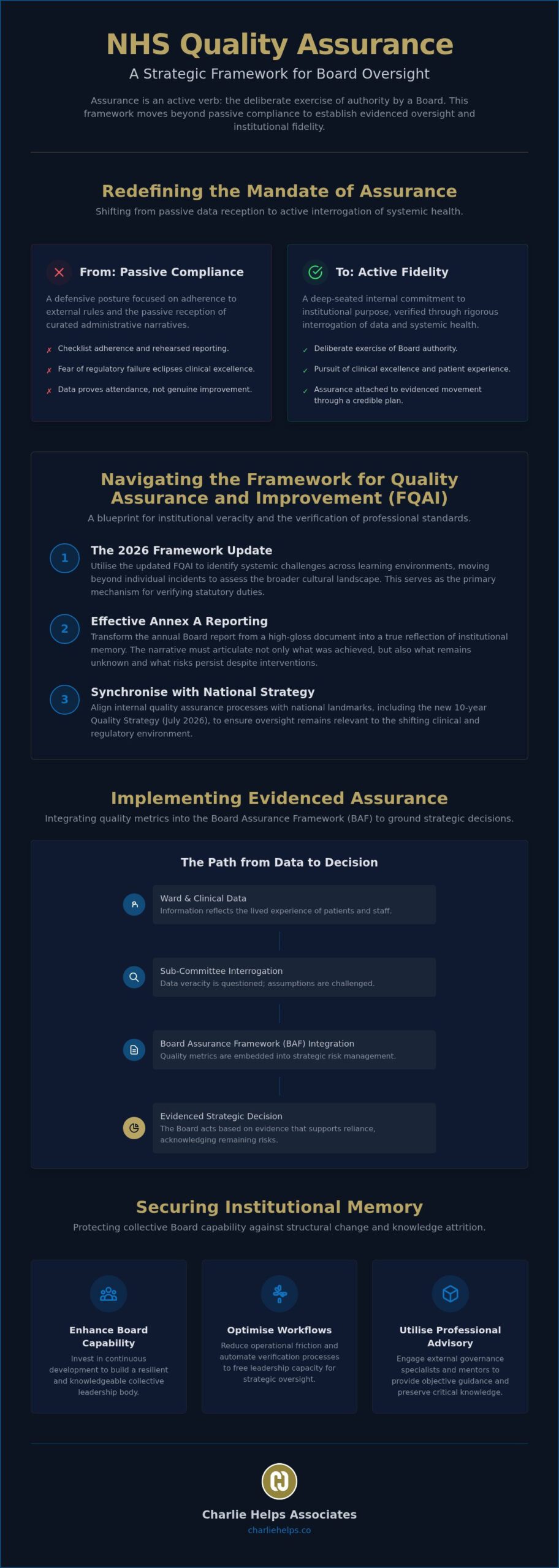
Governance is not an abstract container; it is a verb. It represents the deliberate exercise of authority by Boards and directors to ensure institutional integrity. Within the landscape of NHS Quality Assurance, this mandate requires a shift from the passive reception of data to the active interrogation of systemic health. Boards hold the ultimate responsibility to verify the veracity of clinical and operational reports. They must ensure that the information presented at the sub-committee level reflects the lived experience of patients and staff rather than a curated administrative narrative.
True assurance does not exist in a static state of compliance. Instead, it attaches to evidenced movement through a credible plan. This distinction is vital. It moves the conversation from a checklist of rules to a rigorous assessment of purpose. When a Board identifies a gap in performance, its role is not merely to note the failure, but to oversee the implementation of a workable correction.
The Distinction between Compliance and Fidelity
Compliance denotes the adherence to external rules, whereas fidelity reflects the deep-seated internal commitment to institutional purpose. Boards must distinguish between data that proves attendance and data that proves improvement. Whilst a Trust might satisfy the technical requirements of the Quality and Outcomes Framework (QOF), such metrics do not always correlate with clinical excellence. Rigorous oversight requires a lucid understanding of what remains unknown within the organisation. Directors must possess the intellectual courage to look beyond the dashboard and question the assumptions underpinning the data.
Authority and the Decision-Making Framework
Effective governance requires clarity regarding who has the authority to challenge QA data at the sub-committee level. It is not enough to observe a deviation; the Board must determine what specific decisions are required when indicators signal a drift from the plan. This necessitates a robust line of accountability from the ward to the Board. Systems must be designed to preserve the integrity of information as it ascends the hierarchy. When the Board acts, it must do so based on evidence that supports reliance, acknowledging the risks that remain even after an intervention is implemented. This ensures that NHS Quality Assurance remains a tool for strategic leadership rather than a bureaucratic burden.
Navigating the Framework for Quality Assurance and Improvement (FQAI)
The April 2026 update to NHS England’s quality assurance framework serves as the primary mechanism for verifying professional standards and statutory requirements. It is a blueprint for institutional veracity. Boards must use this framework to identify systemic challenges across learning environments, moving beyond the superficiality of individual incidents to grasp the broader cultural landscape. True assurance is realised when directors can demonstrate a commitment to transformation through evidenced self-assessment rather than mere compliance with a schedule.
Assurance is not a gift bestowed by a regulator; it is a trophy won through rigorous internal scrutiny. The FQAI landmark documents for 2026 and 2027 provide the necessary structure to verify that responsible officers fulfil their statutory duties. By aligning NHS Quality Assurance with these national landmarks, Boards can ensure their oversight remains synchronised with the shifting clinical environment and the new 10-year Quality Strategy published in July 2026.
Interpreting Annex A: The Board Report
Annex A provides the template for the annual board report, yet its utility depends entirely on the quality of the underlying narrative. Boards should avoid the trap of “consultancy theatre,” where high-gloss reporting masks a lack of practical judgement. A statement of compliance must be a reflection of institutional memory. It should articulate not just what has been achieved, but what remains unknown. Reports must explicitly identify the risks that remain despite QA interventions to ensure the Board remains clear-eyed about its vulnerabilities. If your Board requires assistance in refining these narratives to reflect true institutional fidelity, our advisory services can provide the necessary strategic guidance.
The Role of Regional Professional Standards Teams
Annex B outlines the support and leadership function provided by NHS England regional teams. Boards should view these teams as partners in excellence, utilising their regional insights to benchmark performance against national quality domains. This collaborative stance allows for a more nuanced interpretation of data, helping the Board to distinguish between isolated anomalies and systemic drift. By engaging with regional professional standards teams, Boards can verify that their internal controls remain workable and robust against the latest national standards.
Implementing Evidenced Assurance within NHS Board Risk Frameworks
Strategic alignment requires the direct integration of quality assurance data into the Board Assurance Framework (BAF). Assurance is not an isolated report; it is the thread that binds clinical performance to corporate risk. Boards must establish a rhythm of reporting that allows for contemplative analysis. This prevents impulsive reactions to temporary data spikes and encourages a focus on long-term systemic stability. By defining the specific evidence required to support reliance on clinical leadership, the Board ensures that its decisions rest upon a foundation of verifiable truth.
Effective NHS Quality Assurance depends on the Board’s ability to interrogate the movement between current performance and the strategic objective. If the data suggests a deviation from the plan, the Board must decide what interventions are required to restore fidelity. This process demands a lucid understanding of the controls in place and the residual risks that remain. It is through this active interrogation that the Board fulfils its mandate to provide safe and effective care, ensuring that institutional memory informs every decision.
Architecting an Integrated Governance Framework
To achieve a multi-professional view of quality, Boards should align QA domains with the six domains of the Education Quality Framework. This alignment ensures that the organisation views professional standards through a consistent lens across all learning environments. A well-constructed framework specifies the exact evidence needed to realise a state of assurance, removing the ambiguity often found in traditional reporting. For organisations seeking to refine their structures, our Public Sector Governance Advisory provides a blueprint for bespoke framework development.
Workflow Optimisation for QA Reporting
Digital process management tools are essential to streamline business processes and enhance operational efficiency. By implementing a workflow optimisation SaaS solution, Boards can automate the tracking of medical revalidation and other critical QA indicators. This automation reduces the administrative burden on clinical leaders, allowing them to focus on strategic oversight rather than manual data collection. Workflow optimisation ensures that the evidence supporting NHS Quality Assurance is current, accurate, and available for Board interrogation. It transforms a static compliance task into a dynamic tool for leadership.
Securing Institutional Memory through Professional Governance Advisory
Institutional memory is a critical asset. It must be protected against high staff turnover and the structural changes that frequently occur within the health service. When experienced directors depart, they often take with them a nuanced understanding of systemic risks and historical context. Advisory services provide a steady hand during these periods of organisational transformation. They ensure that NHS Quality Assurance remains a continuous process of interrogation rather than a series of disconnected administrative events. By preserving this memory, Boards can maintain a consistent trajectory toward excellence despite shifting personnel.
The ultimate aim of quality oversight is to achieve a culture of accountability where every decision is rooted in evidence. This requires a move away from the performative aspects of compliance toward a genuine interrogation of clinical outcomes. Directors must possess the intellectual force to challenge data and the moral depth to prioritise patient safety above reputational management. When the Board functions as a cohesive, informed unit, it creates a stabilising effect that permeates the entire organisation. This stability is essential for the successful implementation of long-term strategic plans.
Mentoring for Board Effectiveness
Leadership capability must be nurtured through structured Executive Leadership Coaching. Mentoring helps leaders navigate the complex intersection of human behaviour and structural systems. Focused coaching ensures that the Board remains a visionary body, preventing the slide into becoming a reactive committee. By enhancing the collective capability to interpret QA data, directors can fulfil their mandate with greater veracity. This professional development is not a luxury; it is a prerequisite for maintaining institutional fidelity in a complex regulatory environment.
The Final Test of Utility
To verify the effectiveness of your NHS Quality Assurance framework, you must subject it to a final test of utility. This test ensures that governance remains a practical action rather than a theoretical exercise. Every report and oversight mechanism should answer four critical questions:
- Does the framework identify the Aim and clarify who has the authority to act?
- What decision is required based on the current evidence of reliance?
- What specific evidence supports the Board’s movement through its credible plan?
- What risks remain, and how will the Board mitigate them through the next cycle?
If your current structures fail to provide these answers, your state of assurance is incomplete. For further support in architecting a more robust system, Contact Charlie Helps Associates to discuss your governance architecture.
Securing the Future of Clinical Oversight
Governance is a deliberate act of leadership. It requires Boards to move beyond the superficial comforts of a checklist to embrace a culture of active interrogation. We have explored how the 2026 FQAI update and the integration of QA data into the Board Assurance Framework provide the necessary structure for this shift. Effective NHS Quality Assurance requires more than the passive observation of clinical data; it demands a lucid understanding of the movement between current performance and strategic intent.
Protecting institutional memory remains a critical priority for the modern Board. By utilising expert mentoring and advisory services, leaders can ensure that their decisions remain rooted in veracity and purpose. Our specialists in Public Sector Governance Advisory and our proprietary Workflow Optimisation SaaS solutions help organisations reduce operational friction while enhancing the clarity of strategic reporting.
We remain optimistic about the potential for institutional renewal when Boards reclaim their authority. By treating assurance as an active commitment to institutional fidelity, you can fulfil your mandate with confidence and poise.
Frequently Asked Questions
What is the primary purpose of the NHS Framework for Quality Assurance and Improvement (FQAI)?
The FQAI serves as the primary mechanism for responsible officers to verify that professional standards meet statutory requirements. It provides a structured path for organisations to realise clinical improvement by ensuring that revalidation and appraisal processes remain rigorous. This framework allows the Board to identify systemic challenges across learning environments, moving beyond individual incidents to grasp the broader cultural landscape within the Trust.
How should an NHS Board interpret the Statement of Compliance in Quality Assurance?
A Board should interpret the Statement of Compliance as a formal declaration of institutional fidelity rather than a repetitive administrative task. It represents an evidenced assertion that the organisation’s systems for professional standards are workable and robust. Directors must ensure this statement reflects a deep-seated commitment to purpose, acknowledging the risks that remain even when technical compliance is achieved.
Can workflow optimisation software improve the veracity of NHS Quality Assurance data?
Workflow optimisation software enhances veracity by automating the collection and tracking of professional standards data. These tools reduce manual error and operational friction, ensuring that the evidence supporting NHS Quality Assurance is current and accurate. By streamlining business processes, digital solutions allow leaders to focus on strategic oversight rather than the burden of administrative verification.
What is the difference between clinical audit and Board-level quality assurance?
Clinical audit focuses on specific patient outcomes and protocol adherence, whereas Board-level assurance interrogates the integrity of the entire oversight system. Assurance requires the Board to verify that the organisation’s structures possess the authority to identify systemic drift from a strategic plan. It is a higher-level exercise of practical judgement that moves from ward-level data to corporate-level reliance.
How does the Board ensure institutional fidelity through the Quality Assurance process?
Directors ensure institutional fidelity by interrogating the intersection of human behaviour and structural systems. This requires a move beyond the performative aspects of compliance to verify that every decision is rooted in evidence. By maintaining a lucid understanding of what remains unknown, the Board can fulfil its mandate to protect the organisation’s purpose and patient safety.
What role does professional mentoring play in enhancing NHS Quality Assurance?
Professional mentoring enhances the collective capability of the Board to interpret complex reports and exercise strategic authority. It provides a steady hand during periods of organisational transformation, helping leaders distinguish between mere compliance and genuine improvement. Mentoring ensures that NHS Quality Assurance remains a tool for visionary leadership, protecting institutional memory against the risks of high staff turnover.
Disclaimer
The articles published on CharlieHelps.co are provided for general information, reflection, and commentary. They draw on professional experience, research, and interpretation, but they do not constitute legal, regulatory, financial, clinical, governance, risk, compliance, assurance, or other professional advice.
Nothing published on this site should be relied upon as practice guidance, formal instruction, or a substitute for proper professional consultation. Readers should seek advice from suitably qualified advisers before acting on, applying, or relying upon any material in relation to their own organisation, Board, duties, circumstances, or decisions.
Although reasonable care is taken to ensure that articles are accurate and current at the time of publication, no warranty is given as to completeness, accuracy, timeliness, or fitness for any particular purpose. Law, regulation, policy, standards, and recognised practice may change, and context matters.
References to external sources, organisations, products, services, or third-party materials are included for information only. They do not imply endorsement unless expressly stated. Where an article contains affiliate links, sponsored references, or commercial relationships, these will be disclosed where relevant.
The views expressed are those of the author unless otherwise stated. Reading, sharing, or responding to material on this site does not create a client, adviser, fiduciary, or professional relationship with Charlie Helps FRSA, CharlieHelps.co, or any associated entity.
Readers remain responsible for their own judgement, decisions, and actions.
