

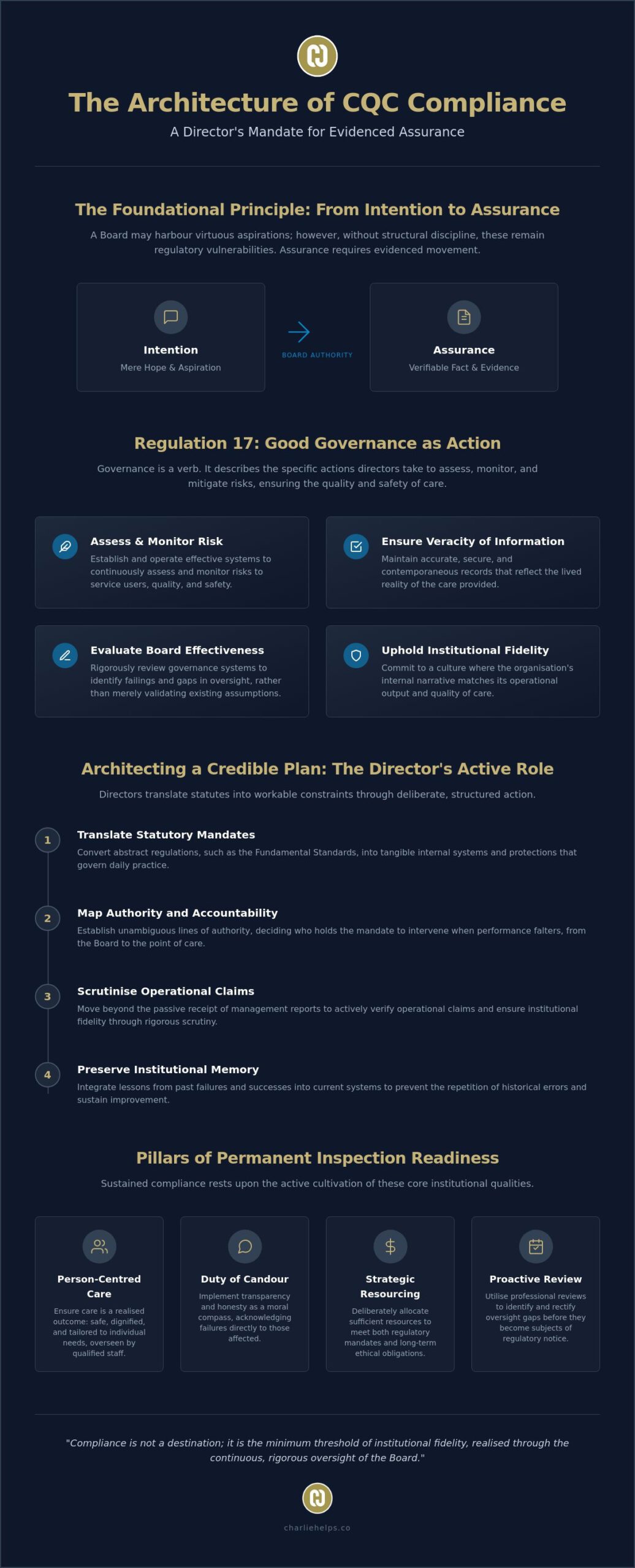
Intentions are not assurance. A Board may harbour the most virtuous aspirations for patient safety; however, without the structural discipline to translate these desires into evidenced movement, they remain regulatory vulnerabilities. Achieving CQC compliance is not a static event recorded in a periodic report, but rather the active exercise of Board authority to realise fundamental standards through continuous, rigorous oversight.
You likely recognise the specific anxiety that Regulation 17 provokes, where the gap between what is intended and what is evidenced often feels precariously wide. This guide provides a rigorous examination of how directors exercise their mandate to bridge that divide, ensuring that institutional memory remains sharp and that assurance is rooted in verifiable fact rather than mere hope. We shall analyse the transition to sector-specific frameworks, the role of workflow optimisation in governance, and the specific decisions required to maintain a state of permanent inspection readiness.
Key Takeaways
- Boards must translate statutory requirements into workable internal constraints to ensure care remains person-centred, safe, and dignified.
- Directors fulfil Regulation 17 by actively assessing and monitoring risks, ensuring CQC compliance through evidenced movement rather than mere intention.
- Professional assurance requires rigorous scrutiny of operational claims, moving beyond the passive receipt of management reports to verify institutional fidelity.
- Sustained compliance relies on a long-term strategic mandate and the deliberate allocation of resources to meet both regulatory and ethical obligations.
- Leaders must maintain accurate institutional memory to bridge the gap between policy and practice during regulatory assessments.
The Architecture of CQC Compliance: Moving Beyond Regulatory Adherence
Compliance is not a destination; it is the minimum threshold of institutional fidelity. Whilst many organisations view regulatory adherence as a burden to be managed, effective Boards treat it as the foundation upon which they build a culture of safety and dignity. The Health and Social Care Act 2008 provides the legal mandate, yet statutes remain inert until directors translate them into workable internal constraints. This translation requires a shift from passive observation to active intervention. Boards must distinguish between the mere intention to follow rules and the evidenced movement toward a credible plan. Ultimately, CQC compliance remains a human endeavour. It relies upon leaders who foster a culture of veracity, ensuring that every claim of quality is supported by observable fact.
The Care Quality Commission (CQC) oversees these standards, but the Board alone holds the authority to architect a framework that prevents standards from falling. This involves a commitment to transparency that transcends the simple completion of checklists. When directors treat compliance as an active exercise of authority, they move the organisation from a state of reactive anxiety to one of composed, strategic oversight.
The Fundamental Standards as Strategic Mandates
Directors must ensure that person-centred care functions as a realised outcome rather than a corporate slogan. This requires the Board to exercise rigorous oversight of staff qualifications, skills, and experience to ensure that care is safe and tailored to individual needs. When standards fail, the Duty of Candour serves as a moral compass. It requires directors to implement transparency and honesty, acknowledging failures directly to those affected. By treating these standards as strategic mandates, the Board transforms abstract regulations into tangible protections for service users.
The Role of Authority in Regulatory Alignment
Authority must be clearly mapped across the organisation to prevent standards from slipping into neglect. The Board decides who holds the mandate to intervene when performance falters, establishing unambiguous lines of accountability from the boardroom to the point of care. Institutional memory plays a vital role in this structure. It prevents the repetition of historical failures by ensuring that lessons learned are integrated into current systems. When every actor understands their specific role in the hierarchy, the organisation achieves a state of sustained alignment with regulatory expectations and maintains CQC compliance through disciplined, collective action.
Regulation 17 and the Mandate for Good Governance
Governance is a verb. It describes the specific actions directors take to assess, monitor, and mitigate risks to service users. Under CQC’s Regulation 17, the Board must establish and operate systems that ensure the quality and safety of care. This is not a passive requirement. It demands that leaders maintain accurate, secure, and contemporaneous records that reflect the lived reality of the care provided. Fidelity to this regulation requires a commitment to veracity, ensuring that the organisation’s internal narrative matches its operational output.
Sustaining CQC compliance depends on the Board’s ability to evaluate its own effectiveness. Systems do not improve themselves; people improve them through rigorous review and adjustment. Directors must ask whether their oversight actually identifies failings or merely validates existing assumptions. This self-reflective discipline ensures that governance remains an active force for safety rather than a bureaucratic exercise.
Systems for Monitoring and Improvement
Directors must implement systems that offer a clear, unvarnished view of performance. These systems are the primary mechanism through which directors maintain CQC compliance across complex service structures. Assurance attaches to evidence. Therefore, the Board should demand data that is both accurate and verifiable. Continuous improvement relies on a willingness to identify what is unknown; leaders who address assumptions with facts realise a more stable regulatory position.
The Board Effectiveness Review as a Compliance Tool
A professional board effectiveness review identifies gaps in oversight before regulators arrive. Evaluating board dynamics ensures that challenge and scrutiny remain present in every decision. By aligning board strategy with fundamental standards, directors realise institutional excellence. To ensure your leadership framework remains fit for purpose, you may wish to speak with an advisor regarding your current governance architecture.
Practical Assurance: Evidencing Institutional Fidelity
Assurance is not a sentiment. It is the result of rigorous scrutiny, not the passive receipt of management reports that merely confirm what directors wish to hear. Boards must ask a fundamental question: what evidence supports our reliance on these operational claims? Institutional fidelity is realised when an organisation’s actions match its stated values and its regulatory obligations. To achieve this, leaders must move beyond the comfort of high-level summaries and demand the veracity of raw data.
The broader context of NHS England’s work with the CQC highlights the necessity for this evidence-led approach. CQC compliance is not a static shield but an active state of readiness maintained through disciplined oversight. When directors treat assurance as a continuous inquiry into the reality of care, they create the structural integrity needed to withstand regulatory pressure. This process requires a focus on movement, ensuring that the organisation is always progressing toward its stated aims through a credible, verifiable plan.
Intention Versus Evidenced Movement
Intention is a promise; evidenced movement is a documented path toward a specific regulatory goal. Directors must scrutinise the veracity of internal audits, ensuring they reflect genuine practice rather than consultancy theatre. High-stakes oversight requires a focus on outcomes rather than the mere existence of policies. If a policy exists but is not implemented, it is a liability. Only through evidenced movement can a Board demonstrate that it has fulfilled its mandate to protect service users and maintain CQC compliance.
Workflow Optimisation as a Governance Enabler
Optimise business processes to reduce operational friction. This allows staff to focus on the quality of care rather than administrative survival. A workflow optimisation software solution provides the digital process management needed for robust audit trails. Realise efficiency by automating routine compliance tasks, ensuring that nothing falls through the cracks. By embedding these requirements into the daily workflow, the Board makes compliance a natural outcome of institutional activity rather than a panicked response to an inspection.
Architecting a Credible Plan for Sustained Compliance
Sustained CQC compliance is the product of a long-term strategic mandate. It is not a reactive posture assumed only when an inspection looms; rather, it requires a Board that is willing to look beyond the immediate horizon and invest in the structures that support long-term safety. Directors must decide how to allocate resources to fulfil their regulatory and ethical obligations, ensuring that clinical and operational teams possess the tools required to meet fundamental standards. Institutional excellence is the reward for those who treat governance as a continuous discipline of leadership, moving from a state of anxiety to one of composed authority.
Internal perspectives often suffer from a natural bias toward the status quo, which can obscure emerging risks. Professional corporate governance consultants UK provide the external scrutiny needed to challenge these internal blind spots and refine organisational strategy. This objective view ensures that the Board remains honest about its failings and ambitious about its improvements, creating a culture where veracity is valued over administrative comfort. By engaging with external expertise, leaders realise a more sophisticated understanding of how their decisions influence the point of care.
The Strategic Role of Advisory and Coaching
Advisory services assist leaders in navigating complex regulatory environments with calm expertise and practical judgement. Executive coaching further develops the leadership capability required to manage organisational performance under significant pressure, fostering the resilience needed for high-stakes oversight. Succession planning acts as a vital safeguard, ensuring that institutional memory and compliance standards endure through leadership transitions. When leaders are coached to think strategically about their mandate, they become more effective at implementing the systems that protect both patients and the organisation’s reputation.
Final Test of Utility: The Five Questions for Boards
To conclude, every Board should subject its current strategy to a final test of utility. This involves identifying five critical elements of oversight to ensure that CQC compliance is grounded in evidence rather than hope. Directors should regularly ask:
- What is our Aim, and who has the authority to implement the required changes?
- What decision is required today to ensure compliance is realised tomorrow?
- What evidence supports our reliance on current operational reports?
- What risks remain unaddressed within our current governance architecture?
- How do we ensure that our actions today do not compromise the safety of tomorrow?
If these questions remain unanswered, the organisation’s regulatory position remains precarious. You are invited to discuss your governance architecture with an advisor to ensure your framework is both robust and humane.
Securing the Future of Institutional Integrity
Leadership is the catalyst that transforms regulatory requirements into lived realities. To achieve sustained CQC compliance, directors must move beyond the passive reception of reports and embrace the active exercise of their mandate. This involves a commitment to veracity, ensuring that every claim of quality is rooted in verifiable data and that institutional memory remains a sharp tool for continuous improvement.
We have examined how a rigorous governance architecture provides the foundation for safety and dignity. You have seen that Regulation 17 demands more than mere intention; it requires a Board to architect systems that assess and mitigate risk with clinical precision. By integrating proprietary workflow optimisation solutions for UK enterprises, leaders realise a state of permanent readiness where excellence becomes the standard. As expert corporate governance consultants, we focus on institutional fidelity to ensure your boardroom excellence is matched by regulatory compliance. The path to institutional fidelity is complex, yet it remains entirely achievable through disciplined leadership and expert advisory.
A stable regulatory future begins with the decision to lead with clarity, authority, and purpose.
Frequently Asked Questions
How does Regulation 17 define the Board’s responsibility for CQC compliance?
Regulation 17 mandates that the Board establishes and operates systems to assess, monitor, and improve the quality and safety of services. It is not a passive obligation, but an active requirement for directors to ensure records are accurate, secure, and contemporaneous. Achieving CQC compliance under this regulation requires leaders to evaluate their own effectiveness through regular, rigorous reviews of their oversight mechanisms and risk mitigation strategies.
What is the difference between assurance and reassurance in a CQC context?
Assurance is the product of evidence-led scrutiny, whereas reassurance is a psychological state often based on unverified management claims. Directors seek assurance by demanding raw data and verifiable facts that support operational assertions. Reassurance, whilst comforting, lacks the structural discipline required for regulatory fidelity. It often masks underlying systemic vulnerabilities that a rigorous inspection will eventually expose, as it relies on hope rather than movement.
Can a Board delegate its accountability for fundamental standards to a manager?
A Board cannot delegate its ultimate accountability for fundamental standards, even if it delegates specific operational duties to a manager. Directors hold the mandate to ensure that care remains safe, effective, and dignified; they remain responsible for the outcomes of the systems they oversee. Whilst managers implement day-to-day functions, the Board retains the authority and the legal liability for any failure to fulfil statutory regulatory requirements.
How does institutional memory impact the outcome of a CQC inspection?
Institutional memory ensures that a Board does not repeat historical failures and can demonstrate a consistent trajectory of improvement during an inspection. It provides the narrative continuity required to show that CQC compliance is a sustained discipline rather than a reactive response to a visit. Without strong institutional memory, an organisation appears fragmented, often failing to explain how past lessons have informed current safety protocols and strategic decisions.
What are the risks of relying on “consultancy theatre” for regulatory alignment?
Consultancy theatre creates a veneer of compliance through slogan-heavy policies that lack operational reality, leaving the organisation vulnerable to regulatory prosecution. Relying on superficial templates or motivational language instead of practical judgement obscures the actual state of care. This approach prioritises the appearance of alignment over the veracity of practice, which regulators quickly identify when operational evidence fails to match the corporate narrative.
How should a Board respond when evidence suggests a failure in person-centred care?
The Board must respond with immediate transparency and a decision to re-examine the structural constraints that allowed the failure to occur. This involves exercising the Duty of Candour to acknowledge the lapse honestly whilst commissioning a review of the systems involved. Directors must then implement a credible plan for remediation, ensuring that future assurance is based on evidenced movement toward person-centred outcomes rather than mere promises or intentions.
Disclaimer
The articles published on CharlieHelps.co are provided for general information, reflection, and commentary. They draw on professional experience, research, and interpretation, but they do not constitute legal, regulatory, financial, clinical, governance, risk, compliance, assurance, or other professional advice. Nothing published on this site should be relied upon as practice guidance, formal instruction, or a substitute for proper professional consultation. Readers should seek advice from suitably qualified advisers before acting on, applying, or relying upon any material in relation to their own organisation, Board, duties, circumstances, or decisions. Although reasonable care is taken to ensure that articles are accurate and current at the time of publication, no warranty is given as to completeness, accuracy, timeliness, or fitness for any particular purpose. Law, regulation, policy, standards, and recognised practice may change, and context matters. References to external sources, organisations, products, services, or third-party materials are included for information only. They do not imply endorsement unless expressly stated. Where an article contains affiliate links, sponsored references, or commercial relationships, these will be disclosed where relevant. The views expressed are those of the author unless otherwise stated. Reading, sharing, or responding to material on this site does not create a client, adviser, fiduciary, or professional relationship with Charlie Helps FRSA, CharlieHelps.co, or any associated entity. Readers remain responsible for their own judgement, decisions, and actions.
