

NHS Risk Management: Beyond Compliance to Institutional Assurance
Effective NHS risk management is the systematic exercise of Board authority to protect patient safety and institutional integrity. It is not a passive accounting exercise, but an active, continuous process of judgement and foresight. The aim is to build institutional resilience, enabling a Trust to anticipate and absorb shocks rather than merely react to failures. This requires a clear distinction between three core areas of exposure: clinical risk, which concerns patient outcomes and safety; financial stewardship, which addresses the viability of the organisation; and operational friction, which encompasses the systemic inefficiencies that degrade performance and morale.
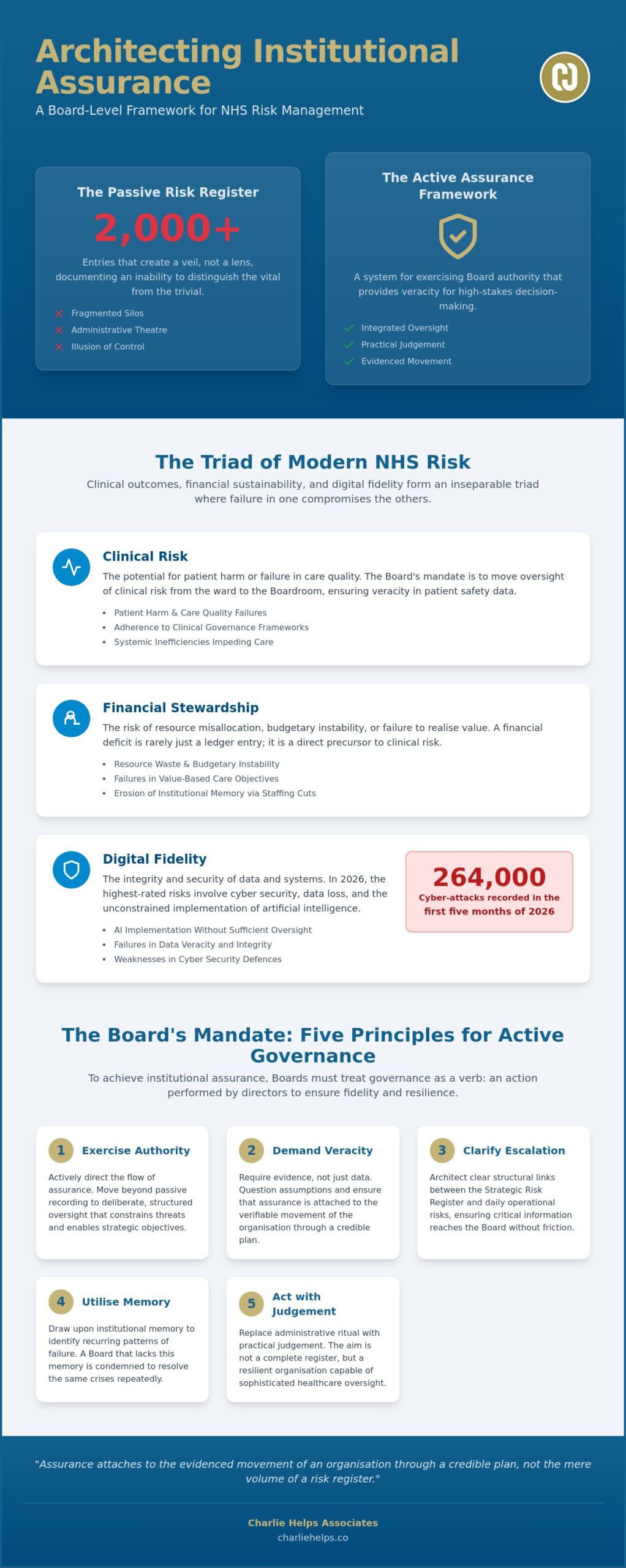
Too often, risk registers become bloated repositories of static information. They fail to provide the veracity required for high-stakes Board-level decision-making. The true purpose of modern governance is to achieve resilience through foresight. This means moving beyond a compliance-oriented mindset, where risk management is treated as a bureaucratic necessity, towards a culture of institutional assurance, where the Board has credible evidence that its strategic objectives are being pursued safely and effectively.
Transitioning from Passive Registers to Active Oversight
A Board must treat governance as a verb. The focus should be on how directors act, individually and collectively, to constrain or enable risk. A risk register is a tool, not a solution. Its value is determined by the quality of the thinking and the credibility of the actions it documents. This requires a shift away from what can be termed “consultancy theatre”, the reliance on colourful heat maps and voluminous reports that obscure more than they reveal. Meaningful assurance comes from granular data, clear accountability, and evidence of movement against an agreed plan.
Furthermore, institutional memory plays a critical part in identifying recurring systemic failures. Boards that fail to learn from past incidents are destined to repeat them. An active oversight framework interrogates patterns of failure, seeking to understand the underlying cultural and systemic weaknesses that allow risks to crystallise. It is this deeper analysis that transforms risk management from a reactive process into a strategic one.
The Mandate for Integrated Governance
The Health and Care Act 2022 reshaped the mandate for Integrated Care Systems (ICS), demanding a more cohesive approach to health and care across entire populations. This legislation reinforces the need for integrated governance, where risk management is not siloed within individual Trusts but is understood in the context of the wider system. A Trust’s risk appetite must align with the strategic objectives of the NHS Long Term Plan, ensuring that local priorities support national goals.
Crucially, assurance attaches to the process of movement, not to the stated intention of a policy. A Board cannot gain assurance from a well-written strategy document alone. It requires evidence that the organisation is making tangible progress towards its objectives. This means tracking milestones, verifying data, and holding executives accountable for realising the plans they present. Without this evidenced movement, any claims of assurance lack the necessary foundation for reliance.
The Triad of Modern NHS Risk: Clinical, Financial, and Digital
The contemporary risk landscape for any NHS Trust is defined by the interplay of three critical variables: clinical outcomes, financial sustainability, and digital fidelity. These are not separate domains to be managed in isolation; they are deeply interconnected forces that shape the organisation’s ability to function. The highest-rated strategic risks projected for 2026 reflect this convergence, with cyber security, significant data loss, and the unmanaged implementation of artificial intelligence (AI) demanding Board-level attention.
The interaction between these variables is often direct and causal. A significant financial deficit, for example, frequently manifests as a clinical safety risk. When funding pressures lead to staffing shortages or delayed equipment maintenance, the quality and safety of patient care are compromised. A successful framework, therefore, must be architected to balance the pursuit of innovation, such as the adoption of AI, with the necessary regulatory restraint and a clear-eyed assessment of potential consequences.
Clinical Safety as a Governance Variable
Historically, clinical risk was often viewed as a matter for the ward, separate from the strategic concerns of the Board. This is no longer a tenable position. For a Board to fulfil its duties, it must exercise senior oversight of frontline safety, ensuring that clinical risk is understood and managed at the highest level of the organisation. The standards set by the Care Quality Commission (CQC) provide a baseline for institutional fidelity, but true assurance requires a more proactive and interrogative stance.
This involves using high-quality clinical data to inform financial prioritisation without compromising patient care. It means asking difficult questions about the trade-offs being made and ensuring that decisions are guided by a clear ethical framework. For a deeper exploration of these duties, Boards can reference established principles of clinical governance and professional standards.
Digital Risk and the AI Governance Mandate
The integration of technology risks into the Strategic Risk Register (SRR) is no longer optional. As NHS Trusts become more reliant on digital systems, the potential for catastrophic failure through cyber-attack or data breach grows. The governance of artificial intelligence presents specific and novel challenges, demanding that Boards ensure algorithmic veracity, protect patient data privacy, and maintain human oversight of automated decision-making.
However, technology also offers solutions. Automated workflow solutions can reduce operational friction and the likelihood of human error in administrative and clinical processes. By automating compliance checks and streamlining information flows, these systems can free up senior staff to focus on more complex, judgement-led tasks, thereby strengthening the overall control environment.
Implementing a Functional Risk Management Framework
To realise a functional Board Assurance Framework (BAF), a Board must establish clear processes for identifying, assessing, and managing strategic risks. The BAF is not merely a list of worries; it is the primary tool through which the Board gains assurance that its strategic objectives will be met. It sits at the apex of the risk management structure, drawing information from, and providing direction to, the organisation’s operational functions.
This structure depends on a clear relationship between the Strategic Risk Register (SRR) and the Operational Risk Register (ORR). The SRR should be a concise, focused document that details the principal threats to the organisation’s strategic aims. The ORR, in contrast, will be a more extensive list of the day-to-day risks managed at a departmental level. The framework must specify who has the authority to make decisions for each high-level risk and what specific decision is required from the Board.
Strategic vs Operational Risk Registers
A critical function of the framework is to define the threshold for escalation. The Board cannot and should not be involved in managing every operational issue. A clear set of criteria must determine when an operational problem becomes a strategic threat that requires Board-level attention. This filtering process is typically managed by an Executive Risk Group (ERG) or a similar committee, which is responsible for synthesising data and presenting a clear, coherent picture to the Board.
The ultimate test of the SRR is whether it reflects the coherent set of strategies needed to achieve the organisation’s long-term plans, including its commitments under the NHS Long Term Plan. It should be a dynamic document, reviewed and challenged regularly, that serves as a guide for strategic decision-making. Architecting such a framework requires a deep understanding of strategic architecture for institutional assurance.
Evidencing Movement through Credible Plans
The principle that assurance attaches to evidenced movement is the bedrock of a functional framework. The Board should only place reliance on assurance that is backed by a credible plan in motion. A verbal update or a statement of intent is insufficient. Evidence is required.
A credible plan has three essential components: clear, measurable milestones that define what progress looks like; assigned authority, specifying which individual is accountable for achieving each milestone; and identified resourcing, confirming that the necessary people, funding, and tools are in place. When the evidence presented to the Board is incomplete, this must be stated explicitly. The Board must be made aware of what assumptions are being made and what residual risks remain, enabling it to make a fully informed judgement.
The Board’s Authority in Risk Mitigation and Workflow Optimisation
Ultimately, risk management is a human endeavour. The effectiveness of any framework depends on the behaviour of the people who operate within it. The leadership culture, set by the Board and the executive team, is the single most important factor in determining whether an organisation manages risk well. A culture of fear and blame will drive risks underground, whilst a culture of openness and learning will encourage early reporting and proactive problem-solving.
Developing high-performance leadership capability within NHS Trusts is therefore a critical component of risk mitigation. Coaching and mentoring can equip leaders with the skills to navigate complexity, foster psychological safety, and build resilient teams. This focus on the human element should be complemented by a strategic approach to process improvement. Positioning workflow optimisation as a tool for reducing systemic risk can significantly increase operational efficiency and release clinical time for patient care.
Leveraging Technology for Process Fidelity
Modern governance architecture can be significantly strengthened by the intelligent use of technology. For instance, a considered guide to workflow optimisation software demonstrates how these systems can automate compliance monitoring, standardise processes, and provide real-time data on performance. This reduces the administrative burden on senior staff and provides a higher degree of assurance that controls are operating effectively.
The ideal is a seamless intersection of human judgement and digital process management. Technology should handle the routine and the predictable, freeing up experienced professionals to focus on the ambiguous and the complex. By streamlining its governance architecture, an organisation can improve its overall performance and its ability to manage risk.
Advisory Support for NHS Trust Leadership
There are times when an external perspective is necessary to challenge assumptions and identify blind spots. Seeking specialist public sector governance advisory support to review Board effectiveness can be a valuable exercise in organisational learning. An independent review can help a Board to assess the quality of its risk management framework, the dynamics of its decision-making, and its overall fitness for purpose.
This leads to the final question that every NHS Board must ask itself: do we have the evidence required to support our reliance on this framework? If the answer is anything less than a confident “yes,” then further work is required. The safety of patients and the long-term health of the institution depend upon it.
For further support in architecting your framework and enhancing Board effectiveness, contact Charlie Helps Associates.
Disclaimer
The articles published on CharlieHelps.co are provided for general information, reflection, and commentary. They draw on professional experience, research, and interpretation, but they do not constitute legal, regulatory, financial, clinical, governance, risk, compliance, assurance, or other professional advice. Nothing published on this site should be relied upon as practice guidance, formal instruction, or a substitute for proper professional consultation. Readers should seek advice from suitably qualified advisers before acting on, applying, or relying upon any material in relation to their own organisation, Board, duties, circumstances, or decisions. Although reasonable care is taken to ensure that articles are accurate and current at the time of publication, no warranty is given as to completeness, accuracy, timeliness, or fitness for any particular purpose. Law, regulation, policy, standards, and recognised practice may change, and context matters. References to external sources, organisations, products, services, or third-party materials are included for information only. They do not imply endorsement unless expressly stated. Where an article contains affiliate links, sponsored references, or commercial relationships, these will be disclosed where relevant. The views expressed are those of the author unless otherwise stated. Reading, sharing, or responding to material on this site does not create a client, adviser, fiduciary, or professional relationship with Charlie Helps FRSA, CharlieHelps.co, or any associated entity. Readers remain responsible for their own judgement, decisions, and actions.
