

The integrity of an NHS Foundation Trust does not reside in its policy documents; it lives in the specific, daily actions of those who hold its mandate. Many Boards and Governors currently struggle to navigate the labyrinthine regulatory shifts within Integrated Care Systems, where the distinction between strategic oversight and operational management often dissolves into ambiguity. You likely recognise the friction that arises when Governor and Director mandates overlap, creating a vacuum where implementation falters and accountability becomes opaque. NHS Foundation Trust Governance requires more than a passive adherence to regulation; it demands a deliberate exercise of authority to protect the institutional mission.
This guide offers a rigorous examination of the governance architecture, moving beyond the performance of compliance to help leaders achieve strategic excellence. We provide a clear path through the 2023/2026 Code requirements, defining the boundaries of authority for Boards and Governors while establishing a framework for evidenced assurance. By aligning institutional memory with a credible plan, your leadership can move from mere intention to the concrete realisation of patient-centred outcomes. This approach ensures that assurance attaches to movement rather than static reports, allowing the Board to fulfil its obligations with clarity and poise.
Key Takeaways
- Recognise the transition from passive compliance to active strategic fidelity by aligning Board actions with the statutory duty to collaborate within Integrated Care Systems.
- Define the distinct boundaries of authority between the Board of Directors and the Council of Governors to ensure rigorous NHS Foundation Trust Governance and transparent accountability.
- Adopt a methodology where assurance attaches to evidenced movement through credible plans, thereby moving beyond the superficiality of slogan-heavy strategic claims.
- Secure institutional memory and architect long-term excellence by utilising independent board effectiveness reviews, and precise succession planning.
The Evolution of NHS Foundation Trust Governance: From Compliance to Strategic Fidelity
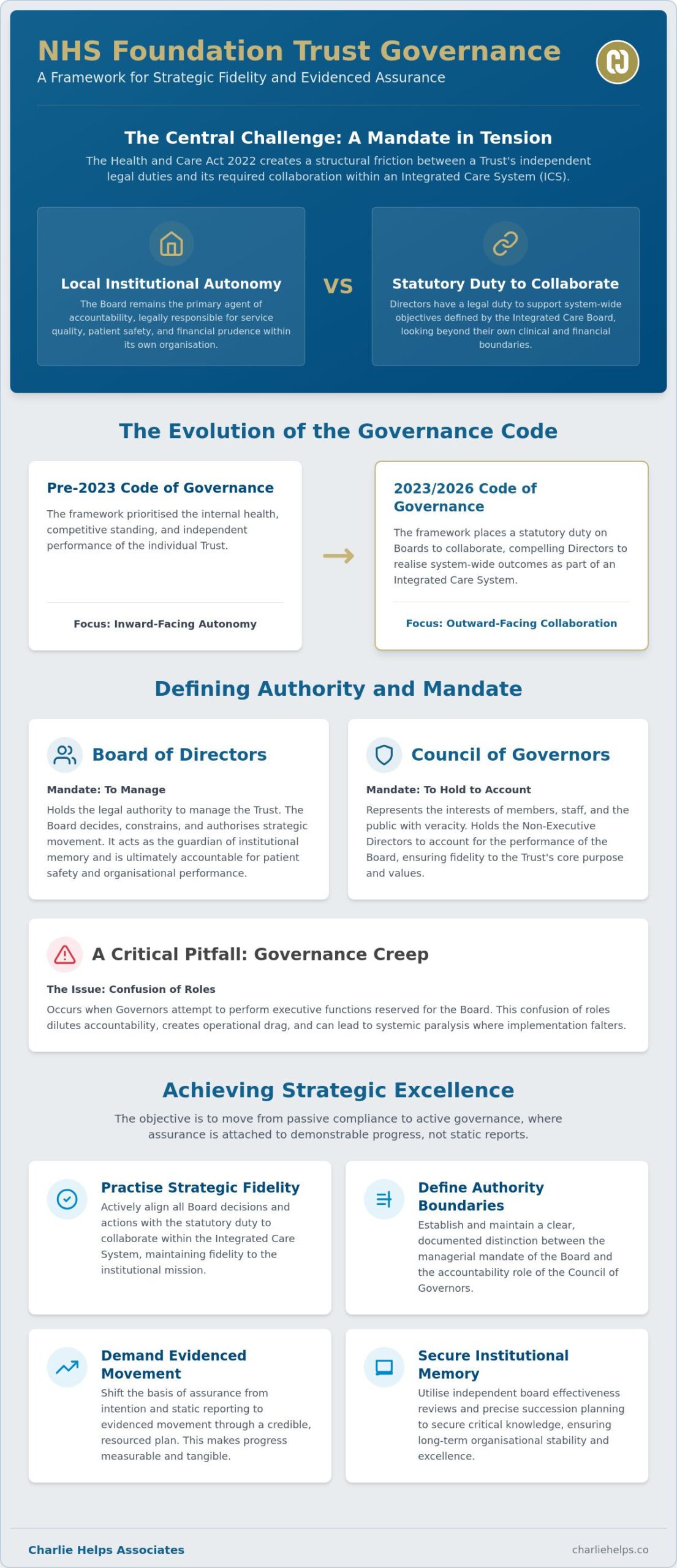
The central challenge for modern Boards is the friction between local institutional autonomy and the statutory duty to collaborate. Governance is an active pursuit; it represents the collective resolve of a Board to maintain fidelity to the NHS Constitution whilst navigating the shifting currents of national policy. For those seeking an NHS Foundation Trust Overview, the historical trajectory reveals a movement from rigid centralisation to a model of earned autonomy that now faces its greatest test. Effective NHS Foundation Trust Governance no longer rests on the laurels of past performance. It requires Directors to act with precision in an environment where the boundaries of the organisation are increasingly porous.
The 2014 Code of Governance prioritised the internal health and competitive standing of the individual Trust. By contrast, the 2026 landscape, solidified by the March 18, 2026 updates to the Code, places a statutory duty on Boards to collaborate. This shift creates a profound tension between local institutional autonomy and the collective requirements of the Integrated Care System. The Board remains the primary agent of accountability, ensuring that NHS Foundation Trust Governance remains grounded in clinical veracity and financial prudence whilst serving a system that extends far beyond its own clinical estate.
The Shift Towards Integrated Care Systems
The Health and Care Act 2022 fundamentally redefined the mandate for Trust Boards by establishing Integrated Care Systems as the primary unit of planning. This legislation compels Directors to look outward, ensuring that Trust-specific objectives do not conflict with the broader goals of the Integrated Care Board (ICB). Directors must now realise system-wide outcomes, requiring a sophisticated understanding of how local actions ripple across the wider healthcare economy. The ICB shapes local priorities, yet the Trust Board retains the legal responsibility for the quality and safety of the services it provides.
Governance as an Action: The Role of the Board
Governance is not an abstract container for rules; it is the sum of decisions made by the Board of Directors. These individuals hold the legal authority to manage the Trust. They decide, they constrain, and they authorise strategic movement. During periods of structural upheaval, the Board acts as the guardian of institutional memory. By preserving the lessons of the past, Directors ensure that patient safety remains the central priority whilst the organisation adapts to new collaborative frameworks. The Board must now decide how it will maintain its unique identity whilst fulfilling a system-wide mandate.
Defining Authority and Mandate: The Board and Council of Governors
Authority within a Trust is not a singular block; it is a distributed set of mandates. Directors possess the legal authority to manage the business, whilst the Council of Governors holds the Non-Executive Directors to account for the performance of the Board. This distinction is critical for rigorous NHS Foundation Trust Governance. The Chair acts as the essential bridge, ensuring that the Board remains receptive to the Council without compromising its executive autonomy. When this relationship falters, the resulting friction often leads to a paralysis of implementation.
Friction typically occurs when Governors attempt to perform executive functions, a phenomenon known as governance creep. This confusion of roles dilutes accountability and creates operational drag. Governors must instead focus on their duty to represent the interests of staff and the public with veracity, ensuring the Board remains faithful to the organisation’s core purpose. Effective leadership requires a clear-eyed understanding of these boundaries to prevent systemic paralysis. To clarify these roles and strengthen institutional oversight, Boards often benefit from specialist mentoring and advisory services.
Holding to Account: The Non-Executive Mandate
Non-Executive Directors (NEDs) provide the internal assurance required to validate executive claims. Their authority rests on their independence and their ability to use evidence to challenge assumptions without becoming obstructive. According to the Official Code of Governance, at least half the Board, excluding the Chair, should be independent NEDs. These individuals must exercise professional judgement to ensure the Trust implements its strategy effectively and maintains financial stability.
The Council of Governors: Fidelity to the Community
The Council of Governors serves as the guardian of institutional fidelity. Their statutory duties include the appointment of the Chair and external auditors, yet their broader mandate involves realising the Trust’s commitment to its local community. They do not manage clinical operations or intervene in day-to-day management. Instead, they ensure the Board acts in accordance with the values of the population it serves. By engaging with the local population, Governors provide the Board with the necessary perspective to achieve long-term strategic excellence. This relationship ensures that NHS Foundation Trust Governance remains anchored in the needs of the community.
Implementing the Code: From Strategic Intent to Evidenced Movement
Strategic intent without evidenced movement is a hallmark of institutional decay. In the context of NHS Foundation Trust Governance, Boards must resist the allure of consultancy theatre; those polished presentations that substitute slogans for substance. True assurance does not emerge from a statement of intent. It attaches to the verifiable progress of a credible plan. Directors must demonstrate fidelity to the Trust’s mandate through the exercise of practical judgement, rather than relying on ungrounded futurism or vague strategic promises. This requires a shift from the comfort of abstract goals to the rigour of concrete implementation.
The vocabulary of the boardroom must remain precise. Terms such as mandate, fidelity, and veracity are not mere ornaments; they are the tools of intellectual force and moral depth. When a Board discusses its strategic goals, it must do so with a clear-eyed view of historical context and current constraints. The objective is to make the strategy workable, ensuring that every claim of progress is rooted in reality rather than aspiration. To refine your reporting structures and move beyond slogan-heavy claims, our governance advisory services provide the necessary architectural rigour.
The Architecture of Assurance
Assurance is the product of evidenced movement against a defined plan. Reliance cannot be placed on intention alone; it requires a triangulated foundation of data, direct observation, and independent external validation. Board reports must be stripped of weasel words and marketing adjectives that obscure performance. Instead, reports should present the Board with a lucid account of what the organisation has fulfilled, what it has realised, and what remains outstanding. This clarity allows for an honest assessment of whether the organisation is moving at the required pace.
A Four-Step Process for Board Decision-Making
To ensure decisions remain grounded in evidence, Boards should adopt a rigorous four-step methodology. First, identify the Aim and establish who has the specific authority to act. This prevents the ambiguity of shared responsibility. Second, determine what decision is required based on the available evidence, ensuring the choice aligns with the Trust’s long-term vision. Third, assess what evidence supports reliance and, crucially, what gaps in knowledge remain. The Board must explicitly state what is unknown. Finally, the Board must identify what risks remain after the decision is implemented. This process transforms governance into an active, disciplined pursuit of excellence.
Architecting Long-Term Excellence: Board Effectiveness and Succession
Excellence in NHS Foundation Trust Governance requires a commitment to perpetual refinement. It is not enough to merely exist within the regulatory framework; the Board must actively architect its own capability to meet future systemic demands. This involves a rigorous assessment of how Directors interact, how they challenge, and how they secure the organisation’s future. True leadership acknowledges that the strength of the Board is the foundation upon which all clinical and operational success is built. By treating leadership as a discipline, Directors ensure that the Trust remains resilient in the face of increasing complexity.
The Board Effectiveness Review as a Strategic Lever
A truly effective board effectiveness review moves beyond administrative checklists to examine the underlying currents of human behaviour. It scrutinises the quality of debate, the veracity of challenge, and the psychological safety required for dissent. Engaging corporate governance consultants UK provides the necessary distance to observe these dynamics objectively, offering insights that an internal audit might overlook. The Board must then act upon these findings with resolve, realising performance gains that are evidenced through improved strategic alignment rather than just improved documentation.
Succession Planning and Institutional Memory
Succession planning is the primary mechanism for securing institutional memory during periods of executive transition. When a seasoned leader departs, the risk of knowledge loss is significant; it can destabilise clinical safety and strategic momentum. Boards must architect a succession plan that prioritises both professional capability and cultural fidelity to the Trust’s mission. This ensures that the organisation’s core values remain intact whilst new leadership implements necessary changes. For Boards seeking to strengthen their leadership pipeline and protect their legacy, our mentoring and advisory services offer a structured path to excellence.
Diversity in thought and background acts as a critical safeguard against board-level groupthink. By including voices that reflect the breadth of the community and the workforce, the Board enhances its ability to anticipate risks and realise inclusive outcomes. Ultimately, NHS Foundation Trust Governance is a continuous act of leadership, not a periodic compliance exercise. It is a daily commitment to integrity, purpose, and the meticulous oversight of the people and systems that protect the patient. The question for every Board is not whether they comply, but whether they lead with the foresight required to sustain the Trust for the next generation.
Securing Institutional Fidelity Through Active Oversight
Leadership within the NHS has moved beyond the performance of compliance. It now requires a sophisticated alignment of local autonomy with the collaborative mandates of Integrated Care Systems. To master NHS Foundation Trust Governance, Directors must ensure that every decision is rooted in veracity and supported by a credible plan for implementation. This involves maintaining clear boundaries between the Board and the Council of Governors whilst architecting a culture of continuous improvement through independent reviews. Each action taken today defines the institutional memory of tomorrow.
Securing the future of your organisation requires a steady hand and a disciplined approach to oversight. Our team brings extensive expertise in UK Public Sector Governance, authoritative Board-level mentoring, and governance architecture frameworks to help you realise strategic excellence. By utilising these structures, your Board can secure institutional memory and navigate regulatory complexity with confidence. Consult with our Corporate Governance Advisory team to architect your Board’s future and ensure your leadership remains a catalyst for patient-centred accountability. Excellent leadership remains the surest path to a resilient and purposeful future.
Frequently Asked Questions
What is the primary difference between the 2014 and 2026 NHS Code of Governance?
The 2026 Code, updated on March 18, 2026, replaces the 2014 Code’s focus on institutional competition with a statutory mandate for system collaboration. Whilst the earlier version prioritised individual trust autonomy, the current framework requires Directors to realise outcomes that benefit the entire Integrated Care System. This evolution reflects a profound shift from insular performance to a model of collective accountability and shared purpose across the healthcare landscape.
Can a Council of Governors overrule a decision made by the Board of Directors?
The Council of Governors does not possess the legal authority to overrule the Board of Directors. Directors hold the specific mandate to manage the business and make all executive decisions. The Council’s role is to hold the Non-Executive Directors to account for the Board’s performance, ensuring the organisation acts in accordance with its core values and the long-term interests of its members and the public.
How often must an NHS Foundation Trust commission an external board effectiveness review?
NHS Foundation Trusts must commission an independent external board effectiveness review at least every three years. This requirement ensures that an objective observer evaluates Board dynamics, leadership behaviour, and decision-making processes. These reviews help the Board identify systemic gaps in oversight and implement performance gains that protect institutional memory and clinical safety across the organisation, ensuring the leadership remains fit for purpose.
What is the “duty to collaborate” within the context of NHS governance?
The duty to collaborate is a legal obligation for Trusts to work with partners across the Integrated Care System to improve health outcomes and reduce inequalities. It signifies a move away from the competitive models of previous decades. Boards must now decide how to fulfil their trust-specific duties whilst simultaneously contributing to the stability and success of the wider healthcare system through shared resources and planning.
How should an NHS Board evidence assurance to the Integrated Care Board?
Boards should evidence NHS Foundation Trust Governance by demonstrating evidenced movement against a defined plan rather than stating mere intent. This assurance requires precise data, direct observation, and external validation that confirms the Trust is realising its strategic objectives. Integrated Care Boards require verifiable proof that the Trust is implementing its commitments to the system with veracity, financial prudence, and clinical safety.
What are the statutory duties of a Foundation Trust Governor regarding NED appointments?
Governors hold the statutory power to appoint and, where necessary, remove the Chair and other Non-Executive Directors. This authority is central to their mandate of holding the Board to account for its performance. By selecting the individuals who provide independent oversight, Governors ensure that the Board remains faithful to the needs of the staff, the patients, and the local population whilst maintaining institutional integrity.
Disclaimer
The articles published on CharlieHelps.co are provided for general information, reflection, and commentary. They draw on professional experience, research, and interpretation, but they do not constitute legal, regulatory, financial, clinical, governance, risk, compliance, assurance, or other professional advice. Nothing published on this site should be relied upon as practice guidance, formal instruction, or a substitute for proper professional consultation. Readers should seek advice from suitably qualified advisers before acting on, applying, or relying upon any material in relation to their own organisation, Board, duties, circumstances, or decisions. Although reasonable care is taken to ensure that articles are accurate and current at the time of publication, no warranty is given as to completeness, accuracy, timeliness, or fitness for any particular purpose. Law, regulation, policy, standards, and recognised practice may change, and context matters. References to external sources, organisations, products, services, or third-party materials are included for information only. They do not imply endorsement unless expressly stated. Where an article contains affiliate links, sponsored references, or commercial relationships, these will be disclosed where relevant. The views expressed are those of the author unless otherwise stated. Reading, sharing, or responding to material on this site does not create a client, adviser, fiduciary, or professional relationship with Charlie Helps FRSA, CharlieHelps.co, or any associated entity. Readers remain responsible for their own judgement, decisions, and actions.
