

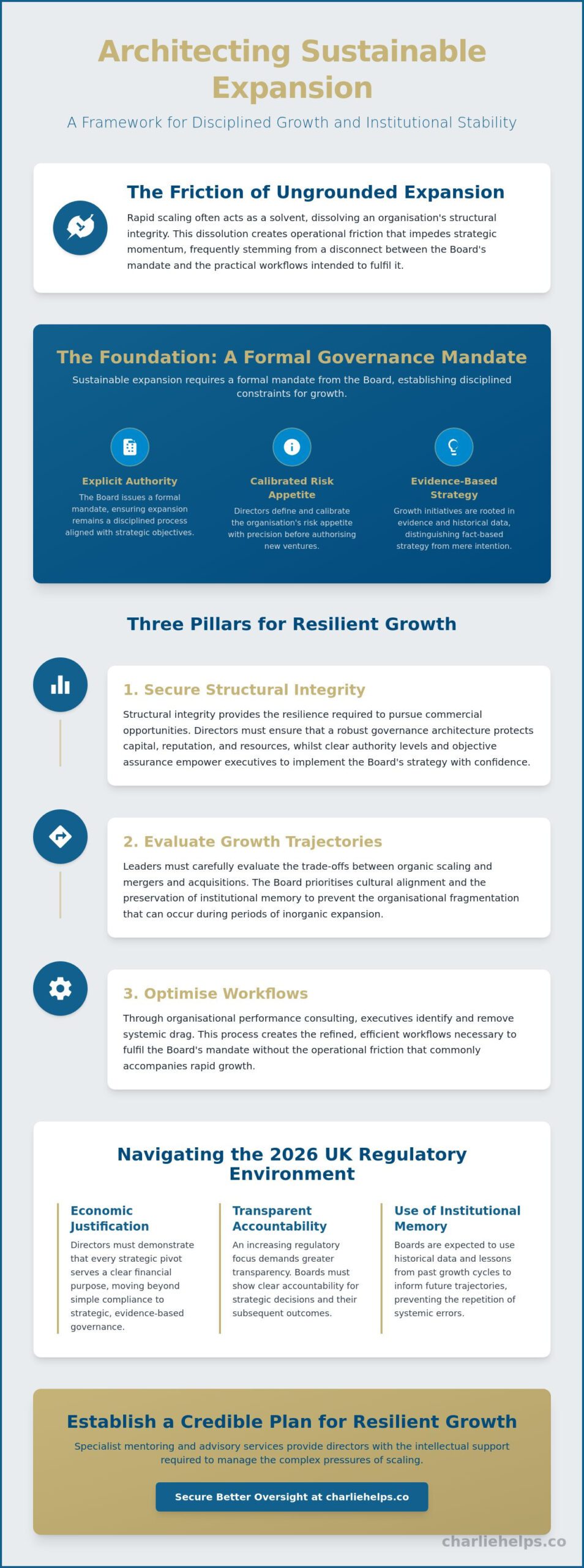
Rapid scaling often acts as a solvent, dissolving the very structural integrity that made an organisation successful in the first place. Most executive teams recognise the specific exhaustion that follows when operational friction begins to impede strategic momentum, especially as the regulatory landscape for 2026 demands greater transparency, economic justification, and accountability. Within the discipline of organisational performance consulting, we observe that these tensions often stem from a disconnect between the Board’s mandate and the practical workflows intended to fulfil it.
The following analysis provides a clear framework for architecting sustainable expansion through rigorous governance, structural integrity, and the removal of systemic drag. Our exploration examines how directors can secure better oversight, implement robust workflows, and realise long-term value without compromising institutional stability. By moving beyond mere statements of intention, Boards can establish a credible plan for growth that remains resilient, ethical, and grounded in evidence.
Key Takeaways
- Boards must establish a formal mandate for expansion, ensuring that growth remains a disciplined process aligned with long-term strategic objectives.
- Directors calibrate risk appetite with greater precision by implementing a robust governance architecture that secures structural integrity across the enterprise.
- Leaders should evaluate the trade-offs between organic scaling and M&A, prioritising cultural alignment and institutional memory to prevent organisational fragmentation.
- Through organisational performance consulting, executives identify and remove operational friction, creating the refined workflows necessary to fulfil the Board’s mandate.
- Specialist mentoring and advisory services provide directors with the intellectual support required to manage the complex pressures of scaling in a shifting regulatory environment.
The Governance Mandate: Redefining Corporate Growth Strategy Consulting
Corporate growth strategy consulting is not merely a commercial exercise. It’s a disciplined advisory process that aligns an organisation’s structural integrity with its commercial ambitions. Sustainable expansion cannot occur in a vacuum; it requires a formal mandate from the Board. Without this explicit authority, expansion efforts often lack the necessary constraints to ensure long-term viability. Boards, investment committees, and senior executives must act as the primary architects of this growth, ensuring that every initiative is rooted in evidence rather than speculative optimism. True value creation is distinct from ungrounded expansion, as it requires a commitment to ethical standards, financial rigour, and long-term institutional health.
The Strategic Environment in 2026
The UK regulatory environment in 2026 prioritises economic justification and transparent accountability. Following recent shifts towards shareholder primacy, directors must now demonstrate that every strategic pivot serves a clear financial purpose. This move from simple compliance to strategic governance has fundamentally changed how directors approach expansion. Boards now rely on institutional memory to evaluate past cycles of growth, ensuring that future trajectories are informed by historical data. This rigour is central to business performance management, where the focus remains on the measurable alignment of activities with strategic intent. Executives who ignore these historical patterns risk repeating systemic errors that lead to operational collapse.
Growth as a Function of Governance
Healthy scaling is an emergent property of effective constraints. Governance provides the boundaries within which executives operate, preventing the operational friction that typically follows ungrounded expansion. To architect these frameworks, many organisations engage professional corporate governance consultants UK who specialise in linking structural oversight to commercial outcomes. This approach distinguishes a fact-based strategy from mere statements of intention, which often fail when they encounter real-world complexity. Within the field of organisational performance consulting, the priority is always the realisation of sustainable value through disciplined action. Directors must ensure that the organisation’s risk appetite is clearly defined before authorising new ventures, as ambiguity at the top often leads to paralysis at the executive level. By establishing these frameworks early, the Board provides a stable platform for the management team to implement the strategy with confidence.
Structural Integrity as a Catalyst for Strategic Expansion
Structural integrity is the silent engine of expansion. For UK enterprises navigating the complexities of 2026, a robust governance architecture ensures that the organisation remains resilient whilst pursuing new commercial opportunities. Within the discipline of organisational performance consulting, we observe that growth often fails not due to a lack of ambition, but because structural weaknesses emerge under the weight of scaling. Directors must assess risk appetite with clinical precision before authorising new ventures, ensuring that the organisation’s capital, reputation, and resources are protected. When the Board decides on a course of action, the executive team must implement it within clearly defined parameters. This relationship relies on assurance, which is the objective verification that growth remains on track and aligned with the original mandate.
Board Oversight and Strategic Mandate
The Board sets the boundaries for executive action, acting as a steady hand that constrains speculative risk. Clear authority levels are vital during periods of rapid organisational change, as they prevent the overlap of responsibilities that typically leads to operational friction. A board effectiveness review serves as a critical tool in this process, identifying internal barriers to growth by examining how decisions are reached, documented, and communicated. By clarifying mandates, the Board empowers executives to act with confidence rather than hesitation. If your current oversight structures feel like a hindrance to your strategic momentum, you may wish to consult with our advisory team to refine your governance model.
Accountability Frameworks for Performance
Accountability is a structural requirement for high-stakes corporate decisions rather than a punitive measure. Clear reporting lines support growth by ensuring that every executive understands their specific mandate and the evidence required to support their progress. Evidence-based reliance remains far superior to blind trust in a professional environment. Directors require constant assurance that the data they receive from committees and management is accurate, timely, and relevant. This rigour ensures that organisational performance consulting translates into tangible, sustainable value that withstands market volatility. Ultimately, the goal is to create a system where performance is an emergent property of a well-architected framework, allowing the organisation to fulfil its potential without compromising its integrity.
Evaluating Growth Trajectories: Organic Ambition versus Inorganic Risk
Choosing between organic scaling and inorganic acquisition is a critical test of a Board’s fiduciary duty. Whilst organic growth relies on the steady refinement of internal systems, mergers and acquisitions (M&A) introduce external complexities that can rapidly destabilise an unprepared organisation. Directors must ensure that any pursuit of inorganic growth is supported by a clear strategic mandate rather than a reactive desire for market share. Within the framework of organisational performance consulting, we examine how these different paths require distinct governance approaches to protect institutional memory and maintain structural integrity. Advisory services provide the objective scrutiny necessary to navigate these choices, ensuring that the Board remains a steady hand during periods of transition.
Risk Assurance in Mergers and Acquisitions
The Board maintains a fundamental duty to scrutinise inorganic growth opportunities with clinical detachment. Acquisitions often fail not because of financial miscalculation, but due to cultural misalignment and the subsequent erosion of accountability. Directors must demand high-quality evidence to support a decision to acquire, moving beyond surface-level financial projections to assess post-merger integration risks. Specialist organisational performance consulting assists Boards in identifying the specific evidence required to authorise these high-stakes transitions. Corporate oversight does not end at the close of a transaction; instead, committees must implement rigorous assurance processes to verify that the new entity adheres to the parent organisation’s governance standards. This oversight ensures that the executive team remains focused on the long-term realisation of value rather than the immediate optics of the deal.
Sustainable Organic Scaling
Realising internal potential through structural refinement is often the most resilient path to expansion. Sustainable organic scaling requires a deep investment in leadership capability and the removal of operational friction that hinders progress. Some directors argue that organic growth is too slow for the requirements of 2026, yet this view ignores the stability that comes from disciplined, incremental expansion. By refining workflows and clarifying reporting lines, executives can achieve significant growth without the volatility associated with external integration. This approach allows the organisation to maintain its core identity whilst fulfilling its mandate. Ultimately, the choice of trajectory must be rooted in a credible plan that prioritises structural health over mere statements of intention.
Workflow Optimisation: Removing Operational Friction to Fulfil Potential
Workflow optimisation serves as the critical bridge between a Board’s strategic mandate and the actual realisation of value. It’s the disciplined alignment of resources and processes that ensures intent translates into action. Operational friction often prevents organisations from fulfilling their mandates, acting as an invisible barrier to sustainable growth. Within the practice of organisational performance consulting, we see that rigorous systems are required to manage the complexity of modern expansion. A disciplined approach to process design removes the systemic drag that occurs when legacy workflows collide with new commercial ambitions. By refining these internal pathways, executives ensure that the organisation remains agile enough to respond to market shifts whilst maintaining strict adherence to governance standards.
Digital Process Management for UK Executives
Senior management in the UK often faces an overwhelming administrative burden that obscures strategic clarity. A Workflow Optimisation SaaS solution streamlines board reporting by automating the collection and synthesis of performance data. This automation ensures that directors receive timely, accurate assurance without the need for manual intervention or the risk of human error. Digital tools enhance transparency, accountability, and strategic alignment, providing a single version of the truth that all stakeholders can rely upon. By implementing these rigorous digital frameworks, executives reclaim the time necessary to focus on high-level decision-making. These systems do not just store data; they actively enforce the constraints set by the Board, ensuring that every project remains within its authorised scope.
Behavioural Alignment and Human Systems
Workflows are not merely technical sequences; they are the invisible architecture that influences human behaviour within a corporate structure. The intersection of human behaviour and structural systems determines whether a strategy succeeds or fails. Software provides the framework, but it cannot replace the nuanced judgment offered by expert advisory and coaching services. Mentoring ensures that leaders understand how to operate within these disciplined systems whilst maintaining their creative agency. Professional guidance helps align individual incentives with the organisation’s long-term vision, ensuring that the human element supports rather than subverts the governance framework. If your current processes are hindering your strategic momentum, you should contact our consultants to discuss a workflow audit. This collaborative approach ensures that technology and human talent work in a symbiotic relationship to achieve sustainable expansion.
Partnering for Performance: The Role of Specialist Advisory and Mentoring
High-level expansion places immense psychological and professional pressure on the executive team. Whilst structural frameworks provide the boundaries, leadership behaviour determines the velocity of progress. Professional mentoring serves as a vital anchor during these periods of rapid change. Within the context of organisational performance consulting, we recognise that a collaborative partnership between advisor and client is essential for maintaining strategic focus. This relationship moves beyond simple instruction, offering instead a reflective space where directors can evaluate their decisions against the organisation’s long-term vision. By aligning individual intent with institutional requirements, leaders ensure that the human element of the business remains as resilient as its governance architecture.
Executive Mentoring for Strategic Alignment
Mentoring at the Board level focuses on the development of strategic foresight and the preservation of institutional memory. Directors must navigate complex growth environments where the stakes are high and the data is often ambiguous. A steady hand is required to ensure that scaling does not lead to institutional drift. By fostering leadership capability, mentors help executives manage the specific anxieties associated with regulatory shifts and operational friction. This process ensures that every member of the leadership team remains aligned with the Board’s original mandate. It allows for the transmission of wisdom across the organisation, ensuring that growth remains grounded in historical success whilst looking towards future opportunities. When leaders operate with clarity, the entire organisation gains a sense of purpose and direction.
Realising the Strategic Vision
Implementing a credible plan for sustainable expansion requires more than mere statements of intention. It demands evidenced movement through an architected framework that prioritises structural health. As we have examined, the removal of operational friction through workflow optimisation and the clarification of authority levels are prerequisites for success. Organisational performance consulting provides the intellectual rigour needed to fulfil these objectives. Ultimately, growth is a choice supported by evidence, requiring directors to decide whether their current structures are fit for the ambitions of 2026. Is your current governance framework a catalyst or a constraint? To examine how your leadership team can achieve disciplined expansion, contact Charlie Helps Associates for a tailored consultation. A credible path forward begins with a single, well-informed decision.
Securing the Future through Disciplined Expansion
Growth is a choice supported by rigour. Sustainable expansion is an emergent property of structural health and leadership alignment; it requires a Board that acts with authority and executives who implement with precision. By anchoring strategy in the UK Corporate Governance Code, organisations ensure that commercial ambitions remain ethical, resilient, and legally sound. Our approach to organisational performance consulting integrates senior-level mentoring with a proprietary Workflow Optimisation SaaS, removing the operational friction that so often hinders scaling.
Boards that prioritise structural integrity today create the institutional memory required for tomorrow’s success. This journey from speculative intention to evidenced movement is a collaborative one, requiring a steady hand and a clear-eyed view of global trends. You possess the agency to transform your current governance framework from a constraint into a catalyst for excellence. Our advisory experience ensures that your leadership team remains focused on the long-term realisation of value whilst navigating the complexities of a shifting regulatory landscape.
Architect your organisation’s sustainable growth with Charlie Helps Associates. With the right architecture in place, expansion becomes a predictable and rewarding fulfilment of your strategic mandate.
Frequently Asked Questions
What is the primary difference between corporate strategy and growth strategy?
Corporate strategy defines the overall scope and direction of the entire firm, whilst growth strategy focuses specifically on the mechanisms and mandates for expansion. Corporate strategy concerns itself with high-level resource allocation and portfolio management. Growth strategy identifies the specific organic or inorganic paths required to increase market presence. Both disciplines require formal authorisation from the Board to ensure they remain aligned with the organisation’s long-term risk appetite and fiduciary duties.
How does corporate governance influence an organisation’s ability to scale?
Corporate governance provides the structural integrity and constraints necessary to prevent operational collapse during rapid scaling. It’s a framework that ensures directors and executives remain accountable for their decisions rather than an actor itself. Effective governance architecture allows a Board to authorise expansion with confidence, knowing that reporting lines and authority levels are clearly defined. This rigour reduces the volatility and operational friction often associated with ungrounded ambition.
Why is workflow optimisation essential for sustainable corporate growth?
Workflow optimisation removes the systemic drag and operational friction that typically emerge when legacy processes meet new strategic demands. Within the field of organisational performance consulting, refined workflows are the bridge between the Board’s mandate and the executive’s implementation. Without this discipline, administrative burdens on senior management increase, obscuring strategic clarity and slowing the pace of realised value. Sustainable growth requires processes that are both rigorous and scalable.
Can executive mentoring improve the success rate of growth initiatives?
Executive mentoring improves success rates by fostering the strategic foresight and institutional memory required to navigate complex growth environments. Professional mentors provide a steady hand, helping leaders manage the psychological pressures of scaling whilst maintaining alignment with the Board’s vision. This collaborative advisory process ensures that leadership behaviour supports rather than subverts the organisational structure. Mentoring bridges the gap between technical process management and the human systems that drive performance.
What role does the Board play in authorising a new growth strategy?
The Board holds the primary authority to authorise a growth strategy, ensuring it aligns with the organisation’s risk appetite and long-term objectives. Directors must scrutinise the evidence presented by executives before granting a formal mandate for expansion. This oversight prevents speculative ventures and ensures that any new strategy is rooted in financial rigour. The Board’s role is to provide the constraints that protect the organisation’s capital, reputation, and resources.
How can UK organisations balance regulatory compliance with aggressive expansion?
UK organisations achieve this balance by treating governance as a catalyst for growth rather than a mere compliance exercise. By adhering to the UK Corporate Governance Code, Boards establish a framework of accountability that supports disciplined expansion. This approach ensures that every strategic pivot is economically justified and transparently documented. Rigorous organisational performance consulting helps directors navigate these regulatory requirements whilst pursuing commercial opportunities, ensuring that growth does not compromise structural integrity.
What evidence should a Board require before approving a merger or acquisition?
A Board should require high-quality evidence that goes beyond financial projections to include cultural alignment assessments and post-merger integration plans. Directors must evaluate the impact on institutional memory and the potential for operational friction. Scrutiny of the target’s governance standards is essential to ensure that the acquisition will not destabilise the parent firm. Evidence-based reliance remains the standard for fulfilling fiduciary duties and ensuring that inorganic expansion fulfils its strategic intent.
How does a Workflow Optimisation SaaS solution reduce operational friction?
A Workflow Optimisation SaaS solution reduces friction by automating the collection of performance data and streamlining board reporting processes. This digital discipline ensures that directors receive timely assurance without the administrative burden of manual synthesis. By enforcing authorised authority levels and reporting lines, the software creates a transparent environment where accountability is an emergent property of the system. Digital tools allow executives to focus on high-stakes decision-making rather than administrative process maintenance.
Disclaimer
The articles published on CharlieHelps.co are provided for general information, reflection, and commentary. They draw on professional experience, research, and interpretation, but they do not constitute legal, regulatory, financial, clinical, governance, risk, compliance, assurance, or other professional advice.Nothing published on this site should be relied upon as practice guidance, formal instruction, or a substitute for proper professional consultation. Readers should seek advice from suitably qualified advisers before acting on, applying, or relying upon any material in relation to their own organisation, Board, duties, circumstances, or decisions.Although reasonable care is taken to ensure that articles are accurate and current at the time of publication, no warranty is given as to completeness, accuracy, timeliness, or fitness for any particular purpose. Law, regulation, policy, standards, and recognised practice may change, and context matters.References to external sources, organisations, products, services, or third-party materials are included for information only. They do not imply endorsement unless expressly stated. Where an article contains affiliate links, sponsored references, or commercial relationships, these will be disclosed where relevant.The views expressed are those of the author unless otherwise stated. Reading, sharing, or responding to material on this site does not create a client, adviser, fiduciary, or professional relationship with Charlie Helps FRSA, CharlieHelps.co, or any associated entity.Readers remain responsible for their own judgement, decisions, and actions.
