

Compliance is no longer a shield; it is a baseline for survival that demands active, human-led oversight. Directors often struggle under the weight of regulatory fatigue, particularly as Provision 29 of the 2024 UK Corporate Governance Code now requires a formal board declaration on the effectiveness of material internal controls. By appointing corporate governance consultants UK, Boards better exercise their mandate for assurance, accountability, and veracity.
You likely recognise that manual workflows and fragmented data create dangerous governance gaps that impede institutional memory. This guide explains how to align board oversight, executive mentoring, and digital workflow optimisation to secure long-term organisational resilience. We examine how to bridge the disconnect between boardroom mandates and operational reality, utilise mentoring services to sharpen leadership focus, and implement workflow optimisation to reduce administrative burdens. By the conclusion, you will understand how to realise an enduring framework that balances moral depth with technical precision.
Key Takeaways
- Boards must move beyond mere compliance to exercise a mandate of value-led oversight, ensuring structural systems support long-term institutional resilience.
- Directors achieve genuine accountability by aligning resilient frameworks with high-performance leadership behaviours.
- Engaging corporate governance consultants UK enables the Board to bridge the gap between abstract mandates and operational reality through evidence-based assurance.
- Mentoring services provide the necessary support for executives to maintain fidelity to organisational purpose whilst navigating complex regulatory shifts.
- Boards realise operational efficiency by integrating workflow optimisation software to automate oversight and protect institutional memory.
The Shifting Mandate for Corporate Governance Consultants in the UK
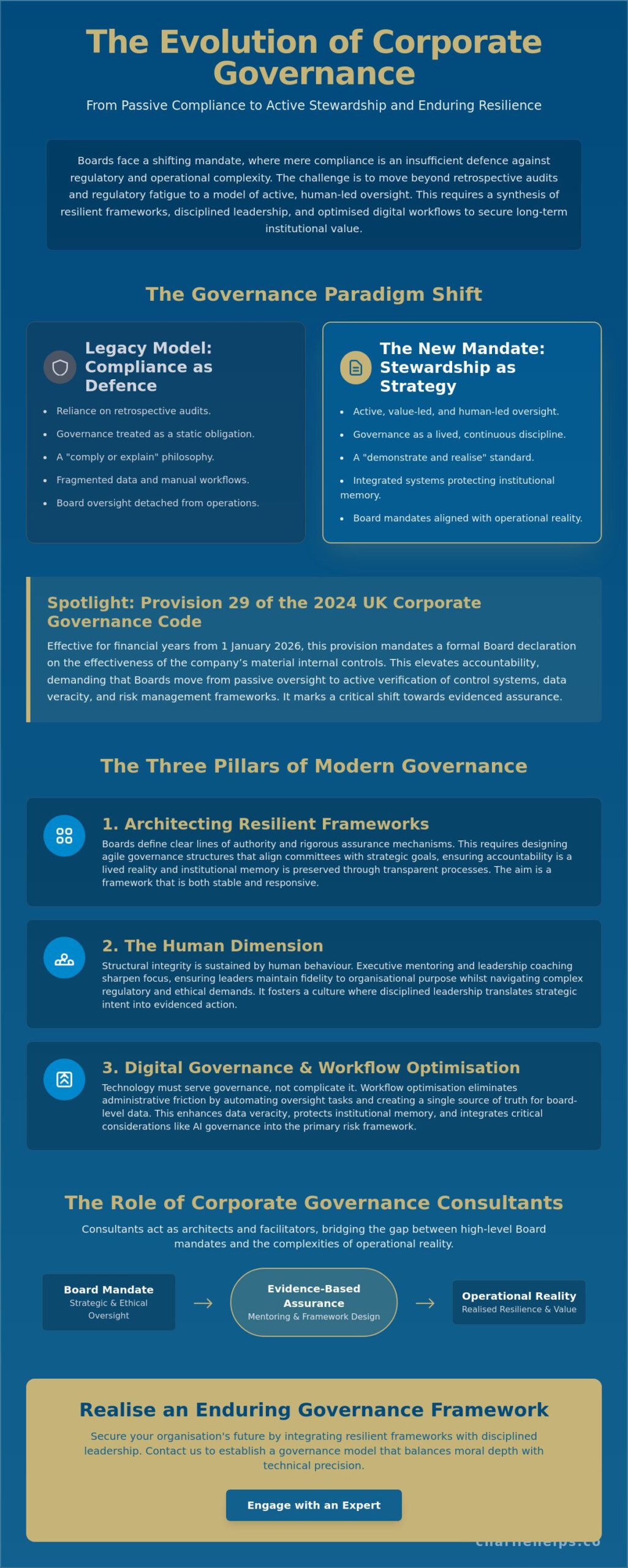
Retrospective audits no longer suffice as a shield against the complexities of the 2026 regulatory landscape. Boards now face an expanded mandate that transcends financial veracity, requiring a profound commitment to ethical stewardship and operational resilience. Professional corporate governance consultants UK act as the architects of this shift, guiding organisations away from passive compliance toward active, value-led oversight. This transition requires directors to treat corporate governance principles as a lived discipline rather than a static annual obligation.
Modern governance requires a synthesis of structural integrity and human behaviour. Whilst technical frameworks provide the skeleton of an organisation, the pulse is found in the decisions of its leaders. Consulting services in this era must therefore bridge the gap between abstract theory and the grounded reality of executive action. Success depends on the ability of the Board to harmonise regulatory requirements with the strategic ambitions of the business.
Beyond the UK Corporate Governance Code
Regulatory adherence in 2026 demands more than a cursory explanation for deviations from the norm. With Provision 29 of the 2024 Code now fully applicable to financial years beginning on or after 1 January 2026, Boards must issue a formal declaration on the effectiveness of material internal controls. This shift marks the rise of Stewardship 2.0, where the focus moves from “comply or explain” to a more rigorous “demonstrate and realise” standard. Directors must now account for long-term stakeholder value, ensuring that environmental, social, and governance obligations are met with the same analytical rigour as financial targets. This rigour extends to operational procurement; for instance, using Green Compare helps organisations align their commercial utility procurement and business finance with broader sustainability and financial goals.
The Need for a Steady Hand in Complex Environments
Systemic stagnation often takes root when boardroom dynamics become detached from the operational front line. Professional corporate governance consultants UK provide the necessary gravitas to challenge entrenched patterns and facilitate cultural alignment. By combining advisory services with mentoring services, consultants help leaders navigate the friction between ESG mandates and traditional risk management. This process requires a steady hand, ensuring that ethical purpose remains anchored in practical judgment and evidenced movement. Cultural evolution is not a byproduct of policy; it is the result of intentional, disciplined leadership. Boards seeking to understand how structural governance, digital workflow optimisation, and executive mentoring integrate into a cohesive model will find a rigorous blueprint in this examination of corporate advisory services UK.
The central issue remains the disconnect between regulatory expectation and leadership capacity. Will your Board continue to treat governance as a burden, or will you choose to realise its potential as a strategic advantage?
Architecting Resilient Governance Frameworks for Modern Enterprises
Frameworks fail when they lack a human pulse. Resilient systems require more than structural elegance; they demand that directors perform the act of governance with intellectual rigour and active oversight. Professional corporate governance consultants UK assist Boards in defining clear lines of authority and rigorous assurance mechanisms that support the organisational mandate. Directors must ensure that accountability is not merely a concept but a lived reality across every level of the enterprise, protecting the fidelity of the mission against operational drift.
Scaling businesses often encounter friction when legacy structures collide with new strategic ambitions. Agile governance resolves this by aligning board committees with specific goals, allowing for rapid decision-making whilst maintaining fidelity to long-term purpose. Transparency serves as the foundation for this movement. It ensures that institutional memory remains intact as the organisation grows and leaders change. By focusing on evidenced movement rather than mere intention, Boards realise a corporate governance framework UK directors can rely upon that is both stable and responsive to the shifts of a complex market.
Designing for Regulatory Compliance and Beyond
FRC expectations for 2026 place a heavy burden on the Board to provide assurance regarding material internal controls. This requirement necessitates a shift from passive oversight to the active verification of data veracity. Directors must now integrate AI governance into their risk frameworks to mitigate the ethical risks of algorithmic bias and operational failure. Expert consulting services help organisations implement these complex requirements without creating administrative paralysis. The Chartered Governance Institute UK & Ireland provides the professional standards that underpin these efforts, ensuring that compliance serves as a baseline for excellence rather than a final destination.
The Board Effectiveness Review as a Strategic Tool
External reviews offer a rare opportunity for honest reflection. These evaluations should move beyond simple compliance to provide a deep-dive analysis of board dynamics and leadership alignment. Identifying blind spots in senior management oversight allows the Board to reset its focus and improve its collective judgment. Corporate governance consultants UK use these reviews to ensure that the Board possesses the necessary skills and diversity of thought to fulfil its fiduciary duties. A successful review does not merely highlight weaknesses; it provides a clear path to realise a more effective and unified leadership team. The ultimate aim is a Board that governs with clarity, confidence, and a shared understanding of risk.
The Human Dimension: Why Leadership Coaching Drives Governance
Structural frameworks remain inert until human agency provides movement. Whilst the previous sections addressed the architecture of oversight, the efficacy of any system rests upon the intellectual force and moral depth of the individuals who inhabit it. Corporate governance consultants UK recognise that boards must perform governance as a disciplined action rather than a passive status. Directors exercise their authority through judgment, and where judgment is clouded by boardroom friction or misaligned incentives, the mandate for assurance suffers. Substantive organisational resilience requires a synthesis of technical logic and psychological alignment.
High-performance cultures do not emerge from policy alone. They are realised through the consistent application of ethical leadership and the removal of operational silos. Coaching services provide a mechanism for directors to examine their own behaviours, ensuring that personal ambitions do not obscure the collective responsibility for accountability. When a Board functions as a cohesive unit, it protects the fidelity of the organisation against the erosion of institutional memory and the risks of strategic drift. Success depends on the ability of leaders to bridge the gap between abstract purpose and the grounded reality of executive execution. Organisations operating in the public sector will find that these principles are equally critical, and those seeking to reclaim authority over their institutional mandate should examine how public sector governance advisory bridges the gap between boardroom policy and operational reality in 2026.
Board-Level Mentoring and Professional Gravitas
Modern chairmanship requires a level of intellectual agility that transcends traditional management experience. Mentoring services assist chairs and directors in developing the strategic wisdom necessary to navigate 2026’s regulatory complexities. These sessions provide a steady hand for first-time CEOs, helping them manage the inherent tension between short-term operational demands and the Board’s long-term mandate for veracity. By fostering professional gravitas, mentors ensure that leaders possess the confidence to challenge assumptions and fulfill their duties with rigour and independence.
Fostering a Culture of Accountability and Integrity
Accountability is a lived behaviour rather than a compliance requirement. Executive team coaching facilitates strategic alignment across departments, ensuring that senior management operates with a shared understanding of risk and reward. This alignment is vital for succession planning, which represents a critical governance mandate to secure the future of the enterprise. Boards that prioritise ethical leadership realise a stronger brand reputation and deeper stakeholder trust. Ultimately, the Board must decide whether to treat leadership development as a luxury or as the essential engine that realises the potential of their governance framework. Evidence suggests that misaligned leadership is the primary cause of governance failure, making the human dimension the most active control in any risk environment.
Digital Governance: Leveraging Workflow Optimisation to Eliminate Friction
Manual oversight often creates a dangerous disconnect between boardroom strategy and operational truth. Digital governance represents the transition from static, retrospective reporting to real-time, evidence-based assurance. By utilising a workflow optimisation SaaS solution, Boards realise a level of visibility that manual processes cannot fulfil. Professional corporate governance consultants UK now advise that digital integration is not merely a technical upgrade; it is a fundamental requirement for maintaining veracity in a complex regulatory environment. Without automated oversight, directors risk acting on fragmented or outdated information, which undermines the collective mandate for accountability.
Friction arises when the speed of business outpaces the capacity of manual reporting systems. Real-time governance data enables directors to identify emerging risks with greater precision, replacing the “tick-box” compliance of previous decades with active, continuous monitoring. This shift provides the evidence required for the formal declarations mandated by the 2024 Code. When systems automate compliance tracking and risk alerts, the Board moves from a reactive stance to a proactive exercise of authority. Intellectual force is better spent on strategic judgment than on the reconciliation of disparate spreadsheets.
The SaaS Methodology for Governance Excellence
Digital tools allow directors to map complex business processes with surgical precision. This mapping identifies potential points of failure before they manifest as regulatory breaches or reputational damage. Automated executive summaries reduce the cognitive “noise” that often obscures critical risks, allowing the Board to focus on high-stakes strategic decisions. Such automation directly supports the operational resilience requirements mandated by UK regulators, ensuring that the organisation maintains its mandate even during periods of systemic volatility. By codifying governance rules into the workflow itself, directors maintain compliance as a byproduct of daily operations rather than an external imposition.
Reducing Operational Friction for Senior Leadership
Administrative burdens frequently distract senior leaders from their primary duty of strategic oversight. Automating low-value administrative tasks through workflow optimisation frees up executive time for high-level mentoring and contemplative leadership. Centralised governance platforms protect institutional memory, ensuring that data integrity remains uncompromised by human error or the fragmentation of siloed departments. Organisations realise a significant return on investment when they replace inefficient manual workflows with streamlined digital processes that provide a single source of truth. To implement these systems effectively, directors should explore a workflow optimisation SaaS solution that aligns technical capability with the rigour of professional governance. This decision is not merely about software; it is about securing the future of the organisational framework.
Navigating Transformation with Charlie Helps Associates
Charlie Helps Associates functions as the necessary bridge between abstract strategic thought and the grounded reality of executive execution. Boards often possess the intention to govern well yet lack the specific mechanisms to realise that ambition. By integrating consulting services, coaching services, and a workflow optimisation SaaS solution, we assist organisations in closing the gap between boardroom mandate and operational truth. As corporate governance consultants UK, we recognise that resilience is not a static state but a result of continuous, evidenced movement.
Directors must reflect on where their current governance framework creates friction rather than flow. Disconnection from operational reality or the use of manual workflows often obscures the veracity of board data. Professional oversight requires a steady hand and a clear-eyed view of systemic challenges. We provide the intellectual force and practical tools needed to implement a framework that balances moral depth with technical precision, ensuring that every decision remains anchored in the organisational mandate.
A Collaborative Path to Excellence
Consultative processes at Charlie Helps mirror the depth of a high-level executive conversation. We reject the impersonal nature of larger firms in favour of a boutique approach that prioritises agility, senior-level access, and bespoke solutions. This methodology ensures that every intervention remains anchored in the specific strategic goals of the enterprise. By combining advisory services with mentoring services, we help leaders develop the professional gravitas required for modern stewardship. Evidence from our previous engagements shows that an integrated governance model allows boards to move from reactive compliance to proactive leadership, ensuring that accountability becomes a lived behaviour amongst all directors.
Your Next Strategic Step
Securing the long-term resilience of your organisation requires a proactive stance. A Board Health Check identifies structural weaknesses and cultural misalignments before they manifest as institutional failures. Leaders seeking to sharpen their strategic focus should engage with our executive coaching and mentoring programmes. These initiatives assist directors in fulfilling their mandate with clarity and independence, protecting the institutional memory of the firm. To begin this transition, Enquire about our Corporate Governance and Advisory Services and decide who holds the authority to realise your governance aims. The central question remains: will you continue to manage by reaction, or will you choose to govern by design?
Securing the Future of Institutional Oversight
Governance requires active human participation to remain effective. Directors must move beyond the constraints of manual reporting and siloed leadership to realise a framework that is both stable and responsive. By engaging corporate governance consultants UK, Boards gain the necessary gravitas to implement these shifts with precision and fidelity to the organisational mandate. Success in the 2026 landscape depends on the synthesis of structural integrity, intellectual agility, and ethical alignment.
Charlie Helps Associates provides the expertise required to bridge the gap between strategic thought and operational truth. Our proprietary Workflow Optimisation SaaS solution provides the veracity needed for regulatory declarations, whilst our human-centric executive mentoring ensures that leaders possess the confidence to exercise their authority. With experience spanning both the public and private sectors in the UK, we assist organisations in fulfilling their duties with rigour and independence. Discover how Charlie Helps Associates can transform your board oversight and begin the movement toward a more resilient institutional future. Your Board possesses the authority to choose excellence over mere compliance.
Frequently Asked Questions
What is the role of a corporate governance consultant in the UK?
Corporate governance consultants UK assist Boards in defining and exercising their mandate for oversight, assurance, and accountability. These professionals provide the technical expertise and strategic wisdom required to align organisational structures with leadership behaviours. By offering advisory services, they help directors bridge the gap between regulatory requirements and operational reality, ensuring that governance remains an active, human-led action rather than a passive compliance status.
How much does a board effectiveness review cost in 2026?
Fees for a board effectiveness review vary significantly based on the firm’s reputation, the scope of the assessment, and the complexity of the organisation. Generally, top-tier strategy firms and global accounting firms command different rates compared to specialised boutique consultancies. Boards should evaluate these costs against the potential risk of governance failure, treating the review as a necessary investment in institutional resilience and leadership alignment rather than a mere administrative expense.
Can workflow optimisation software really improve corporate governance?
Workflow optimisation software improves governance by automating oversight and reducing the administrative friction that often obscures critical data. By implementing a SaaS solution, Boards realise real-time visibility into operational processes, which supports the veracity of their reporting. This technology protects institutional memory and ensures that compliance becomes an inherent part of daily operations, allowing directors to focus their intellectual force on high-level strategic judgment rather than manual data reconciliation.
How do UK governance consultants help with regulatory compliance?
Consultants assist organisations in navigating the 2024 UK Corporate Governance Code, particularly the requirements of Provision 29 concerning material internal controls. They help Boards implement the necessary assurance mechanisms to fulfil their legal and ethical obligations. By providing a steady hand in complex environments, these advisors ensure that directors possess the evidence required to make formal declarations of compliance with confidence, precision, and rigour. Organisations seeking a comprehensive framework for this process will benefit from examining how corporate advisory services UK integrate structural governance with operational execution to achieve institutional excellence in 2026.
What is the difference between executive coaching and governance advisory?
Governance advisory focuses on the structural and strategic frameworks of an organisation, such as committee mandates, authority levels, and risk controls. In contrast, coaching services address the human dimension by influencing leadership behaviours and boardroom dynamics. Whilst advisory services define the rules of engagement, coaching ensures that the people within the system possess the psychological alignment and intellectual agility required to execute those rules effectively.
How often should a UK board undergo a formal effectiveness review?
The UK Corporate Governance Code recommends that FTSE 350 companies undergo an externally facilitated board effectiveness review at least every three years. However, many Boards choose to perform internal evaluations annually to identify emerging structural weaknesses and cultural misalignments. Regular reviews ensure that the Board maintains its mandate for accountability and adapts its oversight to the shifting regulatory landscape, including the increased transparency requirements of 2026.
How do you integrate ESG into a corporate governance framework?
Integrating ESG requires the Board to treat environmental and social mandates with the same analytical rigour as financial targets. Directors must embed these goals into the core risk management framework, ensuring that ethical purpose remains anchored in practical judgment and evidenced movement. By aligning ESG objectives with executive incentives, the Board realises a corporate governance framework UK organisations can depend upon that supports long-term stakeholder value and protects the brand’s reputation in a complex global market.
Why should we choose a boutique consultancy over a Big 4 firm?
Boutique consultancies offer a level of agility and senior-level access that larger firms often struggle to match. A specialised firm provides tailored solutions that reflect the unique strategic goals and cultural nuances of the organisation, avoiding the impersonal nature of mass-market advice. This approach prioritises depth of insight and a human-centric mentoring style, ensuring that the Board receives grounded, practical support rather than abstract theory or “consultancy theatre.” Leaders who recognise the cost of institutional misalignment and wish to move beyond elaborate frameworks toward genuine operational fidelity should explore how public sector governance advisory delivers structured, human-led assurance that mirrors strategic ambition with operational truth.
Disclaimer
The articles published on CharlieHelps.co are provided for general information, reflection, and commentary. They draw on professional experience, research, and interpretation, but they do not constitute legal, regulatory, financial, clinical, governance, risk, compliance, assurance, or other professional advice.
Nothing published on this site should be relied upon as practice guidance, formal instruction, or a substitute for proper professional consultation. Readers should seek advice from suitably qualified advisers before acting on, applying, or relying upon any material in relation to their own organisation, Board, duties, circumstances, or decisions.
Although reasonable care is taken to ensure that articles are accurate and current at the time of publication, no warranty is given as to completeness, accuracy, timeliness, or fitness for any particular purpose. Law, regulation, policy, standards, and recognised practice may change, and context matters.
References to external sources, organisations, products, services, or third-party materials are included for information only. They do not imply endorsement unless expressly stated. Where an article contains affiliate links, sponsored references, or commercial relationships, these will be disclosed where relevant.
The views expressed are those of the author unless otherwise stated. Reading, sharing, or responding to material on this site does not create a client, adviser, fiduciary, or professional relationship with Charlie Helps FRSA, CharlieHelps.co, or any associated entity.
Readers remain responsible for their own judgement, decisions, and actions.
