

A corporate crisis is not a temporary interruption of business; it is a permanent revelation of a Board’s structural integrity. When acute disruption strikes, directors often find that the carefully curated workflows of peacetime dissolve into operational friction, leaving the organisation exposed to regulatory scrutiny and a loss of institutional control. You likely recognise that maintaining authority during such upheaval requires more than a tactical response; it demands the strategic depth provided by corporate crisis management consulting to ensure leadership remains composed and decisive.
This article provides a rigorous examination of how Boards maintain institutional memory and operational integrity through periods of intense organisational stress. We shall explore the methods by which directors implement robust governance frameworks, protect institutional value, and ensure every emergency decision remains grounded in evidence, accountability, and professional restraint.
Key Takeaways
- Boards must uphold their mandate by implementing governance architectures that define clear authority levels, ensuring that operational integrity remains intact during disruption.
- Engaging in corporate crisis management consulting enables directors to maintain institutional memory and professional weight, even when standard workflows fail.
- Risk Committees should prioritise the identification of systemic threats to ensure internal controls fulfil the rigorous standards of the 2024 UK Corporate Governance Code.
- Workflow optimisation and AI governance tools reduce friction in emergency decision-making, allowing committees to act with composure, evidence, and practical judgment.
- Strategic mentoring and coaching prepare executives to manage the human dimensions of crisis, ensuring that organisational upheaval serves as a catalyst for leadership excellence.
The Anatomy of Corporate Crisis and the Board Mandate
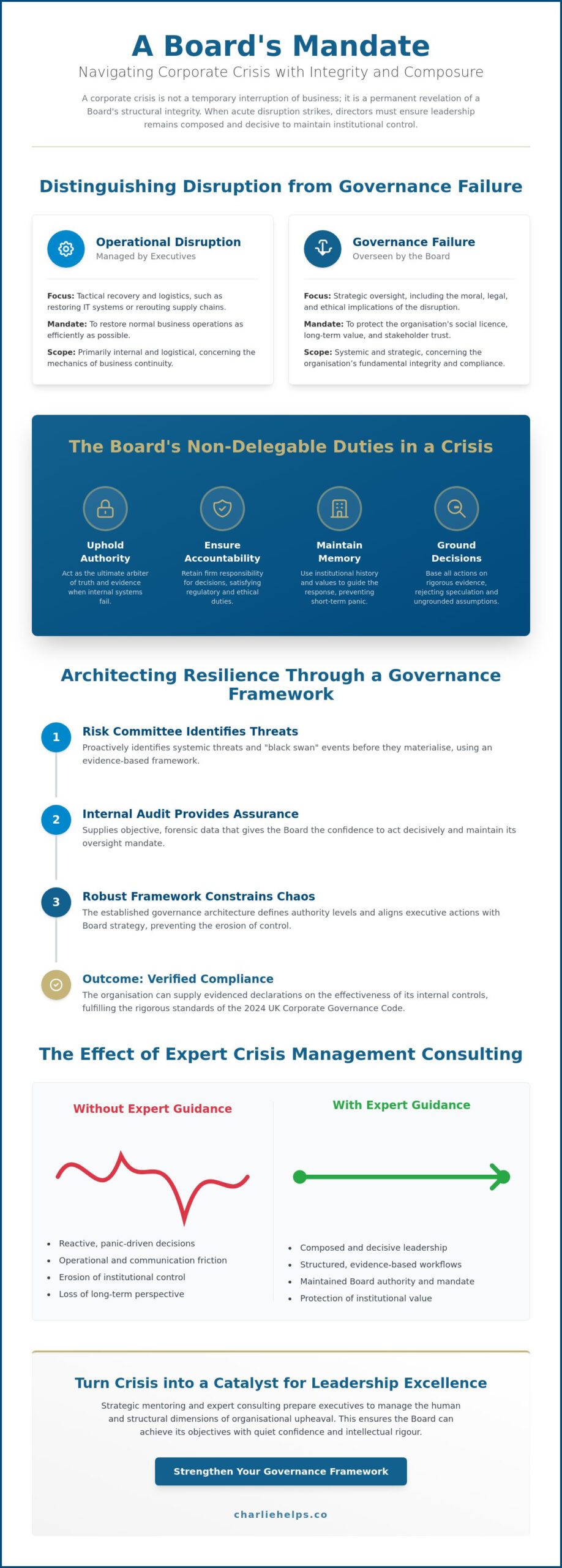
A corporate crisis represents a fundamental disruption to an organisation’s ability to fulfil its strategic purpose. It is not merely an operational setback; it is a systemic challenge that tests the very foundations of leadership and institutional integrity. Whilst managers focus on the logistics of recovery, directors hold the primary accountability for maintaining institutional memory and strategic direction during periods of acute upheaval. This mandate requires a clear-eyed understanding of the organisation’s core values and a commitment to protecting its long-term viability against corrosive uncertainty.
Boards must act as the ultimate arbiters of truth and evidence when internal systems fail. In the absence of reliable data or clear precedents, directors provide the necessary restraint and judgment to guide the organisation through the fog of disruption. Engaging corporate crisis management consulting supports this process by offering a structured approach to decision-making, ensuring that the Board’s authority remains unquestioned and its actions remain grounded in ethical principles rather than reactive panic.
Distinguishing Operational Disruption from Governance Failure
Managers typically handle the logistical complexities of a disruption, such as restoring IT systems or rerouting supply chains. However, the Board must oversee the broader moral and legal implications of these events. A technical fault becomes a governance crisis at the precise moment it threatens the organisation’s social licence or its compliance with the 2024 UK Corporate Governance Code. By applying foundational crisis management principles, directors ensure that institutional memory guides the response, preventing the loss of long-term perspective amidst short-term chaos.
The Legal and Ethical Weight of Board Accountability
Accountability is a non-delegable duty that rests firmly with the Board and its individual directors. This responsibility remains constant regardless of the crisis scale, requiring a level of professional weight that transcends mere tactical problem-solving. Directors must reject “consultancy theatre” in favour of rigorous, evidence-based judgment that satisfies both regulatory requirements and ethical expectations. By integrating corporate crisis management consulting into their strategic planning, Boards can implement robust succession plans and foster leadership resilience. These actions provide the necessary assurance that the organisation can survive immediate threats whilst preparing for future challenges with quiet confidence and intellectual rigour.
Architecting Robust Governance Frameworks for Resilience
Governance frameworks constrain chaos. They define where authority resides before the pressure of an emergency distorts judgment. A well-structured architecture acts as a scaffolding for the organisation’s integrity, establishing predefined authority levels that prevent the erosion of decision-making power. Directors rely on these systems to ensure that the mandate remains clear, even when the operational environment becomes opaque. Integrated governance ensures that executive actions remain aligned with Board oversight, preventing a decoupling of strategy and execution. Many UK Boards now seek Professional Corporate Governance Consultants in the UK to audit their existing frameworks for vulnerabilities. This alignment is critical given the requirements of the 2024 UK Corporate Governance Code, which demands evidenced declarations on the effectiveness of internal controls.
The Role of the Risk Committee and Internal Audit
The Risk Committee identifies “black swan” events before they crystallise. This process requires a contemporary crisis management framework that prioritises evidence over assumption. Assurance must be forensic, providing the Board with the confidence to act decisively. Internal auditors provide the objective data that allows directors to maintain their mandate, fulfil their accountability, and provide necessary oversight. Risk appetite statements are not ornaments; they are active constraints on executive behaviour that require frequent revision to reflect shifting market realities. Static policies offer no protection against dynamic threats, and corporate crisis management consulting helps Committees refine these appetites into practical tools for oversight.
Building Institutional Memory Through Governance
Institutional memory protects the organisation from repeating historical failures. It serves as a repository of hard-won wisdom that informs current response workflows. Governance architectures are living systems, not static documents. Committees must feel empowered to challenge executive assumptions during emergency meetings, ensuring that the Board remains the ultimate arbiter of truth. Specialist corporate crisis management consulting provides the most value here, fostering a culture of healthy scepticism, intellectual rigour, and professional weight. To explore how these frameworks can be realised in your organisation, you may contact our advisory team for a confidential discussion.
Leadership Behaviour and the Ethics of Accountability
Data does not make decisions. People do. Whilst financial metrics provide a quantifiable measure of organisational distress, the true erosion of value often begins with a collapse in leadership composure. Effective corporate crisis management consulting must therefore address the human behaviour behind the data, recognising that a Board’s response is only as robust as the psychological fortitude of its directors. Directors must maintain professional weight and a sense of calm expertise when the temptation to react impulsively is at its peak. This involves a deliberate move away from high-volume, low-value activity towards a state of focused, analytical restraint.
Moral seriousness supersedes motivational slogans. In the crucible of a crisis, the Board must protect the organisation’s culture with the same vigour it applies to protecting the balance sheet. This involves a commitment to practical judgment and a rejection of “consultancy theatre” that prioritises optics over substance. Understanding the board’s role in crisis preparedness requires directors to acknowledge that their behaviour sets the standard for the entire enterprise. When leaders demonstrate integrity under pressure, they reinforce the foundations of institutional trust that sustain the organisation through long-term recovery.
Mentoring Leaders for High-Stakes Decision Making
Professional mentoring programmes help directors develop the gravitas required for crisis leadership. Under acute stress, the ability to distinguish between fact, inference, and assumption becomes a critical survival skill. Coaching services should focus on the intersection of human behaviour and structural systems, ensuring that leaders don’t merely follow a manual but instead apply reasoned judgment to unique challenges. This intellectual rigour allows the Board to maintain its mandate whilst others succumb to cognitive biases. Mentoring provides a safe environment for directors to test their assumptions and refine their decision-making workflows before they are required to act in the public eye.
The Ethics of Transparency and Boardroom Integrity
Transparency frameworks ensure that the Board remains the primary source of authority for all stakeholders. Integrity is not a static trait; it is realised through actions that match the organisation’s stated governance principles. Directors must resist the urge to use “weasel words” when communicating with regulators or the public, as vague qualifiers often signal a lack of institutional control. Clear, evidenced communication strengthens accountability and preserves the organisation’s social licence, even during periods of extreme upheaval. By prioritising honesty over obfuscation, the Board demonstrates that it remains the steady hand in a complex and often hostile environment.
Optimising Response Workflows Through Digital Governance
Chaos thrives in the gaps between intent and action. When a crisis unfolds, the friction of manual processes often paralyses decision-making, leading to a rapid loss of institutional control. Boards must recognise that corporate crisis management consulting now involves the integration of digital process management to ensure that response protocols remain fluid and evidenced. By adopting a workflow optimisation SaaS solution, directors can replace fragmented spreadsheets with a unified architecture that maintains a rigorous audit trail of every decision made under pressure.
Rigour requires evidence. Digital systems automate the collection of data for Board-level assurance, ensuring that accountability is not merely a statement of intent but a documented reality. These solutions allow committees to monitor the implementation of emergency workflows in real time, providing the necessary oversight to constrain operational drift. When the Board possesses a clear, digital record of actions taken, it can satisfy regulatory requirements and maintain the organisation’s social licence with greater confidence.
Reducing Operational Friction in Emergency Protocols
Operational friction delays critical decisions. It creates a vacuum where rumours replace facts, and hesitation replaces leadership. Workflow optimisation software ensures that every actor understands their specific mandate, removing the ambiguity that often plagues emergency workflows. These digital tools streamline the communication between the Board and the executive response team, ensuring that assurance is based on objective data rather than retrospective summaries. This clarity allows the organisation to maintain its strategic purpose even whilst the operational environment remains volatile.
AI Governance and the Future of Boardroom Oversight
AI governance frameworks must be embedded into the Board’s risk oversight protocols to prevent automated systems from exacerbating a crisis. Research indicates that 39% of directors believe technology-enabled compliance monitoring tools would most improve their Board’s oversight. Boardroom AI can assist in complex scenario planning, yet the Board must remain the final arbiter of truth. Technology should serve the governance structure, providing the evidence required for directors to fulfil their accountability without surrendering their practical judgment. To implement these digital frameworks within your organisation, request a consultation with our advisory team.
Engaging Expert Crisis Management Consulting for Long-Term Assurance
Authority in a crisis is not granted; it is earned through rigorous preparation. Charlie Helps Associates acts as a partner in excellence, providing the steady hand and quiet confidence required to navigate periods of acute organisational upheaval. Strategic corporate crisis management consulting should not be viewed as a reactive service but as a long-term commitment to organisational health. We move beyond superficial responses, ensuring that every strategic decision remains grounded in the organisation’s core mandate and ethical framework. This partnership ensures that directors remain the ultimate arbiters of truth, even when traditional internal systems face unprecedented stress.
Selecting a consultant requires a focus on three distinct pillars: authority, evidence, and risk awareness. Authority stems from a deep understanding of the UK’s regulatory landscape and the specific obligations of the Board. Evidence provides the objective basis for reliance, ensuring that decisions are not made on impulse but on verified data. Risk awareness involves the ability to identify both chronic systemic weaknesses and acute external threats before they crystallise. These criteria ensure that the Board maintains its mandate and protects institutional memory, regardless of the complexity of the disruption.
A Consultative Path Forward: Beyond Consultancy Theatre
True assurance requires evidenced movement through a credible plan. Our approach balances strategic advisory with grounded, human-centric mentoring, helping directors develop the professional weight needed for high-stakes oversight. We reject the shallow promises of “consultancy theatre,” opting instead for a methodical process that translates philosophical depth into practical, realised improvements. This transition from high-level strategic purpose to specific emergency decision-making workflows is essential for maintaining operational integrity. Directors may further strengthen their oversight by consulting The Definitive Board Effectiveness Review Guide to identify systemic vulnerabilities before they manifest as failures.
Securing Your Organisation’s Mandate
Boards achieve assurance when they can demonstrate a rigorous approach to crisis preparedness that satisfies both internal standards and external regulatory scrutiny. Strategic value is realised through tailored governance frameworks and the professional support of a seasoned advisor who understands the human element behind the data. This expertise allows the Board to maintain its mandate and protect institutional memory whilst the operational environment remains volatile. By implementing these frameworks, directors ensure that the organisation remains resilient, purposeful, and ethically sound. Securing the organisation’s future requires more than just a statement of intention; it requires action. What decision is required today to ensure your Board maintains its authority when the next disruption occurs? You may Contact Charlie Helps Associates to refine your governance architecture and establish a foundation for long-term excellence.
Securing the Future Through Strategic Governance
A Board’s authority is most visible during periods of acute organisational upheaval. Directors maintain this mandate not through reactive panic, but by architecting robust governance frameworks that preserve institutional memory and operational integrity. When leadership behaviour remains grounded in ethical accountability and professional weight, the organisation can navigate disruption with a sense of calm expertise. Realising this level of structural maturity requires a shift from passive compliance to proactive, evidence-based oversight.
Expertise in corporate crisis management consulting establishes the necessary scaffolding for this resilience. Charlie Helps Associates offers specialised support through 24/7 emergency response consulting, ensuring that directors possess a steady hand when the stakes are highest. Our proprietary Workflow Optimisation SaaS solution and deep expertise in AI governance for UK Boards supply the digital assurance required to satisfy modern regulatory scrutiny. This integrated approach ensures that every emergency decision remains grounded in practical judgment, and moral seriousness.
Securing your organisation’s mandate is a continuous process of refinement and reflection. By choosing to implement a credible plan today, you protect the long-term viability of your enterprise and the integrity of your leadership. We invite you to begin a confidential consultation to secure your organisation’s governance architecture and fulfil your commitment to excellence.
Frequently Asked Questions
What is the primary role of a Board during a corporate crisis?
The Board serves as the ultimate arbiter of truth and strategic continuity during an organisational crisis. Directors must ensure that every emergency action remains aligned with the organisation’s long-term purpose whilst fulfilling their non-delegable duty of accountability to stakeholders and regulators. By providing the necessary restraint and judgment, directors prevent operational chaos from eroding the organisation’s structural integrity.
How does corporate crisis management consulting differ from PR or communications advice?
Corporate crisis management consulting focuses on the structural and ethical integrity of the organisation rather than mere reputation management. Whilst PR firms manage public perception, governance consultants assist directors in maintaining operational control, satisfying regulatory requirements, and ensuring that decision-making remains evidenced and legally sound. This approach prioritises the Board’s mandate over simple optics.
What are the essential components of a robust corporate governance framework for crisis?
A robust framework requires predefined authority levels, integrated risk oversight, and a clear mandate for the Risk Committee. These architectures must facilitate a seamless flow of objective data between executives and directors, ensuring that the Board can provide the necessary assurance and maintain its mandate throughout the period of upheaval. Rigorous internal controls and clear reporting lines form the foundation of this resilience.
Can workflow optimisation software really improve a Board’s crisis response?
Digital tools reduce the operational friction that often paralyses leadership during a disruption. By implementing a workflow optimisation SaaS solution, Boards can automate the collection of evidence for assurance and maintain a rigorous audit trail, ensuring that emergency protocols are followed with precision and practical judgment. These systems ensure that accountability is a documented reality rather than a mere statement of intent.
Why is institutional memory so critical for UK organisations facing disruption?
Institutional memory provides the hard-won wisdom necessary to avoid repeating historical failures during new disruptions. UK organisations rely on this repository of knowledge to maintain strategic perspective, ensuring that the Board’s response is informed by past experience rather than reactive impulse or ungrounded assumptions. Preserving this memory is a primary responsibility of long-serving directors and committees.
How does executive mentoring help leaders during high-stakes organisational change?
Mentoring services help leaders develop the professional weight and composure required to manage high-stakes organisational change. Through these programmes, executives learn to distinguish between fact, inference, and assumption under pressure, ensuring that their leadership behaviour remains consistent with the organisation’s stated governance principles. This intellectual rigour allows the Board to maintain its mandate whilst others succumb to cognitive biases.
What is the first step a Board should take when a governance failure is identified?
Directors must first establish the objective facts of the situation through a rigorous internal review. Once the scope of the failure is understood, the Board should assess the impact on its mandate and seek objective assurance to identify material control failures and remedial actions, as required by Provision 29 of the 2024 UK Corporate Governance Code. This process ensures that the organisation moves from a state of failure to evidenced recovery.
How can AI governance be integrated into existing risk management frameworks?
Boards should embed AI governance into their existing risk oversight protocols by establishing clear ethical constraints for automated systems. Integrating boardroom AI allows for more sophisticated scenario planning, provided that directors remain the final decision-makers and that technology serves the established governance architecture rather than dictating the organisation’s response. This ensures that AI remains a tool for oversight rather than a source of unmanaged risk.
Disclaimer
The articles published on CharlieHelps.co are provided for general information, reflection, and commentary. They draw on professional experience, research, and interpretation, but they do not constitute legal, regulatory, financial, clinical, governance, risk, compliance, assurance, or other professional advice.Nothing published on this site should be relied upon as practice guidance, formal instruction, or a substitute for proper professional consultation. Readers should seek advice from suitably qualified advisers before acting on, applying, or relying upon any material in relation to their own organisation, Board, duties, circumstances, or decisions.Although reasonable care is taken to ensure that articles are accurate and current at the time of publication, no warranty is given as to completeness, accuracy, timeliness, or fitness for any particular purpose. Law, regulation, policy, standards, and recognised practice may change, and context matters.References to external sources, organisations, products, services, or third-party materials are included for information only. They do not imply endorsement unless expressly stated. Where an article contains affiliate links, sponsored references, or commercial relationships, these will be disclosed where relevant.The views expressed are those of the author unless otherwise stated. Reading, sharing, or responding to material on this site does not create a client, adviser, fiduciary, or professional relationship with Charlie Helps FRSA, CharlieHelps.co, or any associated entity.Readers remain responsible for their own judgement, decisions, and actions.
