

If a Board can’t distinguish between a sincere intention and evidenced movement, does accountability actually exist? It’s a question that haunts the modern boardroom. Risk levels for General Counsels reached 7.9 out of 10 in 2026, yet many leadership teams remain trapped in the inertia of institutional memory. You likely recognise the friction of increasing regulatory complexity as AI systems integrate into core operations, turning what should be oversight into a dense administrative fog. Amidst these pressures, corporate accountability consulting must move beyond the theatre of compliance to address the structural reality of how directors actually function.
This article explores how leaders use sophisticated governance frameworks and evidence-based assurance to realise a shift from reporting burdens to strategic mandates. We examine how UK boards can architect a durable governance structure, clarify mandates of authority, and ground institutional fidelity in verifiable movement rather than mere aspiration.
Key Takeaways
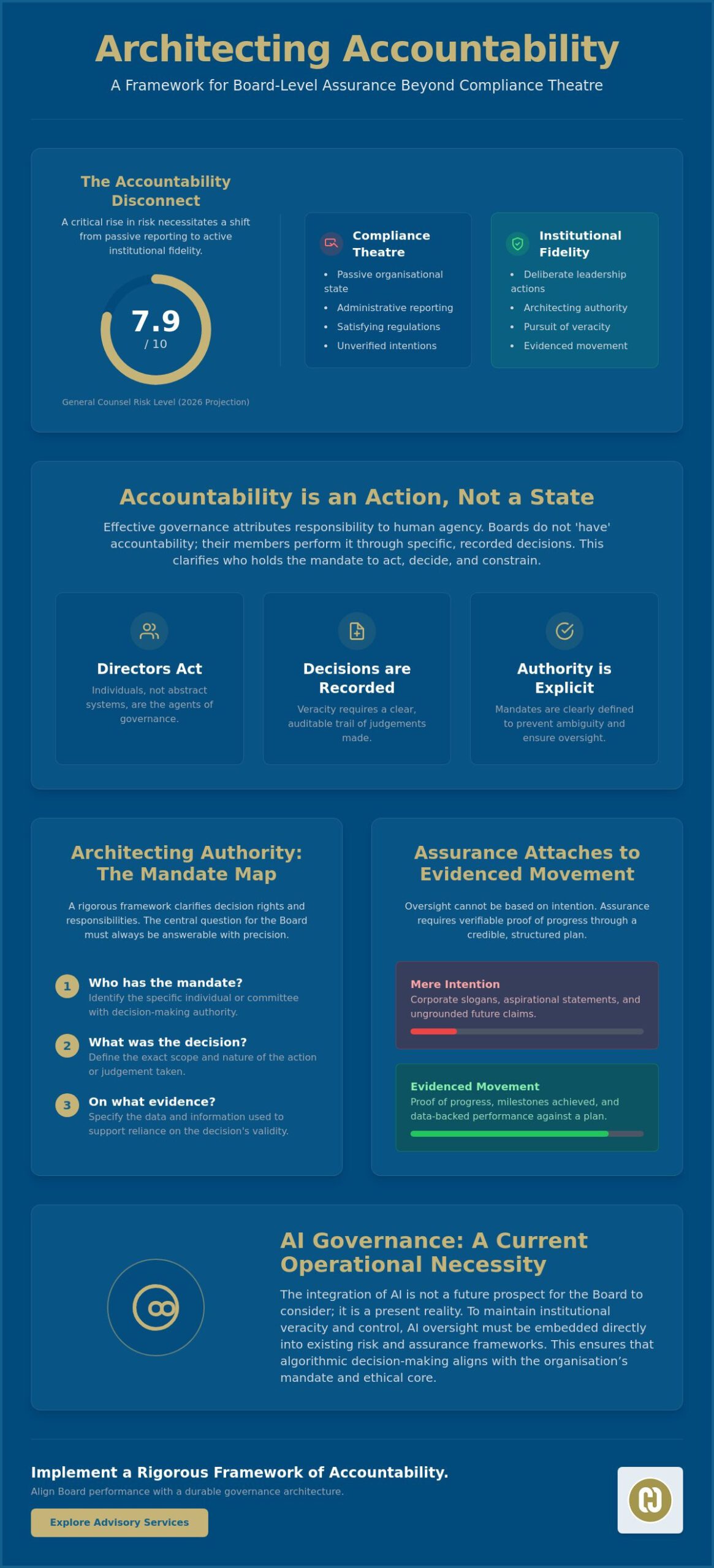
- Boards must view accountability as a series of deliberate actions rather than a passive organisational state. This shift from compliance theatre to institutional fidelity defines the modern leadership landscape.
- Engaging in corporate accountability consulting allows directors to architect clear mandates of authority. This ensures every decision-maker understands their specific remit within the broader governance structure.
- Effective assurance attaches to evidenced movement through a credible plan rather than mere corporate intention. Leaders must require proof of progress to fulfil their oversight obligations.
- Directors should embed AI governance into existing risk frameworks to maintain veracity. Boardroom AI is a current operational necessity rather than a future prospect.
- Leaders can realise strategic value by aligning performance with a rigorous governance architecture. This involves implementing workflow optimisation to bridge the gap between intent and action.
The Evolution of Corporate Accountability Consulting: Beyond Passive Oversight
Accountability is not a static organisational state. It is an act. For too long, Boards treated Corporate accountability as a byproduct of administrative reporting, a passive outcome of ticking boxes to satisfy regulators. This approach, often dismissed as compliance theatre, fails to address the structural reality of modern enterprise. In 2026, the implementation of the EU Corporate Sustainability Due Diligence Directive (CSDDD) and updated Senior Managers and Certification Regime (SMCR) thresholds requires a more rigorous stance. Effective corporate accountability consulting now focuses on architecting authority rather than merely managing disclosures. It requires a move from mere corporate intention to evidenced movement through a credible plan.
Defining Accountability as a Governance Verb
Directors act. They decide. They constrain. When we treat governance as an abstract agent, we obscure the human agency required to maintain institutional integrity. A Board doesn’t “have” accountability; its members perform it through the active pursuit of veracity. The Aim of any framework must be clear: it exists to ensure that those with a mandate remain answerable for their specific decisions. This distinction separates passive compliance from a culture of genuine oversight. Without clear lines of authority, institutional memory fades, and the organisation loses its ability to learn from past judgements. Clarity on who has the mandate to act is the prerequisite for any workable system of assurance.
The Role of Institutional Fidelity in 2026
Fidelity implies a steadfast commitment to the original mandate and the ethical core of the enterprise. It stands in stark contrast to the fleeting nature of motivational management slogans that often populate annual reports. In a landscape where General Counsel risk levels have risen to 7.9 out of 10, protecting an organisation’s moral depth is a strategic necessity. Institutional fidelity ensures that the enterprise remains true to its purpose whilst navigating the complexities of AI integration and shifting global standards. By prioritising veracity over marketing hype, leaders protect their reputation and ensure the organisation remains a durable entity. Those seeking to implement these rigorous standards often require bespoke Advisory Services to bridge the gap between abstract policy and practical judgement.
Architecting Authority: The Structural Requirements for Board-Level Assurance
Authority serves as the bedrock of institutional fidelity. Without a clear mandate, accountability remains an abstract concept, drifting through boardrooms without a point of anchorage. Academic research on corporate governance highlights that structural mechanisms, rather than mere good intentions, determine how effectively directors oversee complex operations. In the context of corporate accountability consulting, we must treat authority as a resource to be mapped, allocated, and verified. Directors who fail to define these boundaries often find themselves responsible for outcomes they did not truly control; conversely, they may find themselves unable to influence the ones they did.
Mapping Mandates and Authority
Who has the authority to decide? This question requires a precise answer. Boards often delegate power through broad, ill-defined statements that create ambiguity within the executive suite. A rigorous Board Risk Management Framework provides the architecture required to clarify these mandates. Directors must specify who decided what, on what date, and using what specific evidence to support their reliance on data. This level of detail ensures that decisions are both valid and actionable. By mapping authority in this way, the Board maintains oversight whilst allowing the executive team the space to realise strategic aims.
The Mechanics of Evidenced Movement
Assurance does not attach to a statement of intent. It attaches to evidenced movement through a credible plan. When directors receive reports, they must distinguish between hard facts, logical inferences, professional judgements, and underlying assumptions. This discipline prevents the Board from relying on administrative theatre or optimistic forecasts. Many organisations utilise corporate advisory services UK to validate these reports, ensuring that the data presented reflects operational reality. Workflow optimisation then acts as the bridge, turning high-level strategy into a series of implementable tasks. If you require assistance in refining these structures, our team offers Advisory Services to help you architect a more resilient organisation.
Navigating 2026 Trends: AI Governance and the Mandate for Veracity
Boardroom AI has transitioned from a speculative horizon to a present operational necessity. In 2026, directors utilise automated systems to process vast datasets and enhance strategic foresight, yet this efficiency introduces new risks to institutional integrity. Effective corporate accountability consulting must now integrate AI oversight into existing risk architectures. Without this integration, Boards risk ceding authority to algorithms they do not fully comprehend. Veracity in reporting depends upon the Board’s ability to interrogate the data sources and logic models that inform executive decisions.
Integrating AI into Governance Frameworks
Human authority must remain paramount. The Colorado AI Act, which took effect in February 2026, requires deployers of high-risk systems to use reasonable care to avoid algorithmic discrimination. Boards must ensure these systems remain subordinate to human judgement and oversight. The risk of “black box” decisions presents a significant threat to veracity; if a director cannot explain the logic behind a strategic choice, they cannot provide genuine assurance. This shift requires strategic leadership development to cultivate AI literacy as a core competency for every board member. Leaders must understand the limitations of the tools they authorise to protect the organisation from unforeseen liabilities.
Public Sector Accountability and Regulatory Scrutiny
Public sector organisations face unique challenges in aligning governance with sustainable value. The UK public demands a level of transparency that extends beyond financial reporting to include the ethical use of automated decision-making. Maintaining institutional memory during periods of rapid political or social change is difficult, yet it is essential for long-term stability. Directors must implement frameworks that protect the enterprise’s moral depth whilst adhering to the National Policy Framework for Artificial Intelligence released by the White House on 20 March 2026. This global landscape requires a sophisticated approach to corporate accountability consulting that balances local mandates with international standards. If your organisation requires a structured approach to these regulatory shifts, our AI Governance advisory services provide the necessary expertise to architect a resilient path forward.
Implementing a Framework of Accountability: From Intent to Realisation
Intent is a private thought; movement is a public fact. Realising strategic value requires more than a policy document; it demands the alignment of organisational performance with a rigorous governance architecture. Many leaders possess the desire to improve, yet they struggle to translate this into workable operational reality. A board effectiveness review serves as the logical starting point for this realignment. It allows directors to identify where institutional memory has failed and where authority remains ambiguous. Through corporate accountability consulting, organisations can bridge the gap between high-level aspiration and evidenced movement.
The Consultative Process for Realising Value
Directors must identify the specific gaps between current board dynamics and the required level of fidelity. We avoid the superficiality of consultancy theatre by focusing on practical judgement and evidenced outcomes. This involves implementing tailored governance frameworks that reduce operational friction and enhance clarity. Every framework must answer four critical questions: what is the Aim, who has the authority to act, what decision is required, and what risks remain? By answering these, the Board ensures that its mandates are both valid and actionable. Workflow optimisation then becomes the mechanism through which the organisation fulfils its strategic goals.
Closing the Loop: Assurance and Continued Fidelity
Assurance is not a one-time event; it is a continuous process of verification and adjustment. Directors must remain vigilant, ensuring that the evidence they rely upon maintains its veracity over time. Sustaining this culture of accountability often requires ongoing support through Coaching Services and Mentoring Services. These interventions help leaders refine their practical judgement and maintain their commitment to the enterprise’s moral depth. If you seek to architect a governance framework that prioritises institutional fidelity, Contact Charlie Helps Associates to discuss how we can assist you in realising these aims.
Architecting the Future of Boardroom Authority
Accountability is a performance, not a policy. It requires directors to move beyond the administrative theatre of compliance towards a rigorous architecture of authority. We have explored how institutional fidelity in 2026 depends upon the Board’s ability to distinguish between mere corporate intent and evidenced movement. By embedding AI governance into existing risk frameworks and clarifying mandates, leadership teams protect the organisation’s moral depth and veracity.
Engaging in professional corporate accountability consulting allows Boards to realise strategic value through structural clarity. Our approach utilises a proprietary Workflow Optimisation SaaS Solution alongside authoritative board-level advisory to bridge the gap between high-level strategy and operational implementation. We apply specific expertise in UK public sector governance to ensure your organisation remains resilient amidst shifting regulatory landscapes. You can architect your institutional fidelity with Charlie Helps Associates to ensure your governance framework supports durable excellence. Better leadership makes institutional fidelity possible.
Frequently Asked Questions
What is the role of a corporate accountability consultant in the UK?
A consultant in this field helps directors architect clear mandates of authority and establish evidence-based assurance frameworks. Instead of focusing on administrative theatre, they assist the Board in performing its duties through practical judgement and structural clarity. This role is essential for navigating the United Kingdom’s complex regulatory landscape, including the 2026 Senior Managers and Certification Regime reforms. They help realise a shift from passive oversight to active leadership.
How does AI governance impact a Board’s accountability framework?
AI governance requires that automated systems remain subordinate to human authority and Board oversight. When algorithms begin to influence strategic decisions, the Board must implement rigorous transparency standards to avoid liabilities associated with opaque decision-making. This integration ensures that veracity remains the foundation of all organisational reporting and strategic foresight. Directors must cultivate AI literacy to protect the enterprise’s moral depth whilst utilising these advanced tools.
Is corporate accountability different from ESG reporting?
Corporate accountability is the performance of answerability, whilst ESG reporting is the administrative disclosure of specific sustainability metrics. Whilst ESG focuses on data, corporate accountability consulting addresses the underlying governance architecture required to make those disclosures credible. One is a reporting exercise; the other is the structural reality of how directors act, decide, and constrain. Accountability ensures that the organisation remains true to its original mandate.
Can workflow optimisation improve Board-level decision-making?
Workflow optimisation serves as the bridge between high-level Board strategy and operational implementation. By refining the processes through which decisions are made and verified, organisations reduce friction and enhance clarity. This structural discipline ensures that every director has the data required to fulfil their mandate with precision and veracity. It turns abstract policy into a series of implementable tasks that support long-term institutional fidelity.
How do we distinguish between corporate intent and evidenced assurance?
Intent represents a private thought or a stated aspiration, whilst assurance attaches to evidenced movement through a credible plan. Boards must distinguish between these by requiring verifiable proof of progress against specific milestones. Realising this distinction is the hallmark of institutional fidelity, as it replaces vague promises with hard facts and logical inferences. Assurance requires a continuous process of verification to ensure that the organisation’s actions match its stated purpose.
What are the risks of failing to implement a rigorous accountability framework?
Failure to implement a rigorous framework leads to institutional inertia and the erosion of institutional memory. Directors face heightened personal risks, especially with General Counsel risk levels rising to 7.9 out of 10 in 2026. Without clear lines of authority, organisations struggle to respond to regulatory scrutiny from the CSDDD or SMCR. This lack of structure eventually results in a loss of veracity, leading to significant reputational and legal consequences.
Disclaimer
The articles published on CharlieHelps.co are provided for general information, reflection, and commentary. They draw on professional experience, research, and interpretation, but they do not constitute legal, regulatory, financial, clinical, governance, risk, compliance, assurance, or other professional advice. Nothing published on this site should be relied upon as practice guidance, formal instruction, or a substitute for proper professional consultation. Readers should seek advice from suitably qualified advisers before acting on, applying, or relying upon any material in relation to their own organisation, Board, duties, circumstances, or decisions. Although reasonable care is taken to ensure that articles are accurate and current at the time of publication, no warranty is given as to completeness, accuracy, timeliness, or fitness for any particular purpose. Law, regulation, policy, standards, and recognised practice may change, and context matters. References to external sources, organisations, products, services, or third-party materials are included for information only. They do not imply endorsement unless expressly stated. Where an article contains affiliate links, sponsored references, or commercial relationships, these will be disclosed where relevant. The views expressed are those of the author unless otherwise stated. Reading, sharing, or responding to material on this site does not create a client, adviser, fiduciary, or professional relationship with Charlie Helps FRSA, CharlieHelps.co, or any associated entity. Readers remain responsible for their own judgement, decisions, and actions.
