

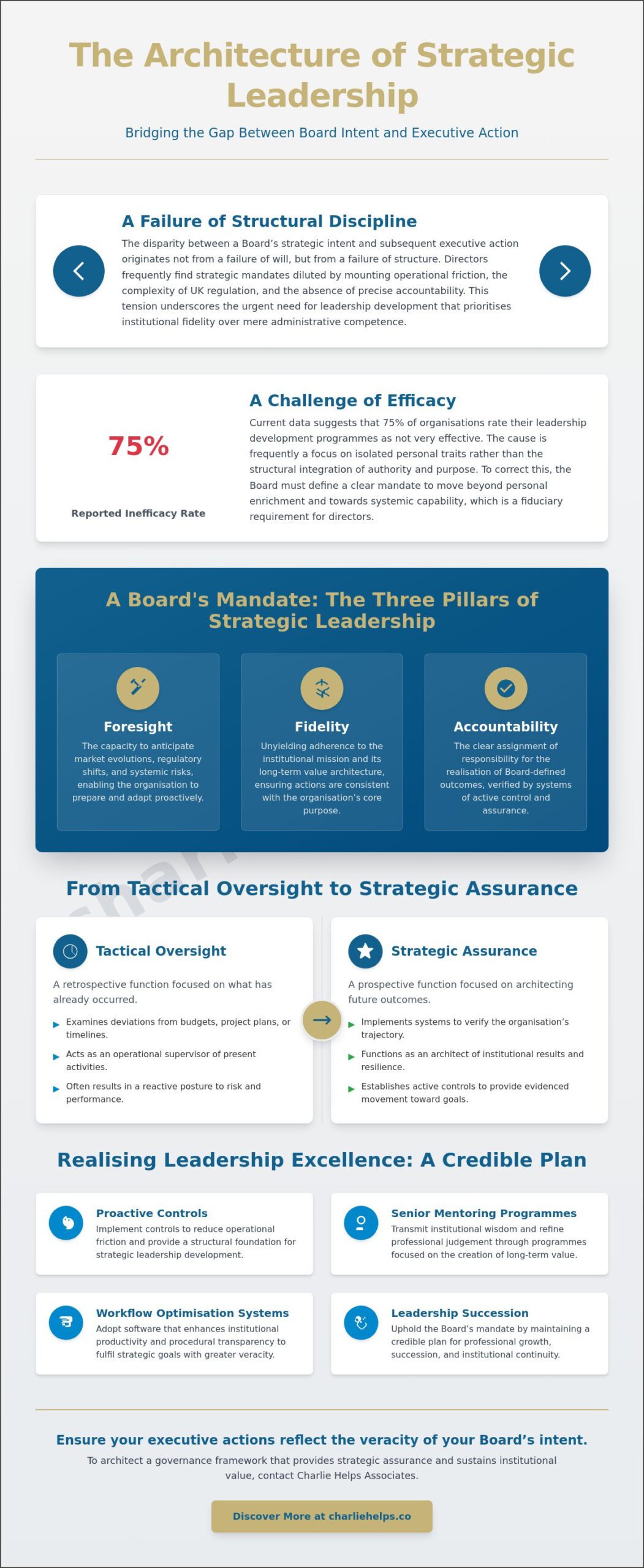
The gap between Board intent and executive action is rarely a failure of will. It is a failure of structural discipline. Directors often find their strategic mandates diluted by mounting operational friction, the weight of UK regulatory complexity, and the absence of precise accountability. You likely recognise the frustration when strategic goals remain unfulfilled whilst the organisation remains tethered to tactical oversight. This tension underscores the urgent need for strategic leadership development that prioritises institutional fidelity over mere administrative competence.
This article provides an intellectual framework for senior leaders to move beyond reactive management and realise long-term institutional value through disciplined governance. We examine how the alignment of individual capability, the rigour of institutional memory, and the verification of leadership behaviours provide the assurance required to sustain excellence. This path requires a shift from mere oversight to a state of active control where every executive action reflects the veracity of the Board’s original intent.
Key Takeaways
- Distinguish between tactical management and strategic leadership to ensure that individual authority aligns with the institutional purpose.
- Implement proactive controls to reduce operational friction and provide the structural foundation for strategic leadership development.
- Transmit institutional wisdom and refine professional judgement through senior mentoring programmes that focus on the creation of long-term value.
- Realise strategic goals by adopting workflow optimisation software that enhances institutional productivity and procedural transparency.
- Uphold the Board’s mandate by maintaining a credible plan for leadership succession, professional growth, and institutional fidelity.
The Architecture of Strategic Leadership Development
Strategic leadership development is not an exercise in professional enrichment. It is a structural necessity for the preservation of institutional value. Boards must recognise that tactical management, whilst necessary for current operations, differs fundamentally from the strategic foresight required to secure the future. Whilst managers oversee the present, leaders must realise the potential of the organisation through the disciplined alignment of individual authority with collective purpose. This alignment ensures that every executive decision supports the long-term strategic architecture rather than merely satisfying immediate operational demands.
Directors must distinguish between the reactive nature of oversight and the proactive requirement of leadership. Understanding the core concepts of strategic leadership requires a shift in perspective from individual performance to systemic capability. Current data suggests that 75% of organisations rate their leadership development programmes as not very effective, often because they focus on isolated traits rather than the structural integration of authority. To reverse this trend, the Board must define a clear mandate based on three pillars: foresight to anticipate market shifts, fidelity to the institutional mission, and accountability for realised outcomes.
Modern UK Boards face a maturation of regulatory, transactional, and governance regimes that demand higher levels of professional diligence. Leadership development has evolved into a fiduciary requirement. It is no longer optional for directors to leave succession or capability to chance. They must ensure that the leadership team possesses the intellectual force to interpret complex environments and the moral depth to uphold the organisation’s integrity. By establishing strategic leadership development as a governance priority, the Board provides the assurance that the institution remains resilient against volatility.
Defining the Strategic Mandate
Leadership functions as a system of active control. It is not a collection of personal traits but a set of Board-defined parameters within which executives exercise authority. Directors must decide the scope of this mandate, ensuring that leaders maintain institutional memory whilst navigating the complexities of AI governance and shifting global trends. This approach replaces vague expectations with precise controls, allowing the organisation to implement strategy with a high degree of veracity and procedural rigour.
The Role of Institutional Fidelity
Fidelity to the organisation’s core purpose acts as a safeguard against the corrosive effects of short-termism. Executive actions must remain consistent with the established strategic architecture to prevent the dilution of long-term value. This requires a commitment to veracity in all reporting to the Board. When leaders prioritise institutional fidelity, they ensure that their decisions reflect the collective interest of shareholders and stakeholders, thereby fulfilling the mandate established by the governance framework.
From Tactical Oversight to Strategic Assurance
Tactical oversight is essentially retrospective. It examines deviations from a budget, a project plan, or a timeline after they occur. Strategic assurance is prospective. It requires leaders to implement systems that verify the organisation’s trajectory before risks crystallise. This transition necessitates a fundamental shift in strategic leadership development, moving executives from the role of operational supervisors to architects of institutional outcomes. Leaders who remain mired in tactical details often fail to see the systemic risks that threaten long-term fidelity.
Effective leaders don’t rely on hope as a strategy. They establish active controls that provide evidenced movement toward strategic goals. When implementing leadership development programs, Boards must ensure that executives learn to build these mechanisms of assurance. This ensures that accountability is not a post-mortem exercise but a live function of governance. In high-stakes environments, the clarity of an accountability structure determines the speed of response. Without this clarity, authority becomes diffuse, and the organisation’s ability to fulfil its mandate is compromised.
Architecting outcomes requires a level of intellectual force that goes beyond standard management training. It involves the creation of a governance environment where every individual understands their role within the wider strategic architecture. This process is unsentimental. It prioritises the health of the institution over the comfort of the individual. By shifting the focus from “doing” to “architecting”, leaders ensure that the organisation’s energy is directed toward the realisation of value rather than the constant correction of avoidable errors. Friction is the enemy of fidelity.
The Mechanism of Active Control
Active control requires leaders to move beyond the execution of tasks and begin architecting the systems that realise institutional intent. Leaders must provide the Board with credible plans that demonstrate how specific controls will mitigate risk and fulfil mandates. The Board’s responsibility is to verify the efficacy of these systems, ensuring that the organisation possesses the structural integrity to withstand market volatility. This verification provides the assurance that strategic intent is being translated into measurable progress without the need for micromanagement.
Reducing Operational Friction
Misaligned leadership behaviours create systemic drag, often manifesting as decision-making bottlenecks or blurred accountabilities. Strategic leadership acts as a lubricant, clarifying mandates and streamlining the flow of authority throughout the hierarchy. This focus on structural efficiency is a core component of organisational performance consulting. When leaders synchronise their actions with the broader governance architecture, they eliminate the friction that prevents the realisation of strategic value. For those seeking to refine these internal structures, our advisory services provide the necessary expertise to align executive behaviour with Board intent.
Fostering Institutional Capability through Mentoring
Institutional capability rests upon the transmission of wisdom from one generation of leaders to the next. Mentoring programmes at the senior level serve as a conduit for this institutional memory, ensuring that successors do not merely inherit a title but also the professional judgement required to sustain excellence. This process is a core component of strategic leadership development, as it focuses on the internalisation of values that support the long-term strategic architecture. Whilst formal training provides technical knowledge, mentoring cultivates the nuance needed to interpret complex regulatory landscapes and maintain fidelity to the Board’s intent.
External advisory services provide the objective distance necessary to evaluate board dynamics without the bias of internal politics. These advisors offer unvarnished feedback, allowing directors to see the misalignment between their stated strategy and their actual behaviour. This objectivity is essential when organisations implement federal leadership development programs or similar institutional frameworks that require rigorous standards of executive conduct. By integrating external perspectives, the Board ensures that its leadership assessments remain grounded in fact rather than assumption.
The Human Element in Governance
Mentoring develops the moral depth and historical resonance required for high-level oversight. Leaders must possess the intellectual force to challenge established norms and the courage to prioritise long-term value over short-term political gain. This human element is the foundation of active control. It requires a professional, humane, and serious context where feedback is direct and unsentimental. When leaders engage in this level of reflection, they strengthen their ability to act as stewards of the organisation’s purpose.
Aligning Behaviour with Strategy
Individual behaviours often diverge from institutional goals due to a lack of clear alignment. Coaching allows leaders to identify and rectify these discrepancies, ensuring that their personal commitments mirror the requirements of the corporate governance framework UK. This alignment is not a matter of personality but of disciplined professional practice. Through mentoring, leaders learn to translate strategic intent into specific, evidenced actions that fulfil the Board’s mandate. This transition from intention to realised movement is the hallmark of a culture rooted in corporate accountability.
Implementing Systems for Workflow Optimisation
Strategy remains a philosophical exercise until leaders implement the systems required to realise it. Workflow optimisation software is not a mere IT utility; it is a structural control that ensures executive action aligns with Board intent. By automating routine processes, directors reduce the cognitive drag that often prevents deep strategic reflection. This shift is a critical component of strategic leadership development, as it equips the leadership team with the digital architecture necessary for authentic assurance and institutional productivity.
Leaders who rely on manual reporting often struggle with data fragmentation and delayed insights. Automated solutions provide the veracity required for high-level oversight, offering the Board evidenced movement toward strategic goals in real time. This digital precision allows the organisation to fulfil its mandate with a level of efficiency that manual oversight cannot match. When the digital architecture supports the governance framework, the organisation moves from a state of reactive management to one of proactive strategic control.
Modern governance requires an unsentimental assessment of how time is utilised at the senior level. Strategic leadership demands that executives move beyond the role of operational supervisors to become architects of institutional outcomes. By implementing disciplined workflow systems, leaders ensure that the organisation’s energy is directed toward value creation rather than the correction of procedural errors. This commitment to operational clarity is the hallmark of a leadership team that values institutional fidelity.
Digital Tools as Strategic Enablers
Workflow optimisation serves as a leadership mandate to protect the organisation’s most valuable resource: intellectual capacity. SaaS solutions reduce the cognitive load on senior executives, allowing them to focus on the complex moral and strategic questions that define their roles. This intersection of human judgement and digital precision ensures that the organisation remains resilient. Leaders must view digital process management as a tool to achieve the foresight required for long-term survival.
Realising Operational Clarity
Automated systems establish a single version of the truth, which is essential for accurate Board reporting and institutional memory. During leadership transitions, these digital records protect the organisation from the loss of procedural wisdom. By reducing friction through the automation of routine governance tasks, leaders provide the Board with the assurance that the strategic architecture remains intact. To integrate these systems into your governance framework, explore our Workflow Optimisation SaaS Solution.
The Board’s Role in Realising Leadership Excellence
The Board acts as the final arbiter of institutional capability. Directors hold the ultimate mandate to ensure that the executive team possesses the intellectual force and professional judgement required to fulfil the organisation’s purpose. This responsibility cannot be delegated to human resources departments or external recruiters alone. Instead, the Board must oversee strategic leadership development as a core governance function, ensuring that leadership growth aligns with the long-term strategic architecture. When directors take an active role in architecting these frameworks, they provide the assurance that the organisation remains resilient against systemic volatility.
Maintaining the veracity of leadership plans requires an objective assessment of current executive capability. Many Boards utilise corporate governance consultants UK to provide the external perspective necessary to validate these structures. These advisors assist the Board in identifying gaps between current performance and future requirements, offering a clear-eyed view of institutional readiness. By engaging in this rigorous process, the Board ensures that executive succession is not left to chance but is the result of a disciplined, evidenced plan.
Assuring Leadership Continuity
Continuity is a function of foresight. The Board must verify that the leadership pipeline contains individuals capable of navigating the increasing regulatory complexity of the UK landscape. This oversight forms a critical component of the broader board risk management framework, as it mitigates the risks associated with leadership transitions and capability gaps. Directors must foster a culture of continuous institutional learning, ensuring that the transmission of wisdom remains a priority at the highest levels of the hierarchy.
The Path to Institutional Excellence
Achieving excellence requires an unsentimental commitment to professional rigour. The Board must move beyond the mere intention of developing leaders and begin implementing the structures that realise this goal. External advisory services play a vital role in architecting these frameworks, providing the tools required to measure progress and enforce accountability. This evidenced approach replaces vague aspirations with a credible path toward institutional maturity. Directors should regularly examine the veracity of their current strategic leadership development initiatives to ensure they support long-term fidelity.
The strength of an institution is rarely found in its stated mission but in the capability of those charged with its execution. If the leadership architecture is misaligned with the Board’s intent, the realisation of strategic value becomes impossible. This raises a fundamental question for every director: does your current leadership development plan provide the genuine assurance required to sustain the organisation through 2026 and beyond?
Securing the Strategic Architecture of 2026
Institutional fidelity is not a passive state. It is the result of deliberate choices made by the Board to align executive authority with long-term purpose. By moving beyond tactical oversight and embracing a framework of strategic assurance, directors provide the stability required to navigate increasing regulatory complexity. This transition necessitates a commitment to strategic leadership development that prioritises professional judgement, institutional memory, and the verification of leadership behaviours.
Realising this vision requires the right combination of human-centric mentoring and digital precision. Our expertise in UK corporate governance and advisory services ensures that your leadership framework remains both rigorous and humane. Through tailored coaching for C-suite members and our proprietary Workflow Optimisation SaaS Solution, we help Boards implement the controls necessary for operational excellence. Establishing a resilient leadership architecture is the most significant contribution a Board can make to an organisation’s future.
Contact Charlie Helps Associates to discuss architecting your leadership development framework and begin the transition toward a more secure, value-driven future.
Frequently Asked Questions
What is the primary difference between management and strategic leadership in a governance context?
Management focuses on the execution of current tasks, the maintenance of operational stability, and the oversight of existing processes. Strategic leadership requires the alignment of individual authority with the long-term institutional purpose. Whilst managers oversee the present, strategic leaders architect the systems that secure the future. This distinction is vital for Boards to maintain fidelity to the original strategic intent and prevent operational drift.
How does the Board decide which leadership development programmes are fit for purpose?
Directors evaluate programmes based on their ability to fulfil specific governance requirements and strategic mandates. A programme is fit for purpose if it provides the Board with assurance that executive capability matches the complexity of the UK regulatory landscape. The Board must seek evidence of professional rigour, intellectual force, and a clear path toward realised institutional value. Programmes should be judged on their structural discipline rather than mere participant satisfaction.
Can strategic leadership capability be realised through digital workflow tools?
Digital workflow tools provide the structural discipline required for strategic leadership development by reducing cognitive load and automating routine governance. These tools allow leaders to focus on complex decision-making whilst ensuring that operational processes remain transparent. The data generated by these systems offers the veracity needed for Board-level assurance and active control. By implementing these tools, leaders ensure that executive action remains consistent with the strategic architecture.
Why is institutional fidelity a critical component of senior leadership mentoring?
Institutional fidelity ensures that leadership mentoring transmits the core values, ethics, and historical resonance of the organisation. This preservation of institutional memory prevents strategic drift and protects the organisation from the corrosive effects of short-termism. Mentoring focuses on developing the professional judgement required to uphold the Board’s long-term strategic architecture. It ensures that successors are equipped to maintain the integrity of the organisation’s mandate.
What role does the Board play in assuring the effectiveness of leadership development?
The Board is the ultimate agent responsible for verifying that leadership development plans are credible, evidenced, and effective. Directors must ensure that these programmes produce measurable movement toward strategic goals rather than mere intentions. This involves regular reviews of leadership behaviours, succession plans, and the alignment of executive action with the corporate mandate. The Board provides the necessary oversight to ensure that leadership growth supports institutional survival.
How do we verify that leadership coaching is fulfilling the organisation’s strategic goals?
Verification requires an unsentimental assessment of leadership behaviours against the established strategic architecture. Boards look for a reduction in operational friction, the successful implementation of complex projects, and the presence of unvarnished reporting. If coaching is effective, the executive team will demonstrate a higher degree of accountability and a clearer focus on fulfilling institutional goals. The Board must demand evidence that coaching leads to better professional judgement in high-stakes environments.
Is a board effectiveness review necessary before implementing a leadership development programme?
A board effectiveness review typically precedes strategic leadership development to identify the specific structural weaknesses that require attention. This review provides the baseline data needed to tailor development programmes to the unique needs of the organisation. Without this initial assessment, the Board risks implementing a generic solution that fails to address the root causes of misalignment. A review ensures that the development mandate is grounded in the actual requirements of the governance framework.
What are the risks of failing to invest in strategic leadership architecture?
Failing to invest in leadership architecture leads to strategic drift, the loss of institutional memory, and increased regulatory risk. Organisations without a disciplined approach to development often suffer from diffuse authority and mounting operational friction. This eventually results in the dilution of long-term value and a diminished ability to survive in complex, volatile environments. Without a credible plan for growth, the Board cannot provide assurance of the organisation’s long-term resilience.
Disclaimer
The articles published on CharlieHelps.co are provided for general information, reflection, and commentary. They draw on professional experience, research, and interpretation, but they do not constitute legal, regulatory, financial, clinical, governance, risk, compliance, assurance, or other professional advice. Nothing published on this site should be relied upon as practice guidance, formal instruction, or a substitute for proper professional consultation. Readers should seek advice from suitably qualified advisers before acting on, applying, or relying upon any material in relation to their own organisation, Board, duties, circumstances, or decisions. Although reasonable care is taken to ensure that articles are accurate and current at the time of publication, no warranty is given as to completeness, accuracy, timeliness, or fitness for any particular purpose. Law, regulation, policy, standards, and recognised practice may change, and context matters. References to external sources, organisations, products, services, or third-party materials are included for information only. They do not imply endorsement unless expressly stated. Where an article contains affiliate links, sponsored references, or commercial relationships, these will be disclosed where relevant. The views expressed are those of the author unless otherwise stated. Reading, sharing, or responding to material on this site does not create a client, adviser, fiduciary, or professional relationship with Charlie Helps FRSA, CharlieHelps.co, or any associated entity. Readers remain responsible for their own judgement, decisions, and actions.
