

Many boards mistake compliance for contribution. Whilst adhering to the UK Data Protection Act 2018 (Regulations 2026) is a legal necessity, the true governance impact on organisational performance stems from the active fidelity of directors to their strategic mandate. Structural alignment and rigorous board oversight are not merely administrative burdens; they are the primary mechanisms through which an organisation maintains its integrity, purpose, and competitive edge. If the board remains a passive observer, the organisation will eventually succumb to the friction of misaligned incentives and fragmented authority.
You recognise the weight of regulatory complexity and the stagnation that occurs when high-level strategy fails to reach operational execution. This article clarifies how specific systems of accountability and assurance directly determine the resilience of modern UK organisations. We shall examine a strategic framework for 2026 that replaces boardroom passivity with active stewardship, providing you with evidence-based strategies to achieve improved strategic alignment, fulfil your duty of care, and realise a state of institutional excellence.
Key Takeaways
- Recognise how active board oversight and structural fidelity serve as the primary determinants of strategic success. Ensure that authority remains aligned with operational intent through disciplined structures.
- Identify the specific mechanisms through which directors realise the governance impact on organisational performance. This involves moving beyond passive compliance toward a model of evidenced movement and active control.
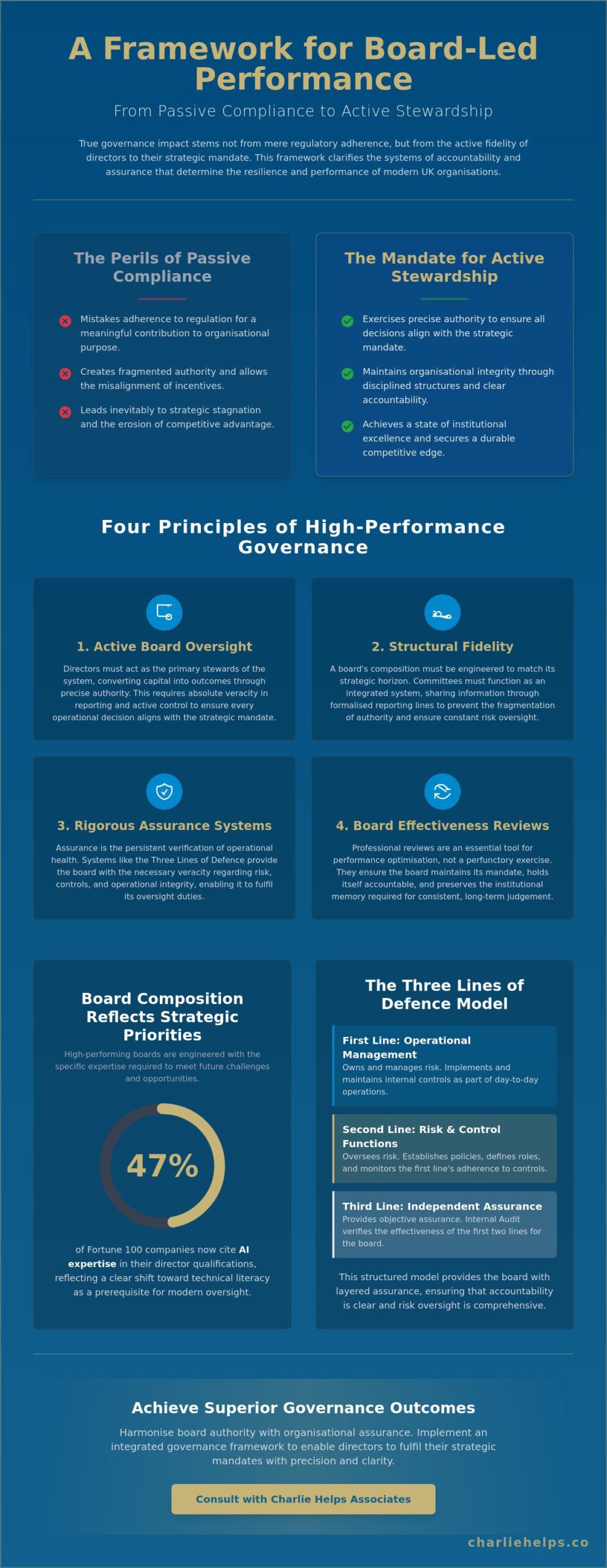
- Implement rigorous assurance systems, such as the three lines of defence model. These systems provide the board with the necessary veracity regarding risk, controls, and operational health.
- Utilise professional board effectiveness reviews as an essential tool for performance optimisation. These reviews ensure the board maintains its mandate, accountability, and institutional memory.
- Adopt integrated governance frameworks and workflow optimisation tools to harmonise board authority with organisational assurance. These systems enable directors to fulfil their strategic mandates with precision and clarity.
The Direct Correlation Between Board Oversight and Strategic Outcome
Board-level authority is the origin of all organisational movement. Directors do not simply occupy seats; they act as the primary stewards of a system that converts capital and human effort into tangible outcomes. The governance impact on organisational performance is most visible when the Board exercises precise authority over the executive function, ensuring that every operational decision aligns with the established strategic mandate. This relationship relies on the integrity of the corporate governance principles adopted by the firm, which dictate how power is distributed, how accountability is enforced, and how risk is mitigated.
Performance remains a consequence of active control rather than a byproduct of passive compliance. Whilst compliance ensures the organisation avoids penalty, active control ensures it achieves its purpose. Institutional memory serves as a stabilising force in this process, providing the historical context necessary to prevent the repetition of past errors and to maintain a consistent trajectory during periods of growth. Boards that cultivate this memory ensure that strategic alignment is not a fleeting state but a permanent characteristic of the organisation.
The Board as the Architect of Performance
Directors shape organisational culture through the deliberate implementation of policy, the setting of ethical standards, and the consistent modelling of leadership behaviours. This architecture requires absolute veracity in reporting; without accurate data, the Board cannot make the informed judgements necessary to guide the enterprise. Board fidelity to the strategic goal ensures that the organisation does not drift into peripheral activities that dilute its core mission. When directors remain faithful to their mandate, they create the structural conditions required to realise long-term value.
Moving Beyond Compliance to Active Control
Legal compliance is the baseline, not the ambition. High-performing organisations distinguish themselves by the active pursuit of excellence, where directors seek to exceed regulatory minimums to secure a competitive advantage. Active control is the persistent verification of operational health. Audit and risk committees fulfil their oversight duties by interrogating evidence, identifying systemic risks, and verifying the efficacy of internal controls. This rigorous scrutiny prevents performance drift and provides the Board with the assurance that the organisation remains on its intended path.
Structural Fidelity: How Directors Organise for High Performance
Structural fidelity requires directors to align the Board’s composition with the organisation’s strategic horizon. High-performing boards are engineered, not merely assembled; they reflect a deliberate choice to match specific expertise with the risks and opportunities of the coming decade. As of 2025, 47% of Fortune 100 companies now cite AI expertise within their director qualifications, reflecting a shift toward technical literacy as a prerequisite for oversight. The governance impact on organisational performance is most pronounced when the Board possesses the cognitive diversity required to interrogate executive assumptions without causing operational friction. Precision in structure precedes excellence in action.
Committees must function as an integrated system rather than isolated silos. When the Audit, Risk, and Nominating committees share information through formalised reporting lines, they prevent the fragmentation of authority. This structural cohesion ensures that risk oversight remains a constant presence in every strategic discussion. Clear reporting lines provide the Board with the veracity needed to judge performance accurately, ensuring that delegated authority does not become a vacuum for accountability. Boards that organise with such discipline achieve a level of strategic agility that their less structured peers cannot replicate.
The Role of the Independent Director
Independent directors provide the critical distance necessary for objective assurance. Their role is to offer an external perspective that challenges executive bias and prevents the stagnation of “groupthink” within the boardroom. By maintaining this distance whilst remaining intellectually engaged, independent directors ensure the Board remains faithful to its long-term mandate. This objective oversight is essential for the realisation of sustainable value, as it forces a focus on institutional health over short-term financial metrics. Their presence acts as a safeguard against the moral and strategic drift that often precedes organisational failure.
Optimising Boardroom Workflows
Digital process management tools reduce the friction inherent in manual board reporting. The transition from physical papers and disparate emails to automated assurance systems allows directors to focus on interpretation and judgement rather than data collection. This evolution in workflow is critical for maintaining institutional memory and ensuring that every decision is backed by a verifiable trail of evidence. For organisations navigating these changes, A Senior Management Guide to AI Governance Transition provides a necessary framework for integrating technology into the boardroom. Boards that wish to refine their internal structures may seek advisory services to ensure their governance architecture supports high performance.
Assurance Systems and the Verification of Operational Health
Boards cannot lead in the dark. Assurance provides the light. It is the primary mechanism for verifying that operational reality matches strategic intent, ensuring that the Board’s mandate is not lost in the layers of management. The governance impact on organisational performance is secured when directors receive accurate, timely, and verified information regarding the efficacy of internal controls. Without a rigorous system of verification, the Board relies on hope rather than evidence, a position that invites strategic drift and operational failure.
Internal audit serves as the final arbiter of operational fidelity. It provides the Board with credible evidence that policies are not merely documents on a shelf but are active principles guiding daily behaviour. By interrogating the veracity of management reports, internal audit functions allow directors to identify systemic weaknesses before they manifest as crises. This disciplined approach to verification ensures that accountability remains a lived reality throughout the organisation, providing the Board with the assurance required to fulfil its duty of care.
The Three Lines of Defence in 2026
Operational management, as the first line of defence, owns the risk and remains accountable for the implementation of controls. Oversight functions, comprising the second line, establish the standards and monitor compliance, yet they lack the independence required for final verification. The Board must therefore rely upon the independent internal audit (the third line) to provide an objective assessment of the entire control environment. This integrated reporting structure allows directors to achieve a holistic view of performance, ensuring that every part of the system remains aligned with the strategic goal.
Risk Appetite as a Performance Driver
A clearly defined risk appetite does not restrict growth; it enables it by providing the parameters for bold strategic movement. When directors articulate their tolerance for uncertainty, they empower management to act with confidence within those bounds. Rigorous risk controls ensure that this movement does not descend into reckless behaviour or ethical compromise. Risk appetite is the board-approved boundary for strategic execution. By aligning risk-taking with the organisation’s capacity to absorb loss, the Board ensures that strategic goals are realised without compromising long-term stability or institutional memory.
Evaluating Effectiveness Through Rigorous Board Reviews
Boardroom stagnation is a silent risk. The Board must interrogate its own efficacy with the same rigour it applies to executive performance, ensuring that the collective leadership remains fit for its strategic purpose. The governance impact on organisational performance is directly correlated to the Board’s ability to self-correct and adapt to shifting regulatory and operational demands. A professional review identifies the subtle fractures in dynamics or capability before they compromise strategic execution, providing a clear map for institutional improvement.
A professional review serves as a diagnostic tool rather than a retrospective audit. It requires directors to confront the reality of their performance, the quality of their debate, and the fidelity of their decisions to the organisation’s long-term mandate. By moving from a culture of politeness to one of professional challenge, the Board secures the assurance needed to lead with confidence. This process ensures that the Board remains an active enabler of success rather than a historical artifact of past priorities.
Components of a Professional Board Effectiveness Review
Assessing the quality of board dynamics, chair leadership, and committee performance is the foundation of a meaningful evaluation. This assessment must also scrutinise the veracity and clarity of information flows between the executive team and the board, as poor data inevitably leads to poor judgement. Directors should evaluate whether committees possess the technical literacy required for modern oversight, particularly regarding emerging risks. For a comprehensive methodology, boards should consult The Definitive Board Effectiveness Review Guide for 2026.
From Review to Performance Mentoring
Bridging the capability gap identified during a review requires more than a report; it requires action. Boards fulfil their development mandates through structured interventions, such as executive coaching or executive performance mentoring. This approach addresses the human element of governance, ensuring that leadership capability matches the complexity of the organisational environment. Mentoring fosters a culture of accountability, continuous improvement, and intellectual force, which are essential for maintaining high performance over the long term.
The shift from triennial snapshots to continuous performance monitoring allows for real-time adjustments to board behaviour and composition. This evolution ensures that the Board maintains its strategic alignment and remains responsive to the needs of its stakeholders. To initiate a professional evaluation of your board’s efficacy and bridge the gap between intent and action, you may contact our advisory team for a confidential consultation.
Implementing Governance Frameworks with Charlie Helps Associates
Charlie Helps Associates operates at the intersection of structural systems and human behaviour. We provide the specialised expertise required to harmonise board-level authority with operational execution. The governance impact on organisational performance is not an abstract concept but a measurable outcome of our Integrated Governance Frameworks. By focusing on structural fidelity, we ensure that the Board’s mandate is translated into specific, verifiable actions throughout the organisation. We recognise that data alone does not ensure success; instead, the human capability to interpret that data determines the organisation’s resilience, longevity, and ethical standing.
Verification and clarity are the hallmarks of our proprietary Workflow Optimisation SaaS Solution, which removes the friction commonly found in boardroom reporting. This system ensures that directors receive information with the veracity and speed necessary for high-stakes decision-making. We move beyond the limitations of generic management consulting by treating corporate governance as a distinct, rigorous discipline. This transition from assessment to institutional movement allows boards to maintain a persistent state of active control, ensuring that authority remains rooted in evidence rather than mere assumption.
Consulting for Organisational Performance Excellence
Advisory services from Charlie Helps Associates provide tailored governance frameworks that match the specific risks of the UK market. Our Integrated Governance Frameworks allow directors to harmonise legal requirements with strategic aspirations, ensuring that compliance never comes at the expense of growth. We also provide Boardroom AI and AI Governance services to ensure directors possess the technical assurance required to navigate the UK Data Protection Act 2018 (Regulations 2026). Our mentoring and coaching services further support this by addressing the human capability gaps that often hinder strategic execution. We work with chairs and directors to refine their leadership behaviours, ensuring that the Board functions as a cohesive, intellectually forceful, and strategically aligned unit. Leaders who wish to enhance their strategic alignment should contact us for a confidential consultation on board effectiveness.
The Path Forward for UK Boards
Excellence in the boardroom remains the primary catalyst for institutional movement. Performance is never an accident; it is the result of deliberate action, verifiable accountability, and the constant verification of operational health. As we look toward 2026, the boards that thrive will be those that embrace structural fidelity and cultivate a culture of professional challenge. They will be the ones who realise their strategic goals through disciplined leadership, precise mandates, and a clear-eyed view of global trends. Does your board currently exercise the level of active control required to secure your organisation’s future?
Securing the Future through Disciplined Stewardship
Leadership requires more than intention; it demands the persistent application of structural fidelity. Directors who cultivate institutional memory, implement rigorous assurance systems, and maintain active control ensure that their organisations remain resilient amongst the complexities of the modern regulatory landscape. The governance impact on organisational performance is realised when Boards bridge the gap between strategic intent and operational health through evidenced movement. This disciplined approach ensures that accountability remains a lived reality rather than a mere policy requirement.
Charlie Helps Associates provides the UK-wide strategic advisory expertise and proprietary Workflow Optimisation SaaS Solution required to achieve this level of precision. Our specialist corporate governance consultants assist you in aligning authority with accountability to fulfil your strategic mandate. Contact Charlie Helps Associates to architect your board’s performance framework. The path to institutional excellence remains open to those who choose the rigour of professional challenge over the comfort of boardroom stagnation.
Frequently Asked Questions
How does corporate governance directly affect profit and organisational performance?
The Board affects profit by ensuring strategic alignment and resource efficiency. When directors enforce rigorous oversight, they mitigate waste and ensure capital is utilised toward high-yield objectives. Research from 2025 indicates that firms with high governance support for shareholder proposals often outperform peers, as disciplined oversight prevents the accumulation of operational friction and ensures that management remains focused on value creation.
What are the key indicators of a high-performing board in the UK?
High-performing boards exhibit technical literacy, cognitive diversity, and a culture of professional challenge. Indicators include the veracity of information flows between executive and non-executive members, the frequency of evidenced-based decision-making, and the presence of clear accountability frameworks. Boards that prioritise structural fidelity ensure that their composition matches the specific risks of the UK market, such as AI-related regulatory changes or climate disclosure requirements.
Can a board effectiveness review actually improve operational efficiency?
Directors use a board effectiveness review to improve efficiency by identifying systemic fractures in authority and communication. When the Board scrutinises its own dynamics, it often uncovers misalignments between board-level strategy and operational execution. Resolving these issues allows the organisation to realise strategic goals without the drag of fragmented accountability, redundant reporting lines, or poor information flow from the executive team.
What is the role of risk management in driving organisational performance?
Risk management systems provide the parameters for safe strategic movement. By establishing a clear risk appetite, the Board allows management to act with confidence within defined boundaries. This disciplined approach prevents reckless behaviour whilst ensuring that the organisation capitalises on material opportunities, thereby securing the positive governance impact on organisational performance through controlled, purposeful growth and the mitigation of systemic failure.
How do independent directors contribute to strategic performance goals?
Independent directors contribute by providing the objective assurance necessary to challenge executive bias. Their external perspective prevents “groupthink” and ensures the Board remains faithful to its long-term mandate. By maintaining a critical distance, they help the organisation fulfil its strategic objectives whilst protecting institutional memory and stakeholder interests, ensuring that short-term pressures do not compromise long-term institutional health.
Why is board-level accountability essential for long-term institutional health?
Accountability ensures that those with authority remain answerable for the outcomes of their decisions. Without a clear map of responsibility, organisations suffer from moral drift, strategic stagnation, and a lack of risk control. Boards that enforce accountability at every level ensure that the organisation maintains its integrity, purpose, and resilience against external shocks, providing stakeholders with the assurance that authority is exercised with fidelity.
What is the difference between governance compliance and governance for performance?
Compliance is a reactive baseline focused on adhering to regulations, whilst governance for performance is a proactive pursuit of excellence. Directors who prioritise performance use governance structures to achieve strategic alignment and operational veracity. This approach ensures that the organisation does not merely avoid penalties but actively thrives through superior oversight, active control, and the deliberate pursuit of institutional goals.
How can workflow optimisation software improve board-level oversight?
Workflow optimisation software reduces the friction inherent in manual reporting and disparate data collection. By automating assurance systems, these tools provide directors with real-time veracity regarding operational health and risk controls. This enables the Board to focus on strategic judgement rather than administrative tasks, thereby enhancing the governance impact on organisational performance through faster, more informed decision-making and improved institutional memory.
Disclaimer
The articles published on CharlieHelps.co are provided for general information, reflection, and commentary. They draw on professional experience, research, and interpretation, but they do not constitute legal, regulatory, financial, clinical, governance, risk, compliance, assurance, or other professional advice. Nothing published on this site should be relied upon as practice guidance, formal instruction, or a substitute for proper professional consultation. Readers should seek advice from suitably qualified advisers before acting on, applying, or relying upon any material in relation to their own organisation, Board, duties, circumstances, or decisions. Although reasonable care is taken to ensure that articles are accurate and current at the time of publication, no warranty is given as to completeness, accuracy, timeliness, or fitness for any particular purpose. Law, regulation, policy, standards, and recognised practice may change, and context matters. References to external sources, organisations, products, services, or third-party materials are included for information only. They do not imply endorsement unless expressly stated. Where an article contains affiliate links, sponsored references, or commercial relationships, these will be disclosed where relevant. The views expressed are those of the author unless otherwise stated. Reading, sharing, or responding to material on this site does not create a client, adviser, fiduciary, or professional relationship with Charlie Helps FRSA, CharlieHelps.co, or any associated entity. Readers remain responsible for their own judgement, decisions, and actions.
