

Reliance is not a passive act of trust; it is a calculated exercise of judgement rooted in the veracity of evidence. Many UK directors currently struggle with a difficult paradox: they are inundated with data yet starved of clarity. Reports frequently focus on management intentions rather than providing evidence of movement, often leaving the Board in a reactive posture. With the 2024 UK Corporate Governance Code demanding greater accountability for internal controls from 2026, the requirement for sophisticated Board Assurance has never been more urgent.
You likely recognise that true oversight requires more than a signature on a compliance statement. This guide provides a rigorous examination of how Boards exercise judgement through evidenced reliance rather than mere compliance. We shall explore the architecture of a clear oversight mandate, the methods for verifying the veracity of management information, and the ways to realise strategic alignment between risk appetite and institutional action. We move from the philosophical requirements of leadership to the practical implementation of governance as an active, human-centric process.
Key Takeaways
- Define the mandate for Board Assurance by distinguishing between internal control mechanisms and the overarching requirement for evidenced reliance.
- Establish a credible framework by aligning strategic objectives with principal risks through the Three Lines of Defence model.
- Shift from passive compliance to active oversight by demanding evidence of movement rather than accepting management’s stated intentions.
- Integrate AI governance into existing risk frameworks to ensure directors maintain authority over emerging technological systems.
- Realise a mature assurance environment that avoids the pitfalls of consultancy theatre and focuses on the veracity of institutional data.
The Architecture of Board Assurance: Veracity and Mandate
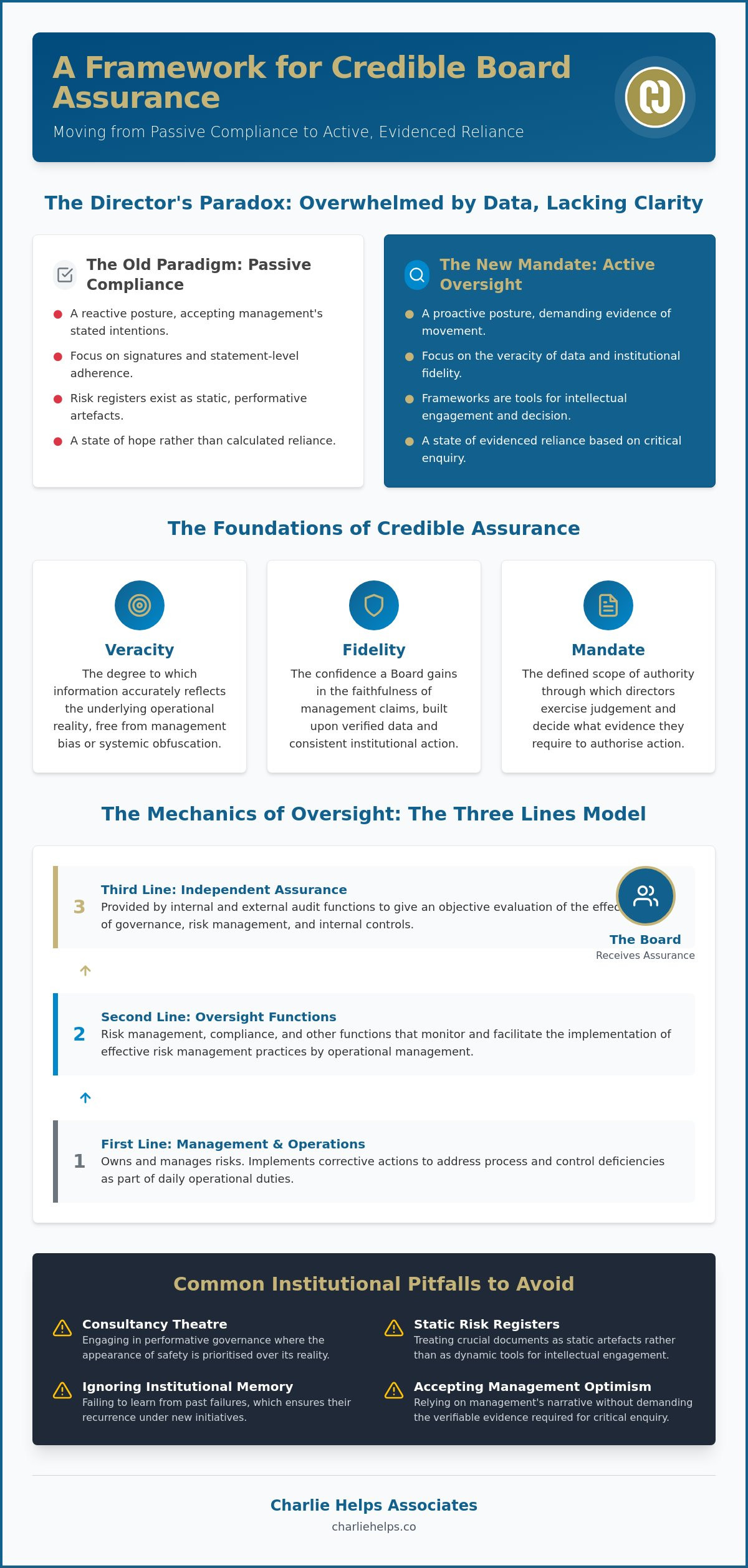
Assurance is a human act. It is the method by which a Board gains confidence in the fidelity of management claims. Whilst internal controls provide the mechanics and risk management identifies the threats, the assurance mandate provides the lens through which directors view reality. Board Assurance attaches to evidenced movement through a credible plan; it rejects the comfort of mere intention. Directors must decide which evidence they require to authorise institutional action. Without this active enquiry, the Board remains a passenger to management’s narrative.
The Distinction Between Oversight and Execution
The Board authorises the mandate, yet management implements the tactical response. This distinction is vital to avoid the performative trap of consultancy theatre. In such environments, risk registers exist as static artefacts rather than tools for intellectual engagement. Directors must identify the specific Aim: they must ask exactly what they need to be assured of before they can fulfil their duties. When directors fail to engage intellectually with these registers, they risk implementing a culture of compliance that prioritises the appearance of safety over its reality. This clarity prevents the Board from becoming a reactive body that merely mirrors management’s optimism. By adopting a Policy Governance model, the Board establishes clear boundaries that constrain executive action whilst enabling operational freedom. It allows directors to focus on the ends rather than the means.
Fidelity and the Veracity of Institutional Data
Data without context is noise. It fails to provide the veracity required for strategic decision-making. If a report indicates a project is on track but fails to mention the exhaustion of the workforce, it lacks fidelity. Institutional memory acts as a safeguard; it ensures the Board remembers past failures to prevent their recurrence. A Board that ignores its own history is destined to implement the same flawed strategies under new titles. Veracity in Board-level reporting is the degree to which information accurately reflects the underlying operational reality, free from the distortions of management bias or systemic obfuscation. When directors verify this veracity, they realise a higher standard of institutional fidelity. They move from a state of hope to a state of evidenced reliance.
Mechanics of a Credible Board Assurance Framework
A credible Board Assurance framework functions as a living map of institutional health. It is not a static repository of data. Instead, it links strategic objectives directly to principal risks and the controls intended to mitigate them. To remain workable, the framework must avoid becoming a source of administrative friction. The Board uses this structure to decide where to place its reliance and where to demand deeper enquiry. This is the difference between passive receipt of information and active oversight.
The Three Lines of Defence model provides a necessary hierarchy for this oversight. In the first line, management implements controls during daily operations. The second line consists of oversight functions, such as risk and compliance, which monitor these controls. The third line provides independent assurance through internal and external audit. This model ensures that no single individual or system operates without a counterweight of critical enquiry. It allows the Board to realise a higher degree of fidelity in its decision-making.
Strategic Objectives and Principal Risks
Directors must identify risks that threaten the core of the institutional mandate. It’s not enough to list generic hazards. The Board must align its risk appetite with the actual capacity for organisational action. Crucially, a framework must explicitly state what remains unknown. Identifying these blind spots is an act of leadership that prevents the Board from reacting blindly to crises. When a Board acknowledges the limits of its information, it can focus its authority on the most critical areas of institutional memory and foresight.
The Role of Internal and External Audit
Committees filter and validate the evidence of reliance. They must distinguish between a hard fact, a professional judgement, and a management assumption. The UK Government’s guidance on assurance emphasises that frameworks should provide a structured approach to this validation. Many Boards engage corporate governance consultants UK to validate the architecture of their framework. This ensures the system remains robust whilst remaining accessible to those who must use it. You may wish to discuss your framework architecture with our advisory team to ensure it meets your specific institutional needs.
Moving from Passive Compliance to Active Oversight
A green RAG status is often a comfort blanket for the unprepared. It suggests stability where there may be stagnation. Genuine Board Assurance requires directors to look beyond the traffic light indicators to interrogate the underlying reality. They must demand evidence of movement rather than accepting promises of future action. Promises are merely intentions; the Board requires realised progress to fulfil its fiduciary duties. When directors settle for intentions, they risk the institutional drift that precedes a crisis.
Systems don’t fail; people do. The behaviour of leaders remains the ultimate control mechanism within any organisation. When a culture permits silence or rewards obfuscation, even the most sophisticated framework will crumble under the weight of human error. Reducing operational friction is essential to ensure high-fidelity information reaches the C-suite without the distortion of management filters. By streamlining the flow of data, directors can ensure they are making decisions based on facts rather than polished narratives.
The Intellectual Discipline of the Board Effectiveness Review
Directors should treat the board effectiveness review as a rigorous diagnostic tool rather than a periodic ritual. This process identifies who holds the authority to challenge the veracity of reports. If no member of the Board asks “how do we know this is true?”, the body remains a spectator to its own governance. Professional coaching and mentoring help directors improve their inquisitive capacity. This ensures they possess the intellectual force to interrogate management assumptions and identify systemic weaknesses before they manifest as operational failures.
Institutional Memory and the Prevention of Drift
Strategic drift occurs when the logic behind past decisions is lost to time. A robust framework preserves this institutional memory, ensuring that current actions remain aligned with long-term purpose. The Company Secretary acts as the custodian of this governance record, maintaining the fidelity of the Board’s decisions. Modern workflow optimisation software can automate the capture of these decisions, creating a permanent audit trail of Board intent and action. If you require assistance in moving from passive oversight to active assurance, contact our advisory team to discuss a bespoke architecture for your Board.
Implementing a Framework for Strategic Value
Realising a mature assurance environment requires the rejection of performative gestures. Directors must architect systems that serve the institutional mandate rather than satisfy a compliance checklist. This transition from consultancy theatre to practical judgement marks the difference between a Board that merely observes and one that actively leads. Effective Board Assurance ensures that every decision rests on a foundation of verified movement. It requires a commitment to intellectual honesty and a refusal to accept unevidenced management claims.
Systems that provide clarity are superior to those that provide volume. The goal is to create a steady, guided conversation between the Board and the executive team. When information flows with fidelity, the Board can exercise its mandate with confidence. This alignment creates a culture where risk appetite is not a theoretical limit but a practical guide for institutional action. Practicality remains the hallmark of a framework that supports, rather than hinders, strategic growth.
The Integration of AI and Digital Assurance
Boards must exercise oversight of AI systems without becoming lost in technical jargon. This is not a challenge of computer science; it is a challenge of authority, mandate, and institutional ethics. Directors should demand that AI-generated insights maintain the same fidelity as any other management report. Digital tools now allow for real-time assurance, replacing the historical latency of quarterly reflections with immediate awareness of operational drift. By integrating AI governance into existing risk frameworks, the Board ensures that technological systems remain subservient to human-centric strategy.
Engaging Professional Governance Advisory
External mentoring and coaching services enhance the Board’s collective performance by offering a clear-eyed view of organisational culture. These advisory services help directors fulfil their regulatory obligations with restraint and precision, avoiding the trap of over-governance. A tailored framework remains workable because it focuses on the essential levers of institutional safety. The final implication for any UK director is clear. A decision is required today to move from passive receipt of data to active verification of movement. You must identify your Aim, establish who has authority, and decide what evidence supports your reliance.
Contact Charlie Helps Associates to architect your bespoke assurance framework.
Securing Institutional Fidelity through Evidenced Reliance
True oversight is a human behaviour, not a mechanical output. Directors must move beyond the receipt of static reports to demand verified movement through a credible plan. By prioritising the veracity of institutional data, and maintaining a clear mandate for enquiry, Boards can prevent the strategic drift that precedes systemic failure. Effective Board Assurance requires this intellectual discipline, ensuring that every strategic decision rests on a foundation of reality rather than management optimism.
The path to a mature governance environment involves integrating modern risks into a framework that remains workable and precise. As authoritative UK Corporate Governance Consultants, we help leaders architect these systems to enhance institutional fidelity. Our proprietary Workflow Optimisation SaaS solution reduces operational friction, whilst our specialists in AI Governance and Boardroom AI ensure your oversight remains relevant in a complex landscape. We invite you to architect your Board Assurance Framework with Charlie Helps Associates to realise a higher standard of leadership. Your commitment to rigorous enquiry today will secure the Aim, authority, and evidence required for tomorrow.
Frequently Asked Questions
What is the primary purpose of a Board Assurance Framework?
The primary purpose of a Board Assurance Framework is to provide directors with the evidenced reliance required to realise strategic objectives whilst constraining principal risks. It functions as a map that connects the Board’s mandate to operational reality. By verifying the fidelity of management information, the framework allows the Board to exercise its authority with intellectual confidence and professional restraint.
How does Board Assurance differ from a standard Risk Register?
A standard Risk Register identifies potential hazards and their theoretical impact upon the organisation. Board Assurance, however, focuses on the veracity of the controls intended to mitigate those hazards. Whilst a register tracks what might go wrong, an assurance framework provides evidence of what is actually occurring. It shifts the focus from identifying a potential problem to verifying the effectiveness of the realised solution.
Who has the ultimate authority for the veracity of the Board Assurance Framework?
The Board of Directors holds the ultimate authority for the veracity of the framework and the information it contains. Whilst management implements the systems and provides the data, the Board decides whether that information is sufficient to support reliance. Directors cannot delegate the intellectual duty of enquiry. They must personally verify that the evidence provided matches the institutional reality they oversee.
Can a Board Assurance Framework prevent organisational failure?
A framework cannot act as an absolute guarantee against failure, but it provides the foresight required to identify strategic drift before it manifests as a crisis. It functions as an early warning system by highlighting gaps in control or evidence. When directors use the framework to challenge management assumptions, they create the intellectual friction necessary to halt systemic decline and implement corrective action.
How often should a Board review its assurance evidence?
Boards should review their assurance evidence at every formal meeting to maintain a constant grip on institutional health. A deeper, more rigorous examination typically occurs annually as part of the Board effectiveness review. This frequency ensures that the Board’s reliance remains rooted in current facts rather than historical assumptions. Continuous oversight prevents the framework from becoming a static document of mere intention.
What role does institutional memory play in Board-level oversight?
Institutional memory preserves the logic behind past decisions to prevent the repetition of historical errors. It ensures that the Board’s current actions remain aligned with the long-term mandate of the organisation. Without this memory, a Board risks implementing flawed strategies that have failed before under different titles. It acts as a safeguard against the strategic amnesia that often precedes organisational failure.
Disclaimer
The articles published on CharlieHelps.co are provided for general information, reflection, and commentary. They draw on professional experience, research, and interpretation, but they do not constitute legal, regulatory, financial, clinical, governance, risk, compliance, assurance, or other professional advice.Nothing published on this site should be relied upon as practice guidance, formal instruction, or a substitute for proper professional consultation. Readers should seek advice from suitably qualified advisers before acting on, applying, or relying upon any material in relation to their own organisation, Board, duties, circumstances, or decisions.Although reasonable care is taken to ensure that articles are accurate and current at the time of publication, no warranty is given as to completeness, accuracy, timeliness, or fitness for any particular purpose. Law, regulation, policy, standards, and recognised practice may change, and context matters.References to external sources, organisations, products, services, or third-party materials are included for information only. They do not imply endorsement unless expressly stated. Where an article contains affiliate links, sponsored references, or commercial relationships, these will be disclosed where relevant.The views expressed are those of the author unless otherwise stated. Reading, sharing, or responding to material on this site does not create a client, adviser, fiduciary, or professional relationship with Charlie Helps FRSA, CharlieHelps.co, or any associated entity.Readers remain responsible for their own judgement, decisions, and actions.
