

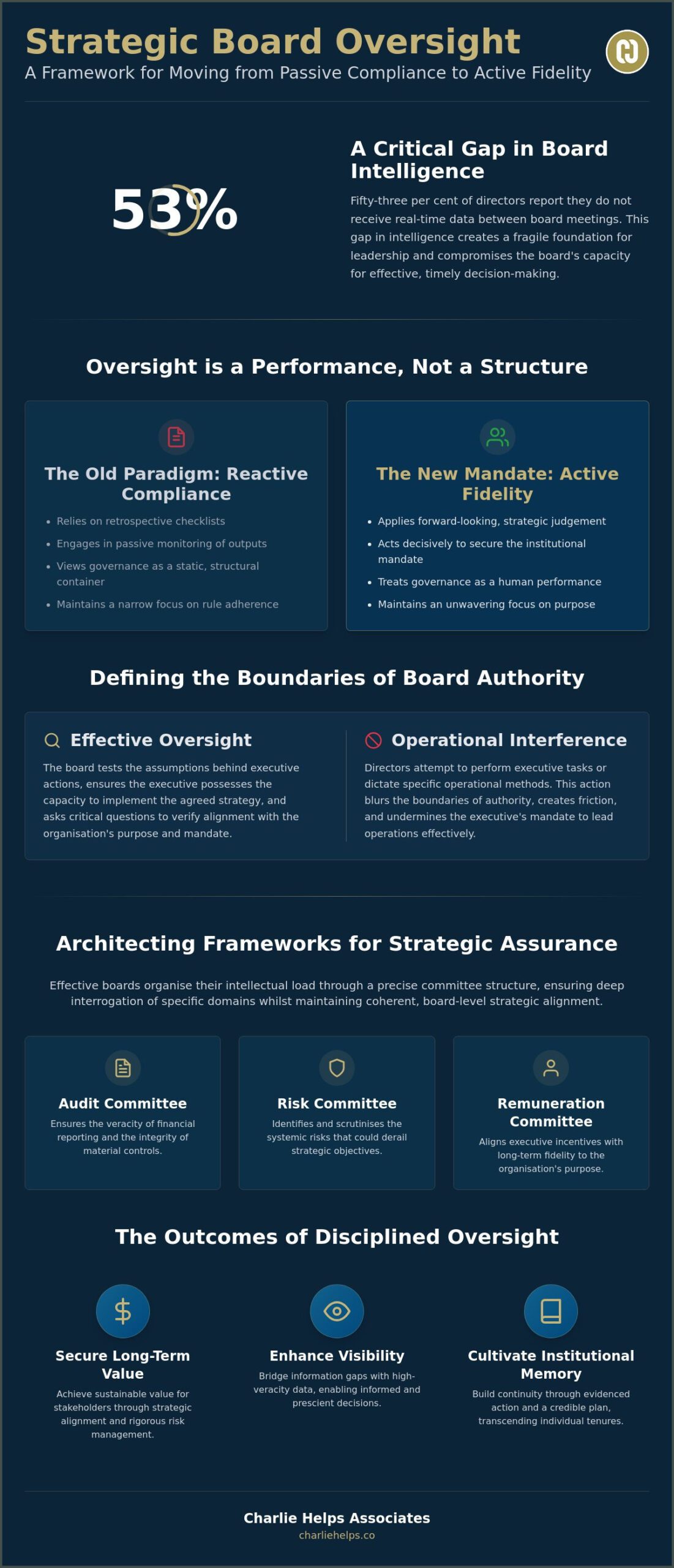
Fifty-three per cent of directors report that they do not receive real-time data between board meetings. This gap in intelligence creates a fragile foundation for leadership. Whilst the 2024 UK Corporate Governance Code mandates rigorous transparency, many boards remain trapped in a cycle of reactive compliance. Effective strategic board oversight is not a passive structural state; it is a human performance of fidelity to an organisation’s purpose and mandate.
You likely recognise the tension between the requirement for deep assurance and the risk of operational interference. As Provision 29 requires boards to make explicit declarations on material controls starting in 2026, the need for clarity has never been more urgent. This article provides a rigorous examination of how directors perform oversight as an active discipline to realise long-term value. We shall define the precise boundaries of board authority, investigate the cultivation of institutional memory, and align strategic ambition with systemic risk.
Key Takeaways
- Define strategic board oversight as an active performance of fidelity to the institutional mandate, moving beyond passive compliance structures.
- Distinguish between monitoring operational outputs, overseeing strategic direction, and preventing board interference in executive management.
- Architect committee frameworks that prioritise strategic alignment, risk assurance, and long-term organisational value.
- Evaluate the behavioural dynamics and intellectual force within the boardroom that determine the veracity and quality of information provided to directors.
- Realise enhanced visibility and institutional memory through a credible plan that integrates workflow optimisation software into the board’s regular cycle.
The Nature of Strategic Board Oversight as an Active Discipline
Oversight is not a structural container. It is an active discipline performed by directors to secure the institutional mandate. Whilst many view Corporate Governance as a set of static rules, it is actually the continuous exercise of authority and judgement. Effective strategic board oversight requires directors to distinguish between monitoring yesterday’s operational outputs and architecting tomorrow’s strategic direction. This distinction ensures that the board remains a source of wisdom rather than a redundant layer of administration.
Directors must specifically act to constrain or enable management through clear authority. When a board merely observes, it abdicates its primary function. Realising long-term value requires a level of lucidity in board reporting that reduces information asymmetry. Without this clarity, boards remain blind to the risks management may inadvertently conceal or ignore. High-quality reporting serves as the connective tissue between executive intent and board assurance, allowing directors to verify that resources align with the stated strategy. It is the board’s duty to demand the veracity of data before making critical decisions.
The Distinction Between Oversight and Interference
The boundary where oversight ends and micro-management begins is often blurred. This boundary is defined by the board mandate. Micro-management occurs when directors attempt to perform executive tasks rather than testing the assumptions behind them. The Chair maintains the equilibrium between support and challenge. They ensure the board provides a steady hand without seizing the wheel, focusing on whether the executive team possesses the capacity to implement the agreed strategy. Clear boundaries prevent friction and preserve the executive’s mandate to lead operations.
Fidelity to Purpose: The Board’s Primary Mandate
Institutional fidelity sits at the core of effective governance. Fidelity is the alignment of action with stated organisational values. Directors secure the long-term interests of stakeholders through active enquiry rather than passive acceptance. They must ask the difficult questions that management might avoid, ensuring the organisation remains true to its founding purpose whilst fulfilling its strategic plan. This requires a commitment to veracity that transcends mere compliance checklists. It is a human performance: a board decides to prioritise ethics over short-term gain, or sustainability over immediate profit, based on the evidence presented.
Architecting Frameworks for Strategic Oversight and Risk
Boards must organise themselves with precision to fulfil their oversight obligations. Whilst traditional compliance-led models often focus on retrospective checklists, modern strategic board oversight requires a forward-looking architecture that integrates risk with strategic ambition. This shift represents The New Paradigm of Corporate Governance, where boards move from being passive monitors to active partners in value creation. By utilising integrated governance frameworks, directors can navigate complex regulatory environments without losing sight of the institutional mandate. Assurance becomes the mechanism to verify that management plans are moving toward completion through evidenced action.
The Role of Committees in Distributing Authority
Committees distribute the board’s intellectual load, allowing for deeper interrogation of specific domains. The Audit Committee ensures the veracity of financial reporting, whilst the Risk Committee identifies the uncertainties that could derail the strategy. The Remuneration Committee aligns executive incentives with long-term fidelity to the organisation’s purpose. To maintain coherence, the board must ensure committee findings inform the full agenda rather than existing in silos. Clear terms of reference are essential; they prevent gaps in oversight and ensure no critical risk remains unexamined. Effective chairs ensure these sub-groups remain focused on their specific mandates to prevent the duplication of effort.
Risk Accountability and the Assurance Map
Directors use assurance maps to identify where evidence supports reliance. These maps provide a visual representation of the three lines of defence, showing exactly where the organisation has verified movement through a credible plan. Given that 53 per cent of directors report a lack of real-time data between meetings, according to a 2026 survey, the assurance map becomes a vital tool for bridging information gaps. This transition from mere intention to evidenced movement is critical for maintaining institutional memory. Boards often use a board effectiveness review as a diagnostic tool to evaluate whether these frameworks remain fit for purpose. Those seeking to refine their internal architecture may benefit from professional advisory services to ensure their frameworks remain resilient and functional against emerging threats.
The Human Element: Behavioural Dynamics in the Boardroom
The boardroom is an arena of human will where the intellectual force of leadership determines the quality of assurance. When directors lack the vigour to challenge management, the veracity of information shared with the board inevitably declines. Effective strategic board oversight relies upon the board’s capacity to penetrate management’s narrative and identify the underlying reality of organisational performance. This human element dictates whether governance is a performative ritual or a rigorous exercise of fidelity. Directors must possess the psychological resilience to remain objective, ensuring that personal allegiances do not compromise their duty to the institutional mandate.
Professional coaching serves as a vital tool for enhancing board-level performance. It provides directors with the reflective space required to refine their approach to support and challenge. By focusing on individual and collective behaviour, coaching helps the board navigate the complexities of power and influence. This ensures the board possesses the requisite intellectual force to maintain oversight during periods of high pressure or systemic change. High-performing boards recognise that their effectiveness is a function of their human dynamics, not merely their structural compliance.
Cultivating a Culture of Candour and Veracity
The board defines the ethical climate of the organisation through its actions and enquiries. Directors must actively encourage management to share bad news early, fostering an environment where reality is preferred over optimism. This cultural shift requires deliberate effort and often involves board dynamics consulting to address the psychological barriers to transparency. When management feels safe to report failures, the board can act to rectify issues before they escalate into systemic crises. Candour is the bedrock of veracity, and veracity is the prerequisite for effective oversight.
Institutional Memory and Succession Planning
Institutional memory represents the collective wisdom and historical context held by the board. It acts as a safeguard against repeating past errors and ensures that strategic decisions align with the organisation’s long-term identity. Succession planning secures the continuity of strategic board oversight, ensuring that new directors can access this reservoir of experience. Protecting this memory is a primary responsibility, as it informs the board’s judgement on the credibility of management’s future plans. Without a clear understanding of the organisation’s history, boards risk making decisions in a vacuum, detached from the reality of past successes and failures.
To refine the human performance within your boardroom, consider engaging our expert mentoring services to align leadership behaviour with institutional fidelity.
Implementing Oversight: Practical Steps for UK Boards
Realising effective strategic board oversight requires a transition from abstract intention to evidenced movement. Directors must implement a credible plan that move beyond the limitations of periodic board packs. To address the intelligence gap where over half of directors lack real-time data, boards should integrate digital tools such as workflow optimisation software. These systems enhance visibility by providing a continuous stream of verifiable data, ensuring that the board’s reliance on management is based on fact rather than optimism. A board that cannot see the work cannot oversee the strategy.
Evaluation is the final component of a resilient oversight architecture. Directors should treat the board effectiveness review not as a compliance hurdle, but as a diagnostic exercise to ensure their methods remain fit for purpose. This self-reflection allows the board to identify where information asymmetry persists and where the collective intellectual force of the room requires sharpening. By making these adjustments, the board maintains its fidelity to the institutional mandate and secures long-term organisational value.
The Five-Point Utility Test for Board Decisions
Boards can reduce noise and focus on strategic priorities by applying a rigorous utility test to every paper presented for decision. This framework requires management to explicitly state the Aim of the proposal, the Authority under which it is made, the specific Decision required, the Evidence supporting the recommendation, and the remaining Risks. Such a structure forces a level of lucidity that traditional reporting often lacks. The board’s primary role in this process is to verify the fidelity of executive reports by interrogating the veracity of the evidence provided. This discipline ensures that every decision is an act of informed judgement rather than a reaction to incomplete narratives.
Leveraging AI and Data for Enhanced Oversight
The emergence of AI governance presents both a challenge and an opportunity for modern boards. A 2026 survey indicates that 84 per cent of directors have altered their approach to scenario planning in response to technological advancements, reflecting a shift toward more data-driven oversight. Boards can now use advanced analytics to achieve a more granular view of organisational health, identifying systemic risks before they manifest as operational failures. Those seeking to navigate these complexities should consider contacting Charlie Helps Associates for tailored governance advisory and mentoring. Ultimately, every director must confront the critical question: what evidence supports our current level of reliance on management?
Securing Institutional Fidelity through Active Assurance
Effective strategic board oversight is the active guard of an organisation’s mandate. It requires directors to move beyond the theatre of compliance and perform their duties with intellectual vigour. By architecting frameworks that prioritise veracity and institutional memory, boards ensure that every strategic decision rests upon evidenced movement rather than mere intention. We’ve explored how the integration of precise utility tests and digital visibility can reduce information asymmetry, allowing the board to act with authority and restraint.
The path toward excellence in leadership involves a continuous refinement of both structural systems and human behaviours. As you navigate the complexities of 2026, the fundamental question remains: does your board possess the evidence required to support its reliance on management? Our expert corporate governance consultants provide bespoke board effectiveness reviews and advisory services for organisational transformation to help you answer this with certainty. Architect your institutional fidelity with Charlie Helps Associates. Transformation is possible through better leadership and a clear-eyed view of your mandate.
Frequently Asked Questions
What is the primary difference between strategic oversight and operational management?
Oversight focuses on the alignment of executive action with the institutional mandate, whilst management addresses the execution of daily tasks. Directors must verify that the organisation remains true to its purpose without seizing the controls of operation. This distinction prevents the board from becoming a redundant administrative layer and ensures that the executive team retains the authority to lead. Effective oversight requires directors to observe the work without performing it.
How can a board ensure it has the right evidence to support its decisions?
Directors ensure evidence is sufficient by demanding reports that pass a rigorous utility test. This involves identifying the specific data that supports management’s claims and mapping that data against the board’s risk appetite. Veracity is not assumed; it is tested through active enquiry and independent assurance. By utilising assurance maps, the board can identify where evidence supports reliance and where gaps in intelligence remain.
What role does the Chair play in facilitating effective strategic oversight?
The Chair maintains the equilibrium between the board and the executive team. They facilitate a culture where directors can apply intellectual force to challenge assumptions whilst remaining supportive of the CEO’s mandate. The Chair ensures that the agenda prioritises long-term fidelity over short-term operational noise. Through their leadership, the Chair transforms the boardroom into an environment where candour is valued and bad news is shared early.
How often should a board review its oversight framework for effectiveness?
Boards should evaluate their frameworks annually through a formal board effectiveness review. This cycle allows directors to assess whether their current methods for strategic board oversight remain fit for purpose. Continuous refinement is necessary to address emerging risks and changes in the regulatory landscape. Regular reviews ensure that the board’s architecture remains a functional tool for organisational transformation rather than a static compliance exercise.
Can digital tools improve the quality of board oversight in 2026?
Digital tools realise greater transparency by bridging the intelligence gap between formal meetings. In 2026, directors use workflow optimisation software to access real-time evidence of progress against strategic plans. This visibility reduces reliance on retrospective narratives and strengthens the board’s capacity for proactive assurance. By integrating these tools, the board achieves a more granular view of organisational health and secures institutional memory.
What are the risks of a board failing to perform its oversight mandate?
Failure to perform the oversight mandate leads to strategic drift and the erosion of institutional memory. Without active enquiry, boards remain blind to systemic risks, which can result in regulatory sanctions or a loss of stakeholder trust. Directors who abdicate this responsibility fail in their primary duty of fidelity to the organisation. This neglect compromises the long-term value of the institution and leaves it vulnerable to internal and external crises.
Disclaimer
The articles published on CharlieHelps.co are provided for general information, reflection, and commentary. They draw on professional experience, research, and interpretation, but they do not constitute legal, regulatory, financial, clinical, governance, risk, compliance, assurance, or other professional advice.Nothing published on this site should be relied upon as practice guidance, formal instruction, or a substitute for proper professional consultation. Readers should seek advice from suitably qualified advisers before acting on, applying, or relying upon any material in relation to their own organisation, Board, duties, circumstances, or decisions.Although reasonable care is taken to ensure that articles are accurate and current at the time of publication, no warranty is given as to completeness, accuracy, timeliness, or fitness for any particular purpose. Law, regulation, policy, standards, and recognised practice may change, and context matters.References to external sources, organisations, products, services, or third-party materials are included for information only. They do not imply endorsement unless expressly stated. Where an article contains affiliate links, sponsored references, or commercial relationships, these will be disclosed where relevant.The views expressed are those of the author unless otherwise stated. Reading, sharing, or responding to material on this site does not create a client, adviser, fiduciary, or professional relationship with Charlie Helps FRSA, CharlieHelps.co, or any associated entity.Readers remain responsible for their own judgement, decisions, and actions.
