

The most sophisticated internal controls remain inert if the human behaviours governing them are defined by friction rather than fidelity. Whilst the 2024 UK Corporate Governance Code now mandates specific declarations on control effectiveness, no framework can compensate for a board that has lost its collective rhythm. You likely recognise the frustration of boardroom friction that stalls critical decision-making, or the opacity that often persists amongst directors and executive teams. Strategic board dynamics consulting has therefore become a requisite tool for the modern chair.
Engagement with these advisory services allows directors to identify, assess, and refine the human interactions that underpin effective corporate governance. This guide provides a clear framework for evaluating these dynamics, ensuring your board achieves strategic value, provides necessary assurance, and maintains institutional memory through leadership transitions. By focusing on director agency and systemic accountability, leaders can move beyond compliance to realise organisational excellence.
Key Takeaways
- Identify how board dynamics consulting moves beyond compliance to examine the personal agency, human behaviours, and specific interactions that determine institutional outcomes.
- Understand why external advisory services provide the necessary distance to challenge established norms, ensuring that institutional memory does not result in systemic inertia.
- Learn a rigorous methodology for assessing the fidelity with which directors fulfil their mandates, focusing on the veracity of debate, the presence of dissenting voices, and the clarity of collective action.
- Discover how refining boardroom performance establishes a higher standard of accountability and transparency that directors can then implement throughout the organisation.
- Realise the strategic value of a board that operates with intellectual force, ensuring that oversight systems achieve their intended purpose without relying on false comfort.
Defining Board Dynamics Consulting in the Modern Governance Landscape
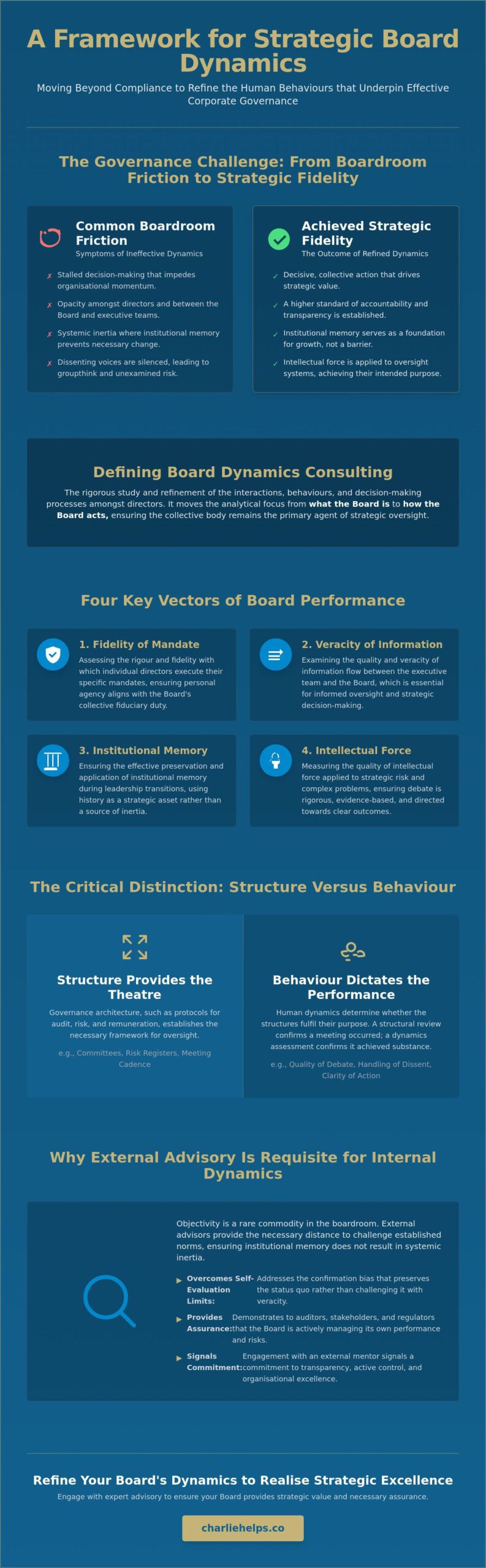
Oversight is an active discipline. It requires more than a passive adherence to regulatory codes or the maintenance of a risk register. Board dynamics consulting is the rigorous study and refinement of the interactions, behaviours, and decision-making processes amongst directors. It moves the analytical focus from what the Board is to how the Board acts. By examining these nuances, consultants ensure that the collective body remains the primary agent of strategic oversight rather than a mere recipient of executive reports.
Professional advisors in this field look beyond the corporate governance principles that define the structural framework of an organisation. They prioritise veracity and accountability, identifying where individual agency might diverge from institutional goals. It’s often the case that friction exists between a director’s specific mandate and the collective fiduciary duty of the Board. Consultants focus on several key vectors of performance to resolve these tensions:
- The fidelity with which directors execute their specific mandates.
- The veracity of information flow between the executive team and the Board.
- The preservation of institutional memory during leadership transitions.
- The quality of intellectual force applied to strategic risk.
The Distinction Between Structure and Behaviour
Governance architecture often obscures the human element. Whilst a Board may have established clear protocols for audit, risk, and remuneration, these structures don’t guarantee effective outcomes. Behavioural dynamics, such as the quality of debate, the handling of dissent, and the clarity of consensus, determine whether a Board fulfils its purpose. A structural review might confirm that a meeting took place; a dynamics assessment reveals whether that meeting achieved anything of substance. Directors must recognise that structure provides the theatre, but behaviour dictates the performance.
The Role of the Consultant as a Strategic Mentor
The advisor acts as a grounded, human-centric mentor. They provide the assurance that directors need to challenge their own assumptions without compromising the Board’s unity. This role requires a balance of intellectual force and practical problem-solving. By offering a measured, reflective approach, the consultant helps the chair and directors navigate complex environments, ensuring that institutional memory serves as a foundation for growth rather than a weight that stalls progress. The goal is to realise a Board that adds tangible strategic value through evidenced movement and active control.
Why UK Boards Require External Advisory for Internal Dynamics
Objectivity is a rare commodity in the boardroom. Directors often find themselves too close to the cultural weave of the organisation to identify systemic failings or subtle behavioural drifts. Whilst internal reviews are a standard requirement, they frequently suffer from a confirmation bias that preserves the status quo rather than challenging it. Board dynamics consulting provides the necessary distance to challenge established norms, ensuring that institutional memory does not result in systemic inertia. A Board that cannot see its own shadows cannot hope to cast light on the organisation’s future.
External advisors bring a sense of historical resonance and moral depth to these proceedings. They link current director behaviours to the long-term vision, purpose, and ethical standing of the enterprise. This advisory process provides necessary assurance to auditors, stakeholders, and regulators, demonstrating that the Board is actively managing its own performance and risks. By engaging with an external mentor, a Board signals its commitment to transparency and active control. This movement from passive observation to active refinement distinguishes a high-performing Board from one that merely satisfies regulatory minimums.
Overcoming the Limitations of Self-Evaluation
Self-evaluation often prioritises comfort over veracity. Directors may hesitate to critique peers or the chair, fearing that such candour might disrupt the collegial atmosphere. However, the 2024 UK Corporate Governance Code shifts the focus to outcomes-based reporting, requiring evidence of how decisions manifest in real-world performance. External specialists facilitate improving board dynamics by asking the difficult questions that internal members might avoid, clarifying strategic intent, and identifying systemic friction. This intellectual force is essential for any Board seeking to fulfil its mandate with integrity.
Identifying the Human Element in Risk Oversight
Risk is not merely a mathematical exercise; it is a human one. Boards must identify where personal agency and individual biases affect the oversight of material controls. When directors fail to exercise dissenting voices, or when information flows lack veracity, the organisation’s risk profile increases. Professional advisory services help committees recognise these human-centric risks, ensuring that the Board remains an active agent of control. This rigour allows the Board to realise its strategic objectives whilst maintaining the highest levels of accountability. Does your current evaluation process provide the necessary assurance that these human risks are being managed?
Evaluating Board Effectiveness: A Methodology for Boardroom Behaviour
Effective evaluation demands a departure from standard compliance checklists. It begins with a rigorous review of the mandate assigned to each director and the fidelity with which they fulfil their specific roles. Board dynamics consulting provides the framework for this scrutiny, ensuring that accountability is not an abstract concept but a lived reality. Advisors examine the alignment between individual actions and the Board’s collective fiduciary duty; if a director’s contribution lacks veracity or focus, the entire system of oversight suffers.
Observation forms the second pillar of this methodology. Advisors must witness the Board in situ to assess the quality of debate, the presence of dissenting voices, and the clarity of decision-making. Building better board dynamics involves identifying whether the chair fosters an environment of intellectual force or one of silent acquiescence. When dissent is suppressed, the Board loses its ability to manage risk effectively, as the collective view becomes narrow and fragile.
Evidence-based movement takes precedence over mere intention. It’s insufficient for a Board to state its desire for excellence; it must demonstrate specific instances where its decisions realised tangible strategic outcomes. Consultants look for a clear trail of active control, where the Board identified a systemic challenge and implemented a credible plan to resolve it. This focus on evidenced movement provides the assurance that stakeholders require in a complex regulatory environment.
Assessing Director Fidelity and Accountability
Accountability rests with specific people, not vague systems. Each director carries a unique burden of assurance, and their performance must be measured against the veracity of their contributions. When a Board identifies a gap in fidelity, it must act with aphoristic precision to correct the course. This process ensures that every member of the Board remains a disciplined agent of the company’s long-term purpose.
The Importance of Institutional Memory in Succession Planning
Stagnant institutional memory often stalls progress during leadership transitions. A disciplined evaluation methodology ensures that the Board’s historical resonance and strategic wisdom are preserved when directors depart. By codifying these insights, the Board maintains its steady hand, ensuring that new members can fulfil their mandates without losing sight of the organisation’s moral depth. This continuity is essential for achieving long-term stability and growth. Does your current evaluation provide a clear plan for active control, or does it merely offer the false comfort of a completed checklist?
Strategic Leadership Development Through Board Dynamics
High-performance leadership at the executive level does not happen in a vacuum. It requires a Board that models the same discipline, intellectual force, and accountability it expects from the C-suite. Board dynamics consulting serves as a prerequisite for effective leadership coaching, as it addresses the behavioural environment in which executive decisions are made. When directors act with veracity, they establish a standard of excellence that permeates the entire organisation.
Consultants utilise board dynamics as a strategic lever to ensure that mandates are fulfilled with precision. This process moves beyond the superficial layer of corporate policy to examine how authority is exercised and how action is attributed. The goal is to realise a culture where every director and executive operates with a clear sense of purpose. By refining these interactions, a Board ensures that its strategic intent is not lost in the transition from the boardroom to the operational front line. Boards that have achieved this behavioural clarity are also better positioned to architect a credible ESG governance strategy UK that moves beyond reactive reporting to genuine institutional fidelity.
Aligning the Board with Executive Performance
Executive performance is inextricably tethered to Board clarity. If the Board lacks a unified understanding of its mandate, the executive team cannot implement strategy with confidence. Advisors facilitate this alignment by scrutinising the quality of the interface between the Board and the CEO. They look for evidence of mutual assurance and institutional fidelity, ensuring that the Board provides the necessary challenge without creating unnecessary friction. This alignment is essential for achieving long-term strategic objectives and maintaining stakeholder trust.
Implementing Change Through Governance Architecture
Structural systems must support human behaviours to be effective. Directors utilise Integrated Governance Frameworks to codify the standards of accountability and transparency established through dynamics consulting. This architecture provides the scaffolding for disciplined action, ensuring that institutional memory is preserved and that authority is clearly delegated. When these systems and behaviours intersect, the Board achieves a state of active control that allows the organisation to navigate complex environments with a steady hand. Are you ready to realise the full potential of your leadership team through a rigorous review of your board dynamics consulting needs?
Realising Board Excellence: The Role of Charlie Helps Associates
Charlie Helps Associates acts as a steady hand for organisations navigating the intricacies of boardroom oversight. Our board dynamics consulting practice identifies the specific behavioural patterns that either support or subvert structural controls. By focusing on the intersection of human behaviour and systemic architecture, we ensure that Boards achieve their strategic objectives whilst maintaining absolute institutional integrity. We provide the measured, reflective approach necessary to transform boardroom friction into disciplined strategic movement.
Advisors at our firm prioritise the development of Integrated Governance Frameworks that support sustainable value creation. These systems do not operate in isolation; instead, they provide the structure through which directors and committees exercise their authority. We ensure that every element of the governance architecture reinforces accountability and transparency. By engaging with our consultancy, organisations secure a partner dedicated to professional excellence and the moral depth of leadership.
A Consultative Process Rooted in Experience
Professional advisors must possess a clear-eyed view of global trends and a deep understanding of the human element behind the data. Our consultants serve as strategic mentors, providing a reflective environment where chairs and directors can assess their own fidelity to the company mandate. This process prioritises veracity over superficial compliance, allowing leadership teams to implement change with confidence. We offer the intellectual force required to challenge stagnant norms and realise a Board that adds tangible strategic value.
Architecting Institutional Excellence for the Public and Private Sectors
Integrated Governance Frameworks provide the necessary scaffolding for excellence across both sectors. Whether overseeing a public body or a private enterprise, directors require systems that ensure accountability and preserve institutional memory. We assist committees in refining their governance architecture to ensure that every action is evidenced and every risk is under active control. This rigour allows the Board to fulfil its purpose with unsentimental clarity and precision.
The ultimate test of a Board’s performance is its ability to remain a disciplined agent of growth during periods of complexity. Engagement with a specialist partner provides the assurance that your leadership team remains focused on its primary fiduciary duties. How will you ensure your Board possesses the intellectual force and behavioural alignment required for the governance challenges of 2026? Contact Charlie Helps Associates to begin a rigorous review of your boardroom dynamics.
Implementing Active Control in the Modern Boardroom
Boardroom performance in 2026 demands a shift from passive observation to active refinement. Directors must recognise that the quality of their collective interactions determines the veracity, accountability, and clarity of the organisation’s strategic oversight. Engaging in board dynamics consulting allows the Board to identify behavioural friction and replace it with disciplined movement. This focus ensures that mandates are fulfilled with the intellectual force required to navigate a volatile global landscape.
Charlie Helps Associates assists leadership teams through expertise in AI governance for UK boards and tailored governance architecture for public sector entities. Our proprietary workflow optimisation SaaS provides the structural support necessary for directors to maintain active control over critical information flows. By integrating human-centric mentoring with these technical systems, we help organisations realise their long-term purpose with integrity. Directors seeking to move beyond passive disclosure will find that implementing robust board transparency frameworks is an essential complement to the behavioural refinements achieved through dynamics consulting.
To explore how your Board can achieve greater strategic clarity, contact Charlie Helps Associates for a confidential consultation. A commitment to boardroom excellence provides the foundation for an organisation that remains both resilient and visionary.
Frequently Asked Questions
What is the primary focus of board dynamics consulting?
Board dynamics consulting focuses on the human behaviours, interpersonal interactions, and personal agency that define how directors fulfil their mandates. It prioritises the study of the quality of debate, the presence of dissenting voices, and the veracity of information flow within the boardroom. By examining these nuances, advisors help the Board move from passive compliance to active strategic oversight.
How does board dynamics consulting differ from a standard board effectiveness review?
Standard effectiveness reviews frequently prioritise structural benchmarks, regulatory checklists, and the presence of specific policies. In contrast, dynamics consulting scrutinises the underlying psychological and cultural factors that influence collective decision-making. Whilst a review might confirm that a committee exists, dynamics consulting evaluates whether that committee possesses the intellectual force, discipline, and clarity required to manage risk effectively.
Why is the Oxford Comma important in corporate governance documentation?
The Oxford Comma ensures absolute clarity in governance documentation by preventing the conflation of distinct items within a list. In mandates, risk registers, and board minutes, precision is a prerequisite for accountability. Its use eliminates ambiguity regarding the specific duties assigned to directors, committees, and executive teams, thereby protecting the organisation from legal or operational misinterpretation.
Can board dynamics consulting improve organisational performance?
Refined boardroom behaviours act as a catalyst for organisational excellence. When a Board operates with clarity and fidelity, it establishes a high standard of accountability that directors then implement throughout the executive ranks. This alignment ensures that strategic objectives are realised with discipline, that authority is clearly attributed, and that institutional memory is preserved across all levels of the enterprise.
How much does a professional board dynamics evaluation cost in the UK?
Fees for professional evaluations vary based on the complexity of the organisation, the number of directors involved, and the depth of the behavioural assessment required. Boards should consider these services as a strategic investment in institutional integrity rather than a mere administrative expense. Specific pricing typically reflects the level of senior expertise, the duration of the engagement, and the scope of the final assurance report.
What role does institutional memory play in board dynamics?
Institutional memory provides the historical resonance necessary for stable governance and consistent decision-making. It prevents the loss of strategic wisdom during periods of transition and ensures that new directors understand the ethical standing of the enterprise. A Board that loses its memory often loses its steady hand, leading to strategic drift or the repetition of past systemic failings.
How can boards ensure accountability amongst directors during a transition?
Accountability is maintained through the use of precise mandates and the continuous monitoring of evidenced movement. During transitions, the chair must ensure that outgoing directors provide a transparent account of their actions and that successors are mentored in the Board’s specific culture of veracity. This rigour ensures that authority and action remain clearly attributed to specific people rather than vague systems.
Is board dynamics consulting relevant for the UK public sector?
Professional advisory services are essential for the UK public sector, where transparency and active control are under constant regulatory scrutiny. Public bodies face unique challenges regarding stakeholder assurance and the management of complex social mandates. Consulting helps these Boards achieve professional excellence whilst fulfilling their specific public duties with unsentimental clarity and absolute integrity.
Disclaimer
The articles published on CharlieHelps.co are provided for general information, reflection, and commentary. They draw on professional experience, research, and interpretation, but they do not constitute legal, regulatory, financial, clinical, governance, risk, compliance, assurance, or other professional advice. Nothing published on this site should be relied upon as practice guidance, formal instruction, or a substitute for proper professional consultation. Readers should seek advice from suitably qualified advisers before acting on, applying, or relying upon any material in relation to their own organisation, Board, duties, circumstances, or decisions. Although reasonable care is taken to ensure that articles are accurate and current at the time of publication, no warranty is given as to completeness, accuracy, timeliness, or fitness for any particular purpose. Law, regulation, policy, standards, and recognised practice may change, and context matters. References to external sources, organisations, products, services, or third-party materials are included for information only. They do not imply endorsement unless expressly stated. Where an article contains affiliate links, sponsored references, or commercial relationships, these will be disclosed where relevant. The views expressed are those of the author unless otherwise stated. Reading, sharing, or responding to material on this site does not create a client, adviser, fiduciary, or professional relationship with Charlie Helps FRSA, CharlieHelps.co, or any associated entity. Readers remain responsible for their own judgement, decisions, and actions.
