

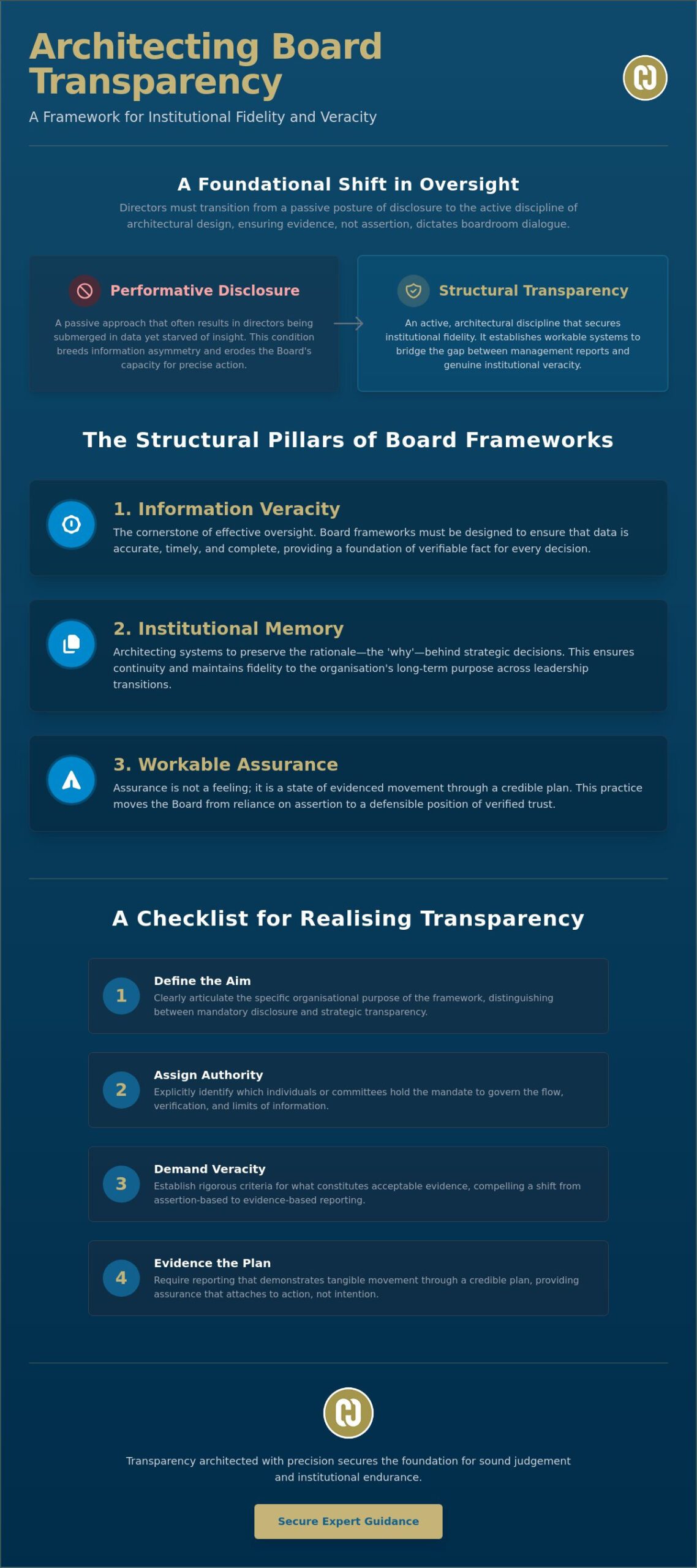
Transparency is not a passive act of disclosure; it is an active architectural discipline that secures institutional fidelity through the rigorous management of evidence. Many directors find themselves submerged in data yet starved of insight, a condition that breeds information asymmetry and erodes the Board’s ability to act with precision. In 2026, the challenge lies in moving beyond the performative to the structural. By implementing board transparency frameworks, Boards can bridge the gap between management reports and genuine institutional veracity.
You likely recognise the weight of this responsibility, particularly as regulators and proxy advisors heighten their expectations for evidence-based decision-making. This article provides a rigorous examination of how Boards can architect these frameworks to secure institutional memory and fulfil their fiduciary mandates. We shall examine the specific structures required for information flow, the necessity of veracity in an AI-augmented environment, and the methods for establishing a defensible position that satisfies both stakeholders and the law.
Key Takeaways
- Directors must recognise transparency as an active structural choice rather than a passive disclosure. This shift is essential to fulfil fiduciary duties and reduce information asymmetry.
- Architect board transparency frameworks that prioritise information veracity. This ensures that the data reaching the Board is accurate, timely, and complete.
- Secure institutional memory by documenting the rationale behind complex decisions. This practice ensures that future directors can access and understand the logic of the past.
- Use a structured checklist to identify the specific organisational aim of each framework. Boards must clearly assign authority to ensure the veracity and implementation of these systems.
- Shift from performative disclosure to workable assurance. Realise this by evidencing movement through a credible plan, which provides a more defensible position for regulators and stakeholders.
Defining the Mandate for Board Transparency
Transparency is a structural choice. It does not occur by accident; it requires the Board to architect systems that diminish information asymmetry. This mandate is not a mere suggestion of best practice. It is a direct extension of the fiduciary duty to act with care, skill, and diligence. When directors lack a clear view of the operational reality, they cannot fulfil their legal obligations. Therefore, board transparency frameworks serve as the necessary scaffolding for institutional fidelity.
True transparency requires the Board to move beyond vague intentions. It demands a credible plan for oversight that management cannot easily bypass. This involves a shift in perspective. Instead of viewing disclosure as a burden to be managed, the Board must treat it as a tool to be wielded. Effective frameworks define the precise movement of information, ensuring that evidence, rather than assertion, dictates the conversation.
Authority and the Disclosure Mandate
Clarity regarding authority is paramount. The Board must explicitly identify which individuals hold the power to determine the limits of institutional openness. This involves establishing a formal mandate that dictates how information flows from management to the boardroom. Such a mandate must align with broader Corporate Governance Principles, providing a clear distinction between mandatory regulatory disclosure and discretionary strategic transparency. Without this distinction, the Board risks drowning in compliance data whilst remaining blind to strategic risks.
Governance as an Action of People
Governance is not an abstract agent that guarantees results. It is the collective action of people. Directors and committees must actively perform the work of interrogation and verification. The Chair plays a critical role here, fostering a boardroom culture where evidence is prioritised over assertion. This approach rejects “consultancy theatre” and its reliance on motivational slogans. Instead, it focuses on making systems workable. By insisting on veracity, the Chair ensures that the Board relies on facts rather than the optimistic projections of management. The goal is to realise a state of informed assurance through practical judgement and steady oversight.
If the Board fails to define who has authority over the flow of information, the risk of disclosure fatigue increases. How can a director distinguish a signal from the noise without a framework that prioritises meaning over volume?
The Structural Pillars of Information Veracity
Information veracity is the cornerstone of effective oversight. It requires that data provided to the Board is accurate, timely, and complete. Without these qualities, a director cannot exercise the necessary restraint or judgement required to protect the organisation. Board transparency frameworks must therefore be designed to filter out the noise and elevate the signal. This architecture ensures that every decision rests upon a foundation of verifiable fact rather than management assertion.
Fidelity to the organisation’s purpose requires that these frameworks align with long-term strategic aims. Boards must decide what specific evidence supports their reliance on management reports. This is not a matter of distrust; it is a matter of professional assurance. By establishing clear criteria for what constitutes “veracious” information, directors can avoid the trap of disclosure fatigue and focus their attention where it is most required. This discipline extends equally to non-financial data, where a rigorous ESG governance strategy UK boards adopt must be held to the same evidentiary standards as any other form of institutional reporting.
Securing Institutional Memory
Institutional memory is the silent partner of every high-performing Board. It ensures that the rationale for past decisions remains accessible to those who follow. Architecting systems to preserve the “why” behind a strategic pivot is as critical as recording the “what”. Formal minutes and decision logs act as the ledger of this memory; they provide the continuity required to maintain fidelity to the organisation’s long-term purpose. Directors should ensure that succession planning includes a methodical transfer of this critical governance knowledge to maintain stability during transitions.
The Discipline of Evidence and Assurance
Assurance is not a feeling of comfort; it is a state of evidenced movement through a credible plan. Boards must move from blind trust to a posture of verified reliance. This transition requires a rigorous internal audit process and specific reporting metrics that align with strategic aims. By using Transparency to Build Trust, directors can establish a baseline for what constitutes acceptable evidence in the boardroom.
When evidence is incomplete, the Board must explicitly identify what remains unknown. Making assumptions is often necessary, yet these must be documented and tested against emerging data. Establishing such a discipline ensures that the Board fulfils its mandate with intellectual force. If you require assistance in refining these oversight mechanisms, you may wish to discuss your governance architecture with a specialist advisor who understands the intersection of human behaviour and structural systems.
A Checklist for Realising Transparency Frameworks
Implementation is where the philosophical meets the practical. To architect effective board transparency frameworks, directors must move beyond the conceptual. They must ask: what specific organisational problem does this framework solve? Clarity of aim prevents the accumulation of meaningless data. Similarly, the Board must determine who holds the authority for the veracity of the information provided. Without a named individual or system responsible for implementation, the framework remains a hollow gesture.
Directors should also evaluate the evidence carefully. They must identify which data points provide the most reliable assurance for the Board and what risks remain when that data is absent. Assessing the potential unintended consequences of specific disclosures is equally vital. Transparency should never be a blunt instrument; it is a precision tool that requires restraint and practical judgement.
Step 1: Architecting the Information Flow
Organise reporting cycles to ensure the Board receives information well before critical decisions are required. Timing is as critical as content. Directors must specify the level of detail necessary to maintain oversight without succumbing to information overload. Each report should link directly to a specific Board mandate or strategic objective. This ensures that every piece of data serves a purpose. By drawing on principles such as BoardSource’s Transparency Initiative, organisations can structure their disclosures to cover ethics, composition, and performance assessment with rigour.
Step 2: Implementing Veracity Checks
Fulfil the requirement for independent verification of key performance data. The Board cannot rely solely on internal narratives. It must establish a process where directors can challenge the assumptions within management papers. A healthy boardroom is one where “bad news” travels as quickly as “good news”. This requires a culture of intellectual honesty and structural checks that prevent the filtering of uncomfortable truths. Realise a system where evidence is the primary currency of the boardroom.
Step 3: Measuring Workable Assurance
Assess whether the framework has achieved its intended aim of reducing information asymmetry. Assurance is not a static state; it is an evidenced movement. The Board should be able to explicitly state which risks remain despite the transparency measures in place. This level of honesty provides a more defensible position for regulators. Review the framework annually as part of a formal board effectiveness review to ensure it remains fit for purpose.
If your current systems fail to provide the clarity required for complex decision-making, you can request a consultation on governance architecture to refine your approach and secure institutional memory.
From Disclosure to Workable Assurance
Transparency is a means to an end. The end is better-informed Board decisions and institutional stability. For a Board to claim oversight, it must move beyond the passive receipt of information. Board transparency frameworks provide the necessary structure to ensure that visibility leads to action. Without this architectural discipline, disclosure remains a performative exercise that fails to satisfy the fiduciary mandate. Directors must recognise that information is only valuable when it is veracious and actionable.
Assurance is not a static state. It attaches to evidenced movement through a credible plan; it is never a product of mere intention. Directors must decide if their current systems provide enough fidelity to withstand rigorous regulatory scrutiny. In the event of a failure, the Board will be judged not by what it intended to achieve, but by the evidence it used to support its reliance on management. The ultimate test of any framework is its utility during a crisis. It must facilitate practical judgement when the stakes are highest.
The Intersection of Culture and Structure
A framework is only as workable as the boardroom culture that supports it. Systems are easily bypassed or ignored if the prevailing behaviour prioritises consensus over veracity. Engaging in board dynamics consulting allows directors to align their individual and collective behaviours with their transparency goals. This process avoids the moralising tone often found in discussions of corporate ethics, focusing instead on the practical reality of human interaction within a structural system. Integrity in the boardroom is a matter of professional discipline.
Next Steps for the High-Stakes Board
Directors should begin by commissioning an independent audit of current information flows and transparency gaps. This evidence-based approach identifies where asymmetry remains a risk. These findings should be integrated into the broader corporate governance framework UK organisations must follow. To conclude, every director should formulate a clear question for their next meeting: “What do we not know that we should know?” This simple inquiry, backed by a rigorous framework, is the starting point for genuine institutional fidelity.
Securing the Future through Architectural Rigour
Institutional fidelity requires more than a commitment to openness. It demands the implementation of board transparency frameworks that prioritise veracity and preserve institutional memory. Directors who treat transparency as a structural discipline, rather than a compliance burden, secure a more defensible position for themselves and their organisations. By establishing clear authorities and rigorous evidence checks, the Board moves from the fragility of blind trust to the stability of informed assurance. This architectural approach is inseparable from the broader discipline of strategic board oversight, which demands that directors perform fidelity to organisational purpose as an active, evidenced commitment.
The work of oversight is never finished. It requires constant recalibration; it demands a culture that values truth over consensus. Boards must continue to ask the difficult questions that management might prefer to leave unanswered. As expert Corporate Governance Consultants, we provide the tailored governance architecture and professional board advisory support necessary to navigate these high-stakes environments. If you are ready to refine your oversight mechanisms and ensure your Board acts with absolute precision, you can contact Charlie Helps Associates to architect your governance framework. We remain your partners in the pursuit of institutional excellence.
Frequently Asked Questions
What is the primary aim of a board transparency framework?
The primary aim of a board transparency framework is the reduction of information asymmetry between management and the Board. It establishes a structural discipline that ensures directors receive veracious data, allowing them to act with the care and skill required by their fiduciary mandates. By architecting these systems, directors ensure that evidence, rather than management assertion, dictates the strategic conversation.
How does a transparency framework differ from standard financial reporting?
Standard financial reporting focuses primarily on historical fiscal compliance and regulatory requirements. In contrast, board transparency frameworks are architectural and forward-looking. They encompass the flow of qualitative data, the rationale behind complex decisions, and the strategic evidence required for oversight across all organisational pillars. These frameworks prioritise the “why” behind an action, whereas financial reports focus on the “what” of the balance sheet.
Who holds the ultimate authority for transparency within a UK organisation?
Within a UK organisation, the Board of Directors holds the ultimate authority for transparency. Individual directors must exercise this authority to satisfy their legal duties under the Companies Act 2006, particularly the duty to promote the success of the company. Whilst the Chair often leads the culture of openness, committees and individual directors must actively perform the work of verification to ensure institutional fidelity.
Can too much transparency hinder Board effectiveness?
Disclosure fatigue is a genuine risk when volume is mistaken for insight. If a framework produces a vast quantity of data without meaningful context, it can obscure critical risks and hinder effective decision-making. A well-architected framework avoids this by filtering noise and elevating the signal. The goal is not the maximum volume of information, but the maximum veracity and relevance of the data provided to the boardroom.
What role does institutional memory play in transparency?
Institutional memory serves as the ledger of the Board’s rationale and strategic intent. It ensures that the logic behind past actions remains accessible to current and future directors, preventing the organisation from repeating historical errors. By documenting the evidence used for past judgements, the Board maintains continuity and fidelity to its long-term purpose, even during periods of significant leadership transition.
How should a Board handle incomplete evidence in its transparency reports?
Boards must explicitly identify what remains unknown when evidence is incomplete. Directors should document their assumptions and the specific risks associated with the missing information. Assurance in these instances attaches to a credible plan for future verification rather than a reliance on management’s mere intentions. This level of intellectual honesty provides a more defensible position for regulators and stakeholders alike.
Disclaimer
The articles published on CharlieHelps.co are provided for general information, reflection, and commentary. They draw on professional experience, research, and interpretation, but they do not constitute legal, regulatory, financial, clinical, governance, risk, compliance, assurance, or other professional advice. Nothing published on this site should be relied upon as practice guidance, formal instruction, or a substitute for proper professional consultation. Readers should seek advice from suitably qualified advisers before acting on, applying, or relying upon any material in relation to their own organisation, Board, duties, circumstances, or decisions. Although reasonable care is taken to ensure that articles are accurate and current at the time of publication, no warranty is given as to completeness, accuracy, timeliness, or fitness for any particular purpose. Law, regulation, policy, standards, and recognised practice may change, and context matters. References to external sources, organisations, products, services, or third-party materials are included for information only. They do not imply endorsement unless expressly stated. Where an article contains affiliate links, sponsored references, or commercial relationships, these will be disclosed where relevant. The views expressed are those of the author unless otherwise stated. Reading, sharing, or responding to material on this site does not create a client, adviser, fiduciary, or professional relationship with Charlie Helps FRSA, CharlieHelps.co, or any associated entity. Readers remain responsible for their own judgement, decisions, and actions.
