

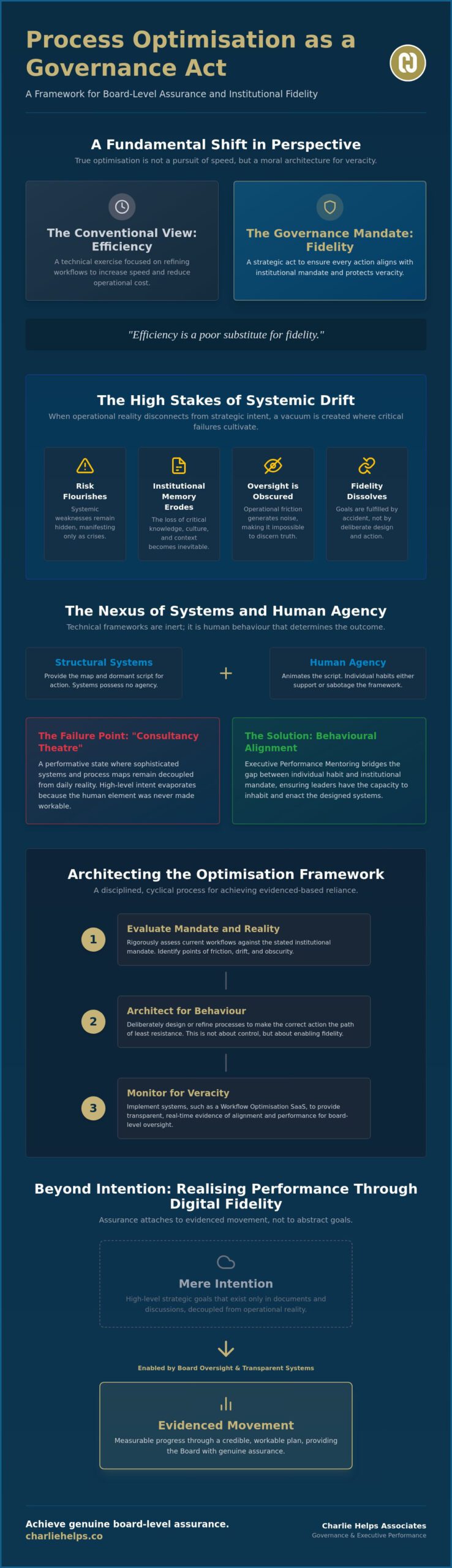
Efficiency is a poor substitute for fidelity. Whilst many view the refinement of workflows as a pursuit of speed, true process optimisation for leaders is a moral architecture designed to safeguard institutional veracity. In 2026, as the ISO 9001:2026 standard emphasises quality culture and resilience, the Board requires more than just functional systems; it demands evidence that every action aligns with strategic intent. When systems become opaque, they erode institutional memory and obscure the visibility required for effective oversight.
You likely recognise the friction that occurs when operational reality drifts from your stated mandate. You understand that a disconnect between intent and evidenced movement creates a vacuum where risk flourishes. This article provides a framework to help you exercise authority over business workflows and achieve genuine board-level assurance. We shall examine how to architect processes that reduce friction, fulfil governance requirements, and ensure your organisation moves with precision rather than mere momentum.
Key Takeaways
- View process optimisation for leaders as a rigorous governance act that aligns business workflows with institutional mandates.
- Explore why technical systems fail without a deep understanding of human behaviour, and how coaching can harmonise executive performance with structural change.
- Adopt a decision-making framework to evaluate, refine, and monitor organisational processes through evidenced-based reliance.
- Learn how a Workflow Optimisation SaaS solution provides the transparency required for boards to exercise oversight, maintain veracity, and protect institutional memory.
- Move beyond the limitations of mere intention to achieve measurable movement through a credible, implementable plan.
The Leadership Mandate: Why Process Optimisation is a Governance Act
Authority resides in action. Too often, boards treat governance as a static framework, a set of rules to be consulted only in times of crisis or during an annual audit. True governance, however, is a verb; it is the continuous action performed by boards and directors to ensure the veracity of every organisational movement. Within this context, process optimisation for leaders emerges not as a technical preference, but as a systematic alignment of workflows with institutional mandates.
Leaders must recognise that Business Process Management (BPM) is more than an operational tool; it is a structural necessity for maintaining oversight. When processes are left to evolve organically, they often drift from the original strategic intent. This drift creates a vacuum where institutional memory erodes, leaving the organisation vulnerable to the loss of critical knowledge and culture. Protecting this memory requires a deliberate architecture that captures how value is created and sustained.
From Abstract Governance to Concrete Action
Boards exercise authority through the deliberate design of systems rather than mere oversight of outcomes. It is insufficient for a board to state an intention for excellence; assurance attaches only to the evidenced movement of a credible plan. Whilst the mandate for process design typically sits with the executive leadership, the board holds the ultimate responsibility for ensuring these systems remain workable and ethical. They must decide whether the current architecture allows for the realisation of the organisation’s core purpose, or if it merely serves to maintain the status quo.
The High Stakes of Operational Friction
Operational friction is more than a nuisance; it is a veil that obscures the data required for board-level assurance. When workflows are inefficient or fragmented, they generate noise that makes it impossible for leaders to discern truth from assumption. This failure to address friction constitutes a lapse in risk accountability, as it hides systemic weaknesses until they manifest as crises. Institutional fidelity is the alignment between board mandate and operational reality. Without this alignment, fidelity dissolves, and the organisation risks fulfilling its goals by accident rather than by design. For those tasked with oversight, process optimisation for leaders is the primary mechanism for restoring that clarity. Leaders seeking a deeper examination of how structural decay undermines performance will find that improving operational productivity through institutional fidelity provides a credible framework for reducing this friction at scale.
The Intersection of Human Behaviour and Structural Systems
Systems are inert. They possess no agency and hold no accountability. Whilst technical frameworks provide the map, it is human agency that determines the destination. Technical solutions often fail because they treat organisational actors as predictable data points rather than complex individuals with established habits. True process optimisation for leaders recognises that a workflow is merely a dormant script until an executive or manager chooses to animate it. When leaders ignore the psychological friction inherent in structural change, they invite systemic drift.
This drift often manifests as consultancy theatre. In this performative state, organisations invest in elaborate process maps and sophisticated software that remain decoupled from daily reality. High-level strategic intent evaporates because the transition from abstract theory to concrete action was never made workable for the people involved. Real leadership requires a rejection of these superficial gestures in favour of active decisions that constrain or enable specific behaviours. To move beyond performance and into realised movement, boards must ensure that their executives possess the maturity to inhabit the systems they design.
The Human Element in Workflow Design
Individual habits either support or sabotage a governance framework. Even the most rigorous system will collapse if executive capability does not align with the new structural requirements. Capability is not a static trait; it is a professional discipline that requires constant refinement. For this reason, Executive Performance Mentoring serves as a critical tool for behavioural alignment. It bridges the gap between individual habit and institutional mandate, ensuring that those in authority have the capacity to fulfil their roles within a revised architecture. Leaders who prioritise this alignment find that their processes become self-sustaining rather than requiring constant intervention.
Systems as the Architects of Behaviour
A well-designed system makes the correct action the path of least resistance. If a process is cumbersome or counter-intuitive, people will inevitably find workarounds that erode institutional veracity. Effective process optimisation for leaders creates structures where accountability is the natural outcome of the workflow rather than an external imposition. This requires absolute clarity in role definitions to prevent the dilution of responsibility. These systems must also act as the repository for institutional memory. By embedding past lessons into current workflows, leaders prevent the repetition of systemic errors and ensure that the organisation learns as it moves. If your current structures feel more like obstacles than enablers, you may wish to discuss a governance review to restore operational clarity.
Architecting the Optimisation Framework: A Decision-Making Guide
Decision-making is the core of process optimisation for leaders. It moves beyond the technical mapping found in standard consultancy theatre to establish a credible basis for reliance. Boards and directors require a framework that does not merely describe a workflow but evaluates its capacity to fulfil a mandate. This requires a shift from blind trust in technical reports to an evidence-based approach where every structural change is justified by its contribution to institutional veracity.
The final architecture must pass the Test of Utility. This rigorous standard requires leaders to identify the specific Aim, confirm who holds authority, determine what decision is required, establish what evidence supports reliance, and acknowledge what risks remain. Without these five elements, a process remains an abstract intention rather than a workable system. Realising performance requires this level of intellectual force and structural discipline.
Step 1: Establishing the Aim and Authority
A process without a defined institutional goal is merely activity. Leaders must identify the specific mandate the workflow is intended to fulfil. Whether the objective is to ensure compliance, increase capacity, or protect institutional memory, the aim must be lucid and measurable. Authority must be clearly assigned; identify the director or committee with the formal mandate to authorise structural changes. Before proceeding, verify the veracity of the initial data used to justify the optimisation. Assumption is the enemy of assurance.
Step 2: Designing for Assurance and Risk
Mapping a workflow is an exercise in identifying where assurance must be evidenced. Leaders should look for points where movement can be verified through data rather than through anecdote. For broader strategic context, consider the Governance Impact on Organisational Performance. It is vital to explicitly state what remains unknown during this phase; identifying assumptions allows the board to monitor specific risks as the plan is implemented. A system that hides its gaps is a system that invites failure.
Step 3: Implementing Evidenced Movement
Transitioning from design to implementation requires clear milestones. These are not mere dates; they are points where specific evidence must be produced to support claims of reduced friction. This phase must remain professional and humane, avoiding condescension toward those executing the tasks. Focus on making the new system workable so that the correct action becomes the path of least resistance. If you require assistance in developing these frameworks, you may request a strategic consultation to align your workflows with governance mandates.
Beyond Intention: Realising Performance through Digital Fidelity
Intent is a ghost without a body. Whilst a leader may possess a clear vision for institutional fidelity, that vision remains unrealised until it is anchored in structural reality. Digital systems provide the necessary architecture for strategy to inhabit. In this context, process optimisation for leaders is not merely an exercise in speed; it is the pursuit of digital fidelity. This ensures that every action recorded within a system is a true reflection of the board mandate. Software is never the solution itself; it is the vehicle for implementing a leader’s judgement.
As we move through 2026, the reliance on manual oversight is becoming increasingly untenable. The shift toward agentic AI and automated workflows requires a new level of structural discipline. Boards must decide whether their current digital tools provide a reliable basis for assurance or if they merely obscure operational drift. Transparency is the antidote to friction. By architecting systems that provide real-time visibility, leaders can move from reactive troubleshooting to proactive governance. Executive teams navigating these pressures will find that a structured approach to improving operational productivity and institutional fidelity offers the practical judgement required to maintain authority during digital shifts.
SaaS as a Tool for Institutional Transparency
Digital tools must automate the collection of evidence for assurance. When a Workflow Optimisation SaaS solution is correctly implemented, it creates a machine-readable record of institutional movement. This reduces the board’s reliance on filtered anecdotal reports and replaces them with verifiable data. For those navigating these shifts, A Senior Management Guide to AI Governance Transition provides a framework for maintaining control during digital migrations. By the end of 2026, Gartner expects 40% of enterprise applications to include task-specific AI agents. This transition demands practical judgement rather than ungrounded futurism; leaders must ensure that these agents operate within the constraints of established ethics and law.
The Final Test: Utility and Action
Every new process or software implementation must pass the Test of Utility. You must be able to identify the specific Aim, the individual with Authority, the required Decision, the Evidence for reliance, and the remaining Risk. If a system fails to answer these five questions, it lacks the veracity required for board-level oversight. Process optimisation for leaders is a continuous commitment to clarity. It requires the courage to dismantle systems that no longer serve the institutional mandate.
Identify the one process in your organisation that currently lacks veracity. Is there a workflow where strategic intent is lost in operational noise? The move from intention to realised performance begins with a single decision to restore structural integrity. If you are ready to move beyond consultancy theatre and implement a rigorous governance architecture, you may consult with our advisors to architect your governance framework. Realising excellence is a choice; ensure your systems are built to sustain it.
Restoring Veracity to the Organisational Core
Excellence is not an accident of effort; it’s the result of rigorous structural discipline. We have explored how process optimisation for leaders serves as a critical mechanism for ensuring institutional fidelity. It bridges the gap between strategic intent and evidenced movement. By harmonising human behaviour with well-designed systems, boards can move beyond the performative nature of consultancy theatre to achieve genuine assurance.
Charlie Helps Associates brings deep expertise in UK public and private sector governance to this pursuit. Our proprietary Workflow Optimisation SaaS solution provides the transparency required for oversight, whilst our professional coaching and mentoring services ensure executive alignment with your refined architecture. These tools allow leaders to realise strategy with a high degree of precision and moral depth.
The mandate for 2026 is clear: lead with precision, decide with evidence, and build for veracity. Architect your institutional excellence with Charlie Helps Associates. There is no better time to secure the future of your organisation through better leadership and structural integrity.
Frequently Asked Questions
What is the primary difference between process improvement and process optimisation for leaders?
Process improvement typically targets incremental gains in speed or cost reduction at a tactical level. In contrast, process optimisation for leaders is the systematic alignment of every workflow with the organisation’s formal mandate. It’s a strategic act of architecture that ensures structural integrity rather than mere functional efficiency. Leaders must decide if a system merely works better or if it actually fulfils the board’s strategic intent.
How does process optimisation directly influence board-level corporate governance?
Process optimisation provides the evidenced movement required for board members to exercise their duty of oversight. Directors cannot rely on mere intentions or filtered reports; they require systems that produce verifiable data. By refining workflows to include specific assurance points, boards can confirm that operational reality matches strategic mandates. This reduces the vacuum of assumption that often leads to governance failures and a loss of veracity.
Who within the executive team should hold the authority for business process optimisation?
The formal authority for business process optimisation typically resides with the Chief Executive Officer or a designated executive director. However, the board or a specific governance committee must authorise the strategic framework within which these changes occur. This ensures that optimisation efforts do not drift into technical silos. Clear assignment of authority prevents the dilution of accountability and ensures that one individual remains responsible for the system’s fidelity.
Can process optimisation be achieved without investing in new SaaS or digital tools?
It’s possible to refine workflows through manual policy changes and structural redesign. However, achieving institutional transparency without digital fidelity is increasingly difficult in complex environments. Digital tools act as a vehicle for implementing strategy by automating evidence collection. Whilst the leader’s judgement is the primary driver, process optimisation for leaders often requires the machine-readable veracity that a modern Workflow Optimisation SaaS solution provides for board-level assurance.
How can a leader ensure that process changes do not erode institutional memory?
Leaders protect institutional memory by treating every process as a repository of past lessons and professional wisdom. When workflows are redesigned, the underlying logic and historical context must be embedded into the new structure. This prevents the repetition of systemic errors. Using professional mentoring to align executive behaviour with new systems also ensures that the human element of memory is not lost during technical transitions.
What are the most common risks that remain after a process has been optimised?
The primary risk is behavioural drift, where individuals revert to old habits that bypass the new architecture. Even an optimised system depends on the maturity of those who inhabit it. Additionally, unrecognised assumptions made during the design phase can manifest as new vulnerabilities. Leaders must explicitly state what remains unknown and maintain a cycle of review to ensure the system continues to fulfil its mandate in a shifting landscape.
Disclaimer
The articles published on CharlieHelps.co are provided for general information, reflection, and commentary. They draw on professional experience, research, and interpretation, but they do not constitute legal, regulatory, financial, clinical, governance, risk, compliance, assurance, or other professional advice.Nothing published on this site should be relied upon as practice guidance, formal instruction, or a substitute for proper professional consultation. Readers should seek advice from suitably qualified advisers before acting on, applying, or relying upon any material in relation to their own organisation, Board, duties, circumstances, or decisions.Although reasonable care is taken to ensure that articles are accurate and current at the time of publication, no warranty is given as to completeness, accuracy, timeliness, or fitness for any particular purpose. Law, regulation, policy, standards, and recognised practice may change, and context matters.References to external sources, organisations, products, services, or third-party materials are included for information only. They do not imply endorsement unless expressly stated. Where an article contains affiliate links, sponsored references, or commercial relationships, these will be disclosed where relevant.The views expressed are those of the author unless otherwise stated. Reading, sharing, or responding to material on this site does not create a client, adviser, fiduciary, or professional relationship with Charlie Helps FRSA, CharlieHelps.co, or any associated entity.Readers remain responsible for their own judgement, decisions, and actions.
