

Strategic paralysis is rarely a failure of intent; it is a symptom of structural decay. As 2026 introduces increasingly dense regulatory requirements, many executive teams find that their efforts to scale are stifled by a persistent friction that erodes the clarity of their mandate. You likely recognise the frustration of watching sophisticated business processes falter because the lines of accountability have become blurred, yet the path to improving operational productivity remains obscured by the very systems designed to support it.
This guide provides a credible plan for process optimisation, demonstrating how leaders can architect governance frameworks that reduce friction and realise sustainable performance through institutional fidelity. We shall examine the transition from speculative intention to evidenced movement, offering the practical judgement required to maintain authority and protect institutional memory during digital shifts. By the conclusion, you will possess a clearer understanding of how to align human behaviour with structural systems to achieve lasting excellence.
Key Takeaways
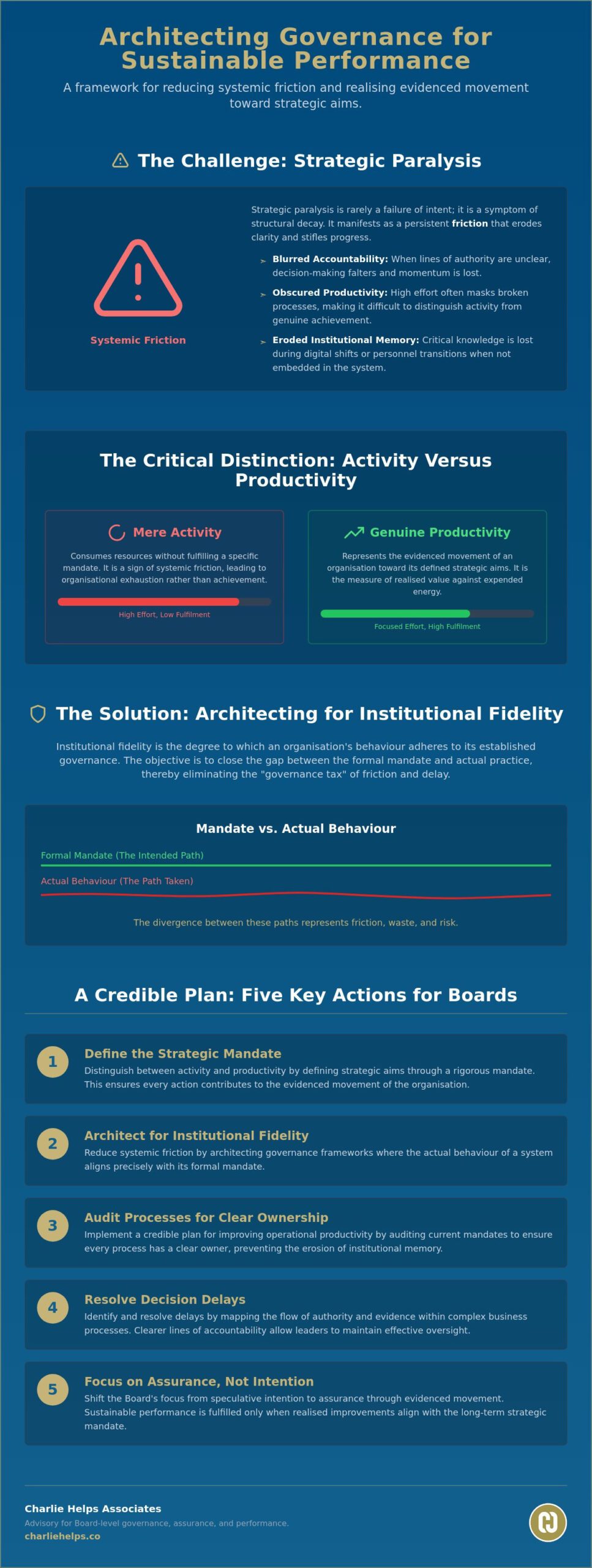
- Distinguish between mere activity and genuine productivity by defining strategic aims through a rigorous mandate. This ensures every action contributes to the evidenced movement of the organisation.
- Reduce systemic friction by architecting governance frameworks that prioritise institutional fidelity. Friction disappears when the actual behaviour of a system aligns precisely with its formal mandate.
- Implement a credible plan for improving operational productivity by auditing current mandates to ensure every process has a clear owner. This clarity of authority prevents the erosion of institutional memory during digital transitions.
- Identify and resolve decision delays by mapping the flow of authority and evidence within complex business processes. Clearer lines of accountability allow leaders to maintain effective oversight and realise sustainable value.
- Shift the focus of the Board from mere intention to assurance through evidenced movement. Sustainable performance is fulfilled only when realised improvements align strictly with the long-term strategic mandate.
Defining the Mandate for Improving Operational Productivity
Productivity is the evidenced movement of an organisation toward its defined strategic aims. It is not a byproduct of frantic activity. Whilst activity merely consumes resources, productivity fulfils a specific mandate. In 2026, the UK regulatory landscape demands greater veracity in performance reporting, particularly as the ISO 9001:2026 standard emphasises quality culture and ethical behaviour. Boards must now prove that their systems actually realise the objectives they set, rather than merely reporting on the volume of work performed. This shift requires a transition from speculative metrics to grounded assurance.
The Distinction Between Effort and Efficiency
High levels of human effort often mask underlying systemic friction. When individuals work harder to compensate for broken processes, the organisation suffers from a hidden tax on its capacity. Efficiency requires a clear alignment between individual actions and institutional goals. By understanding operational efficiency, leaders recognise that productivity is the ratio of realised value to institutional energy expended. Without this clarity, effort remains decoupled from outcome, leading to a culture of exhaustion rather than achievement. True productivity is found where the system performs the work, allowing the people to provide the judgement.
Why Boards Must Oversee Operational Flow
Oversight is not micromanagement; it is the assurance that systems function as intended. Directors have a duty to ensure that the organisation’s architecture supports its strategic intent. Operational friction compromises the Board’s ability to discharge its fiduciary duties, as it creates a disconnect between policy and practice. Improving operational productivity requires boards to establish clear authority and constraints for operational flow. This transparency protects the veracity of institutional memory, ensuring that risk management is rooted in fact rather than assumption. If the Board cannot see the movement, they cannot lead the journey. Leaders seeking to refine these mandates often benefit from advisory services to align their governance architecture with their strategic goals.
Architecting Systems for Institutional Fidelity
Institutional fidelity is the degree to which an organisation adheres to its established governance frameworks. It represents the structural integrity of the enterprise. Friction arises when there is a divergence between the formal mandate and the actual behaviour of the system. This gap creates a “governance tax” that slows execution and obscures accountability. Improving operational productivity requires a deliberate effort to close this gap by ensuring that the organisation’s architecture actually constrains and directs human action as intended. When behaviour and mandate align, the organisation moves with a singular purpose.
Reducing Friction through Governance Architecture
Common sources of friction include unclear authority, redundant approvals, and fragmented data. These issues are often symptoms of an incomplete or poorly implemented architecting a modern corporate governance framework. When directors fail to define clear lines of authority, the system defaults to consensus-seeking, which paralyses movement. Research into reducing administrative spending highlights how organisational interventions can eliminate the waste associated with complex, non-value-adding processes. A precise architecture provides the necessary constraints to enable faster decision-making by removing the ambiguity that necessitates excessive oversight. By embedding accountability into the design of business processes, leaders ensure that workflows remain transparent and repeatable, rather than reliant on the heroic efforts of individuals.
The Role of Institutional Memory in Process Fidelity
Institutional memory ensures that past improvements are not lost during personnel transitions. It is the repository of organisational logic; it tells us why we work as we do. Digital process management tools must act as the vessel for this logic, rather than mere task lists. Without this continuity, every digital transition becomes a “year zero” event that erodes value and destroys institutional wisdom. When logic is externalised into the workflow, the organisation achieves a level of fidelity that survives the departure of key individuals. This fidelity to the plan serves as a primary source of board-level assurance, as it provides evidence that the system remains workable and aligned with the strategic mandate. Organisations looking to audit these systems may find value in specialised advisory services to ensure their architecture remains fit for purpose.
Implementing Workflow Optimisation: A Strategic How-To
Optimisation begins with a cold assessment of the current mandate. Directors must audit every process to ensure it possesses a clear owner and a defined aim. Improving operational productivity is impossible when authority is diffused or when processes exist merely for optics. This “consultancy theatre” consumes resources without contributing to evidenced movement. A credible plan for optimisation requires the Board to ask who has the authority to change a process and what evidence supports such a change. By mapping the flow of authority and evidence, leaders identify precisely where decisions are delayed and where institutional memory is failing.
Auditing the Current Mandate
A rigorous audit exposes the gap between intention and reality. We must identify processes that serve no strategic aim but persist through organisational inertia. The Board requires a credible plan that identifies the specific Aim, the individual with authority, and the decision required to move forward. This approach replaces vague benchmarking with practical judgement. It ensures that any subsequent change is rooted in the veracity of current operational data rather than optimistic assumptions. Only when the mandate is clear can the system begin to function with fidelity.
Realising Efficiency through Structured Automation
Automation must follow logic; it is a grave error to automate a broken or unexamined process. When systems are digitised without a prior audit of their mandate, the organisation merely accelerates its existing friction. As leaders manage the guide to AI governance transition, they must ensure that AI-supported systems respect institutional constraints. The goal is to make workflows workable for the humans who interact with them. In 2026, agentic AI systems can accelerate the BPM lifecycle by up to 90%, but this speed is only valuable if the underlying logic is sound. We do not seek faster chaos; we seek faster order.
Continuous assurance replaces the flawed model of periodic review. A system for continuous monitoring ensures that movement remains aligned with the strategic mandate in real-time. This verification process protects the veracity of all regulatory reporting, which is critical as the ISO 9001:2026 revision approaches. Directors must verify that the new workflow maintains institutional fidelity whilst fulfilling strategic goals. To implement these frameworks effectively, Boards may require specialised consulting services to architect a system that balances speed with oversight.
Assurance and the Realisation of Sustainable Value
Assurance is not a promise. It is the evidenced movement through a credible, functioning plan. Boards must move beyond the comfort of mere intention and require proof that the organisation is fulfilling its strategic mandate. Improving operational productivity is not a finite project but a continuous state of alignment. Directors must determine if the realised improvements align with long-term strategic goals. If the improvements are merely superficial, the organisation has not achieved its aim.
Measuring Movement through Credible Plans
The transition from measuring raw output to measuring realised value requires a fundamental shift in reporting. Senior management requires a mandate for institutional fidelity to achieve a meaningful return on investment. Reporting cadences should provide actionable intelligence rather than raw data. The Board must see where authority is being exercised and where it is being avoided. If the movement is not evidenced, the plan is not credible. This rigour ensures that the organisation maintains its course despite the inevitable pressures of the market.
The Board’s Decision: When to Intervene
Thresholds for intervention must be clearly defined. When operational friction becomes a governance failure, the Board has a duty to act. This often requires professional executive performance mentoring to align leadership behaviour with new, optimised systems. Leaders must review the delegation of authority to ensure it supports the workflows implemented during the optimisation process. If authority remains trapped in legacy silos, the new architecture will fail. Improving operational productivity remains a human endeavour supported by structural integrity.
Assurance is the shadow cast by a functioning plan. Boards must explicitly state what remains unknown and what assumptions persist within their models. The central question remains: does our current architecture enable or inhibit our operational productivity? If the governance framework acts as a barrier to evidenced movement, it has failed its primary purpose. True excellence is fulfilled when the system facilitates the mandate without the need for constant, manual correction. To refine these systems, Boards may seek advisory services to ensure their oversight remains both humane and intellectually rigorous.
Architecting the Future of Organisational Excellence
True leadership recognises that a system’s output is limited by its structural integrity. We have explored how defining a clear mandate and architecting systems for institutional fidelity creates the necessary environment for sustainable growth. By removing the friction inherent in vague authority and fragmented processes, directors can focus on the strategic decisions that fulfil their fiduciary duties. Improving operational productivity is the natural consequence of a system that aligns human behaviour with a rigorous governance architecture.
Achieving this level of precision requires a partner who understands the high stakes of organisational oversight. Charlie Helps Associates provides specialised Board-level advisory for UK enterprises, offering the practical judgement needed to make complex workflows workable. Through our expert corporate governance consultants, specialised advisory, and proprietary workflow optimisation SaaS, we assist you in the transition from speculative intention to evidenced movement. Refine your institutional performance with Charlie Helps Associates and ensure your organisation possesses the resilience to thrive in 2026 and beyond.
Frequently Asked Questions
What is the difference between operational efficiency and operational productivity?
Operational efficiency refers to the ratio of energy expended to the output achieved. Productivity, however, represents the evidenced movement of an organisation toward its defined strategic aims. Whilst efficiency focuses on resource optimisation, improving operational productivity requires a clear mandate that ensures every action fulfils a specific strategic purpose. One measures the cost of the journey; the other measures the progress toward the destination.
How does corporate governance impact day-to-day operational performance?
Directors and Boards impact performance by architecting the frameworks of authority and constraint within which people act. When leadership establishes clear lines of accountability and precise mandates, they reduce the ambiguity that leads to systemic friction. Effective oversight ensures that day-to-day operations align with the strategic intent of the enterprise, thereby protecting the organisation’s institutional fidelity.
What are the primary indicators of operational friction in a UK organisation?
Friction typically manifests as strategic paralysis, redundant approval loops, or a loss of institutional memory during digital shifts. Leaders often observe a divergence between the formal mandate and the actual behaviour of the system. This disconnect suggests that the current governance architecture no longer constrains action effectively, requiring a rigorous audit to assist in improving operational productivity by identifying where authority has become diffused or obscured.
When should a Board consider implementing workflow optimisation software?
Boards should consider such implementations when manual oversight no longer provides sufficient assurance of evidenced movement. A Workflow Optimisation SaaS Solution becomes necessary when the complexity of business processes threatens to erode institutional memory or veracity in reporting. The software must act as a repository for organisational logic, ensuring that processes remain workable and transparent for all stakeholders.
How can an organisation maintain institutional memory during a digital transformation?
Maintaining memory requires the externalisation of organisational logic into the digital workflow itself. Rather than relying on the tacit knowledge of individuals, systems must be designed to carry the institutional wisdom of the enterprise. This approach ensures that fidelity to the plan survives personnel transitions, allowing the organisation to realise sustainable value without the risk of structural decay during technological shifts.
What role does the Oxford Comma play in professional governance documentation?
The Oxford Comma is a tool for precision and veracity in formal documentation. It eliminates ambiguity in complex lists of authorities, mandates, and constraints, ensuring that regulators and directors interpret instructions with absolute clarity. In the high-stakes environment of organisational oversight, such grammatical rigour prevents the misinterpretation of Board decisions and protects the integrity of the institutional record.
Disclaimer
The articles published on CharlieHelps.co are provided for general information, reflection, and commentary. They draw on professional experience, research, and interpretation, but they do not constitute legal, regulatory, financial, clinical, governance, risk, compliance, assurance, or other professional advice.Nothing published on this site should be relied upon as practice guidance, formal instruction, or a substitute for proper professional consultation. Readers should seek advice from suitably qualified advisers before acting on, applying, or relying upon any material in relation to their own organisation, Board, duties, circumstances, or decisions.Although reasonable care is taken to ensure that articles are accurate and current at the time of publication, no warranty is given as to completeness, accuracy, timeliness, or fitness for any particular purpose. Law, regulation, policy, standards, and recognised practice may change, and context matters.References to external sources, organisations, products, services, or third-party materials are included for information only. They do not imply endorsement unless expressly stated. Where an article contains affiliate links, sponsored references, or commercial relationships, these will be disclosed where relevant.The views expressed are those of the author unless otherwise stated. Reading, sharing, or responding to material on this site does not create a client, adviser, fiduciary, or professional relationship with Charlie Helps FRSA, CharlieHelps.co, or any associated entity.Readers remain responsible for their own judgement, decisions, and actions.
