

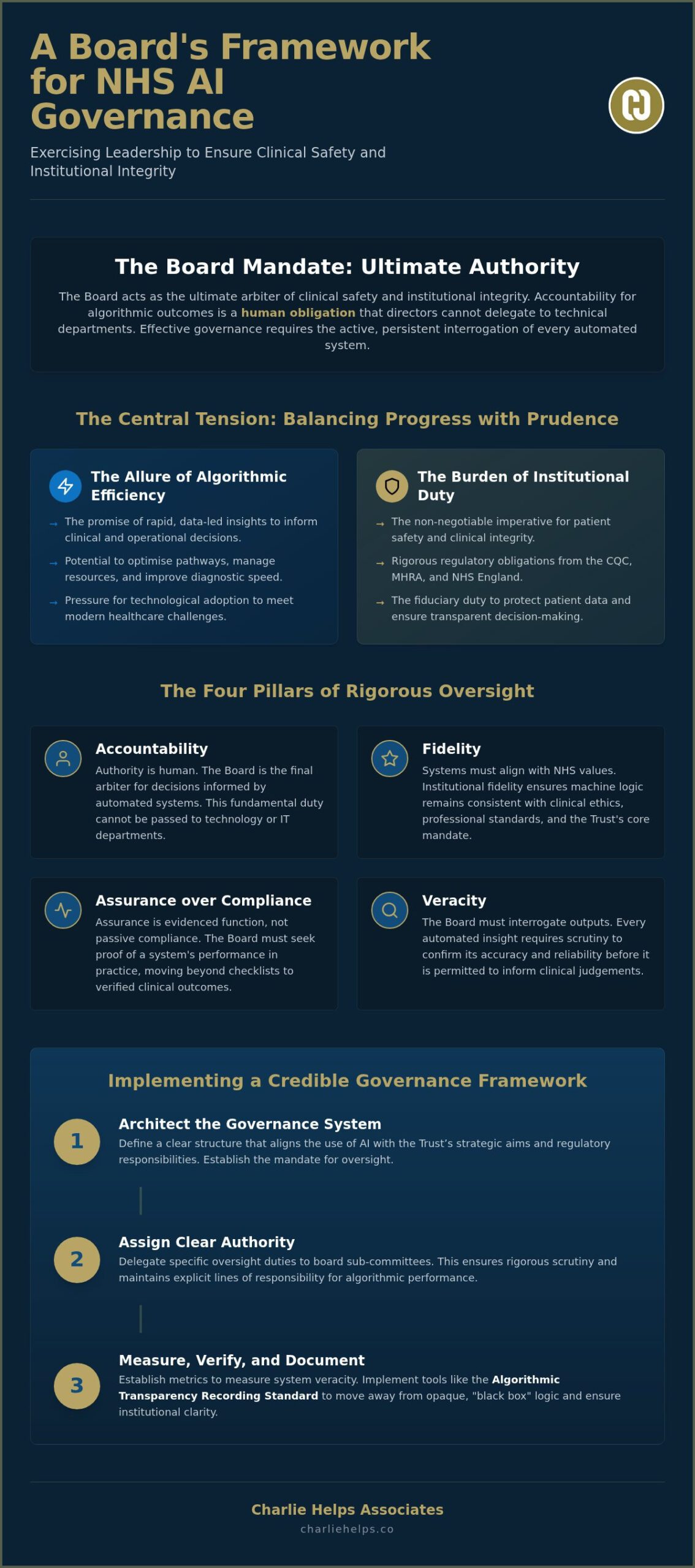
The Board remains the ultimate arbiter of clinical safety and institutional integrity. Whilst the allure of algorithmic efficiency is undeniable, many NHS leaders feel a justified trepidation regarding the opaque nature of automated decision-making. You likely recognise the friction between the promise of rapid insights and the heavy burden of regulatory expectations from the CQC, MHRA, and NHS England. When a Board establishes effective NHS AI governance, it performs an active exercise of leadership that requires directors to interrogate the veracity of every automated output.
This guide provides a strategic framework to help you move beyond passive compliance and establish rigorous board-level oversight. We will examine how to define clear lines of accountability, implement systems for assurance and fidelity, and cultivate the confidence necessary to meet CQC well-led criteria. By the conclusion, you will possess a practical path to ensure your organisation’s use of technology remains grounded in human judgement, professional restraint, and ethical purpose.
Key Takeaways
- Understand that the Board holds the ultimate authority for algorithmic outcomes, as accountability is a human obligation that cannot be delegated to technical departments.
- Establish institutional fidelity by ensuring that automated systems remain consistent with core NHS values through a credible plan for implementation.
- Architect a framework for NHS AI governance that aligns strategic aims with the Trust’s overarching mandate and regulatory obligations.
- Assign clear authority to board sub-committees to realise the practical value of automated insights whilst maintaining rigorous oversight.
- Strengthen the veracity of technology-led decisions to reduce operational friction and foster trust amongst staff and patients.
The Board Mandate for Artificial Intelligence Oversight
The Board acts. It does not merely observe the influx of new technologies; it actively constrains or enables their use based on evidenced risk. Whilst technical teams manage the infrastructure of machine learning, the responsibility for clinical outcomes remains a human obligation that directors cannot delegate to an IT department. Effective NHS AI governance requires more than a passive reliance on procurement checklists. It demands the active, persistent interrogation of automated systems to uphold clinical safety and institutional integrity. Directors must recognise that an algorithm is an extension of the Trust’s clinical strategy, not a separate technical entity.
A core conflict exists between the pressure for rapid technological adoption and the non-negotiable requirement for patient safety. This tension requires directors to exercise restraint. They must ensure that the speed of implementation does not outpace the organisation’s ability to verify the veracity of algorithmic insights. Governance, in this context, is the series of decisions performed by people, specifically directors and committees, to ensure that technology serves the clinical mandate rather than subverting it through opaque logic.
The Distinction Between Compliance and Assurance
Compliance follows the rules whilst assurance provides the evidence that those rules actually function. Technical standards, such as DCB0129 for manufacturers and DCB0160 for deploying organisations, provide a necessary baseline for safety, yet they remain insufficient for board-level oversight. Directors must look beyond certificates to question the underlying assumptions of models. True assurance requires a comprehensive Overview of AI in healthcare to evaluate whether an automated insight possesses the veracity required for clinical reliance. The Board must seek evidence of movement through a credible plan, rather than accepting mere intentions of safety.
Fiduciary Duty in the Age of Algorithms
Directors hold a legal and moral obligation to protect patient data and clinical outcomes. AI introduces profound risks to institutional memory, often obscuring the logic behind critical decisions and eroding professional accountability. When algorithms operate as “black boxes”, they threaten the very foundation of the Trust’s duty of care. Directors must exercise practical judgement even when evidence is incomplete, explicitly stating what remains unknown. They must ensure that every system remains subservient to the Trust’s mandate, prioritising patient safety and moral depth over the convenience of automation.
Establishing Fidelity and Assurance in Automated Systems
Institutional fidelity is the measure of how closely an automated system adheres to the Trust’s foundational values. It requires directors to ensure that machine logic does not deviate from clinical ethics or professional standards. Moving from a technical pilot to a clinical reality requires a credible plan, one that prioritises safety over speed. In this context, NHS AI governance acts as a facilitator of progress. It provides the rigorous structure necessary to accelerate adoption whilst mitigating the risks of algorithmic drift. Proper oversight does not obstruct innovation; it provides the safety parameters required for its successful implementation.
Assurance differs from intention. Whilst many organisations express an intention to use AI safely, boards must demand evidenced movement through a structured framework. This means identifying specific milestones where the veracity of the system is tested against real-world clinical outcomes. Directors who seek to strengthen their oversight capabilities should focus on how authority is delegated and how decisions are recorded within these systems. Assurance attaches to the proof of a system’s performance, not the promise of its potential.
The Algorithmic Transparency Recording Standard
Transparency serves as the foundation for board-level trust. The Algorithmic Transparency Recording Standard provides a vital mechanism for institutional clarity, moving the organisation away from “black box” logic by documenting the specific parameters and intended uses of each tool. By establishing who has authority over specific algorithmic decisions, the Board creates a clear line of accountability. This documentation ensures that the logic governing patient care remains visible, scrutinised, and aligned with the Trust’s mandate.
Measuring Veracity and Reliability
Measuring the veracity of an AI system is a core function of the Board’s risk management strategy. Directors must define acceptable risk thresholds for automated triage or diagnostic tools, ensuring that these systems do not compromise the Trust’s duty of care. Establishing a permanent record of decision-making protects the organisation’s institutional memory. This record ensures that the rationale for using an AI model remains accessible and justifiable, even as technology evolves or personnel change. Reliability is not a static attribute; it is a quality that directors must continuously verify through rigorous, evidence-based oversight.
Implementing a Credible NHS AI Governance Framework
Implementing NHS AI governance requires a methodical architecture. Directors must first define the strategic aim, ensuring it aligns strictly with the Trust’s overarching mandate. This alignment prevents technological drift and ensures that every automated tool serves a clear clinical or operational purpose. Once the aim is clear, the Board must assign specific authority and accountability to board sub-committees. This ensures that NHS AI governance is not a vague collective responsibility but a series of distinct actions performed by named individuals with the power to intervene.
A rigorous evidence-based review process must underpin every implementation. This process requires directors to scrutinise the veracity of data and the fidelity of algorithmic outputs before clinical reliance is authorised. Integrating these specific AI risks into the existing board risk management framework ensures that emerging technology does not bypass established safety protocols. Finally, regular board effectiveness reviews allow the organisation to assess whether its leadership possesses the necessary capability to oversee these complex systems.
The Role of the Audit and Risk Committee
The Audit and Risk Committee must expand its remit to include algorithmic risk and data fidelity. Independent assurance is necessary to validate internal claims of system safety, as the Board cannot rely solely on the optimism of technical developers. Directors can utilise workflow optimisation software to track these governance actions, providing a clear audit trail of who decided what and upon what evidence they relied, whilst ensuring institutional memory remains intact.
Professional Judgement and the Human Element
Machine logic must remain subservient to professional clinical judgement. AI serves to support, not replace, the nuanced reasoning of a trained practitioner. Boards must train themselves to ask technical leads the right questions, focusing on the human element behind the data and the potential for algorithmic bias. This human-centric approach to leadership ensures that the Trust remains a place of moral depth, prioritising the safety and dignity of patients over the allure of automated efficiency.
Realising Institutional Value through Strategic Oversight
The Board acts. Directors must reject the notion that oversight is a burden upon progress, as refined NHS AI governance serves as the primary mechanism for unlocking the actual value of automated systems. When a Board establishes clear parameters for use, it reduces the operational friction that often accompanies technical ambiguity. This clarity fosters trust amongst clinicians and patients. They see that the organisation prioritises veracity and clinical safety over the mere novelty of automation. The transition from performative “consultancy theatre” to a practical, workable implementation is a hallmark of sophisticated leadership. Strategic NHS AI governance is not a technical filter; it is an exercise of moral and professional judgement.
Rigorous oversight ensures that every algorithmic tool remains an instrument of the clinical mandate. By treating technology as a managed asset rather than a separate technical entity, the Board ensures institutional fidelity. This approach allows the organisation to realise long-term sustainability through ethical technology management. It is the link between board-level scrutiny and frontline clinical excellence that defines a truly well-led Trust. Governance is the verb that describes how leaders ensure technology remains subservient to the human duty of care.
Governance as a Driver of Performance
Clear frameworks enable the organisation to adopt refined technologies with greater speed and safety. When directors possess the authority and evidence required to make informed decisions, they can authorise the implementation of systems that would otherwise remain stalled in pilot phases. Fidelity at the board level translates to confidence on the ward. Ethical management of these tools ensures that the Trust fulfils its mandate whilst maintaining the integrity of its institutional memory. Performance is a consequence of evidenced movement through a credible plan.
Taking the Next Step in Governance Architecture
The Board faces a fundamental decision: will AI remain a shadow system operating in the margins, or will it become a fully integrated, managed asset? Navigating this complex regulatory and ethical landscape requires more than just technical expertise; it requires a deep understanding of organisational behaviour and structural systems. Leaders who recognise the necessity of expert advisory support are better positioned to architect a framework that withstands regulatory scrutiny. We invite you to contact Charlie Helps Associates for a confidential discussion regarding your governance architecture and how to strengthen your strategic oversight.
Governing the Algorithmic Future
Directors must recognise that the integration of automated systems is a profound test of leadership. It requires a move away from technical deference towards a culture of rigorous interrogation. By establishing a precise architecture for NHS AI governance, the Board ensures that technology remains an instrument of clinical intent rather than a source of institutional drift. Assurance is not a sentiment; it is evidenced movement through a credible plan.
Success in this landscape requires a shift from mere compliance to active assurance. This transition ensures that every algorithmic decision remains grounded in human accountability and moral depth. As professional corporate governance consultants with deep UK public sector experience, we focus on strengthening leadership capability to meet these contemporary challenges. We help you architect frameworks that realise institutional fidelity and enhance board effectiveness through bespoke advisory services. This approach makes workable the complex requirements of regulators whilst protecting the Trust’s duty of care.
Your Board possesses the authority to shape how technology serves your patients. By choosing a path of active oversight, you ensure that innovation remains a human-centric achievement rooted in professional excellence.
Frequently Asked Questions
What are the primary regulatory requirements for NHS AI governance in 2026?
Primary requirements include adherence to the NHS England AI guidance, updated in May 2026, and the Data Protection Act 2018. Directors must also ensure compliance with clinical safety standards DCB0129 and DCB0160, which mandate rigorous risk assessments for both manufacturers and deploying organisations. These standards, alongside the Digital Technology Assessment Criteria (DTAC), form the essential regulatory baseline for NHS AI governance within any Trust.
How does the Board ensure clinical safety when using automated decision systems?
The Board ensures clinical safety by interrogating the evidence supporting every algorithmic safety case. Directors must mandate the implementation of DCB0160 standards to identify and mitigate potential hazards before any automated system enters a clinical environment. This process requires a human-in-the-loop approach where professional clinical judgement remains the final arbiter for patient care decisions.
Who holds ultimate accountability for AI outcomes within an NHS Trust?
The Board of Directors holds ultimate accountability for the outcomes of every algorithmic decision. Whilst technical leads manage the infrastructure, the legal and moral responsibility for patient safety and data integrity cannot be delegated to external vendors or internal departments. Directors must exercise active oversight to ensure that automated systems remain subservient to the Trust’s clinical mandate and ethical standards.
How can an Integrated Care Board (ICB) harmonise AI governance across multiple providers?
An Integrated Care Board (ICB) harmonises oversight by architecting shared standards and integrated risk frameworks across its constituent providers. By establishing collaborative committees, the ICB ensures that institutional fidelity remains consistent throughout the local health economy. This collective approach reduces operational friction and ensures that every provider operates under a unified mandate for technological safety and veracity.
What role does the UK GDPR play in the governance of clinical AI models?
The UK GDPR provides the legal framework for data protection and transparency in automated processing. It requires the Board to authorise comprehensive Data Protection Impact Assessments (DPIAs) for all clinical AI models to ensure patient rights are respected. These assessments maintain institutional clarity regarding how personal data informs algorithmic outputs and protect the organisation from regulatory failure.
How should a Board evaluate the veracity of AI-generated clinical insights?
Evaluation of veracity requires the Board to benchmark AI-generated insights against established clinical gold standards. Directors must demand evidence of model performance and maintain a permanent record of the logic used in decision-making. This rigorous review process ensures that the Trust relies only on technology that demonstrates high fidelity and consistent reliability in real-world clinical settings.
Disclaimer
The articles published on CharlieHelps.co are provided for general information, reflection, and commentary. They draw on professional experience, research, and interpretation, but they do not constitute legal, regulatory, financial, clinical, governance, risk, compliance, assurance, or other professional advice.Nothing published on this site should be relied upon as practice guidance, formal instruction, or a substitute for proper professional consultation. Readers should seek advice from suitably qualified advisers before acting on, applying, or relying upon any material in relation to their own organisation, Board, duties, circumstances, or decisions.Although reasonable care is taken to ensure that articles are accurate and current at the time of publication, no warranty is given as to completeness, accuracy, timeliness, or fitness for any particular purpose. Law, regulation, policy, standards, and recognised practice may change, and context matters.References to external sources, organisations, products, services, or third-party materials are included for information only. They do not imply endorsement unless expressly stated. Where an article contains affiliate links, sponsored references, or commercial relationships, these will be disclosed where relevant.The views expressed are those of the author unless otherwise stated. Reading, sharing, or responding to material on this site does not create a client, adviser, fiduciary, or professional relationship with Charlie Helps FRSA, CharlieHelps.co, or any associated entity.Readers remain responsible for their own judgement, decisions, and actions.
