

Most board evaluations are an exercise in administrative theatre rather than strategic discovery. Whilst the 2024 UK Corporate Governance Code demands greater transparency, many directors still struggle to distinguish between superficial compliance and the substantive data required to oversee complex risks. You likely recognise the fatigue of reviewing board performance metrics UK frameworks that prioritise the volume of reporting over the clarity of insight. It is a common frustration to possess mountains of data yet remain uncertain about the true health of the organisation’s culture, its internal controls, or its long-term resilience.
This exploration offers a rigorous framework for moving beyond mere box-ticking to achieve genuine strategic assurance. We shall examine how boards can measure qualitative factors, align their reporting with the new Provision 29 requirements, and cultivate the disciplined judgment necessary to realise long-term institutional value. By shifting the focus from administrative output to evidence-based oversight, leadership teams can transform the board from a passive observer into a potent engine for institutional excellence.
Key Takeaways
- Boards must distinguish between compliance-driven reporting and strategic assurance to ensure they fulfil their specific mandate effectively.
- Categorise board performance metrics UK into structural, behavioural, and strategic domains to secure a holistic view of institutional health.
- Avoid the trap of being data-rich but insight-poor by prioritising professional judgment and the quality of boardroom debate over automated dashboards.
- Deciding which metrics are critical requires a bespoke framework that aligns with the UK Corporate Governance Code and specific organisational contexts.
- High-performing leadership cultures are realised when Directors move beyond administrative tasks to embrace disciplined strategic oversight and professional advisory.
The Purpose of Board Performance Metrics in the UK
Boards function as the ultimate stewards of institutional value. To perform this role effectively, Directors require more than intuition; they need a rigorous framework of evidence to assess their own efficacy. We define board performance metrics UK as the systematic data points and qualitative indicators used by Directors to verify the fulfilment of their specific mandate. These metrics do not exist to satisfy regulatory curiosity. Instead, they provide the Board with the necessary assurance that its decisions align with long-term strategic goals and the expectations of stakeholders.
The Mandate for Measurement
The legal and ethical obligations for UK Boards to conduct regular effectiveness reviews are now firmly established within the 2024 UK Corporate Governance Code. This framework shifts the focus from passive oversight to a model of active accountability where the Board, as a collective entity, must demonstrate its impact. The Chairperson carries a distinct responsibility here, setting the tone for a culture of rigorous self-assessment. By using a precise vocabulary of authority, mandate, and assurance, the Chair clarifies that performance tracking is a tool for excellence rather than a burden of bureaucracy. This clarity ensures that every Director understands how their individual contribution supports the collective institutional memory and the broader corporate governance principles that underpin the UK market.
Assurance versus Compliance
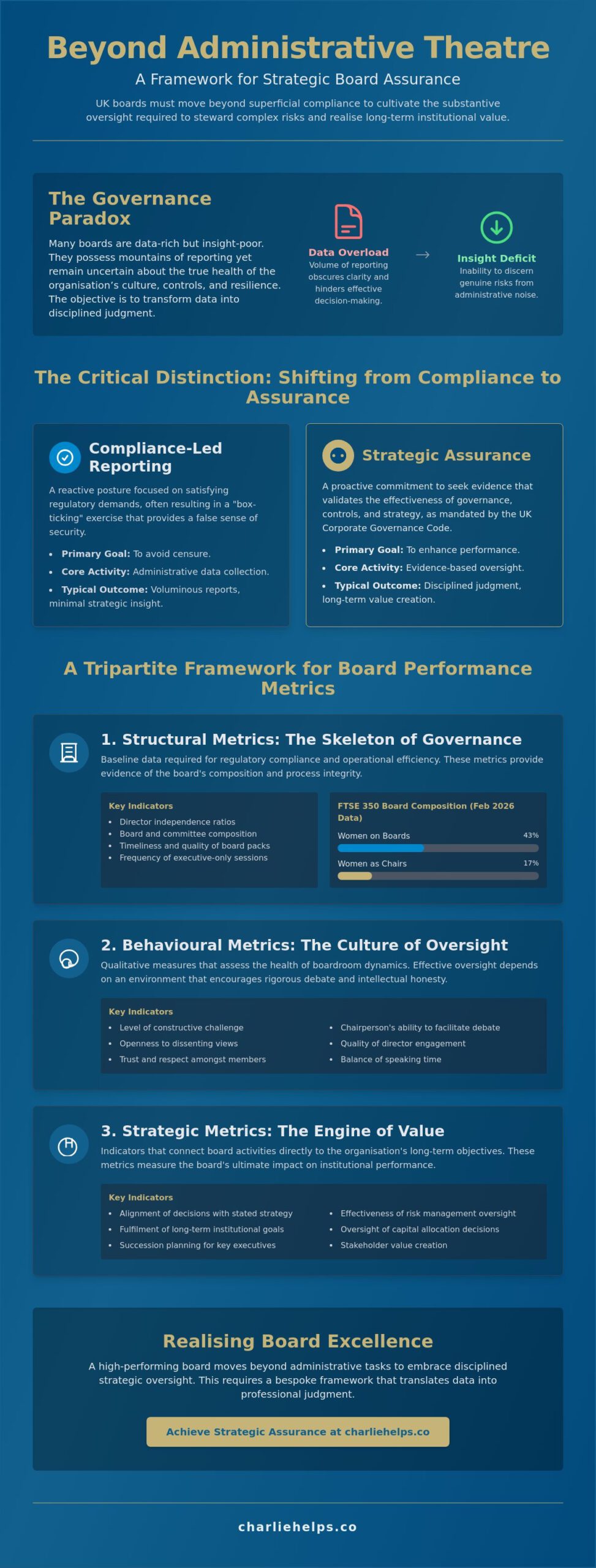
A critical distinction must be made between compliance-led reporting and the proactive pursuit of strategic assurance. Compliance often descends into a “box-ticking” exercise, where the primary goal is to avoid censure rather than to enhance performance. In contrast, strategic assurance is the primary driver of value. It involves Directors actively seeking evidence to support their reliance on executive reports. With the introduction of Provision 29 in the 2024 Code, which requires an annual declaration on the effectiveness of material internal controls starting for accounting periods from 1 January 2026, the need for robust data is acute. Directors must apply professional judgment to interpret this information, ensuring that board performance metrics UK facilitate a deeper understanding of organisational health rather than merely populating a dashboard. This disciplined approach allows the Board to identify risks before they crystallise and to realise the strategic objectives set for the firm.
Essential Categories of UK Board Performance Metrics
A fragmented approach to measurement often results in a loss of strategic focus. To capture the full picture of effectiveness, Directors must categorise board performance metrics UK into structural, behavioural, and strategic domains. This tripartite framework prevents the Board from over-indexing on easily quantifiable data whilst neglecting the human dynamics that drive decision-making quality. By organising metrics in this way, leadership teams ensure that they don’t merely monitor activity, but actually evaluate the impact of their collective oversight.
Structural and Quantitative Indicators
Structural metrics form the skeleton of governance, providing the baseline data required for regulatory compliance and operational efficiency. These include independence ratios, board composition, and the frequency of executive-only sessions. For instance, as of February 2026, women hold 43% of board positions in FTSE 350 companies, yet only 17% of Chairs are women. Monitoring these ratios provides the evidence needed to assess whether the Board is fulfilling its diversity mandates or if leadership remains concentrated in a narrow demographic. Equally critical is the measurement of information flow; the timeliness and quality of board packs are primary indicators of whether Directors have the necessary tools to exercise their authority effectively. A Board cannot decide well if its information is late, opaque, or overly filtered.
Behavioural and Qualitative Measures
Data alone cannot reveal the health of a boardroom culture. Effective oversight requires assessing the level of constructive challenge provided by Non-Executive Directors during strategic debates. This involves evaluating whether the environment encourages an openness to dissenting views or if it has devolved into a climate of guarded consensus. The Chairperson’s ability to facilitate inclusive and rigorous discussion is a vital qualitative metric. Research into effective board assessments suggests that the quality of debate often outweighs the length of the meeting as a predictor of institutional success. Directors should measure the “psychological safety” of the room, ensuring that every member feels empowered to question assumptions without fear of reprisal.
Specialised Committees require tailored metrics to fulfil their distinct mandates. The Audit Committee, for instance, must now track the effectiveness of material internal controls as mandated by the 2024 Code, whilst the Remuneration Committee focuses on the transparency of malus and clawback disclosures. Beyond these technicalities, the Board must evaluate its diversity of thought. With ethnic minorities holding only 16% of FTSE 250 board roles as of March 2026, tracking these figures is essential for maintaining a mandate from a broad stakeholder base. Finally, the Board must assess its institutional memory. This metric ensures that the rationale behind strategic pivots is preserved, allowing future Directors to understand the risks that were previously accepted or mitigated. For Boards looking to implement these sophisticated frameworks, professional mentoring and advisory can help bridge the gap between raw data and strategic wisdom.
The Metric Trap: Why Data Alone Fails to Realise Excellence
Data does not equal wisdom. A Board can possess an exhaustive set of board performance metrics UK yet remain blind to the systemic rot within its own culture. This paradox arises when Directors confuse the map for the territory, treating a dashboard as an objective reality rather than a curated reflection of executive priorities. Metrics are only as valuable as the professional judgment applied to them by experienced Directors. Without this critical layer of interpretation, data serves as a veil, obscuring the very risks it was designed to illuminate.
Executives, whether consciously or not, may present data that justifies their own performance, a phenomenon often described as “gaming” the system. When a Board relies solely on reported figures without independent verification, it risks abdicating its authority to the very agents it is meant to oversee. A Board Effectiveness Review serves as a vital qualitative intervention in this regard. It provides the necessary context to understand why certain numbers are moving, identifying whether a trend is a result of strategic success or merely a statistical fluke.
The Limits of Quantitative Oversight
A “green” dashboard can be a dangerous sedative. It may hide a culture of fear, strategic stagnation, or a lack of psychological safety that prevents whistleblowers from speaking up. Numbers cannot capture the nuances of human behaviour or the subtle shifts in boardroom dynamics that precede a crisis. To achieve genuine assurance, Directors must look beyond the spreadsheet to the underlying motivations and incentives. Relying on measuring board effectiveness through quantitative means alone leaves the organisation vulnerable to blind spots that no algorithm can detect.
Protecting Institutional Memory
Institutional memory is the collective wisdom and historical context held by the Board. It represents the “why” behind the “what,” preserving the rationale for past strategic decisions. High director turnover or inadequate record-keeping erodes this performance over time, turning the Board into a collection of strangers with no shared narrative. To mitigate this risk, Boards should measure the preservation of strategic intent across multiple years. This involves assessing how well current decisions align with long-term commitments and whether the Board retains enough context to challenge executive proposals effectively. By treating institutional memory as a metric for sustainability, Directors safeguard the organisation against the repetition of past failures and ensure they fulfil their mandate with consistency.
Designing a Framework for Strategic Board Oversight
Leadership is a practice of refinement. A performance framework should not be a static document, but a dynamic architecture for decision-making. Boards must decide which board performance metrics UK are critical based on their specific organisational context, market position, and risk appetite. This requires moving beyond generic templates that treat all companies as identical entities. Instead, Directors must curate a bespoke set of indicators that reflect their unique strategic journey and the specific challenges they face. By doing so, they ensure that the metrics remain a tool for agency rather than an administrative burden.
Incorporating an external perspective is often the only way to break through internal biases. Experienced Corporate Governance Consultants UK provide the objectivity needed to identify blind spots in board dynamics and information flows. They act as a steady hand, helping the Board to distinguish between operational noise and the critical signals that demand attention. This external validation ensures that the framework remains rigorous, relevant, and aligned with the high stakes of organizational oversight.
The Implementation Process
Implementation begins with a forensic review of the current mandate. Directors must identify the specific decisions they are required to make to fulfil their legal and ethical duties. Instead of consuming data for its own sake, the Board should select metrics that provide evidence for reliance, allowing them to support executive proposals with confidence. This process involves asking what specific evidence is necessary to trust a report, a culture, or an internal control system. Once established, a regular cycle of review ensures the framework evolves alongside the organisation, preventing it from becoming a relic of past priorities.
The Role of Committees in Performance
Committees serve as the specialised engines of detailed oversight. The Audit Committee should measure the effectiveness of the internal control environment, particularly as Provision 29 of the 2024 Code necessitates an annual declaration on material controls for periods starting on or after 1 January 2026. Simultaneously, the Nomination Committee must track board diversity and succession readiness. As of February 2026, whilst women hold 43% of board positions in the FTSE 350, their representation in CEO roles remains at a low 8%. Committees must use these board performance metrics UK to drive meaningful change in leadership pipelines. These specialised insights must feed seamlessly into the main Board’s oversight process to provide a unified, coherent view of institutional performance.
Realising a high-performing board requires a credible plan rather than mere statements of intention. If your current framework feels like an administrative burden rather than a strategic asset, we can help you re-architect your approach to governance. To discuss how to implement a bespoke framework for your organisation, contact our advisory team today.
Realising Board Excellence through Professional Advisory
Excellence in the boardroom is not a fortunate accident. It is the result of a deliberate, disciplined approach to oversight. By refining board performance metrics UK, Directors move beyond the noise of administrative trivia to reach the clarity of strategic assurance. This transition ensures that the Board remains the architect of the organisation’s future rather than a mere passenger in its present. The ultimate goal is not to produce a polished annual report, but to realise a high-performing leadership culture that values integrity, purpose, and rigorous enquiry.
Directors must reflect on the quality of the assurance they currently receive. If the metrics provided by the executive team feel like an exercise in justification rather than illumination, the Board’s authority is compromised. Achieving strategic goals requires a framework that exposes vulnerabilities as clearly as it celebrates successes. This level of transparency is the only credible path to long-term institutional value and ethical conduct.
Moving from Intention to Action
Transformation begins with a single decision: the decision to question the adequacy of current evidence. Directors must ask whether the information they receive allows them to fulfil their mandate with genuine confidence. Professional coaching and mentoring play a vital role here, strengthening individual director capability and fostering the intellectual courage required for constructive challenge. Leadership teams should examine the specific evidence that supports their current reliance on executive reporting. If that evidence is thin, the risk to institutional integrity is high. Moving from intention to action requires a credible plan that prioritises the development of human judgment alongside structural systems.
Strategic Support for UK Boards
A tailored governance architecture reduces operational friction and enhances the clarity of the Board’s authority. Independent evaluations provide a mirror, reflecting the reality of boardroom dynamics without the distortion of internal politics. These assessments ensure that board performance metrics UK serve the Board’s strategic goals rather than merely satisfying a regulatory requirement. Charlie Helps Associates acts as a partner for leadership teams seeking to transcend standard compliance and realise a culture of excellence. We offer the steady hand and seasoned expertise necessary to navigate complex organisational landscapes.
Institutional integrity is maintained through the relentless pursuit of truth. When Boards engage in external advisory, they demonstrate a commitment to this pursuit, acknowledging that internal perspectives have natural limits. This collaboration allows for the implementation of integrated governance frameworks that align with the 2024 UK Corporate Governance Code whilst remaining sensitive to the human element behind the data. By fostering a climate of openness and rigorous self-assessment, Boards can achieve their mandate and fulfil their ethical obligations to shareholders and the wider public. To discuss a bespoke approach for your organisation, contact Charlie Helps Associates.
From Administrative Compliance to Strategic Wisdom
Leadership requires a constant evaluation of the evidence that supports strategic decisions. The mere accumulation of data often creates a fog of information rather than the clarity of insight. Boards that prioritise board performance metrics UK frameworks rooted in professional judgment and qualitative dynamics are better positioned to fulfil their mandate. By integrating structural data with behavioural assessments, Directors can protect institutional memory and ensure the organisation remains resilient against systemic risks.
Achieving this level of oversight requires a transition from passive reporting to active, evidence-based assurance. Our expert Corporate Governance Consultants provide the bespoke advisory services, specialised coaching, and mentoring needed to re-architect your board dynamics. We help leadership teams realise their potential for excellence through a methodical, guided process. We invite you to refine your Board performance through professional advisory. The potential for better leadership remains a constant opportunity for those willing to look deeper.
Frequently Asked Questions
What are the most critical board performance metrics for UK companies?
The most critical metrics encompass board composition, the quality of information flow, and the rigour of constructive challenge. Directors should monitor independence ratios and diversity targets; for example, the FTSE 350 target of 40% women on boards. Beyond numbers, the most vital board performance metrics UK focus on the effectiveness of strategic oversight and the clarity of delegated authority.
How often should a UK Board conduct a performance effectiveness review?
UK Boards should conduct a formal effectiveness review annually, with FTSE 350 companies required to facilitate an externally led assessment at least every three years. This cycle ensures that the Board remains aligned with the 2024 UK Corporate Governance Code. Regular reviews prevent the erosion of institutional memory and allow Directors to adjust their governance architecture in response to market shifts.
Can qualitative factors like board culture be measured accurately?
Qualitative factors like board culture are measured through structured peer reviews, confidential interviews, and the observation of boardroom dynamics. These methods identify whether a climate of openness exists or if the Board has succumbed to guarded consensus. By assessing the level of psychological safety, Directors can determine if the environment supports the constructive challenge necessary for sound decision-making.
What is the role of the Chairperson in measuring board performance?
The Chairperson is responsible for setting the ethical tone and ensuring the Board operates as an effective collective unit. They oversee the performance evaluation process and facilitate the subsequent action plan to address identified weaknesses. A skilled Chair ensures that board performance metrics UK lead to substantive changes in behaviour rather than remaining a theoretical exercise in the annual report.
How do performance metrics link to the UK Corporate Governance Code?
Performance metrics provide the evidentiary basis for the disclosures required by the UK Corporate Governance Code, specifically regarding board effectiveness and internal controls. Provision 29 of the 2024 Code necessitates an annual declaration on the effectiveness of material controls. Metrics allow the Board to demonstrate its accountability and provide the assurance that it is fulfilling its mandate under the “comply or explain” principle.
Should a Board use external consultants for their performance evaluation?
Engaging external Corporate Governance Consultants is essential for larger organisations to secure an objective, independent perspective on board dynamics. External advisors identify blind spots that internal reviews often miss, particularly regarding the interpersonal relationships between Directors and executives. This independence is a prerequisite for maintaining stakeholder trust and ensuring the integrity of the evaluation process.
How can a Board avoid the trap of data overload in performance reporting?
Boards avoid data overload by prioritising “evidence for reliance” over a high volume of reporting. Directors must decide which specific indicators are critical to their strategic goals and ignore the operational noise that belongs to management. A well-designed governance framework filters information so that only the data required to exercise professional judgment reaches the boardroom table.
What is the difference between board compliance and board assurance?
Board compliance is the adherence to minimum legal and regulatory standards, whereas board assurance is the proactive pursuit of truth regarding organisational health. Compliance often involves box-ticking to satisfy external auditors. Assurance requires Directors to seek substantive evidence that supports their reliance on executive claims, ensuring that the Board remains an active agent of oversight rather than a passive observer.
Disclaimer
The articles published on CharlieHelps.co are provided for general information, reflection, and commentary. They draw on professional experience, research, and interpretation, but they do not constitute legal, regulatory, financial, clinical, governance, risk, compliance, assurance, or other professional advice. Nothing published on this site should be relied upon as practice guidance, formal instruction, or a substitute for proper professional consultation. Readers should seek advice from suitably qualified advisers before acting on, applying, or relying upon any material in relation to their own organisation, Board, duties, circumstances, or decisions. Although reasonable care is taken to ensure that articles are accurate and current at the time of publication, no warranty is given as to completeness, accuracy, timeliness, or fitness for any particular purpose. Law, regulation, policy, standards, and recognised practice may change, and context matters. References to external sources, organisations, products, services, or third-party materials are included for information only. They do not imply endorsement unless expressly stated. Where an article contains affiliate links, sponsored references, or commercial relationships, these will be disclosed where relevant. The views expressed are those of the author unless otherwise stated. Reading, sharing, or responding to material on this site does not create a client, adviser, fiduciary, or professional relationship with Charlie Helps FRSA, CharlieHelps.co, or any associated entity. Readers remain responsible for their own judgement, decisions, and actions.
