

Compliance is not a strategy. Whilst many UK Boards find themselves submerged in the fragmented demands of ESG reporting, the true mandate of the director remains the preservation and growth of the organisation itself. The necessity of sustainable value creation board architecture is often obscured by the noise of compliance; it is a structural challenge rather than a simple reporting hurdle. You likely feel the weight of this misalignment, sensing that the current focus on disclosure has become a surrogate for genuine leadership.
This article offers a rigorous examination of how Boards must evolve from compliance-led oversight to a governance architecture that secures long-term institutional value. By moving beyond superficial performance, we offer a disciplined framework for sustainable decision-making that enhances institutional fidelity. We shall outline how to bridge the gap between short-term demands and enduring purpose, securing clearer assurance for regulators and investors alike.
Key Takeaways
- Directors fulfil their fiduciary mandate by aligning capital and resources with long-term institutional health, meeting the rigorous expectations of Section 172.
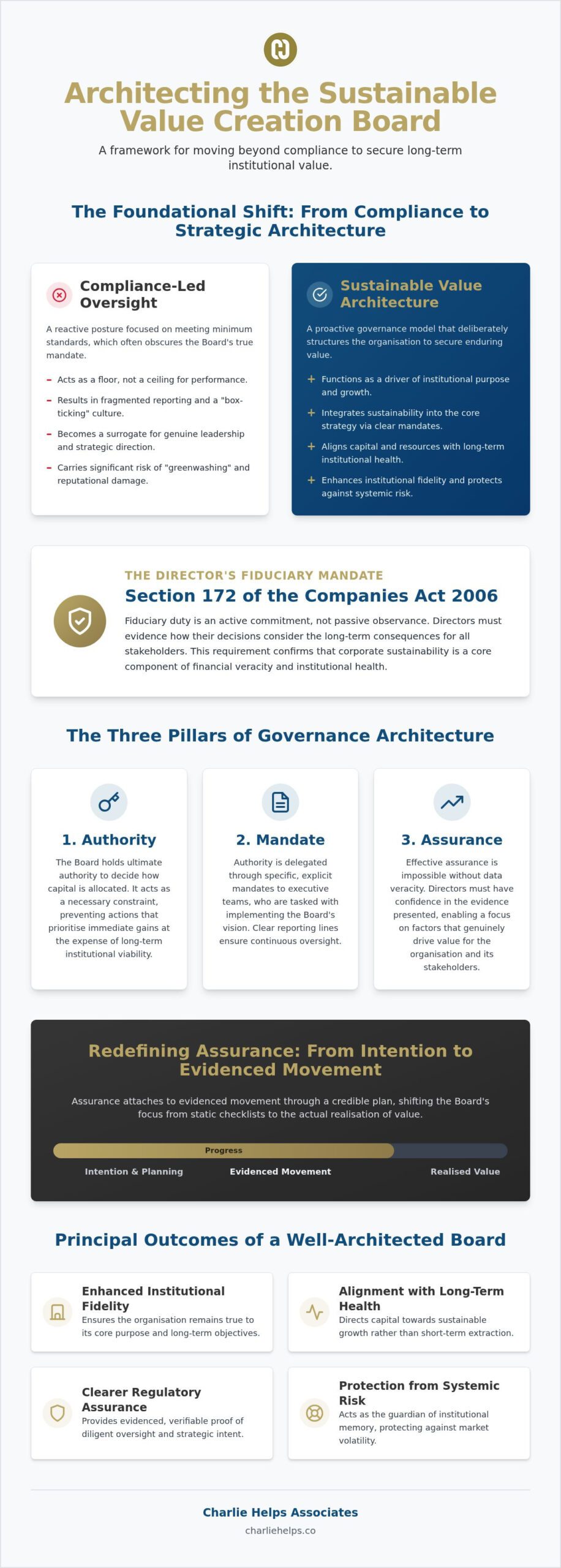
- Architecting a sustainable value creation board requires explicit structures for authority, mandate, and assurance to ensure governance remains a functional action.
- Boards must define assurance as evidenced movement through a credible plan, shifting focus from static checklists to the actual realisation of value.
- Effective governance architecture relies upon a corresponding evolution in leadership behaviour and culture to maintain institutional fidelity.
The Fiduciary Mandate for Sustainable Value Creation
Fiduciary duty is the anchor of the Board. It is an active commitment to the enduring health of the firm rather than a passive observance of regulation. The architecture of a sustainable value creation board begins with the recognition that capital and resources must align with the long-term institutional health of the organisation. This is the exercise of judgement in a landscape of uncertainty. By 2026, the expectations surrounding Section 172 of the Companies Act 2006 have hardened; directors must now evidence how their decisions consider the long-term consequences for all stakeholders as a fundamental component of financial veracity. This evolution confirms that corporate sustainability is no longer a peripheral concern but a core fiduciary mandate.
A Board does not merely respond to external pressure. It architects the internal systems necessary to realise long-term objectives. When directors view sustainability as an elective pursuit, they fail to protect the institution from systemic risks. True fidelity requires a shift from the hollow performance of “box-ticking” to a governance model rooted in moral depth and practical judgement. This transition ensures that the organisation remains a viable, thriving entity for decades rather than a vehicle for short-term extraction.
Distinguishing Value Creation from Compliance
Compliance acts as a floor, not a ceiling. Whilst meeting regulatory standards is necessary, it does not constitute a strategy for growth. When directors treat sustainability as a bureaucratic hurdle, they risk the reputational damage of greenwashing, where stated intent is not matched by structural authority. The Board must explicitly authorise sustainability as a strategic priority through clear mandates and the precise allocation of capital. Without this authority, sustainability remains a fragmented reporting exercise rather than a driver of institutional value.
The Fiduciary Duty of Long-Termism
Short-term market pressures frequently erode the foundations of sustainable growth. The Board serves as the guardian of institutional memory, protecting the organisation’s long-term viability against the volatility of quarterly expectations. To fulfil this role, directors require a clear mandate from shareholders to pursue objectives that transcend the immediate reporting cycle. This clarity allows the Board to implement a framework that values endurance over expedience, ensuring the organisation can realise its purpose whilst maintaining the trust of its investors and the wider public.
Designing a Governance Architecture for Sustainable Outcomes
Governance is an action performed by people. It is not an abstract agent or a static container. To make these actions workable, a Board must establish a rigorous architecture that directs human behaviour towards long-term ends. A sustainable value creation board relies on three specific pillars: authority, mandate, and assurance. These components ensure that sustainability is not a siloed initiative but a fundamental aspect of how the organisation functions. By adopting Integrated Governance Frameworks, directors can architect institutional excellence that aligns every committee with the core purpose of the firm.
Authority and the Distribution of Responsibility
The Board holds the ultimate authority to decide how capital is allocated to secure the organisation’s future. This authority is then delegated through specific mandates to executive teams, who are responsible for implementing the Board’s vision. Clear reporting lines are essential; they ensure that the Board remains informed of progress and can intervene when necessary. Directors must also act as a constraint, preventing any executive actions that prioritise immediate gains at the expense of long-term sustainable value.
Veracity in Data and Reporting
Assurance is impossible without veracity. Directors must have confidence in the evidence provided to them to exercise proper oversight. Fragmented reporting often obscures the truth, making it difficult for the Board to identify systemic risks. Effective oversight by a sustainable value creation board requires a commitment to data integrity. Utilising workflow optimisation software can significantly reduce operational friction, allowing for the collection of reliable, real-time data. This technological support enables a focus on double materiality, identifying the factors that truly drive value for both the organisation and its stakeholders. If you require assistance in refining these structures, our consultants can provide specialist advisory services to help you architect a more resilient framework.
Achieving Assurance through Evidenced Movement
Assurance is not a static state or a final certificate. It is the evidenced movement of an organisation through a credible, time-bound plan. For a sustainable value creation board, this movement provides the necessary veracity for stakeholders to trust the organisation’s direction. Directors must move from accepting mere statements of intent to verifying that resources are allocated and milestones are met. Real assurance attaches to the implementation of the plan rather than the hope of its success.
Critics often argue that sustainability is too complex for precise measurement. This claim frequently serves as a veil for inaction. While the nuances of social and environmental impact are broad, directors must identify the specific indicators that reflect real-world change and long-term institutional health. Rigour in measurement is a choice. A Board that fails to measure fails to lead.
The Credible Plan as a Governance Tool
A credible plan consists of specific milestones, clearly allocated resources, and defined accountability for every senior leader. The Board monitors this progress by reviewing evidence of movement rather than descending into the minutiae of executive operations. This approach maintains a clear distinction between oversight and management. A board effectiveness review validates the credibility of sustainability plans by assessing whether the Board possesses the collective skill and authority to scrutinise the data provided.
Institutional Memory and Continuous Oversight
Leadership transitions represent a significant risk to the continuity of long-term objectives. The Company Secretary and the Board must collaborate to protect institutional memory, ensuring that the sustainable value creation board maintains its focus even as individual directors depart. This involves codifying the logic behind key decisions and maintaining a record of the evidence used to support them. Constant questioning of the strategic plan’s assumptions is required to maintain fidelity to the original mandate. This disciplined oversight ensures that the organisation remains on its intended path regardless of external volatility or internal shifts.
Strategic Advisory and the Evolution of Leadership
Structural frameworks provide the necessary shape for an organisation, yet they remain inert without a corresponding shift in leadership behaviour. A sustainable value creation board requires more than a rigorous manual of procedures; it demands directors who possess the psychological fortitude to resist the gravity of short-termism. Architecture is the skeleton, but culture is the breath that makes it workable. When the human element is neglected, even the most sophisticated governance systems collapse into a performance of compliance. To realise genuine institutional fidelity, Boards must cultivate the specific capabilities required to oversee long-term value in a landscape of increasing complexity.
The Role of External Counsel in Governance Fidelity
External counsel serves as a necessary mirror for the Board. For many UK organisations, the proximity to daily operations creates a natural myopia that obscures systemic risks. Engaging corporate governance consultants UK helps to identify these blind spots, ensuring that the Board’s strategy remains rooted in reality rather than assumption. Independent assurance is a prerequisite for building trust with external stakeholders, regulators, and investors. Whilst “off-the-shelf” sustainability solutions offer a veneer of readiness, they rarely address the unique structural requirements of a specific firm. Bespoke advisory ensures that the governance architecture is tailored to the organisation’s unique mandate, authority, and institutional memory.
Mentoring for Sustainable Stewardship
Leadership at the highest level is a lonely discipline. The Chairperson and CEO must navigate the moral complexities of sustainable value creation whilst managing the competing appetites of diverse stakeholders. Dedicated executive leadership coaching UK provides a confidential space for developing strategic wisdom, a core leadership competency for 2026. This mentoring focuses on the intersection of human behaviour and structural systems, helping leaders to implement a culture of constant questioning and rigorous assurance. By refining these leadership capabilities, the Board ensures that its commitment to sustainability is not a mere intention, but an evidenced movement towards a resilient future.
The architecture of excellence is never accidental. It requires a deliberate decision to move beyond the comfort of compliance and into the rigour of true governance. If you are prepared to architect a framework that secures long-term institutional value, we invite you to contact Charlie Helps Associates for a confidential discussion regarding your governance needs. The aim is clarity; the decision is yours; the evidence of success will be the enduring health of your organisation.
Architecting Institutional Fidelity for the Next Decade
Securing the long-term health of an organisation is a deliberate act of leadership. It requires directors to move from the passive observance of regulation to the active architecture of value. You have seen that institutional fidelity depends upon a clear mandate, the precise allocation of resources, and a culture of constant questioning. A sustainable value creation board does not merely intend to succeed; it implements a credible plan and seeks assurance through evidenced movement.
Success in this landscape demands a shift in leadership behaviour. Our expertise in UK Corporate Governance Code compliance and bespoke leadership mentoring for C-suite executives provides the steady hand required for organisational transformation. We offer specialised advisory services to help you identify blind spots and realise a framework that secures your organisation’s future.
The potential for organisational renewal lies in the quality of your oversight. With the right architecture and a commitment to strategic wisdom, you can fulfil your mandate and realise enduring value for all stakeholders.
Frequently Asked Questions
What is the primary role of a sustainable value creation board?
The primary role of a sustainable value creation board is the intentional alignment of capital, resources, and human behaviour to secure long-term institutional health. Directors must move beyond reactive compliance to architect a governance framework that prioritises endurance over immediate extraction. This involves setting a clear mandate and ensuring that executive actions remain consistent with the organisation’s enduring purpose.
How does sustainable value creation differ from traditional ESG reporting?
Sustainable value creation focuses on the structural architecture of decision-making, whereas traditional ESG reporting often remains a retrospective data exercise. Reporting identifies what has occurred; architecting ensures the organisation pursues specific, long-term ends. A sustainable value creation board treats sustainability as a strategic discipline performed by people. It moves the focus from static disclosure to the active realisation of value through evidenced movement.
What legal mandates govern sustainable value for UK directors in 2026?
Section 172 of the Companies Act 2006 remains the primary legal mandate, requiring directors to promote the success of the company for the benefit of its members. By 2026, regulatory expectations have clarified that this success is inseparable from the long-term consequences of decisions. Directors must evidence how they consider stakeholder interests and environmental impact to fulfil their fiduciary duty. Failure to do so risks a breach of the duty to exercise reasonable care, skill, and diligence.
Can a Board be held liable for failing to pursue sustainable value?
Directors may face personal liability if they fail to address systemic risks that threaten long-term institutional viability. Whilst courts rarely second-guess commercial judgement, they increasingly scrutinise the process of decision-making. If a Board ignores material sustainability risks, shareholders may initiate derivative claims for breach of fiduciary duty. Liability often attaches to a failure of oversight or the absence of a credible plan to protect the firm’s future value.
How should a Board organise its committees to oversee sustainability effectively?
Boards should integrate sustainability oversight into existing committee structures to prevent the formation of ineffective silos. The Audit Committee typically oversees the veracity of sustainability data, whilst the Remuneration Committee aligns executive incentives with long-term milestones. This integrated approach ensures that every committee exercises its authority to support the organisation’s sustainable mandate. Some organisations also appoint a dedicated sustainability committee to provide deeper scrutiny of complex systemic shifts.
What evidence does a Board require to gain assurance on sustainability claims?
Assurance requires verifiable evidence of movement through a credible, time-bound plan. Directors should demand data that possesses veracity, such as audited emissions reports, resource allocation logs, and verified supply chain assessments. They must also scrutinise the assumptions underlying executive reports to ensure that progress is real rather than performative. Relying on sustainable value creation board structures allows for continuous oversight, ensuring that every claim is backed by documented decisions.
Disclaimer
The articles published on CharlieHelps.co are provided for general information, reflection, and commentary. They draw on professional experience, research, and interpretation, but they do not constitute legal, regulatory, financial, clinical, governance, risk, compliance, assurance, or other professional advice.
Nothing published on this site should be relied upon as practice guidance, formal instruction, or a substitute for proper professional consultation. Readers should seek advice from suitably qualified advisers before acting on, applying, or relying upon any material in relation to their own organisation, Board, duties, circumstances, or decisions.
Although reasonable care is taken to ensure that articles are accurate and current at the time of publication, no warranty is given as to completeness, accuracy, timeliness, or fitness for any particular purpose. Law, regulation, policy, standards, and recognised practice may change, and context matters.
References to external sources, organisations, products, services, or third-party materials are included for information only. They do not imply endorsement unless expressly stated. Where an article contains affiliate links, sponsored references, or commercial relationships, these will be disclosed where relevant.
The views expressed are those of the author unless otherwise stated. Reading, sharing, or responding to material on this site does not create a client, adviser, fiduciary, or professional relationship with Charlie Helps FRSA, CharlieHelps.co, or any associated entity.
Readers remain responsible for their own judgement, decisions, and actions.
