

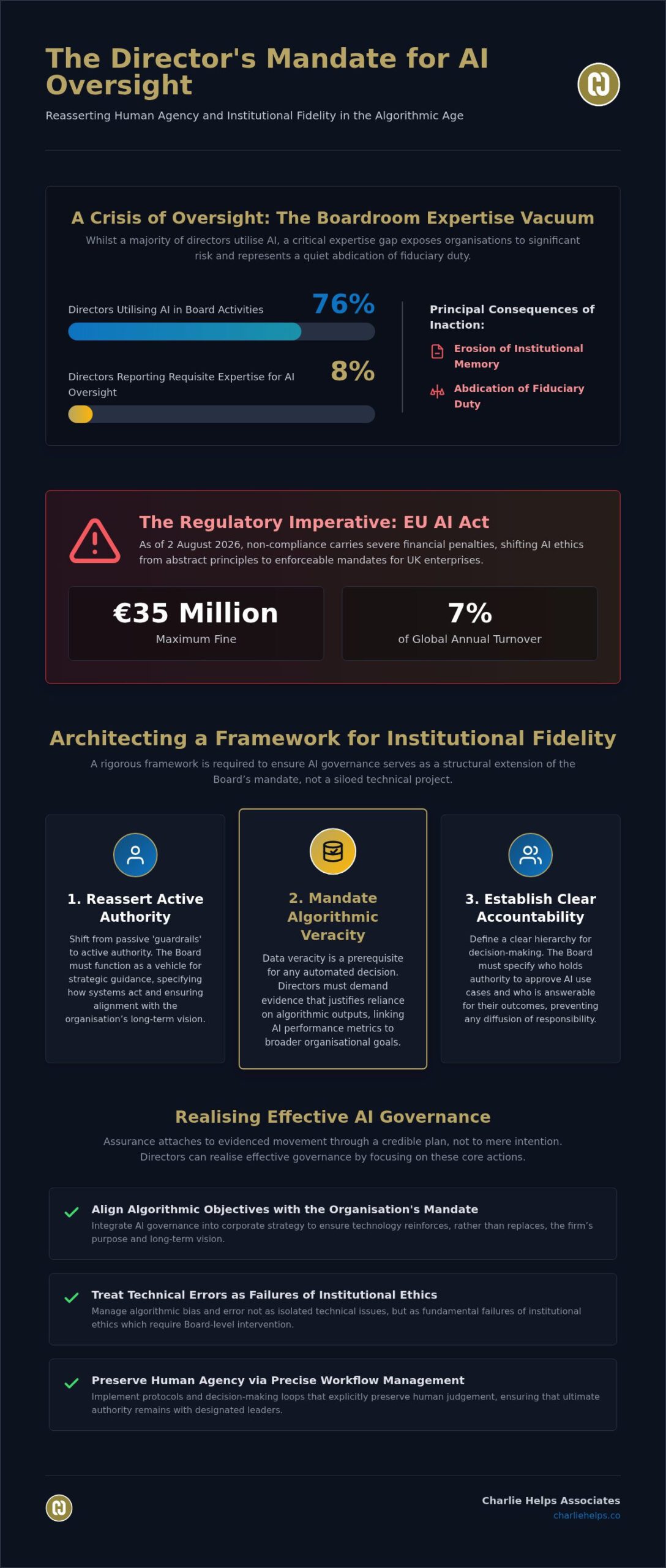
Whilst 76% of corporate directors utilise artificial intelligence in their board activities, a mere 8% report having the expertise required to oversee it. You likely recognise that this expertise gap creates a vacuum where algorithmic reliance erodes institutional memory and leaves the organisation exposed to the severe penalties of the EU AI Act. This disconnect represents a fundamental crisis of oversight; it is a silence where there should be a command. The risk is not merely technical failure, but the quiet abdication of the Board’s fiduciary duty of care. Effective AI governance must begin with the reassertion of human agency over the machine.
This guide provides a rigorous framework for directors to reclaim their mandate, ensuring that algorithms remain subordinate to human judgement and institutional purpose. We shall examine how to establish authority, ethical assurance, and data veracity. You will learn to fulfil legal requirements without succumbing to the distractions of consultancy theatre. Our aim is to make workable a system of oversight that secures boardroom authority through evidence, restraint, and practical judgement. By the conclusion, you will possess a clear-eyed strategy to implement oversight that is both humane and intellectually formidable.
Key Takeaways
- Boards must reassert their authority over automated systems to maintain institutional fidelity and ensure algorithms remain subordinate to human judgement.
- Directors can implement an integrated framework for AI governance that aligns algorithmic objectives with the long-term vision, ethical standards, and mandate of the organisation.
- Managing algorithmic bias requires treating technical errors as failures of institutional ethics, which necessitates precise workflow management to preserve human agency.
- Independent board effectiveness reviews and leadership coaching help directors realise the necessary assurance to navigate the complexity of the algorithmic landscape.
The Board Mandate for AI Oversight in 2026
Authority cannot be delegated to an algorithm. Whilst many executive teams view artificial intelligence as a technical layer to be managed by IT departments, the Board must recognise AI governance as a fundamental exercise of its mandate. This duty involves maintaining institutional fidelity by ensuring that every automated process reflects the core values and strategic aims of the firm. Directors must distinguish between the technical management of software and the strategic oversight of systems that now influence corporate culture, risk profiles, and fiduciary obligations. A Board that fails to specify how a system acts, decides, or constrains human choice effectively abdicates its responsibility to the machine.
From Passive Guardrails to Active Authority
We must reject the fiction that AI acts as an autonomous agent. Only people act; only people decide. Boards often fall into the trap of setting passive guardrails, which implies a boundary that exists independently of leadership. Instead, directors must exercise active authority over automated decision-making processes. An effective AI Governance Board functions as a vehicle for strategic guidance, ensuring that every deployment aligns with the long-term vision of the organisation. This requires directors to demand evidence of veracity before placing reliance on algorithmic outputs, thereby preserving institutional memory against the tide of automated erosion.
The Legal and Regulatory Landscape in the United Kingdom
The global landscape of AI regulation has shifted from abstract ethics to enforceable mandates. As of 2 August 2026, major provisions of the EU AI Act have entered into force, creating immediate implications for UK enterprises with cross-border operations. Penalties for non-compliance are severe, reaching up to 35 million Euros or 7% of global annual turnover. Within the United Kingdom, the Financial Reporting Council (FRC) and the Information Commissioner’s Office (ICO) have tightened standards for algorithmic accountability. Directors must now ensure veracity in regulatory filings, demonstrating that they have assessed the risks of automated systems and implemented a credible plan to realise compliance. Success in this environment requires more than mere intention; it necessitates a documented movement towards structural integrity and ethical assurance.
Architecting a Framework for Institutional Fidelity
Fidelity requires architecture. Structural veracity is the antidote to algorithmic drift. An integrated framework ensures that AI governance serves as a structural extension of the Board’s existing oversight rather than a siloed technical project. This framework must align every automated objective with the long-term vision of the organisation, preventing the erosion of institutional memory. Directors should implement protocols for the continuous monitoring of algorithmic performance, demanding evidence that justifies stakeholder reliance. Without such evidence, assurance remains a mere assertion rather than a verified state. Utilising the NIST AI Risk Management Framework provides a rigorous baseline for categorising these risks, yet the Board’s duty extends to ensuring these categories align with the specific mandate of the firm.
Integrating Algorithmic Veracity into Corporate Strategy
Data veracity is a prerequisite for any automated decision. If the underlying data lacks integrity, the resulting decision lacks authority. Directors must link AI performance metrics to broader organisational goals, ensuring that technology supports the firm’s purpose. To achieve this, many Boards engage corporate governance consultants UK to architect frameworks that resist operational friction. These frameworks prioritise the preservation of human judgement within the decision-making loop. By anchoring technology in strategy, the Board ensures that automation reinforces, rather than replaces, the collective wisdom of the leadership team.
Establishing Clear Lines of Accountability
Accountability is a personal burden. The Board must specify exactly who has the authority to approve new AI use cases within the firm. This decision-making hierarchy ensures that no system operates without a human sponsor who is answerable for its outcomes. Assurance attaches to evidenced movement through a credible plan, not to the mere existence of a policy document. Directors must define how the organisation intervenes when an algorithm deviates from its intended path. This clarity prevents the diffusion of responsibility often found in complex technical environments. If you require assistance in defining these hierarchies, you may wish to discuss your governance architecture with a strategic advisor. The final test of any framework is its utility in a crisis; a well-defined hierarchy ensures that when systems fail, the path to resolution is already established.
Managing Algorithmic Risk and Human Agency
Algorithmic bias is not a technical glitch; it is a failure of institutional ethics. When an automated system produces skewed results, it reflects a lapse in the Board’s oversight of the data and logic that govern organisational behaviour. Directors must treat these risks as direct threats to the firm’s integrity. Effective AI governance requires that human judgement remains the final arbiter of any automated output. We must avoid ungrounded futurism and focus on the verifiable facts of system performance. Oversight is a human act, performed by people who understand that data is merely a representation of human behaviour, not a replacement for it. The Board’s authority rests on its ability to constrain the machine when it threatens the moral depth of the organisation.
Beyond Bias: Securing Ethical Assurance
Ethical assurance must be a measurable outcome of boardroom oversight. It’s not enough to intend fairness; the Board must evidence it through rigorous testing and structural veracity. ‘Black box’ algorithms present a specific risk to corporate accountability because they obscure the logic behind critical decisions. Directors must insist on reports that clearly distinguish between fact, inference, and assumption. This clarity allows the Board to identify where automated systems might constrain human choice in ways that contradict the organisation’s mandate. Research from Stanford HAI policy initiatives emphasises that human-centred oversight is essential to prevent these systems from operating in a moral vacuum. Without this human-centric focus, the firm risks losing its institutional memory to the cold logic of the algorithm.
Workflow Optimisation and the Mitigation of Friction
Operational friction often arises when new technologies are layered onto inefficient legacy processes. Precisely managed workflows reduce this friction without sacrificing the necessary oversight. Utilising workflow optimisation software helps directors maintain visibility over automated tasks. These digital tools help directors implement checks and balances that ensure fidelity to the firm’s strategic aims. By focusing on the human behaviour behind the data, leadership can improve organisational performance while maintaining a steady hand on the controls. A credible plan for technology adoption always includes a mechanism for human intervention when an algorithm deviates from its intended path. This ensures that movement through the plan remains evidenced and that the Board’s authority is never truly surrendered.
The preservation of human agency is the ultimate aim of any governance architecture. Directors must reject the notion that automated systems are too complex for non-technical oversight. Complexity is often a mask for a lack of veracity. By demanding clarity and maintaining a methodical approach to risk, the Board ensures that technology remains a tool for growth rather than a source of systemic failure. This requires a steady hand and a clear-eyed view of the global trends that shape our regulatory environment. Ultimately, the Board decides where the machine ends and human responsibility begins.
Realising Effective AI Governance through Professional Advisory
Professional advisory serves as the structural scaffolding for boardroom authority. Whilst internal committees provide the initial architecture, an external perspective is necessary to verify that these systems actually fulfil the organisation’s mandate. Effective AI governance is realised when directors move from a position of passive reliance to one of informed assurance. This movement requires a methodical assessment of the Board’s own capability to scrutinise algorithmic logic. Professional advisors don’t merely provide reports; they help directors implement a system of restraint that ensures technology remains a servant to corporate purpose.
The Role of Independent Board Effectiveness Reviews
External scrutiny is the only way to confirm that a Board’s oversight of automated systems is robust rather than performative. A comprehensive board effectiveness review must now incorporate a rigorous assessment of AI maturity. This process evaluates the Board’s capability to question algorithmic assumptions and identify what risks remain after a framework is implemented. It’s a test of utility. Does the current structure allow directors to detect drift before it leads to regulatory failure? By subjecting their processes to independent review, directors secure the evidence they need to provide genuine assurance to shareholders, stakeholders, and regulators alike.
Coaching Leaders for the Algorithmic Age
Leadership in an automated environment demands a fusion of human-centric wisdom and technical literacy. Executive coaching builds the specific capability required to lead teams where human behaviour and structural systems intersect. Leaders must learn to manage the “two-clock” problem of compliance whilst maintaining the firm’s institutional memory. This is not about learning code; it is about refining the practical judgement needed to govern it. We invite directors and C-suite executives to contact us to discuss tailored advisory support. Investing in leadership capability ensures that the organisation’s moral depth remains intact as it scales its technical operations.
The implication is clear. The Board must act now to secure its authority before the complexity of automated systems makes oversight unworkable. Delay is a decision to surrender control. By implementing a credible plan for professional advisory and AI governance, directors realise the structural veracity required to protect the firm’s future. The machine is ready; the question is whether the Board is prepared to lead it.
Securing the Boardroom Mandate for an Algorithmic Future
The transition to automated systems is not a technical shift but a fundamental leadership challenge. Directors must reassert their authority by ensuring that algorithms remain subordinate to human judgement and organisational purpose. Effective AI governance requires more than a policy document; it necessitates a structural commitment to veracity and institutional fidelity. By architecting frameworks that prioritise evidence over intention, Boards can navigate the complexity of the global regulatory landscape whilst preserving the moral depth of their organisations.
Our advisory services are rooted in institutional fidelity and backed by decades of boardroom experience. We utilise a proprietary workflow optimisation methodology to reduce operational friction and help directors implement oversight that is both humane and intellectually formidable. This methodical approach ensures that every automated decision remains within the Board’s mandate. You have the authority to shape how technology serves your firm; now is the time to exercise it.
Leadership remains the ultimate arbiter of corporate success. We look forward to supporting your journey toward excellence and structural integrity.
Frequently Asked Questions
Is the Board legally responsible for decisions made by an AI system?
Directors remain legally responsible for all corporate outcomes, including those determined by automated systems. Fiduciary duties require that the Board maintains active oversight and does not surrender its mandate to an algorithm. Legal accountability rests with the people who authorise the system’s use, not the software itself. Directors must ensure they have implemented a credible plan for oversight to mitigate the risk of personal liability.
Can we implement AI governance without stifling operational efficiency?
Directors improve operational efficiency by implementing a rigorous AI governance framework that reduces the friction caused by unmanaged technical debt. By architecting a clear structure, leadership removes the ambiguity that often leads to delays in decision-making. Utilising a proprietary Workflow Optimisation SaaS solution allows the organisation to maintain veracity whilst accelerating the implementation of strategic initiatives. Proper architecture ensures that technology supports, rather than obstructs, the firm’s purpose.
How does AI governance differ from traditional IT risk management?
Systems for traditional IT risk management focus on technical uptime and data security, whilst strategic oversight addresses institutional fidelity and ethical assurance. This higher level of scrutiny examines how automated systems act, decide, or constrain human choice in alignment with corporate values. It moves beyond binary technical checks to evaluate the moral depth and long-term vision of the organisation. Only people can provide the strategic guidance required to lead an algorithmic age.
What evidence does the Board require to provide assurance on AI safety?
The Board requires evidenced movement through a credible plan to provide genuine assurance. This includes documented data veracity, clear hierarchies of accountability, and proof of human intervention protocols. Directors must distinguish between fact, inference, and assumption in all algorithmic reporting. Assurance attaches to the verified state of the system’s performance rather than the mere intention of the technical team, ensuring that safety remains a measurable outcome.
What happens if our AI governance framework fails to meet UK regulatory standards?
Failure to meet regulatory standards, such as those established by the EU AI Act or UK frameworks, exposes the organisation to severe financial penalties. Fines can reach 35 million Euros or 7% of global annual turnover. Beyond financial loss, the firm faces the erosion of institutional memory and a breakdown in stakeholder trust. Regulators now demand transparency and veracity in all filings related to AI governance and automated decision-making.
How often should a Board conduct an effectiveness review of its AI systems?
A Board should conduct an effectiveness review of its automated systems at least annually, or whenever significant changes occur within the algorithmic landscape. These reviews should be integrated into broader board effectiveness reviews to ensure a holistic view of organisational performance. Regular scrutiny allows directors to identify drift and reassert their authority before technical complexity makes oversight unworkable. Frequent evaluation preserves the human-centric focus required for long-term success.
Disclaimer
The articles published on CharlieHelps.co are provided for general information, reflection, and commentary. They draw on professional experience, research, and interpretation, but they do not constitute legal, regulatory, financial, clinical, governance, risk, compliance, assurance, or other professional advice.
Nothing published on this site should be relied upon as practice guidance, formal instruction, or a substitute for proper professional consultation. Readers should seek advice from suitably qualified advisers before acting on, applying, or relying upon any material in relation to their own organisation, Board, duties, circumstances, or decisions.
Although reasonable care is taken to ensure that articles are accurate and current at the time of publication, no warranty is given as to completeness, accuracy, timeliness, or fitness for any particular purpose. Law, regulation, policy, standards, and recognised practice may change, and context matters.
References to external sources, organisations, products, services, or third-party materials are included for information only. They do not imply endorsement unless expressly stated. Where an article contains affiliate links, sponsored references, or commercial relationships, these will be disclosed where relevant.
The views expressed are those of the author unless otherwise stated. Reading, sharing, or responding to material on this site does not create a client, adviser, fiduciary, or professional relationship with Charlie Helps FRSA, CharlieHelps.co, or any associated entity.
Readers remain responsible for their own judgement, decisions, and actions.
