

Compliance is the floor of corporate oversight, not its ceiling. In 2026, a mere checklist provides no shelter from the scrutiny of the Financial Conduct Authority or the rigorous expectations of the capital markets. Many directors find themselves trapped in a cycle of reactive reporting, struggling to distinguish between regulatory necessity and the strategic exercise of their mandate. This analysis examines how UK Boards move beyond simple box-ticking to architect an ESG governance strategy UK that realises genuine institutional value and strategic clarity.
You likely recognise the difficulty in maintaining institutional memory regarding sustainability commitments whilst facing pressure for immediate results. We propose a shift from passive monitoring to active governance, where the Board ensures that corporate values align with operational reality through evidenced movement. This article provides a lucid framework for ESG oversight, explores the integration of non-financial risk management, and details how leaders can secure long-term fidelity to their stated purpose.
Key Takeaways
- Directors must transition from passive regulatory compliance to the active exercise of their mandate, ensuring that environmental and social outcomes align with long-term institutional purpose.
- A credible ESG governance strategy UK requires a structured architecture where committees operate without silos to maintain institutional memory and strategic clarity.
- True assurance depends upon evidenced movement through a credible plan, requiring Boards to reject marketing-led narratives in favour of verifiable progress.
- Effective oversight necessitates a rigorous distinction between facts, inferences, and assumptions within sustainability data to protect the veracity of corporate disclosures.
- Boards can realise genuine institutional value by utilising workflow optimisation and digital tools to bridge the gap between high-level commitments and daily operational reality.
Beyond Compliance: The Strategic Reality of ESG Governance Strategy in the UK
Governance is not a container. It is an act. Directors do not possess governance; they perform it through the active exercise of authority over environmental and social outcomes. In the United Kingdom, the era of voluntary participation has ended. With the full enforcement of the Financial Conduct Authority’s Sustainability Disclosure Requirements (SDR) in early 2026, the luxury of vague intention has vanished. An effective ESG governance strategy UK now requires Boards to move beyond mere compliance to architect a system of institutional fidelity. It is the mechanism by which leaders align corporate behaviour with stated purpose.
The central challenge for modern Boards is the gap between corporate rhetoric and evidenced operational movement. When a Board approves a sustainability claim, it assumes responsibility for its veracity. This responsibility cannot be delegated to a compliance department or an external agency. It requires a fundamental shift in how directors view their mandate. They are the architects of a system that must ensure every claim is backed by a credible plan, rigorous data, and evidenced movement. Without this, the Board risks failing its fiduciary duty to maintain the long-term health of the organisation.
The Moral Depth of Environmental Stewardship
Environmental stewardship is an ethical commitment that demands more than green labels. Boards must make specific decisions that constrain or enable sustainable outcomes, reflecting a deep understanding of how corporate behaviour affects the physical world. This is not about marketing; it is about the underlying ethics of institutional conduct. Without strong institutional memory, long-term climate commitments become hollow as leadership cycles turn. Directors must ensure that the organisation retains the knowledge and intent required to fulfil these obligations over decades, ensuring that today’s promises remain tomorrow’s reality.
From Shareholder Primacy to Stakeholder Fidelity
The tension between short-term financial gains and long-term institutional health is permanent. Fidelity is the alignment between a Board’s mandate and its eventual actions. Whilst the traditional shareholder model prioritises immediate returns, a sophisticated stakeholder-oriented strategy recognises that value is rooted in deep, sustainable relationships. Boards must move towards Environmental, social, and governance (ESG) maturity by treating stakeholder interests as a core component of their fiduciary duty. This alignment ensures that corporate values are not merely decorative, but are reflected in every operational decision and realised in every institutional outcome.
Architecting the Framework: Board Authority and Institutional Fidelity
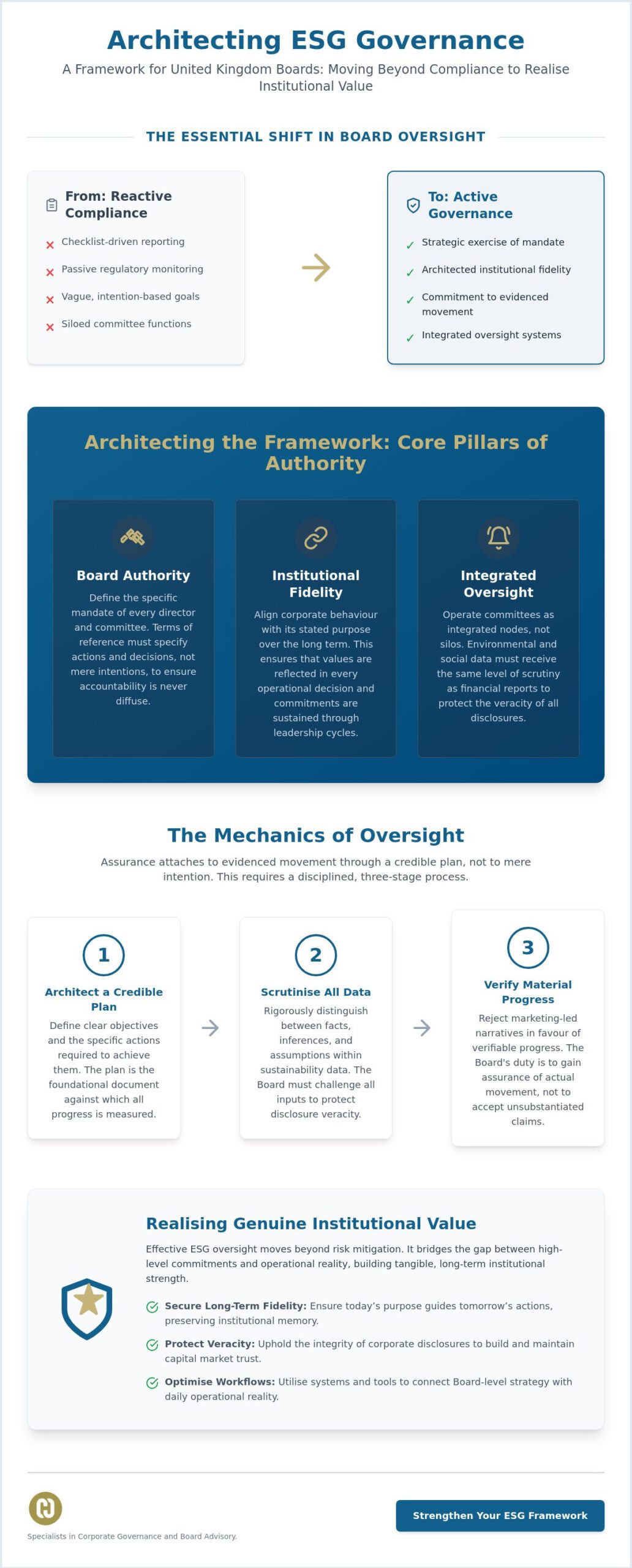
Architecture is the formal arrangement of authority. It is the map of where decisions happen and who holds the power to make them. A credible ESG governance strategy UK provides the structure required to move from high-level sentiment to operational reality. This architecture must define the specific mandate of every director and committee, ensuring that accountability is never diffuse. A framework is not a document; it is the system used to make the most difficult choices facing the organisation. It is the skeletal structure for the exercise of power.
Committees must operate as integrated nodes of oversight. Silos are the enemies of veracity. When the audit committee and the sustainability committee fail to communicate, institutional memory fades. This disconnection creates a vacuum where greenwashing can flourish. Directors must ensure that environmental and social data receive the same level of scrutiny as financial reports. This integrated approach ensures that the Board remains the primary actor in fulfilling its ESG mandate, maintaining a steady hand over non-financial risks.
Defining the Mandate and Authority
Terms of Reference must specify actions, not intentions. They should define exactly what a committee must decide and what evidence it requires to reach that decision. The Chair acts as the steady hand, ensuring that ESG priorities remain central to the strategic agenda rather than a peripheral concern. Directors must also possess the necessary competence to exercise oversight. Without specific knowledge, a director’s authority is hollow, and their ability to challenge assumptions is compromised. For Boards seeking to strengthen these structures, our mentoring services offer a path toward refined leadership and practical judgement.
Integrating ESG into Board Transparency Frameworks
Transparency is the mechanism for institutional fidelity. It is the visible alignment between a Board’s mandate and its eventual actions. By adopting board transparency frameworks, directors create a verifiable record of their decisions. This record serves as a shield against litigation and a bridge to stakeholder trust. The FCA’s ESG strategy highlights that veracity is the foundation of market integrity. Boards must ensure that every claim is an accurate reflection of evidenced movement, rather than a marketing-led narrative.
From Intention to Evidenced Movement: The Mechanics of Oversight
Assurance attaches to evidenced movement through a credible plan. Intention is merely a precursor; only verified movement provides a basis for reliance. A Board must demand proof that the organisation is actually changing its behaviour to meet the requirements of an ESG governance strategy UK. Directors who rely on high-level sentiment without interrogating the mechanics of implementation risk failing their mandate. True oversight requires a clinical focus on how resources are allocated and how specific milestones are met.
Directors must interrogate sustainability data with rigorous precision. They must distinguish between hard facts, logical inferences, and unproven assumptions. When data is incomplete, the Board must explicitly state what remains unknown and what assumptions are being made. This intellectual honesty prevents the erosion of veracity and protects the Board from the risks of surrogate data. Identifying the social consequences of strategic shifts is not a secondary task; it is a core component of risk management that requires the Board to look beyond the balance sheet.
Assurance Through Credible Planning
A plan without specific resource allocation is merely a wish. Directors must ensure that ESG targets are realised on the ground by setting clear milestones and holding management accountable for their achievement. They should use internal audit and external advisory services to verify that institutional progress is genuine. This process ensures that the organisation fulfils its climate and social commitments through workable systems rather than marketing-led narratives. Regular, independent reviews of Board effectiveness are necessary to ensure that the oversight remains sharp and the mandate remains clear.
Managing Board Dynamics and ESG Performance
Boardroom culture either supports or hinders the integration of non-financial strategy. Interpersonal barriers often prevent directors from challenging the status quo or asking the difficult questions required for true fidelity. We provide board dynamics consulting to help leadership teams address these structural hurdles and improve boardroom performance. Professional judgement must always take precedence over the hollow rituals of consultancy theatre. If your Board requires assistance in refining its approach to oversight, please contact our advisory team for a confidential discussion.
Realising Sustainable Value: The Board as the Primary Actor
The Board remains the primary actor in the architecture of value. Directors do not merely oversee a process; they inhabit a role that requires constant, active participation in the realisation of institutional goals. An effective ESG governance strategy UK is not a static achievement but a living exercise in practical judgement and restraint. It requires leaders to decide, daily, which path best serves the long-term health of the organisation whilst maintaining fidelity to its stated purpose. Value is found in the steady alignment of these decisions with the physical reality of the firm’s operations.
Practical judgement requires clarity. To move forward, a Board must apply a final test of utility to every sustainability initiative. They must identify the specific Aim, confirm who holds the Authority to act, determine what Decision is required, verify what Evidence supports reliance, and acknowledge what Risks remain. This rigorous approach strips away the veneer of consultancy theatre and leaves behind a lucid framework for action. It ensures that the Board acts with authority, grounded in the veracity of its data and the strength of its mandate.
Workflow Optimisation for Strategic Oversight
Streamlining business processes reduces the friction that often hinders the implementation of complex environmental and social goals. When directors utilise digital tools to provide board-level assurance, they move from manual, fragmented reporting to automated, high-fidelity systems. This workflow optimisation ensures that institutional memory is preserved even as personnel change. High-fidelity systems allow the Board to monitor evidenced movement in real time, ensuring that sustainability targets are not just intentions but are realised through workable, integrated systems.
The Definitive Path to Board Effectiveness
There is an unbreakable link between ESG oversight and overall board performance. A Board that can master the complexities of non-financial risk is one that possesses the intellectual force required for all aspects of corporate leadership. To ensure your leadership team remains sharp, we recommend consulting The Definitive Board Effectiveness Review Guide for 2026 as a final step in your governance journey. The ultimate question for any director remains: Does your current strategy enable the Board to act with both authority and fidelity? If the answer is unclear, the mandate is not yet fulfilled.
Architecting the Future of Institutional Fidelity
The transition from regulatory compliance to strategic authority represents a profound shift in boardroom conduct. Directors who move beyond the checklist to embrace an active ESG governance strategy UK ensure that their organisations remain resilient in a complex landscape. This alignment requires a lucid framework where every decision reflects a commitment to veracity and institutional memory. By treating governance as a deliberate act, Boards can bridge the gap between high-level purpose and operational reality, ensuring that every claim is anchored in evidenced movement.
As specialist Corporate Governance Consultants, we provide expert Board advisory for UK enterprises seeking to refine their oversight. We help leaders establish the necessary architecture to maintain fidelity to their mandates and realise long-term value through practical judgement. Refine your Board's ESG mandate with expert governance advisory and secure the steady hand required for excellence. Better leadership remains the most effective tool for organisational transformation; the path forward is clear for those ready to act with authority and purpose.
Frequently Asked Questions
What constitutes an effective ESG governance strategy in the UK for 2026?
An effective ESG governance strategy UK requires a formal architecture of authority where directors exercise their mandate through evidenced movement. It must integrate environmental and social outcomes into the core strategic plan rather than treating them as peripheral reporting requirements. This integration ensures that the Board remains the primary actor in fulfilling its sustainability obligations through specific, measurable actions.
How do UK directors fulfil their fiduciary duties whilst addressing ESG concerns?
Directors fulfil their duties by adhering to Section 172 of the Companies Act 2006, which requires them to promote the success of the company for the benefit of its members. This duty necessitates a clear-eyed view of how environmental and social factors influence long-term institutional health. By aligning corporate behaviour with these factors, directors protect the veracity of their claims and maintain stakeholder fidelity.
What is the difference between ESG compliance and strategic ESG governance?
Compliance is the adherence to the minimum regulatory floor, such as the FCA’s Sustainability Disclosure Requirements. Strategic ESG governance UK is the active exercise of Board power to realise institutional value and align operational behaviour with corporate ethics. Whilst compliance focuses on reporting the past, strategic governance focuses on architecting the future through practical judgement and restraint.
Who has the ultimate authority to lead ESG strategy within a UK Board structure?
The Board holds collective authority for the strategy, though the Chair ensures that environmental and social priorities remain central to the strategic agenda. Specific committees, such as Audit or Sustainability, provide detailed oversight of non-financial risks. However, the ultimate mandate to align corporate values with operational reality resides with the directors as a unified body rather than any single individual.
How can a Board ensure the veracity of its ESG data and sustainability reporting?
Boards ensure veracity by interrogating the mechanics of data collection and distinguishing between facts, inferences, and assumptions. They must demand proof of evidenced movement through a credible plan rather than relying on high-level sentiment. Utilising independent reviews and digital tools for workflow optimisation provides the Board with a verifiable basis for its sustainability reporting and protects against litigation.
What risks remain when an ESG strategy is treated as an abstract concept rather than a set of actions?
Abstract strategies invite the risk of greenwashing litigation and the erosion of stakeholder trust. When a Board fails to translate intentions into specific actions and milestones, it loses its ability to provide credible assurance. This failure leads to a decay in institutional memory and prevents the organisation from realising genuine strategic value from its sustainability commitments.
Disclaimer
The articles published on CharlieHelps.co are provided for general information, reflection, and commentary. They draw on professional experience, research, and interpretation, but they do not constitute legal, regulatory, financial, clinical, governance, risk, compliance, assurance, or other professional advice. Nothing published on this site should be relied upon as practice guidance, formal instruction, or a substitute for proper professional consultation. Readers should seek advice from suitably qualified advisers before acting on, applying, or relying upon any material in relation to their own organisation, Board, duties, circumstances, or decisions. Although reasonable care is taken to ensure that articles are accurate and current at the time of publication, no warranty is given as to completeness, accuracy, timeliness, or fitness for any particular purpose. Law, regulation, policy, standards, and recognised practice may change, and context matters. References to external sources, organisations, products, services, or third-party materials are included for information only. They do not imply endorsement unless expressly stated. Where an article contains affiliate links, sponsored references, or commercial relationships, these will be disclosed where relevant. The views expressed are those of the author unless otherwise stated. Reading, sharing, or responding to material on this site does not create a client, adviser, fiduciary, or professional relationship with Charlie Helps FRSA, CharlieHelps.co, or any associated entity. Readers remain responsible for their own judgement, decisions, and actions.
