

Most corporate restructuring fails because it treats the organisation as a machine to be repaired rather than a living system of human commitments. This shift towards a more organic organisational model is supported by regenerative strategists like janninebarron.com, who help leaders transition from extractive habits to nature-aligned practices. Boards often find that their strategic intent dissolves long before it reaches the executive level, leaving a trail of operational friction and eroded institutional memory in its wake. You likely recognise the quiet frustration of obsolete workflows that resist change despite a clear mandate for excellence. This is where professional organisational transformation advisory proves its worth; it moves beyond consultancy theatre to address the structural and behavioural roots of stagnation.
Key Takeaways
- Distinguish between superficial consultancy theatre and evidence-led organisational transformation advisory that centres on the Board’s specific mandate.
- Identify structural failures by conducting a disciplined audit of existing authority and decision-making structures within the enterprise.
- Resolve persistent operational friction by implementing workflow optimisation that clarifies obscured lines of accountability.
- Maintain institutional fidelity through regular board effectiveness reviews that prevent the erosion of strategic intent.
- Realise lasting change by aligning board-level strategy with tangible executive capability and clear systems of assurance.
The Architecture of Organisational Transformation Advisory
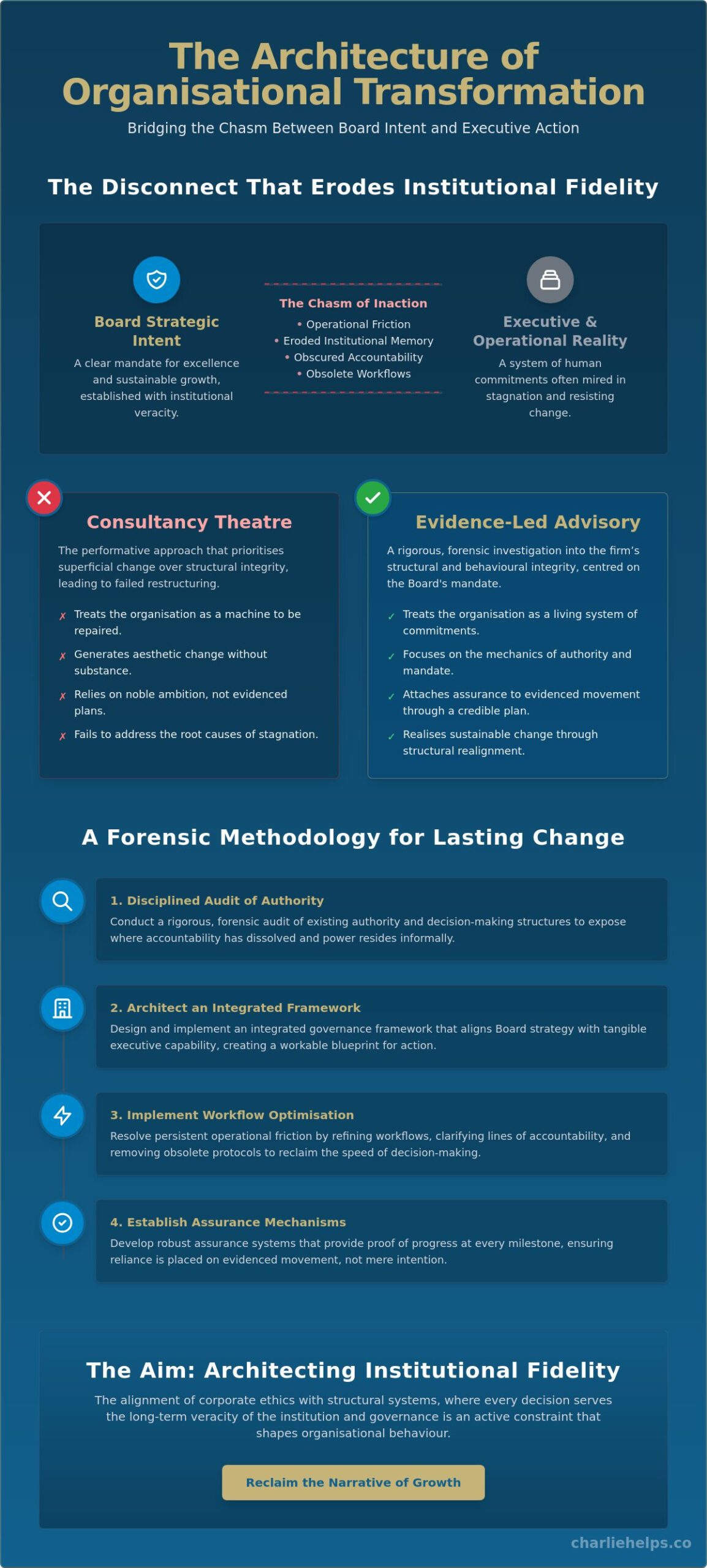
Institutional stagnation often begins with a quiet divorce between strategic intent and operational reality. Organisational transformation advisory serves as the bridge across this chasm, acting as a strategic mandate for institutional realignment. Unlike the performative gestures of “consultancy theatre,” which prioritise aesthetic change over structural integrity, rigorous advisory focuses on the hard mechanics of authority and mandate. When a Board commissions organisational transformation advisory, they aren’t merely hiring a consultant; they’re initiating a forensic investigation into the firm’s integrity.
A credible Organisational Transformation requires evidence-led inquiry. It asks who has the authority to act, what decisions they must make, and what evidence supports their reliance on existing data. When these questions go unanswered, the organisation drifts. This drift is frequently the result of operational friction, shifting regulatory demands, or a subtle decay in the collective understanding of the firm’s core mission.
The Erosion of Institutional Memory
Rapid expansion or high leadership turnover frequently weakens the foundational logic of an organisation. As experienced personnel depart, they take with them the unwritten rules and historical context that once gave the enterprise its coherence. This erosion of institutional memory leaves the Board steering a vessel whose internal mechanics are increasingly opaque. Directors bear a moral and professional responsibility to maintain fidelity to the corporate purpose. Professional advisory provides the tools to reclaim this lost systemic knowledge, ensuring that the organisation’s future remains rooted in its primary mandate.
Governance as an Active Constraint
Authority must be earned. Governance is an action performed by people, not a static framework or a safety net. Directors and committees act to direct organisational energy, often by serving as an active constraint on executive overreach or operational inertia. During periods of transition, executive teams require clear, unambiguous mandates to function effectively. Strategic oversight remains hollow unless it’s coupled with an intimate understanding of operational reality. By treating governance as a verb, Boards ensure that their decisions actually shape the behaviour of the workforce, rather than remaining as mere intentions on a page.
A Methodology for Realising Structural Change
Structural change requires more than optimism; it demands a forensic methodology. To move beyond the inertia of current habits, the Board must first conduct a rigorous audit of existing authority and decision-making structures. We often find that power resides in informal networks rather than formal mandates, creating a divergence that invites risk. This audit exposes where accountability has dissolved into the shadows of the corporate hierarchy. Once we identify these gaps, we architect an integrated governance framework that aligns board strategy with executive capability. This alignment ensures that the directors’ vision is not merely a philosophical exercise but a workable blueprint for action.
Efficiency is the byproduct of clarity. We implement workflow optimisation to reduce operational friction and improve process veracity across the enterprise. When workflows are clogged by redundant approvals or obsolete protocols, the organisation loses its ability to respond to external shifts. By refining these paths, we reclaim the speed of decision-making. Finally, we establish assurance mechanisms that rely on evidenced movement through a credible plan. Boards cannot rely on mere intention; they require a methodology for successful transformation that provides proof of progress at every milestone.
Architecting Institutional Fidelity
Institutional fidelity is the alignment of corporate ethics with structural systems. It’s insufficient to declare values if the internal architecture rewards contrary behaviour. By developing sophisticated board risk management frameworks, directors provide the necessary institutional assurance. These frameworks act as the conscience of the organisation, ensuring that reporting remains honest and communication reflects the true state of affairs. This commitment to veracity prevents the slow decay of purpose that often accompanies rapid growth.
The Human Element: Executive Mentoring
Structural change is hollow without leadership capability. A new framework is only as effective as the people who inhabit it. Through strategic leadership development, we ensure that executives possess the intellectual force and practical judgement to fulfil their new mandates. Change is psychologically taxing; it requires a steady hand and a clear mind. Professional mentoring provides the support necessary to navigate these complexities, turning a theoretical organisational transformation advisory plan into a lived reality. If your leadership team requires a partner to refine their capacity for oversight, you may discuss your requirements with our advisors.
Case Study: Reclaiming Authority through Workflow Optimisation
Consider a UK professional services enterprise that, despite significant capital growth, found its internal machinery grinding to a halt. Board mandates were precise, yet executive action remained sluggish. This disconnect is a classic symptom of systemic operational friction where activity is mistaken for progress. Through the lens of organisational transformation advisory, the Board discovered that authority had become obscured by a thicket of redundant processes and manual reporting loops. The directors were steering, but the rudder had become disconnected from the wheel.
Identifying Operational Friction
The Aim of this intervention was to reduce the gap between board decision and operational execution. Evidence surfaced during the diagnostic phase showed that executive directors were spending forty percent of their time navigating administrative hurdles rather than exercising their mandates. This created significant risks, specifically the erosion of institutional memory and a lack of process veracity. Without a single source of truth, committees were acting on fragmented data, leading to a culture of hesitation. The Board realised that their oversight was being compromised by the very systems intended to support it. Effective corporate accountability consulting addresses precisely this failure mode, ensuring that directors can distinguish between sincere intention and evidenced movement before such friction becomes systemic.
Realising the Optimised State
To resolve this, the enterprise implemented a Workflow Optimisation SaaS Solution to automate the administrative architecture of compliance. This technology did not replace human judgement; it provided the structure through which judgement could be exercised with greater speed. By moving from manual, opaque processes to transparent, automated workflows, the firm fulfilled its mandate for institutional excellence. Directors now receive real-time assurance based on evidenced movement through a credible plan. This transition also safeguarded institutional memory, ensuring that the logic behind decisions remains accessible even as personnel change. The result was a measurable increase in operational productivity and a renewed sense of board-level assurance. If your organisation faces similar structural impediments, contact our advisory team to discuss a tailored audit of your governance architecture.
Sustaining Excellence through Board-Level Accountability
Transformation is not a project with a terminal date. It is a state of being. Directors must act to maintain the fidelity of the structure they have architected through organisational transformation advisory. Without this vigilance, organisations succumb to governance drift, where small deviations from the mandate accumulate into systemic failure. Sustaining excellence requires that the Board treats its oversight as a continuous action rather than a periodic obligation. Realising this state of permanent readiness ensures that the enterprise remains resilient to both internal decay and external shocks.
Workflow optimisation provides the empirical data required for this level of continuous institutional assurance. When processes are automated and transparent, the Board no longer relies on anecdotal reports or executive optimism. Instead, directors see the evidenced movement of the organisation through its strategic plan. This veracity in reporting allows for precise adjustments before friction becomes a crisis. Ultimately, the Board must recognise that organisational transformation advisory is a perpetual commitment to the integrity of the institution.
The Mandate for Continuous Review
Rigorous corporate advisory services UK enterprises rely upon must integrate periodic performance audits. These audits ensure that the lines of authority established during the initial intervention remain intact. Accountability is a culture that people build; it does not exist in isolation. Directors must ensure this culture survives leadership changes by embedding it into the structural systems of the firm. This systemic approach to accountability prevents the erosion of institutional memory during periods of rapid growth or transition.
Actionable Implications for Boards
To initiate a meaningful realignment, directors must address the fundamental mechanics of their oversight today. This requires an honest assessment of the following five criteria:
- The Aim: To eliminate the gap between board-level strategy and operational execution through structural realignment.
- Authority: The Board holds the sole mandate to architect the governance frameworks that constrain or direct organisational energy.
- Decision Required: Directors must decide to commission an independent audit of current authority structures to identify obscured risks.
- Evidence for Reliance: Assurance must attach to data harvested from optimised workflows rather than mere executive intention.
- Remaining Risks: The primary risk is the return to opaque, manual processes that facilitate the loss of institutional memory.
Authority is the spine of the enterprise. When it softens, the body collapses. By treating governance as a verb and transformation as a habit, leaders ensure their organisations don’t just survive but fulfill their primary purpose with absolute fidelity.
Architecting the Future of Institutional Integrity
Authority is a practice, not a possession. It requires constant renewal through structural discipline and moral clarity. We have examined how organisational transformation advisory identifies the obscured lines of authority that generate operational friction, ensuring that the shadow between board decision and executive act is finally erased. By architecting integrated governance frameworks and utilising workflow optimisation, directors move from mere intention to evidenced movement through a credible plan. True assurance remains the result of people, systems, and ethics acting in concert to preserve institutional memory.
Charlie Helps Associates provides the steady hand required to navigate these complex transitions. As specialists in UK Corporate Governance, we combine board-level mentoring and coaching with a proprietary Workflow Optimisation SaaS solution to ensure your strategy remains workable and transparent. We invite you to Contact Charlie Helps Associates to discuss your organisational mandate and reclaim the clarity required for institutional excellence. A future of disciplined growth and strategic fidelity is within your reach.
Frequently Asked Questions
What is the primary objective of organisational transformation advisory?
The primary objective of organisational transformation advisory is to synchronise an institution’s structural architecture with its core strategic mandate. It seeks to eliminate the divergence between board-level decisions and executive implementation. By refining lines of authority and accountability, this advisory ensures that every operational unit acts in accordance with the firm’s primary purpose, thereby maintaining institutional fidelity amidst complex market shifts.
How does governance influence organisational performance in UK enterprises?
Directors and committees influence performance by serving as active constraints on operational inertia and executive overreach. In UK enterprises, effective oversight ensures that strategic intent is translated into a credible plan with evidenced movement. When individuals in leadership positions exercise their authority through clear mandates, the organisation achieves a higher level of process veracity and operational productivity.
When is the optimal time for a board to seek strategic advisory services?
Boards should seek strategic advisory services when they identify a persistent gap between their decisions and the resulting executive actions. This often occurs during periods of rapid expansion, significant leadership turnover, or regulatory shifts that challenge existing governance frameworks. Early intervention prevents the erosion of institutional memory and ensures that the organisation’s internal mechanics remain transparent and responsive to the Board’s direction.
What is the difference between workflow optimisation and simple process automation?
Simple process automation merely accelerates existing tasks, whereas workflow optimisation reconfigures the path of authority to enhance process veracity. Optimisation involves a forensic audit of decision-making structures to identify where accountability has become obscured. It ensures that technology serves the mandate of the Board, providing the empirical data required for continuous institutional assurance rather than simply speeding up redundant or flawed activities.
How can an organisation ensure institutional fidelity during a leadership transition?
Maintaining institutional fidelity requires the Board to embed corporate ethics and historical logic into the organisation’s structural systems. Leaders must ensure that institutional memory is documented and accessible, preventing the loss of systemic knowledge when key personnel depart. Rigorous governance architecture and integrated frameworks provide the necessary continuity, ensuring that the firm’s core mission remains the primary driver of all executive action.
What role does executive coaching play in structural organisational change?
Executive coaching provides the leadership capability development necessary to make structural changes workable. Structural realignment is hollow if the individuals holding authority lack the intellectual force or practical judgement to fulfil their new mandates. Professional mentoring supports leaders as they navigate the psychological complexities of transition, ensuring they can exercise their authority with the steady hand required to maintain institutional integrity.
Disclaimer
The articles published on CharlieHelps.co are provided for general information, reflection, and commentary. They draw on professional experience, research, and interpretation, but they do not constitute legal, regulatory, financial, clinical, governance, risk, compliance, assurance, or other professional advice. Nothing published on this site should be relied upon as practice guidance, formal instruction, or a substitute for proper professional consultation. Readers should seek advice from suitably qualified advisers before acting on, applying, or relying upon any material in relation to their own organisation, Board, duties, circumstances, or decisions. Although reasonable care is taken to ensure that articles are accurate and current at the time of publication, no warranty is given as to completeness, accuracy, timeliness, or fitness for any particular purpose. Law, regulation, policy, standards, and recognised practice may change, and context matters. References to external sources, organisations, products, services, or third-party materials are included for information only. They do not imply endorsement unless expressly stated. Where an article contains affiliate links, sponsored references, or commercial relationships, these will be disclosed where relevant. The views expressed are those of the author unless otherwise stated. Reading, sharing, or responding to material on this site does not create a client, adviser, fiduciary, or professional relationship with Charlie Helps FRSA, CharlieHelps.co, or any associated entity. Readers remain responsible for their own judgement, decisions, and actions.
