

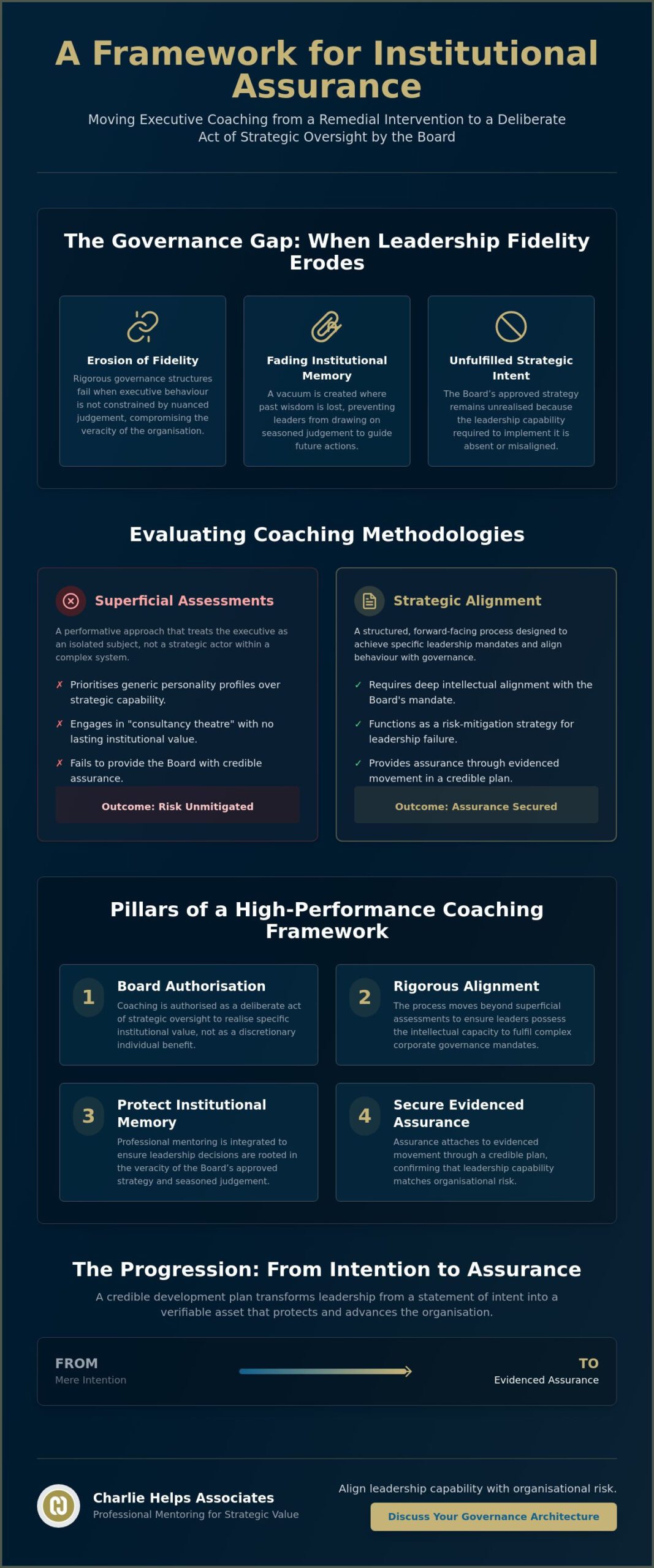
What if the most profound risk to your organisation’s stability is not a failure of strategy, but a subtle erosion of leadership fidelity? Boards often find that even the most rigorous governance structures fail to constrain executive behaviour when senior leaders lack the nuanced judgement required to implement them amidst complex regulatory demands. This misalignment creates a vacuum where institutional memory fades and strategic intent remains unfulfilled. Within the context of high-stakes executive leadership coaching UK, the objective shifts from individual professional development to a strategic mechanism for institutional assurance.
You likely recognise that traditional mentoring often lacks the evidentiary weight required to satisfy a modern Board’s need for certainty. This article provides a strategic framework for C-suite leaders who seek to align executive behaviour with governance structures, ensuring that leadership capability matches organisational risk. We shall examine how to move beyond “consultancy theatre” to achieve a state where every senior decision reflects the veracity of the Board’s approved mandate, protects institutional memory, and fulfils the strategic vision.
Key Takeaways
- Understand why Boards must authorise executive leadership coaching UK as a deliberate act to realise strategic value rather than a remedial individual intervention.
- Distinguish between superficial psychometric assessments and the rigorous intellectual alignment required to fulfil complex corporate governance mandates.
- Establish a high-performance framework by identifying the specific Aim and ensuring the coaching mandate integrates with existing organisational systems.
- Protect institutional memory through professional mentoring that ensures senior leadership behaviour reflects the veracity of the Board’s approved strategy.
- Secure clear assurance that leadership capability matches organisational risk through evidenced movement through a credible development plan.
The Mandate for Executive Leadership Coaching in UK Corporate Governance
Governance is not a static container or a set of abstract rules. It is a live performance conducted by people. Boards, directors, and committees do not merely “have” governance; they exercise it through their decisions and the constraints they place upon the organisation. When a Board authorises The Mandate for Executive Leadership Coaching, it performs a deliberate act of strategic oversight. This intervention ensures that the “Human Element” of the C-suite remains in strict alignment with the institutional architecture. Without this alignment, the most rigorous frameworks remain hollow, unable to translate strategic intent into realised value.
The primary objective of executive leadership coaching UK is to provide the Board with assurance. Directors must know that senior leaders possess the capacity to fulfil their mandates within complex, often volatile, regulatory environments. This is a matter of institutional fidelity. If leadership behaviour diverges from the Board’s approved strategy, the veracity of the entire organisation is compromised. Coaching acts as a corrective mechanism, ensuring that individual capability scales alongside organisational risk.
Distinguishing Mentoring from Coaching in the Boardroom
Whilst often conflated, mentoring and coaching serve distinct functions within the governance landscape. Mentoring focuses on the transfer of institutional memory and the cultivation of seasoned judgement. It is a retrospective and reflective process, drawing on the wisdom of experience to guide future actions. In contrast, coaching is a structured, forward-facing process designed to achieve specific leadership mandates. It focuses on the practical implementation of strategy. Both are necessary to ensure that senior management decisions are rooted in evidence rather than “consultancy theatre” or ungrounded intuition.
The Board’s Duty of Care and Leadership Oversight
Directors carry a fundamental duty of care to mitigate operational risks, including the risk of leadership failure. They decide to invest in professional development not as a perk, but as a risk-mitigation strategy. Boards require more than just a statement of intent; they demand evidenced movement through a credible plan. This ensures that leaders can implement complex strategies and fulfil their roles with the high-level judgement required by regulators. When leadership capability is verified through structured observation and feedback, the Board can confidently assert that the organisation’s human capital is fit for purpose. For those seeking to align their leadership team with these rigorous standards, you may contact us to discuss a tailored governance architecture.
Evaluating Coaching Methodologies: From Psychometrics to Strategic Alignment
The current market for executive leadership coaching UK is saturated with superficial psychometric assessments. These tools often provide a veneer of scientific rigour, yet they rarely address the deep intellectual alignment required to fulfil a Board mandate. When organisations prioritise personality profiles over strategic capability, they engage in consultancy theatre. This performative approach fails to realise long-term institutional value because it treats the executive as an isolated subject rather than a strategic actor within a complex system. When Evaluating Coaching Methodologies, Directors must look beyond the individual to the structural requirements of the role.
Professional capability becomes paramount in navigating complex regulatory environments. Leaders do not operate in a vacuum; they function within a framework of authority and accountability that demands high-level judgement. A credible plan for leadership development provides the Board with the necessary assurance that the executive team remains fit to implement the organisation’s strategy. This assurance is not a static state; it is a dynamic quality maintained through constant refinement of leadership action.
Evidence of Progress vs. Mere Intention
Assurance attaches to evidenced movement through a credible plan. Boards cannot rely on mere intention or vague promises of growth. They require specific evidence that a leader’s judgement has sharpened and that their actions align with the organisation’s risk profile. Institutional memory is the preserved essence of past wisdom applied to current challenges through the senior leadership team. Without this memory, an organisation is doomed to repeat its errors, regardless of the sophistication of its governance architecture.
The Role of Intellectual Force in Senior Management
Senior management requires intellectual force. A leader must communicate strategic vision with aphoristic precision, stripping away ambiguity to reveal the core intent. Lucid and elegant communication is not a cosmetic addition to the C-suite; it is a fundamental requirement for the implementation of complex mandates. Coaching refines this practical judgement, enabling executives to speak with an authority that commands respect and ensures the realisation of corporate goals. If your leadership team requires this level of refinement, you might discuss your requirements with a seasoned advisor.
Implementing a High-Performance Coaching Framework in the UK
Implementing a high-performance framework for executive leadership coaching UK requires a methodical approach that mirrors the consultative process of a Board. First, directors must identify the specific Aim of the intervention and establish who holds the authority to authorise the programme. This clarity prevents the coaching from becoming an unguided personal exercise. Second, the coaching mandate must align with the existing corporate governance framework; it should reinforce, not circumvent, established lines of accountability.
Third, the Board must define the evidence required to support reliance on the coaching outcomes. Assurance is not found in testimonials but in evidenced movement through a credible plan. Fourth, the programme integrates with leadership succession planning advisory to ensure that institutional memory remains intact during transitions. Finally, the Board should review the realised value and identify what risks remain, ensuring that the organisation remains resilient.
Integrating Coaching with Succession Planning
Succession planning is often treated as a bureaucratic exercise in replacement, yet it requires a rigorous focus on leadership capability development. Coaching ensures the fidelity of the leadership pipeline by preparing potential successors to fulfil high-level mandates before they assume formal authority. The Board oversees this transition, deciding when a candidate has demonstrated the practical judgement necessary to sustain institutional stability. This foresight prevents the erosion of institutional memory when key personnel depart.
Measuring Realised Value and Institutional Impact
We reject the vague descriptor “impactful” in favour of realised organisational performance. Boards require objective data to track leadership movement within integrated governance frameworks. This tracking reveals whether senior leaders have implemented the strategic vision or if they have merely maintained the status quo. Workflow optimisation supports these goals by providing the structural support necessary for leaders to act with efficiency. If you are ready to architect a leadership framework that satisfies your Board’s mandate, contact us to begin the consultation.
The Charlie Helps Approach: Professional Mentoring for Strategic Value
Charlie Helps Associates acts as a steady hand within complex organisational environments. We balance the role of a strategic advisor with that of a grounded, human-centric mentor. This dual focus ensures that every engagement carries the necessary professional weight and gravitas required by the C-suite. Our corporate governance consultants UK integrate executive leadership coaching UK into a broader advisory framework. This integration ensures that leadership development is never an isolated event but a core component of institutional health.
Every coaching engagement we undertake is rooted in the lexicon of high-level management and organisational theory. We reject the shallow promises of motivational language in favour of practical judgement and restraint. By focusing on abstract nouns that denote quality and long-term vision, we help leaders navigate the intersection of human behaviour and structural systems. This approach allows senior executives to fulfil their mandates with a sense of calm expertise, even when the regulatory environment is volatile.
Engaging with the Advisory Team
Engaging with our advisory team requires leaders to think deeply about their oversight responsibilities. We facilitate a consultative process that values intellectual depth over the artificial speed often found in “consultancy theatre”. This methodical rhythm allows for a more reflective approach to systemic challenges. Boards seeking to realise better leadership performance must decide to authorise a mandate that prioritises evidenced movement through a credible plan. This decision provides the foundation for long-term institutional stability and the preservation of institutional memory.
Institutional Excellence through Human Behaviour
Governance is an action performed by people. Directors, committees, and executives are the primary agents of institutional fidelity. The potential for transformation lies at the intersection of structural systems and human behaviour. When these elements align, the organisation achieves a state of veracity that satisfies both regulators and stakeholders. The central issue remains whether the Board is prepared to treat leadership capability as a measurable strategic asset. Does your Board possess the readiness to authorise a strategic coaching mandate that secures the organisation’s future?
Securing Institutional Veracity through Strategic Oversight
Leadership is the primary instrument of institutional fidelity. Boards that recognise this truth move beyond performative development to authorise coaching as a rigorous strategic mandate. By anchoring individual capability in the principles of the UK Corporate Governance Code, directors ensure that senior leaders possess the practical judgement required to fulfil complex mandates. This process secures institutional memory, protects the organisation from the erosion of strategic intent, and maintains the veracity of every senior decision. Our expertise across public and private sectors, supported by a proprietary Workflow Optimisation methodology, provides the evidence-based movement Boards require for genuine assurance.
The standard for executive leadership coaching UK must remain high to meet the expectations of modern regulators. When you align executive behaviour with structural systems, you create an environment where excellence becomes a repeatable habit rather than a fortunate accident. We invite you to begin a guided conversation regarding your leadership mandate. It is time to ensure that your leadership team reflects the integrity, purpose, and vision of your Board. We look forward to supporting your path toward institutional excellence.
Frequently Asked Questions
What is the primary aim of executive leadership coaching within a UK governance framework?
The primary aim is to align individual leadership capability with the organisation’s strategic mandate and risk profile. Within the context of executive leadership coaching UK, this alignment ensures that senior leaders possess the practical judgement required to fulfil their roles with institutional fidelity. It is a deliberate action performed by the Board to realise strategic value, protect institutional memory, and secure the organisation’s future.
How does the Board ensure that coaching programmes achieve institutional fidelity?
Directors ensure fidelity by establishing a specific Aim and requiring evidenced movement through a credible plan. They must decide to integrate the coaching mandate with existing corporate governance frameworks. This oversight prevents the programme from becoming a superficial personal development exercise, ensuring instead that it reinforces the organisation’s structural systems, ethical standards, and strategic vision.
Who has the authority to authorise executive coaching for senior management teams?
Authority typically resides with the Board of Directors or a specific committee, such as the Nomination or Remuneration Committee. These individuals decide to authorise a coaching mandate as part of their duty of care to mitigate operational risk. By exercising this authority, they ensure that investment in senior leadership is rooted in evidence, satisfies regulatory expectations, and is directed toward organisational excellence.
What evidence supports reliance on the outcomes of a leadership coaching programme?
Reliance is supported by evidence of sharpened practical judgement and the successful implementation of strategic goals. Boards require clear assurance that leadership behaviour reflects the veracity of the approved strategy. This evidence often manifests as improved senior decision-making, better alignment with regulatory requirements, and a tangible contribution to the preservation of institutional memory.
Can executive coaching be integrated with existing succession planning advisory services?
Integration is essential to maintain the fidelity of the leadership pipeline. Executive leadership coaching UK prepares potential successors to fulfil high-level mandates before they assume formal authority. This process ensures that institutional memory remains intact during transitions, allowing the Board to oversee the transfer of seasoned judgement and authority with confidence and clarity.
What risks remain if a leadership coaching programme is implemented without a governance mandate?
Implementation without a mandate risks leadership misalignment and a failure to realise institutional value. Without Board oversight, coaching often descends into “consultancy theatre”, where individual goals diverge from the strategic vision. This creates a vacuum where institutional memory fades, leaving the organisation vulnerable to poor judgement, operational instability, and increased regulatory scrutiny.
Disclaimer
The articles published on CharlieHelps.co are provided for general information, reflection, and commentary. They draw on professional experience, research, and interpretation, but they do not constitute legal, regulatory, financial, clinical, governance, risk, compliance, assurance, or other professional advice. Nothing published on this site should be relied upon as practice guidance, formal instruction, or a substitute for proper professional consultation. Readers should seek advice from suitably qualified advisers before acting on, applying, or relying upon any material in relation to their own organisation, Board, duties, circumstances, or decisions. Although reasonable care is taken to ensure that articles are accurate and current at the time of publication, no warranty is given as to completeness, accuracy, timeliness, or fitness for any particular purpose. Law, regulation, policy, standards, and recognised practice may change, and context matters. References to external sources, organisations, products, services, or third-party materials are included for information only. They do not imply endorsement unless expressly stated. Where an article contains affiliate links, sponsored references, or commercial relationships, these will be disclosed where relevant. The views expressed are those of the author unless otherwise stated. Reading, sharing, or responding to material on this site does not create a client, adviser, fiduciary, or professional relationship with Charlie Helps FRSA, CharlieHelps.co, or any associated entity. Readers remain responsible for their own judgement, decisions, and actions.
