

Governance is a performance, not a document. Boards do not merely exist; they act, decide, and constrain. When institutional fidelity falters, the cause is rarely a lack of policy but a failure of human alignment. You likely recognise the exhaustion of consultancy theatre, where elaborate frameworks offer no practical assurance whilst frontline behaviour drifts from boardroom intent. Seeking professional public sector governance advisory should be an exercise in reclaiming authority rather than adding to the information overload.
We agree that a board’s primary mandate is to ensure that operational veracity mirrors strategic ambition. This resource offers a rigorous plan to move beyond compliance toward a model where structural systems and human behaviour function in unison. We shall examine the implications of the 2026 International Framework: Good Governance in the Public Sector and outline how leaders can realise genuine operational efficiency by bridging the gap between boardroom policy and institutional reality.
Key Takeaways
- Distinguish between compliance theatre and institutional fidelity to ensure that Board authority translates into genuine public value.
- Understand how professional public sector governance advisory can architect integrated frameworks that align high-level policy with frontline behaviour.
- Identify the criteria for selecting consultants who offer practical judgement and intellectual force over the hollow slogans of consultancy theatre.
- Realise operational veracity by utilising workflow optimisation software as a necessary digital extension of the Board’s oversight and institutional memory.
- Recognise that true assurance requires evidenced movement through a credible plan, shifting the focus from static intentions to active performance.
The Mandate for Public Sector Governance Advisory: Beyond Compliance Theatre
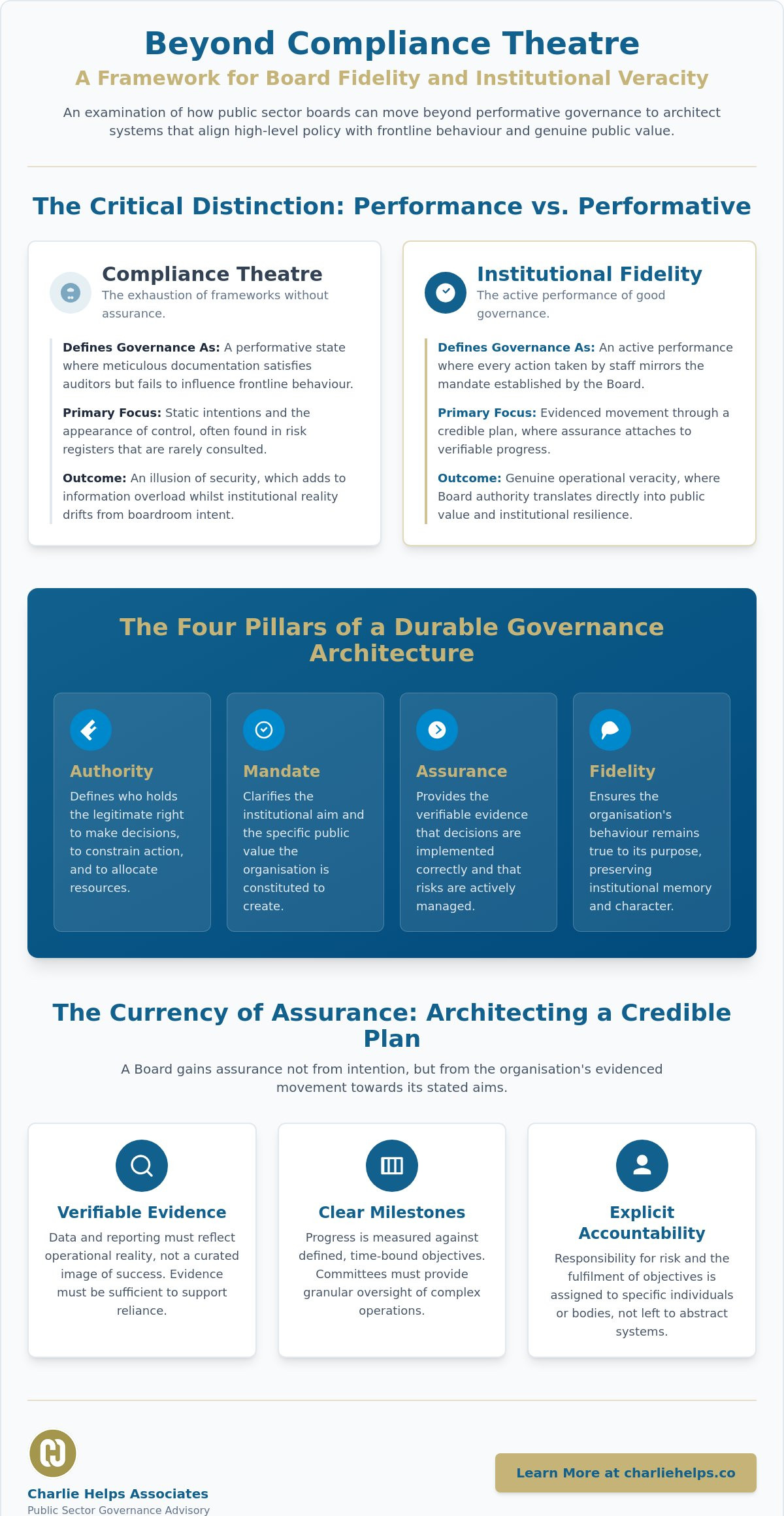
Governance is not a passive framework. It is an active performance by individuals. We define public sector governance advisory as the professional practice of aligning institutional authority with public value. In 2026, many organisations remain trapped in compliance theatre. This is a performative state where Boards satisfy auditors through meticulous documentation but fail to influence frontline behaviour. Institutional fidelity, by contrast, requires that every action taken by staff mirrors the mandate established in the boardroom. Boards must act as the primary engines of oversight. They cannot treat governance as a self-regulating system or a container for policy.
The systemic tension of 2026 is acute. Leaders face a landscape of economic fragmentation, technological adoption, and climate volatility. These forces demand operational agility, yet regulatory constraints often feel like a brake on progress. A credible advisory partner helps leaders navigate this friction. The aim is not to bypass rules, but to internalise them so they support rather than stifle the institutional mission. True assurance attaches to evidenced movement through a credible plan, not the mere existence of a risk register.
The Distinction Between Oversight and Action
Directors perform governance through specific decisions, constraints, and authorisations. Systems do not decide; people do. A Board maintains institutional memory by ensuring that strategic intent survives leadership transitions. This requires a shift in perspective. Governance cannot act, yet the individuals within a governance architecture must exercise practical judgement to fulfil their obligations. When a Board authorises a budget or constrains a project, it is performing a moral act of leadership that defines the organisation’s character.
The Regulatory Landscape for UK Public Bodies
UK public bodies face tightening expectations from the Charity Commission and local government regulators. These bodies now demand evidenced movement through credible plans rather than mere statements of intent. Boards must interpret these shifts to maintain public confidence. Adhering to good governance principles provides the foundation for this veracity. Reporting must reflect reality, not a curated image of success. Stakeholder engagement is no longer a peripheral activity; it is a core component of accountability that requires honest, evidence-based communication. What risks remain when the Board chooses silence over transparency?
Evaluating Governance Architectures: A Framework for Board Fidelity
Architecture is not a blueprint; it is a living structure of human performance. A durable governance architecture rests upon four pillars: authority, mandate, assurance, and fidelity. Authority defines who has the right to decide. Mandate clarifies the institutional aim. Assurance provides the evidence that decisions are implemented. Fidelity ensures that the organisation’s behaviour remains true to its purpose. Professional public sector governance advisory provides the diagnostic tools to test these pillars. Without this rigor, Boards risk presiding over a structure that exists only on paper.
Linking strategy to frontline behaviour requires more than a memo. It requires a system that constrains risk whilst enabling action. Leaders must consider architecting a modern corporate governance framework in the UK that integrates these layers. Compliance is not a static state of being. It is an evidenced movement toward a standard. Boards must shift from reviewing past failures to overseeing the active implementation of current plans. This transition requires a refusal to accept intentions as a substitute for evidenced progress.
The Components of a Credible Plan
A credible plan is the currency of assurance. It consists of verifiable evidence, clear milestones, and explicit risk accountability. Assurance does not attach to a Board’s intentions; it attaches to the organisation’s movement toward its stated aims. Committees play a vital role here. They provide the granular oversight needed for complex operations without diluting the Board’s ultimate authority. They act as the eyes of the Board, ensuring that every authorisation is backed by reality and that institutional memory is preserved through transition.
Ethics and Accountability in the Public Sphere
Ethics is the strategic mandate of the public institution. It is the moral gravity that prevents institutional drift. Boards must guard against ungrounded futurism, which prioritises abstract trends over immediate ethical obligations. The International Framework for Good Governance emphasises that accountability must be embedded into the cultural fabric. This is achieved through practical judgement and a refusal to accept consultancy theatre. If you require a partner to help refine these structures, you may speak with our advisors about your specific requirements. The aim is always to align human behaviour with structural systems to fulfil the public mandate.
Selecting a Governance Advisor: Distinguishing Expertise from Theatre
Consultancy theatre thrives on complexity without clarity. When seeking corporate governance consultants UK, leaders must look past slogan-heavy claims and world-class labels. These terms often mask a lack of intellectual force and practical judgement. A strategic advisor should act as a steady hand, offering calm expertise whilst navigating the high stakes of public oversight. They must understand that public sector governance advisory is not about providing a static binder of policies; it is about refining the human performance of leadership.
Effective advisory services prioritise the intersection of human behaviour and structural systems. They reject ungrounded futurism in favour of restraint and evidenced assurance. This measured approach invites the Board to think deeply about their mandate. It ensures that the advisor remains a partner in excellence rather than a mere service provider. To begin this alignment, you may request a consultation with our senior advisors to evaluate your current architecture.
The Test of Utility for Advisory Partners
Every advisor must pass a rigorous test of utility. Can they identify the Aim of the institution, who holds Authority, what Decision is required, what Evidence supports reliance, and what Risks remain? If an advisor cannot answer these five questions, they offer theatre, not assurance. They must grasp the human element behind organisational data. Citing principles found in the APEC Good Practice Guide on Public Sector Governance helps ground these discussions in global standards. However, the application must remain local and specific to the institutional context.
Mentoring as a Tool for Boardroom Excellence
Executive mentoring and coaching services achieve strategic alignment by focusing on the individual director’s capability. A strategic guide fosters Board dynamics that allow for rigorous challenge and intellectual honesty. This is not about motivational speaking; it is about the disciplined exercise of authority. Mentored leadership succession ensures that institutional memory is preserved, preventing the erosion of veracity during transitions. By enhancing professional capabilities at the C-suite level, organisations realise a culture where accountability is a shared performance, not a bureaucratic burden.
Realising Operational Veracity through Workflow Optimisation
Operational veracity is the measurable proof of institutional fidelity. In the public sector, this veracity requires the elimination of friction between boardroom intent and frontline execution. Workflow optimisation software serves as a necessary digital extension of oversight, providing the Board with a real-time view of how staff implement specific authorisations. It is no longer sufficient to rely on retrospective reports that may mask operational drift. Instead, leaders must utilise public sector governance advisory to integrate digital constraint systems that ensure every action aligns with the institutional mandate.
Boardroom AI and AI governance have become central to this effort in 2026. Whilst Estonia now handles 99% of citizen requests through automated systems, the responsibility for these outcomes remains with human directors. AI should assist in identifying systemic bottlenecks and surfacing data for better decision-making, but it cannot replace the practical judgement of a Board. Realising operational efficiency is a fiduciary duty to the public. It ensures that resources are utilised with precision and that the institution remains worthy of the trust placed in it by the community.
Systemic Optimisation of Business Processes
Implementing a workflow optimisation SaaS solution requires a methodical approach to business process mapping. The Board must first identify the critical paths where human behaviour most frequently deviates from established policy. Automation then acts as a structural constraint, ensuring that processes adhere to mandates without requiring constant manual intervention. This system relies entirely on data veracity. If the underlying data is flawed, the reporting system will offer a false sense of security. Digital systems must therefore include rigorous validation steps to ensure that the evidence provided to the Board is accurate, timely, and relevant.
The Final Implication: Governance as Action
Effective leadership requires a movement from passive oversight to active, evidenced governance. A Board that merely reviews documents is performing a ritual; a Board that constrains risk and authorises movement through a credible plan is performing a service. The fundamental requirement of 2026 is the alignment of structural systems with human performance. This leads to a final, critical question for every public sector leader: Does your current advisory partner provide genuine assurance, or are they merely maintaining the appearance of it? If you seek to architect a more durable governance structure, you may contact Charlie Helps Associates for a serious discussion on institutional fidelity. The aim is not to satisfy a checklist, but to fulfil a mandate.
Securing the Institutional Mandate
Institutional fidelity is not a destination but a continuous performance of leadership. We have examined how Boards must move beyond compliance theatre to ensure that strategic intent mirrors operational reality. This requires a rigorous architecture where authority is clear, human behaviour aligns with structural systems, and institutional memory remains intact. True assurance only exists when there is evidenced movement through a credible plan. Passive oversight is no longer sufficient to satisfy the demands of modern public value.
Our public sector governance advisory provides the intellectual force and practical tools required to achieve this alignment. With a specialist focus on UK Board-level governance and a proprietary Workflow Optimisation SaaS solution, we help leaders realise operational veracity. By bridging the gap between boardroom policy and frontline behaviour, organisations can fulfil their mandates with confidence and restraint. You are invited to request a formal consultation to discuss your governance architecture. Better leadership remains the most reliable path to institutional excellence.
Frequently Asked Questions
What is the primary role of a public sector governance advisor?
A public sector governance advisor acts as a strategic guide to align institutional authority with public value. Their primary function is to refine the human performance of leadership rather than merely managing documents. By providing professional public sector governance advisory, they help Boards move beyond compliance theatre. This ensures that every decision, constraint, and authorisation by the Board translates into evidenced movement toward the organisation’s stated mandate.
How does governance architecture differ from a standard compliance framework?
Governance architecture is a living structure of human performance, whilst a standard compliance framework is often a static set of documents. Architecture establishes the necessary links between Board strategy and frontline behaviour through authority, mandate, and assurance. Compliance frameworks typically focus on satisfying external auditors. Architecture focuses on institutional fidelity. It ensures that the organisation’s actual performance remains true to its purpose and ethical obligations.
Can digital workflow tools truly improve board-level oversight?
Digital workflow tools serve as a necessary extension of boardroom oversight by reducing operational friction. They provide a structural constraint that ensures staff implement processes according to the Board’s established mandates. By utilising a workflow optimisation SaaS solution, leaders can realise operational veracity through real-time data. This automation prevents drift and ensures that institutional memory is preserved within the digital systems of the organisation.
What are the risks of “consultancy theatre” in public sector organisations?
Consultancy theatre creates a false sense of security by offering elaborate frameworks that lack practical assurance. The risks include a total misalignment between boardroom policy and frontline behaviour. When organisations prioritise slogan-heavy claims over practical judgement, they lose the ability to constrain risk effectively. This performative state satisfies bureaucratic checklists but fails to fulfil the institutional mandate or achieve genuine public value.
How should a board evaluate the veracity of the information it receives?
A Board evaluates veracity by demanding evidenced movement through a credible plan rather than accepting mere statements of intent. Directors must exercise practical judgement to scrutinise the source and accuracy of the data they receive. This involves questioning who has the authority to report and what structural constraints validate the information. Veracity is only realised when reporting reflects the actual state of institutional performance.
What is the relationship between institutional memory and effective governance?
Institutional memory is the moral and intellectual thread that allows strategic intent to survive leadership transitions. Effective governance relies on the ability of the Board to maintain this memory through mentored succession and robust architectural systems. Without it, organisations lose sight of their mandate and repeat historical errors. Preserving this memory ensures that the institution remains consistent in its pursuit of excellence and accountability.
Disclaimer
The articles published on CharlieHelps.co are provided for general information, reflection, and commentary. They draw on professional experience, research, and interpretation, but they do not constitute legal, regulatory, financial, clinical, governance, risk, compliance, assurance, or other professional advice.Nothing published on this site should be relied upon as practice guidance, formal instruction, or a substitute for proper professional consultation. Readers should seek advice from suitably qualified advisers before acting on, applying, or relying upon any material in relation to their own organisation, Board, duties, circumstances, or decisions.Although reasonable care is taken to ensure that articles are accurate and current at the time of publication, no warranty is given as to completeness, accuracy, timeliness, or fitness for any particular purpose. Law, regulation, policy, standards, and recognised practice may change, and context matters.References to external sources, organisations, products, services, or third-party materials are included for information only. They do not imply endorsement unless expressly stated. Where an article contains affiliate links, sponsored references, or commercial relationships, these will be disclosed where relevant.The views expressed are those of the author unless otherwise stated. Reading, sharing, or responding to material on this site does not create a client, adviser, fiduciary, or professional relationship with Charlie Helps FRSA, CharlieHelps.co, or any associated entity.Readers remain responsible for their own judgement, decisions, and actions.
