

Most executive teams are merely collections of high-performing individuals who, despite their personal brilliance, fail to act as a singular institutional force. This fragmentation often stems from a fundamental misunderstanding of what leadership requires at the highest level. You likely recognise the specific friction that occurs when board strategy meets executive silos, or when surface-level coaching leaves structural governance issues untouched. True executive team coaching UK must address the architecture of the institution itself, ensuring that directors and C-suite leaders act with a shared mandate, absolute fidelity to the strategic goal, and a clear sense of collective authority.
This article offers a rigorous guide for Board members and C-suite leaders to select coaching that moves beyond the theatre of motivational rhetoric. You will learn how to architect a decision-making framework that provides genuine assurance through evidenced movement, rather than mere intention. We shall examine the methods required to enhance institutional memory and establish a culture of collective accountability that withstands external pressures.
Key Takeaways
- Understand that governance is an active process performed by directors; coaching ensures that executive behaviour remains faithful to the institutional mandate.
- Learn how to structure executive team coaching UK to bridge the gap between individual capability and collective authority within the C-suite.
- Recognise the indicators of “consultancy theatre” to ensure you select a partner who prioritises intellectual force over motivational slogans.
- Implement frameworks that provide assurance through evidenced movement, rather than relying on the mere intention of strategic goals.
- Focus on the intersection of human behaviour and structural systems to build a decision-making framework that enhances institutional memory.
Defining the Mandate: Why Executive Team Coaching is a Governance Necessity
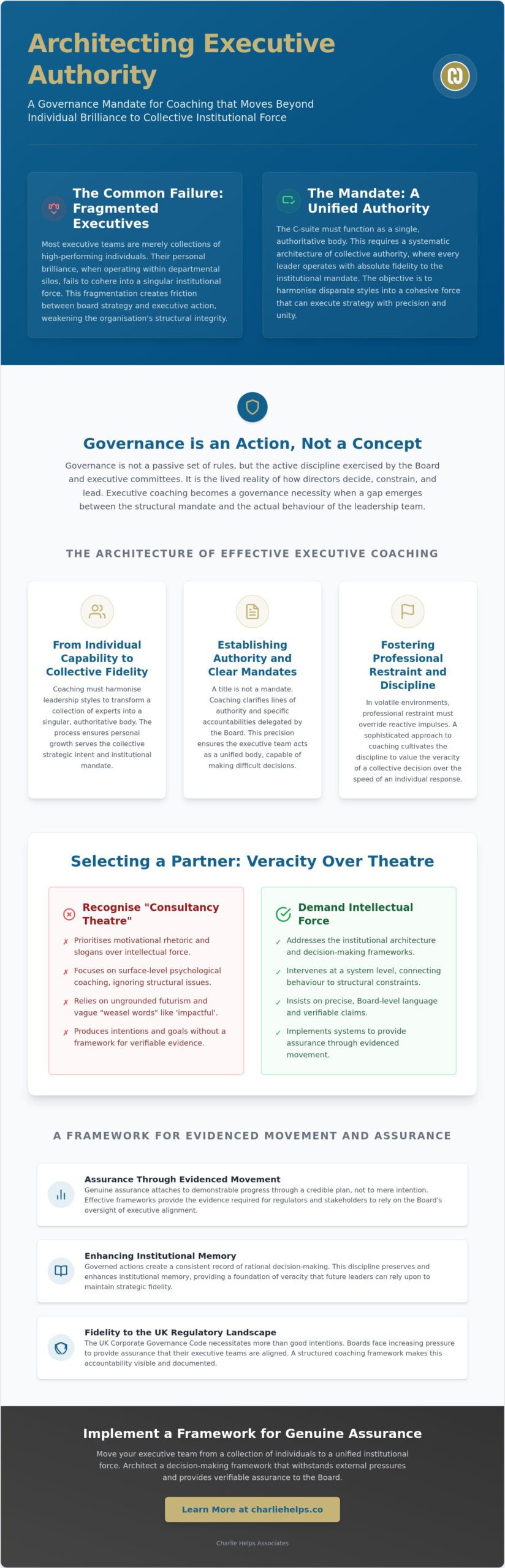
Governance is an action performed by people; specifically, it is the active discipline exercised by the Board and executive committees. It is not a passive container or a set of rules, but the lived reality of how directors decide, constrain, and lead. When a gap emerges between the structural mandate and the actual behaviour of the leadership team, the institution risks fragmentation. This is where executive team coaching UK becomes a governance necessity. By Defining Coaching as a rigorous, system-level intervention, we move beyond individual development into the realm of institutional fidelity. This fidelity requires a collective commitment to the veracity of the organisational purpose. Executive team coaching is the systematic architecture of collective authority, ensuring that every member of the C-suite operates with absolute fidelity to the institutional mandate.
From Individual Capability to Collective Fidelity
Individual brilliance often fails within a fragmented executive structure. A C-suite composed of high-performing specialists does not automatically function as a cohesive unit of authority. When leaders operate in silos, they prioritise departmental goals over the institutional mandate, creating friction that slows strategic progress. Executive team coaching UK serves to harmonise these disparate leadership styles. It transforms a collection of experts into a singular, authoritative body. This process relies upon leadership capability development as its foundation, ensuring that personal growth serves the collective strategic intent.
The UK Regulatory Landscape and Board Accountability
The UK Corporate Governance Code requires more than just good intentions; it necessitates evidenced movement in leadership culture. Boards now face increasing pressure to provide assurance that their executive teams are aligned with the long-term success of the company. This assurance is not found in marketing slogans or “consultancy theatre” but in the active fulfilment of strategic objectives through a credible plan. Within the C-suite, accountability must be visible and documented. Effective coaching frameworks provide the evidence required for regulators and stakeholders to rely on the Board’s oversight. It is through this evidenced movement that a leadership team realises its mandate and maintains institutional memory.
The Mechanics of High-Stakes Leadership Capability Development
High-stakes leadership requires a precise calibration of personal agency and systemic constraint. It is rarely enough for a C-suite leader to possess high individual capability; they must also understand how their actions intersect with the wider organisational architecture. Effective executive team coaching UK addresses this intersection directly. It moves beyond the psychological to the structural, ensuring that leadership actions are governed by the institutional mandate rather than personal preference or departmental bias. Individual brilliance is insufficient if the structural architecture is weak.
Professional restraint is the hallmark of a mature executive team. In volatile environments, the impulse to react can override the discipline of the strategic plan. A sophisticated approach to executive team coaching fosters this restraint, teaching leaders to value the veracity of the collective decision over the speed of an individual response. This discipline preserves institutional memory, as governed actions create a consistent record of rational decision-making that future leaders can rely upon. It’s a process of building a steady hand in a complex environment.
Establishing Authority and Mandates within the C-Suite
There is a critical distinction between holding a position and exercising a legitimate mandate. A position is a title on an organisational chart; a mandate is the specific authority delegated by the Board to achieve a defined objective. Coaching clarifies these lines of authority, ensuring that every member of the executive team understands their specific accountabilities. When roles are blurred, authority is diluted. By clarifying mandates, the executive team begins to act as a unified body, capable of making hard choices that individuals might otherwise avoid. This clarity is the foundation of institutional fidelity.
Veracity and Assurance in Leadership Performance
Assurance is the byproduct of evidenced movement through a credible plan. To provide this to the Board, the executive team must move beyond “consultancy theatre,” where progress is measured by sentiment rather than structural improvement. Real movement is documented and verifiable. This focus on veracity ensures that strategic goals are fulfilled rather than merely intended. For a broader perspective on how this integrates with individual development, consider our executive leadership coaching UK pillar. If your team requires a more rigorous framework for collective authority, you may consult our advisory specialists to discuss a tailored intervention.
Selecting a Coaching Partner: Avoiding the Pitfalls of Consultancy Theatre
The selection of an advisor for executive team coaching UK requires a rigorous vetting process that many boards overlook. Most proposals rely on what we term “consultancy theatre”: a performance of expertise that uses vague qualifiers to mask a lack of structural depth. You should apply a “zero weasel words” test to any coaching proposal. If a provider relies on adjectives like “innovative” or “world-class” without providing specific evidence of movement, they likely lack the intellectual force required for C-suite intervention. Boards need partners who demonstrate practical judgement and an understanding of the intersection between human behaviour and institutional systems. Authority is not found in marketing slogans; it is found in the veracity of the evidence presented.
Discerning Intellectual Force from Marketing Hype
True advisory work possesses a moral depth that marketing hype cannot replicate. You should seek a partner who values aphoristic precision and lucid reasoning over dense, jargon-heavy reports. Clarity and brevity are not merely stylistic choices; they are indicators of a clear-eyed view of organisational reality. An advisor who understands the institutional mandate will speak with the authority of experience, providing insights that are memorable and actionable. They recognise that the veracity of their counsel is more important than the volume of their output. This approach ensures that the executive team remains focused on the strategic goal rather than the distractions of ungrounded futurism.
The Role of Professional Restraint and Practical Judgement
In high-pressure scenarios, professional restraint is a rare and valuable quality. The most effective coaches often speak the least, but their contributions carry significant weight because they are rooted in practical judgement. When evaluating a potential partner, consider their capacity for emergency response and their ability to remain composed in complex environments. They must treat the Board as a peer-level audience, offering a steady hand rather than a scripted programme. This level of maturity ensures that the coaching realised is faithful to the institutional purpose. If you require an advisor who prioritises evidence over rhetoric, you may request a consultation with our governance advisors to discuss your specific requirements.
Implementing a Framework for Evidenced Movement and Assurance
Assurance is not a sentiment; it is a calculation based on verifiable evidence. For a Board to rely on the progress of its C-suite, it must observe more than a change in mood or a temporary surge in morale. It requires a documented shift in how directors decide, how committees constrain, and how authority is exercised. In the context of executive team coaching UK, this shift must be made workable through a plan that withstands regulatory scrutiny. Mere intention is the ghost of a strategy. Only evidenced movement provides the substance of assurance required by stakeholders and regulators alike.
A credible plan for leadership development must be rooted in the institutional mandate. It should move beyond the abstract and into the practical, defining the specific actions required to fulfil the organisational purpose. This process ensures that the executive team remains faithful to the strategic goals set by the Board. By focusing on the intersection of human behaviour and structural systems, the organisation can realise a level of alignment that motivational rhetoric can never achieve. Success is found in the steady, governed movement towards a defined objective.
Architecting the Path to Realisation
Every intervention must pass a final test of utility. We ask five rigorous questions: What is the Aim? Who has Authority? What Decision is required? What Evidence supports reliance? What Risks remain? This framework ensures that coaching serves the institution rather than the personal preferences of individual leaders. It aligns the human element with the structural systems of the firm, creating a decision-making framework that is both transparent and accountable. Such alignment is particularly critical during periods of transition. Integrating leadership succession planning advisory ensures that institutional memory is not lost when individuals depart, protecting the fidelity of the mandate across successive generations of leadership.
Securing Long-Term Value through Strategic Advisory
The transition from a coaching engagement to a sustained governance framework is the final stage of institutional architecture. The coach acts as a steady hand, guiding the team through the complexity of organisational shifts whilst maintaining a focus on the long-term vision. Once the initial intervention concludes, the executive team must own the decision-making frameworks and accountability structures that have been implemented. This ownership ensures that the veracity of the leadership remains intact long after the advisor has departed. If your Board requires a rigorous, evidence-led path to realise its strategic objectives, Contact Charlie Helps Associates to discuss a governed approach to leadership.
Securing the Strategic Mandate through Collective Authority
Strategic success requires more than individual talent. It demands that the executive team functions as a singular, authoritative body. By utilising executive team coaching UK as a structural discipline, Boards can ensure that C-suite actions remain faithful to the institutional mandate. This approach replaces the vagaries of motivational rhetoric with the precision of evidenced movement and clear decision-making frameworks. It ensures that every director and committee member understands the intersection of human behaviour and organisational systems.
Realising long-term value depends on the veracity of your leadership. Every intervention must satisfy the rigorous test of utility: identifying the aim, clarifying authority, necessitating specific decisions, providing evidence for reliance, and acknowledging remaining risks. Charlie Helps Associates offers expertise in corporate governance architecture and tailored advisory for the UK public and private sectors. We prioritise movement that is verifiable and plans that are credible. Architect your team’s institutional fidelity with Charlie Helps Associates. The potential for transformation is profound when leadership is grounded in integrity and purpose.
Frequently Asked Questions
What is the primary difference between executive team coaching and standard leadership training?
Executive team coaching addresses the systemic architecture of the C-suite whilst standard training typically focuses on individual skill acquisition. Coaching ensures that collective behaviour remains faithful to the institutional mandate. It treats the team as a singular body of authority rather than a collection of pupils. This approach allows for the real-time adjustment of decision-making frameworks to meet strategic goals.
How does executive team coaching UK align with the Corporate Governance Code?
Executive team coaching UK aligns with the Code by providing the evidenced movement required for board assurance. The Code emphasises board effectiveness and a culture of integrity. Coaching makes these requirements workable through documented progress and a credible plan. It allows directors to demonstrate that they are actively fulfilling their oversight duties through a rigorous, governed process.
Can executive coaching help with leadership succession planning at the Board level?
Coaching serves as a vital component of succession planning by ensuring institutional memory is preserved during leadership transitions. It prepares the executive team to integrate new members into a pre-existing culture of collective authority and fidelity. This prevents the fragmentation of the mandate when key figures depart. It ensures that the organisational purpose remains the primary driver of all executive action.
What evidence should a Board require to ensure a coaching programme is fulfilling its mandate?
A Board should require evidence of realised strategic goals and documented decision-making processes to confirm a programme is fulfilling its mandate. Assurance attaches to evidenced movement through a credible plan rather than mere intention. Boards must seek proof that the coaching has resulted in a more cohesive decision-making framework. Reliance should only be placed on outcomes that are verifiable and documented.
How do you handle conflict or fragmented authority within a senior executive team?
Conflict is addressed by clarifying the specific mandates and lines of authority delegated by the Board. Coaching identifies where personal biases or departmental silos have fragmented the collective authority of the C-suite. By re-centring the team on the institutional goal, leaders can exercise professional restraint. This process ensures that decisions are made by those with the legitimate mandate to act.
Why is it necessary to avoid “consultancy theatre” in high-stakes leadership development?
Consultancy theatre must be avoided because its reliance on motivational slogans masks a lack of intellectual force. High-stakes leadership development requires practical judgement and a clear-eyed view of global trends. Slogans offer no structural depth and fail to address the complexities of corporate governance. Real progress is achieved through lucid reasoning and a focus on the veracity of the organisational purpose.
Disclaimer
The articles published on CharlieHelps.co are provided for general information, reflection, and commentary. They draw on professional experience, research, and interpretation, but they do not constitute legal, regulatory, financial, clinical, governance, risk, compliance, assurance, or other professional advice. Nothing published on this site should be relied upon as practice guidance, formal instruction, or a substitute for proper professional consultation. Readers should seek advice from suitably qualified advisers before acting on, applying, or relying upon any material in relation to their own organisation, Board, duties, circumstances, or decisions. Although reasonable care is taken to ensure that articles are accurate and current at the time of publication, no warranty is given as to completeness, accuracy, timeliness, or fitness for any particular purpose. Law, regulation, policy, standards, and recognised practice may change, and context matters. References to external sources, organisations, products, services, or third-party materials are included for information only. They do not imply endorsement unless expressly stated. Where an article contains affiliate links, sponsored references, or commercial relationships, these will be disclosed where relevant. The views expressed are those of the author unless otherwise stated. Reading, sharing, or responding to material on this site does not create a client, adviser, fiduciary, or professional relationship with Charlie Helps FRSA, CharlieHelps.co, or any associated entity. Readers remain responsible for their own judgement, decisions, and actions.
