

Governance is not an agent; it is an architecture. It functions as the active mechanism through which a Board exercises its mandate, ensures accountability, and preserves institutional memory. Designing a robust corporate governance framework UK directors can rely upon requires moving beyond the inertia of simple compliance. Many Boards currently face a sense of regulatory fatigue, particularly as the 2024 Code updates necessitate a more rigorous approach to internal control declarations.
You likely recognise that “box-ticking” provides little protection against systemic failure or the slow erosion of institutional integrity. This article provides a rigorous examination of how to architect a framework that enhances board effectiveness and secures long-term resilience. We will analyse the requirements of Provision 29, clarify the scope of material controls, and establish a logical sequence for refining risk oversight.
Key Takeaways
- Boards must move beyond passive compliance to fulfil the heightened expectations of the 2024 Code regarding reporting accuracy and internal control declarations.
- Architecting a resilient corporate governance framework UK directors can trust requires establishing precise mandates for committees, ensuring all delegated authority remains subject to board oversight.
- Directors should approach the “comply or explain” regime with strategic rigour, offering cogent rationales for departures that reflect the specific context of the organisation.
- Boards must integrate AI oversight into their risk management structures to maintain accountability for the ethical and operational use of emerging technologies.
- Implementation requires a transition from static documents to an active culture where the Board demands evidence, assurance, and institutional memory to confirm controls function as intended.
The Evolution of the UK Corporate Governance Code in 2026
The Financial Reporting Council (FRC) maintains the UK Corporate Governance Code to promote transparency, integrity, and long-term sustainable success. This is not a static document but a dynamic standard that reflects the shifting expectations of investors and society. Boards must now address heightened requirements regarding internal controls and reporting accuracy, moving away from the “box-ticking” exercises of the past. A robust corporate governance framework UK companies implement today must prioritise active, evidenced assurance over passive compliance. This evolution reflects a broader move towards institutional resilience where the Board takes direct accountability for the systems it oversees.
The Centrality of Board Leadership
Directors must establish a clear purpose that aligns with the desired organisational culture. The Board acts as the ultimate authority for risk appetite and strategic direction; it does not merely observe executive action but actively constrains or enables it. Institutional memory serves as the foundation for consistent decision-making across leadership cycles, ensuring that lessons from past crises inform future strategy. By setting the “tone at the top,” directors ensure that governance remains a human-centric endeavour rather than a bureaucratic hurdle. Leadership requires the courage to ask difficult questions of management and the discipline to insist on data that confirms operational health.
Understanding the 2024 Code Updates
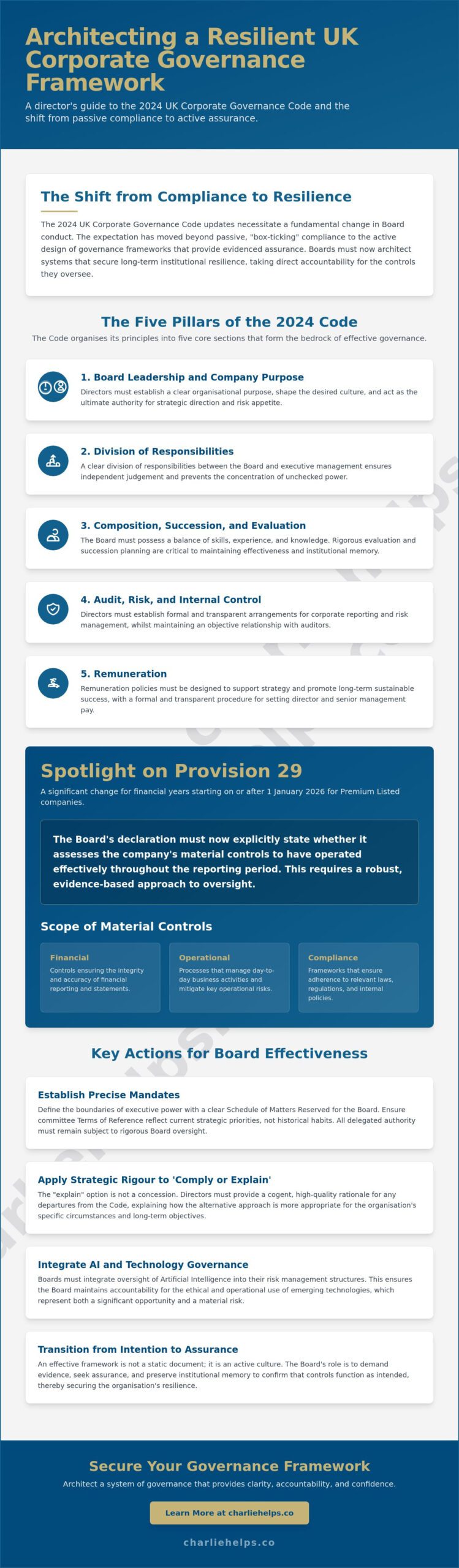
The 2024 Code organises its principles into five core sections: Board Leadership and Company Purpose; Division of Responsibilities; Composition, Succession, and Evaluation; Audit, Risk, and Internal Control; and Remuneration. While much of the Code became effective in 2025, Provision 29 represents a significant shift for financial years beginning on or after 1 January 2026. This provision requires directors to monitor the effectiveness of all material controls (including financial, operational, and compliance controls) and provide a robust annual declaration. These requirements apply to all companies with a Premium Listing on the London Stock Exchange, whilst those with Standard Listings often adopt the Code as a matter of best practice to maintain investor confidence. This shift requires a methodical plan to map existing controls against the new expectations for evidenced movement.
The transition to the 2024 requirements demands more than a revision of the handbook. It requires a shift in how directors perceive their mandate. Success in this environment is measured by the quality of assurance, the clarity of accountability, and the strength of the internal control environment. Boards that fail to adapt risk not only regulatory sanction but also the loss of institutional trust. The following sections will explore how to architect the specific pillars required to fulfil these modern mandates.
The Architectural Pillars of an Effective Governance Framework
Architecture is the silent partner of leadership. Directors use a framework to organise the relationships between shareholders, the Board, executive management, and other stakeholders. A well-designed corporate governance framework UK organisations adopt ensures that delegated authority does not become fragmented or opaque. It creates a clear map of accountability where every decision-maker understands the scope of their mandate. This structure prioritises accountability over mere administrative activity, ensuring that the Board remains the final arbiter of strategic integrity.
Defining Authority and Mandates
The Schedule of Matters Reserved for the Board establishes the boundaries of executive power. It ensures that critical decisions, such as strategic shifts or significant capital expenditure, remain under the direct control of the directors. Clear Terms of Reference for Audit, Nomination, and Remuneration Committees must reflect current strategic priorities rather than historical habits. The Chartered Governance Institute UK & Ireland provides vital guidance on the 2024 Code changes, highlighting how these structures support the “comply or explain” regime. Whilst executives fulfil the strategy, the Board provides the necessary challenge and assurance to ensure the organisation stays on its intended course.
Institutional Memory and Knowledge Management
Boards must preserve the reasoning behind historical decisions to avoid repeating systemic errors. Governance architecture should include mechanisms for capturing and retrieving institutional insights, preventing the loss of wisdom during leadership transitions. Effective succession planning relies on a stable repository of organisational knowledge rather than the fleeting memories of individual directors. When a Board maintains a rigorous record of its deliberations, it secures the institutional memory required for consistent, long-term oversight.
A robust framework facilitates the flow of high-quality information to support rigorous board debate. It ensures that directors base their judgements on evidence rather than assumption. If your current structure feels like a burden rather than a tool for leadership, you may benefit from professional advisory services to realise a more integrated approach. The architecture must serve the Board, providing the clarity needed to navigate a complex regulatory environment with confidence.
Navigating the Comply or Explain Regime with Strategic Rigour
Rigour is the antidote to boilerplate compliance. The “comply or explain” principle acknowledges that a one-size-fits-all approach is often counter-productive, yet it requires directors to justify their choices with absolute clarity. A departure from a specific Provision is not a failure of governance if the Board provides a cogent rationale. Explanations must be evidenced, context-specific, and focused on how the alternative approach achieves the Code’s Principles. Investors increasingly value transparency and intellectual honesty over rigid adherence to checkboxes, as these qualities signal a Board that is truly in command of its mandate. A robust corporate governance framework UK companies implement must reflect this shift from rote adherence to strategic judgement.
Avoiding Consultancy Theatre in Reporting
Boards should reject “weasel words” and slogan-heavy claims in their annual governance reports. This “consultancy theatre” often serves to obscure a lack of meaningful oversight or a failure to address systemic risks. Reports must distinguish between statements of intention and evidenced movement through a credible plan. The focus should remain on what the directors decided, why they chose a specific path, and what assurance they received from management. Active voice ensures that accountability remains visible, replacing vague passive descriptions with clear statements of board action and decision-making.
The Role of the Board Effectiveness Review
Regular evaluations identify gaps in board dynamics, composition, and information flow. These assessments serve as a diagnostic tool for the health of the leadership team, ensuring that the framework remains a tool for leadership rather than a bureaucratic burden. External reviews provide an objective lens on whether the governance architecture is fulfilling its intended purpose, free from the biases of internal consensus. To understand the specific requirements for the coming year, directors should consult the Definitive Board Effectiveness Review Guide. By acting on these insights, the Board ensures that its oversight remains resilient, informed, and fit for the complexities of 2026.
Ultimately, the “explain” portion of the regime is an opportunity for a Board to demonstrate its unique value proposition. It is a chance to show how the directors have tailored their approach to the specific risks and opportunities of their sector. When a Board provides a well-reasoned explanation, it builds trust with shareholders and regulators alike. This intellectual honesty serves as the foundation of a modern corporate governance framework UK directors use to navigate the complexities of 2026, ensuring that judgement remains at the heart of institutional oversight.
Integrating AI Governance and Institutional Memory into Board Oversight
AI is no longer merely a technical issue; it is a critical component of strategic risk and opportunity. Directors must treat algorithmic influence with the same gravity as financial solvency or operational safety. A modern corporate governance framework UK Boards implement must establish a clear mandate for the ethical and operational use of AI within the organisation. By defining the parameters for algorithmic accountability and human-in-the-loop oversight, the Board ensures that technological deployment aligns with corporate purpose and ethics. This integration prevents AI from becoming a “black box” that operates outside the reach of traditional assurance, ensuring that the human element remains the final point of judgement.
Boardroom AI and Decision Support
Directors must understand how AI tools influence the data and reports they rely upon for assurance. If an executive committee uses predictive analytics to justify a strategic shift, the Board must possess the literacy to challenge the underlying assumptions. The governance architecture should define which committee or director has authority over AI deployment and risk mitigation. Preserving institutional memory regarding the evolution of AI strategy ensures that the organisation maintains a consistent moral and operational compass across leadership cycles. This prevents the “drift” that often occurs when technical systems outpace human oversight, allowing the Board to maintain a steady hand.
The Strategic Value of Workflow Optimisation
Modern frameworks utilise digital tools to reduce operational friction and improve the quality of board papers. When directors utilise a Workflow Optimisation SaaS Solution, they can refocus their attention on high-level strategy rather than administrative minutiae. These systems support the Board’s duty to maintain accurate records and audit trails, fulfilling the requirement for evidenced movement through a credible plan. Effective digital process management ensures that information reaches the Board in a state that invites rigorous debate rather than simple acknowledgement. By streamlining the flow of data, directors ensure that their limited time is spent on the most critical strategic judgements.
Strategic oversight in the digital age requires more than a casual awareness of emerging trends. It demands a disciplined approach to how technology supports or subverts the Board’s mandate. If your organisation requires assistance in integrating these technical risks into your existing structures, our experts provide specialised AI governance consulting to help you maintain control. The objective is to ensure that the Board remains the final arbiter of value, regardless of the tools used to generate it. This ensures that the organisation remains resilient in the face of rapid technological change.
From Intention to Assurance: Implementing a Robust Governance Mandate
Implementation remains the final, most rigorous test of any corporate governance framework UK directors establish. Directors must lead the disciplined transition from a static written document to a living organisational culture where accountability is felt at every level. The Board must demand evidence that internal controls are operating as intended, rather than assuming compliance based on filtered executive reports. When directors insist on raw data and direct assurance, they close the gap between strategic intention and operational reality. Institutional excellence is realised through the consistent application of judgement, ethics, and professional rigour. A robust framework empowers the Board to navigate crises with composure, relying on established structures rather than reactive instinct.
Directors must move beyond the comfort of the boardroom table to verify that organisational behaviour reflects stated principles. This verification is not a lack of trust in management but a fulfilment of the Board’s fiduciary duty. By establishing clear metrics for success and failure, the Board provides the executives with a defined space in which to operate. The framework acts as a set of guardrails, ensuring that the pursuit of profit does not compromise the long-term viability of the institution. It is through this constant, quiet pressure that a Board achieves true resilience and maintains its mandate in a complex environment.
The Path to Institutional Excellence
Boards should seek Professional Corporate Governance Consultants in the UK to architect bespoke solutions that address their specific risk profile. Mentoring and coaching can help directors develop the practical judgement required for complex oversight, particularly when navigating the nuances of the 2024 Code. The ultimate goal is a framework that provides the Board with genuine assurance and stakeholders with lasting trust. Excellence is not a destination but a habit of oversight that prioritises depth over speed and evidence over assertion.
Closing Action: Evaluating Your Current Framework
Evaluation is the first step toward refinement. Directors should reflect on the current state of their architecture by asking three critical questions. What evidence supports your reliance on current internal controls? Does your framework capture institutional memory, or does it vanish when directors depart? Finally, does your current structure facilitate or hinder the flow of decision-relevant information? For a tailored review of your systems, contact Charlie Helps Associates to discuss how to strengthen your governance architecture. A clear-eyed assessment today secures the institutional resilience required for tomorrow.
Securing Institutional Resilience through Strategic Design
Resilience is not an accident; it is the result of deliberate architectural choices. Directors must move beyond the administrative fatigue of the 2024 Code to realise a corporate governance framework UK stakeholders can rely upon with confidence. Success in 2026 requires a shift from rote compliance to a culture of evidenced assurance, where the Board actively manages its mandate through clear committee authority, rigorous internal controls, and the preservation of institutional memory. By integrating emerging risks like AI into the core governance structure, leadership teams ensure that technological advancement serves rather than subverts the organisational purpose.
Securing this level of oversight requires a partner who understands the intersection of human behaviour and structural systems. We provide expert consulting in governance architecture, a proprietary Workflow Optimisation SaaS Solution to reduce operational friction, and 24/7 Emergency Response Consulting capabilities for high-stakes environments. You possess the authority to redefine your organisation’s future through better leadership and more rigorous structures. Architect your institutional excellence with Charlie Helps Associates and ensure your Board remains a steady hand in an increasingly complex landscape.
Frequently Asked Questions
What are the five main sections of the UK Corporate Governance Code?
The Code organises its principles into five core areas: Board Leadership and Company Purpose, Division of Responsibilities, Composition, Succession, and Evaluation, Audit, Risk, and Internal Control, and Remuneration. Directors use these sections to ensure their oversight covers the full breadth of organisational health. Each section provides specific Principles and Provisions that guide board behaviour, accountability, and strategic alignment.
How does the “comply or explain” regime work for UK companies?
This regime allows Boards to depart from specific Provisions if they provide a cogent, context-specific rationale. Directors must explain how their alternative approach fulfils the Code’s Principles and supports the company’s long-term success. This flexibility acknowledges that a one-size-fits-all approach is often counter-productive, requiring instead a focus on intellectual honesty, transparency, and strategic judgement.
What is the significance of Provision 29 in the 2024 Code update?
Provision 29 represents a significant shift in accountability, requiring directors to monitor the effectiveness of material controls and provide an annual declaration. This mandate encompasses financial, operational, and compliance controls. For financial years beginning on or after 1 January 2026, the Board must offer evidenced assurance that these systems function as intended, rather than assuming compliance based on passive reports.
Who is responsible for implementing the corporate governance framework?
The Board holds ultimate authority for implementing a corporate governance framework UK stakeholders can trust. Directors define the architecture and set the strategic risk appetite, whilst executives fulfil the operational requirements of the organisation. Committees provide the necessary challenge to ensure that delegated authority remains subject to board oversight, assurance, and rigorous accountability.
How often should a Board conduct an external effectiveness review?
FTSE 350 companies should facilitate an external board effectiveness review at least every three years. These evaluations allow directors to identify structural or cultural gaps that might hinder effective oversight or decision-making. Regular reviews provide an objective lens on board dynamics, ensuring the framework remains a tool for leadership rather than a bureaucratic burden.
Can a small company adopt the UK Corporate Governance Code?
Smaller companies frequently adopt the Code to signal maturity and secure institutional trust from investors and stakeholders. Whilst mandatory only for Premium Listed companies, the Principles offer a scalable blueprint for any Board seeking to improve its oversight. Directors can adapt the Provisions to reflect the organisation’s specific complexity, size, and strategic priorities.
What is the difference between a governance framework and a board charter?
A governance framework is the comprehensive architecture that organises relationships and accountability between shareholders, the Board, and executive management. A board charter is a specific document that defines the internal procedures, mandates, and responsibilities of the directors. The charter serves as a foundational component within the broader organisational framework, rather than replacing it.
How does AI governance fit into the existing UK framework?
AI governance fits within the risk management and internal control structures of the existing framework. Boards must establish clear mandates for the ethical use of algorithms and ensure that human judgement remains the final point of accountability for technological outcomes. This integration prevents technological deployment from operating outside the reach of traditional board assurance and strategic intent.
Disclaimer
The articles published on CharlieHelps.co are provided for general information, reflection, and commentary. They draw on professional experience, research, and interpretation, but they do not constitute legal, regulatory, financial, clinical, governance, risk, compliance, assurance, or other professional advice.Nothing published on this site should be relied upon as practice guidance, formal instruction, or a substitute for proper professional consultation. Readers should seek advice from suitably qualified advisers before acting on, applying, or relying upon any material in relation to their own organisation, Board, duties, circumstances, or decisions.Although reasonable care is taken to ensure that articles are accurate and current at the time of publication, no warranty is given as to completeness, accuracy, timeliness, or fitness for any particular purpose. Law, regulation, policy, standards, and recognised practice may change, and context matters.References to external sources, organisations, products, services, or third-party materials are included for information only. They do not imply endorsement unless expressly stated. Where an article contains affiliate links, sponsored references, or commercial relationships, these will be disclosed where relevant.The views expressed are those of the author unless otherwise stated. Reading, sharing, or responding to material on this site does not create a client, adviser, fiduciary, or professional relationship with Charlie Helps FRSA, CharlieHelps.co, or any associated entity.Readers remain responsible for their own judgement, decisions, and actions.
