

Why does every strategic initiative in your organisation feel like wading through treacle? Senior management frequently encounters a persistent drag on execution, where decision-making paralysis, redundant reporting cycles, and software complexity exhaust the workforce. Whilst many leaders seek solace in new digital tools, these systems often add layers of complication rather than removing them. Genuine operational friction reduction requires a shift in perspective, moving away from technical fixes towards a more rigorous governance architecture.
Boards must recognise that institutional drag is rarely a matter of individual effort; it is a symptom of structural misalignment. This article provides a framework to differentiate between necessary oversight and unnecessary friction, allowing directors to restore momentum and fulfil their strategic mandates. You will discover how to identify the root causes of organisational stagnation, improve institutional memory, and implement a plan that achieves faster execution through clarity and professional judgment.
Key Takeaways
- Distinguish between mere activity and genuine achievement to protect your organisation from a culture of exhausted performance.
- Discover how Boards can achieve operational friction reduction by addressing structural misalignment and clarifying executive mandates.
- Recognise why software-first interventions often fail, as automating a redundant process merely allows an organisation to fail more quickly.
- Identify where authority is stalled by redundant oversight and learn how to dismantle legacy reporting cycles that hinder institutional flow.
- Master a framework that differentiates between necessary assurance and unnecessary drag to restore institutional momentum and execution speed.
The Myth of Constant Activity as Productivity
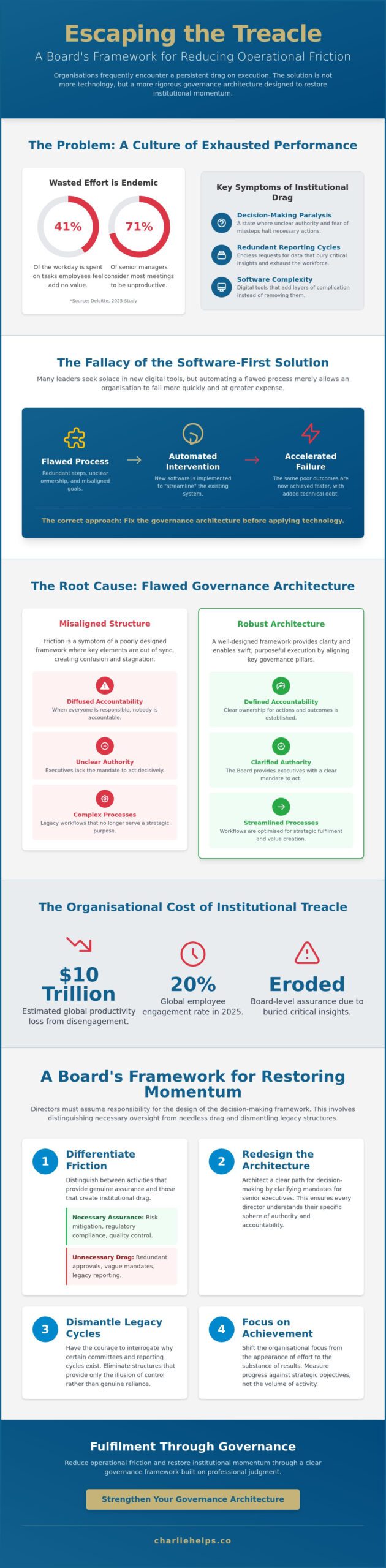
Activity often serves as a mask for stagnation. In many Boardrooms, a flurry of reports and meetings is mistaken for progress, yet this frantic pace rarely correlates with the realisation of strategic goals. A 2025 study by Deloitte indicated that 41% of the workday is spent on tasks that employees feel add no value, whilst 71% of senior managers consider meetings to be unproductive. This discrepancy highlights a fundamental misunderstanding of institutional momentum. Genuine operational friction reduction is not merely a quest for speed; it is the systematic removal of structural barriers that impede the ability of an organisation to fulfil its mandate.
Friction manifests when internal processes require more energy than the value they produce. Whilst directors must ensure robust oversight, they must also distinguish between necessary regulatory friction, which provides essential assurance, and redundant administrative drag, which merely exhausts staff. Small business owners can often eliminate this drag by leveraging external expertise; for example, you can learn more about Thank Heavens Bookkeeping to see how professional financial management reduces administrative friction. When an organisation prioritises the appearance of effort over the substance of results, it enters a state of exhausted performance. This state is not a failure of individual will, but a failure of governance architecture.
Defining Operational Friction in a UK Governance Context
Friction represents the resistance encountered by an organisation whilst executing its strategic mandate. Directors often face a choice between healthy tension, which ensures accountability and risk mitigation, and destructive institutional drag, which slows decision-making to a crawl. Within a mature framework of Business Process Management, leaders can identify where these resistances originate. Operational friction reduction begins with the understanding that friction is a symptom of structural misalignment where authority, accountability, and process are out of sync.
The Cost of Institutional Treacle
Institutional drag erodes the clarity of Board-level assurance by burying critical insights under layers of redundant data. When senior management operates within a culture of institutional treacle, the psychological toll is profound. Executives find their agency constrained by processes that lack clear authority, leading to decision-making paralysis and a sense of futility. This exhaustion is reflected in global trends; employee engagement fell to 20% in 2025, contributing to an estimated $10 trillion in lost productivity.
The pursuit of busyness frequently obscures the failure to achieve strategic objectives. Instead of focusing on growth, ethics, or quality, the workforce becomes preoccupied with navigating the labyrinth of their own creation. To restore flow, Boards must have the courage to interrogate why certain cycles exist and whether they provide genuine reliance or merely the illusion of control.
Governance Architecture and the Roots of Operational Friction
Governance is not an actor. It is the skeletal structure that supports or constrains an organisation, functioning as the framework within which directors and executives operate. When this framework is poorly designed, friction becomes an inevitable byproduct of structural misalignment. Friction often arises when the Board fails to clarify mandates for senior executives, creating an environment where accountability is diffused and objectives become opaque. Without a precise architecture, redundant committees and layered approvals flourish in the vacuum of uncertainty, consuming institutional energy that should be directed toward strategic fulfilment.
Robust governance architecture provides the clarity required for swift, decisive movement. It ensures that every director and executive understands their specific sphere of authority, reducing the need for the constant internal negotiation that characterises stagnant organisations. By architecting a clear path for decision-making, the Board enables the organisation to move with purpose rather than merely reacting to internal pressures. This structural clarity is the foundation of operational friction reduction, allowing for a more elegant and rigorous approach to institutional oversight.
The Board as the Architect of Flow
Directors must assume responsibility for the design of the decision-making framework. Whilst oversight is essential for risk mitigation, over-engineered systems can inadvertently stifle operational productivity by prioritising bureaucratic process over strategic purpose. To understand how these structures can be refined to support performance, directors may consult Professional Corporate Governance Consultants in the UK for deeper framework insights. A well-designed architecture ensures that authority is delegated effectively, preventing the Board from becoming a bottleneck in the daily execution of strategy.
Mandate and Assurance: The Twin Pillars of Efficiency
Clear mandates reduce the need for constant, friction-heavy check-ins between the Board and the executive team. When a director provides a precise mandate, they empower management to act within defined boundaries, which is a core component of managing Workplace Friction. Not all resistance is negative; however, assurance should be a streamlined, evidence-based process rather than a series of arbitrary hurdles. Effective operational friction reduction relies on institutional memory to prevent the repetition of previous structural errors, ensuring that the organisation learns from past misalignments. By refining these twin pillars, Boards can achieve a state where oversight supports institutional momentum. Those seeking to recalibrate their internal structures can request a governance review to identify specific areas of drag.
The Fallacy of Software-First Friction Reduction
Technology is a subordinate partner in the pursuit of excellence. Many Boards fall into the trap of believing that a new software suite will resolve institutional drag. It won’t. Digital tools often formalise existing friction rather than removing it. If a director authorises the automation of a redundant process, they merely allow the organisation to fail more quickly. Technology must fulfil a specific governance requirement, yet it is frequently allowed to dictate organisational culture by default. Genuine operational friction reduction begins with a rigorous audit of human agency and authority before a single line of code is implemented.
When an executive team introduces automation into a system plagued by unclear accountability, they create a high-speed vacuum. The friction remains, but it is now hidden within the logic of the software, making it harder for the Board to identify and rectify. Leaders must resist the temptation to treat digitisation as a panacea for structural misalignment. Instead, the focus must remain on whether a tool clarifies a mandate or merely adds a layer of digital noise to an already exhausted workforce.
Why SaaS Solutions Often Compound the Problem
Software bloat occurs when executives implement tools without a clear strategic purpose. A new dashboard may provide the illusion of oversight, but it rarely achieves genuine Board-level assurance if the underlying data is flawed. Directors risk engaging in “digital consultancy theatre,” where high-tech features mask structural flaws and unresolved accountability. Instead of clarifying mandates, these tools often add layers of complexity that exhaust management and obscure the very performance they were meant to track. This complexity forces staff to spend more time managing the tool than fulfilling their actual roles, which erodes institutional momentum.
The Role of Workflow Optimisation in Governance
Optimisation is the act of aligning digital pathways with established mandates and spheres of authority. For a Workflow Optimisation SaaS Solution to be effective, it must reflect the Board’s commitment to transparency and its specific appetite for risk. Successful implementation requires a profound understanding of board risk management, ensuring that technology serves the strategy rather than the other way around. Leaders should reject ungrounded futurism in favour of evidenced movement through a credible digital plan. This approach ensures that every technological investment supports the realisation of strategic objectives without introducing fresh friction into the system. By insisting on this alignment, directors ensure that digitisation becomes a catalyst for institutional flow rather than another source of treacle.
Practical Strategies for Reducing Institutional Resistance
Authority must be precise. Leaders must first identify where decision-making is stalled by redundant oversight, as institutional momentum is a result of intentional pruning rather than accidental growth. Operational friction reduction requires the courage to dismantle legacy reporting cycles that no longer serve a strategic purpose. These cycles often persist because they provide a veneer of control, yet they actually erode the ability of the executive team to act with agility. Boards should prioritise the quality of judgment over the sheer volume of data produced, as a deluge of information often serves to hide, rather than highlight, critical risks.
Resistance is frequently found at the intersection of habit and fear. When an organisation has operated under a heavy administrative burden for years, the shift toward a leaner structure can feel like a loss of security. Directors must provide the necessary assurance that clarity of mandate is a more effective safeguard than a multitude of check-ins. By focusing on evidenced movement through a credible plan, the Board can ensure that every action taken is a step toward the realisation of the institutional vision.
Auditing the Decision-Making Chain
Mapping the journey of a single strategic decision reveals hidden friction points where momentum is lost. Directors must interrogate the process by asking who has the authority to act and what evidence supports their reliance on specific data sets. If a committee exists merely to review what has already been decided elsewhere, it does not contribute to the fulfilment of the Board’s objectives. Pruning these redundant layers is essential to restore institutional flow and ensure that mandates remain clear, actionable, and aligned with the overarching governance architecture.
Executive Coaching as a Catalyst for Flow
Transitioning to leaner structures requires more than just structural changes; it demands a shift in leadership behaviour. Mentoring Services allow leaders to recognise their own role in creating organisational drag, often by substituting personal involvement for robust governance. Developing leadership capability involves learning to trust established frameworks and the competence of the executive team. To measure the success of these interventions and identify further areas for refinement, organisations can consult The Definitive Board Effectiveness Review Guide. For those ready to address these challenges directly, you may contact our advisory team to begin your organisational recalibration.
Fulfilment Through Governance and Strategic Advisory
Charlie Helps Associates provides the rigorous oversight required to eliminate organisational drag. We recognise that operational friction reduction is not a technical exercise but a strategic imperative. Our Advisory Services focus on architecting governance that supports, rather than hinders, performance. By combining human-centric mentoring with a proprietary approach to workflow optimisation, we enable directors to achieve a culture where accountability, institutional memory, and clarity secure sustainable value.
Directors often find themselves trapped in cycles of reactive management, where the symptoms of friction are addressed whilst the root causes remain untouched. We offer a steady hand in these complex environments, providing the calm expertise needed to recalibrate institutional structures. Our process identifies who has the authority, what decisions are required, and what evidence supports reliance, ensuring that every strategic move is rooted in practical judgment and professional weight.
This commitment to professional weight is equally vital when managing corporate or personal finances; for those seeking comprehensive tax and wealth management solutions, visit Timothy Roberts & Associates, LLC.
Governance Architecture and Professional Advisory
We help Boards develop robust frameworks that clarify authority, mandate, and accountability across all levels of the organisation. Our strategic support ensures that regulatory compliance remains a source of assurance rather than a source of friction. When directors possess a clear understanding of their governance architecture, they can constrain risk without stifling the initiative of their executive teams. This clarity allows for the realisation of strategic goals through a disciplined application of resources and intent. Boards seeking to restore institutional momentum should contact our team for a bespoke consultation on organisational performance.
A Credible Path to Operational Excellence
Organisations must move beyond statements of intention to evidenced structural change. Effective operational friction reduction represents a morally serious commitment to leadership integrity and the removal of institutional treacle. It is the act of choosing clarity over complexity and purpose over mere activity. Through our Mentoring Services, we guide executives in navigating the transition to leaner, more effective structures that prioritise the quality of decision-making. Such structured support is equally valuable in the clinical field; for example, Martin Hogg offers private practice coaching for therapists to help practitioners streamline their operations and professional development. This process requires directors to examine their own reliance on data and the evidence they use to support their assurance processes. The final implication remains for the Board to decide: will you continue to manage the symptoms of friction, or will you choose to architect its permanent removal?
Restoring Institutional Momentum
Institutional momentum relies upon the courage of directors to interrogate the structures they oversee. Activity must no longer be confused with achievement, as true performance stems from clear mandates, streamlined assurance, and precise accountability. Realising operational friction reduction requires a shift from technical interventions toward a rigorous alignment of authority and purpose.
Charlie Helps Associates brings extensive expertise in UK Public Sector and Corporate Governance to every engagement. Our proprietary Workflow Optimisation Methodology identifies and prunes the administrative drag that exhausts senior management. Through authoritative Board-level mentoring, we assist leaders in transitioning from managing friction to architecting its removal. Directors who prioritise the quality of judgment over the volume of data will find their organisations move with renewed purpose and speed.
Architect a friction-free future with our Governance Advisory Services. Professional judgment remains the catalyst for a more elegant and effective organisational flow.
Frequently Asked Questions
What is the primary cause of operational friction in UK organisations?
Operational friction originates from structural misalignment where authority and accountability are poorly defined. Whilst many leaders blame individual performance or technical failures, the root cause usually lies in the architecture of the decision-making framework. When mandates are opaque, executives hesitate to act, leading to a state of exhausted performance. Boards must interrogate these structures to ensure that every committee and reporting line has a clear strategic purpose that supports institutional momentum.
How can a Board differentiate between necessary oversight and unnecessary friction?
Boards must evaluate whether a process provides essential evidence for risk assurance or merely serves as a redundant administrative hurdle. Necessary oversight offers directors a clear basis for reliance, whereas unnecessary friction consumes energy without reducing risk. By auditing the decision-making chain, committees can identify where oversight has become over-engineered. Pruning these redundant layers allows for faster execution whilst maintaining the rigorous standards required for institutional integrity and professional judgment.
Can software alone reduce operational friction for senior management?
Digital tools cannot achieve operational friction reduction in isolation; they frequently formalise existing inefficiencies if implemented without a clear governance mandate. Software bloat occurs when organisations prioritise dashboards over structural clarity. If a director authorises the automation of a redundant process, they merely allow the organisation to fail more quickly. Technology should remain a subordinate partner that fulfills a specific governance requirement rather than dictating the organisational culture or decision-making pathways.
What role does institutional memory play in reducing organisational drag?
Institutional memory serves as a vital safeguard against the repetition of previous structural errors and misalignments. When an organisation lacks a robust record of past governance decisions, it risks recreating the same friction-heavy processes that were previously dismantled. Retaining this knowledge ensures that the Board can architect a more elegant and durable framework. This continuity allows the organisation to move with purpose, drawing on past insights to avoid the creation of fresh institutional treacle.
How does executive mentoring contribute to operational friction reduction?
Executive mentoring enables leaders to identify how their specific behaviours and decision-making styles contribute to institutional drag. Mentoring services facilitate operational friction reduction by encouraging a shift from personal intervention to reliance on established governance frameworks. Leaders learn to trust the mandates they have issued, which reduces the need for constant, friction-heavy check-ins. This development of leadership capability is essential for sustaining a culture where authority is delegated effectively and execution is swift.
What are the signs that a governance framework is creating redundant friction?
Visible indicators of redundant friction include decision-making paralysis amongst senior management and reporting cycles that produce data without providing genuine assurance. When executives spend a significant portion of their workday on tasks that add no value, the governance framework is likely failing. Boards should look for signs of institutional treacle, where every strategic initiative feels unnecessarily difficult. Identifying these bottlenecks is the first step toward restoring flow and fulfilling the organisation’s strategic mandate.
Is it possible to maintain regulatory compliance whilst reducing administrative friction?
Directors can fulfill regulatory requirements more effectively by focusing on high-quality evidence rather than a high volume of administrative activity. Compliance does not necessitate friction; instead, it requires a streamlined assurance process that provides the Board with the necessary reliance. Specialised software and advisory for anti-money laundering compliance provide a clear example of how to achieve this; find out more about how these systems support streamlined board-level assurance. By aligning reporting cycles with specific risk appetite, committees can reduce administrative drag whilst maintaining rigorous oversight. This approach ensures that the organisation remains compliant without sacrificing the agility required for strategic success and institutional growth.
Disclaimer
The articles published on CharlieHelps.co are provided for general information, reflection, and commentary. They draw on professional experience, research, and interpretation, but they do not constitute legal, regulatory, financial, clinical, governance, risk, compliance, assurance, or other professional advice. Nothing published on this site should be relied upon as practice guidance, formal instruction, or a substitute for proper professional consultation. Readers should seek advice from suitably qualified advisers before acting on, applying, or relying upon any material in relation to their own organisation, Board, duties, circumstances, or decisions. Although reasonable care is taken to ensure that articles are accurate and current at the time of publication, no warranty is given as to completeness, accuracy, timeliness, or fitness for any particular purpose. Law, regulation, policy, standards, and recognised practice may change, and context matters. References to external sources, organisations, products, services, or third-party materials are included for information only. They do not imply endorsement unless expressly stated. Where an article contains affiliate links, sponsored references, or commercial relationships, these will be disclosed where relevant. The views expressed are those of the author unless otherwise stated. Reading, sharing, or responding to material on this site does not create a client, adviser, fiduciary, or professional relationship with Charlie Helps FRSA, CharlieHelps.co, or any associated entity. Readers remain responsible for their own judgement, decisions, and actions.
