

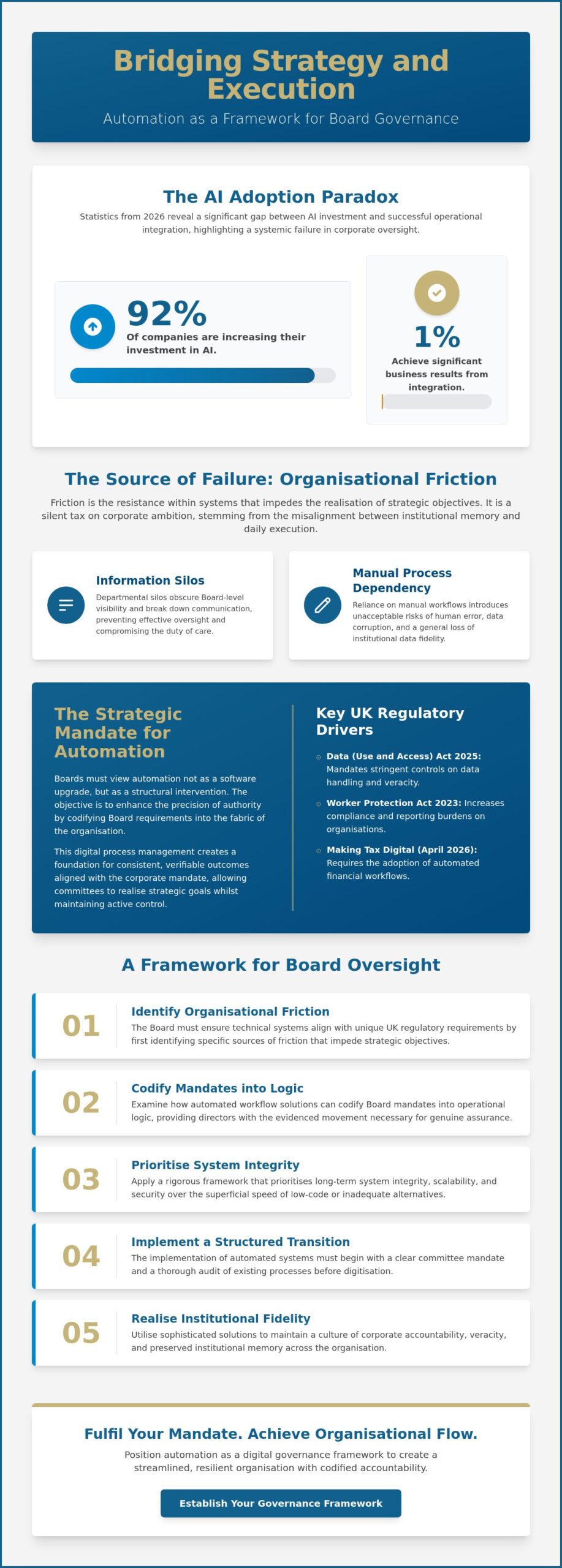
Statistics from 2026 reveal that whilst 92% of companies are increasing their investment in AI, only 1% have successfully integrated it into their workflows to achieve significant business results. This gap highlights a systemic failure to align technical speed with the rigorous demands of corporate oversight. Many boards struggle with operational friction that delays decision-making, often because their automated workflow solutions UK implementations lack the veracity required for genuine assurance. When systems ignore institutional memory, they do not merely fail to improve efficiency; they actively erode the fidelity of organisational data.
You understand that manual error in high-stakes environments represents a risk that no modern director should accept. This article demonstrates how UK organisations can realise operational excellence by positioning automation as a digital governance framework. We shall examine the impact of the Data (Use and Access) Act 2025, the transition toward agentic AI, and the specific mechanisms boards use to maintain active control over automated systems. By codifying accountability into the logic of the workflow, leadership teams can fulfil their mandate to create a streamlined, resilient organisational flow.
Key Takeaways
- Identify the specific sources of organisational friction that impede strategic objectives, ensuring technical systems align with unique UK regulatory requirements.
- Examine how automated workflow solutions UK codify Board mandates into operational logic, providing directors with the evidenced movement necessary for genuine assurance.
- Apply a rigorous framework for Board oversight that prioritises long-term system integrity, scalability, and security over the superficial speed of low-code alternatives.
- Implement a structured transition to automated systems, beginning with a clear committee mandate and a thorough audit of existing process streamlining before digitisation.
- Realise institutional fidelity by utilising sophisticated SaaS solutions to maintain a culture of corporate accountability, veracity, and preserved institutional memory.
The Architecture of Efficiency: Addressing Organisational Friction in UK Enterprises
Friction is the resistance within systems that impedes the realisation of strategic objectives. It acts as a silent tax on corporate ambition, draining resources and blurring the clarity of leadership. Directors often misinterpret this resistance as a lack of employee motivation or a failure of individual performance. In reality, friction stems from the structural misalignment between institutional memory and daily execution. It is the friction of the machine that grinds down the intent of the governor, creating a gap between board-level strategy and operational reality.
UK organisations navigate a uniquely complex regulatory environment. The Data (Use and Access) Act 2025, which came into force on 5 February 2026, and the Worker Protection Act 2023 create specific burdens for compliance, reporting, and financial tracking. Additionally, the April 2026 deadline for Making Tax Digital (MTD) requires many entities to adopt automated financial workflows. These mandates require a level of administrative precision that manual processes cannot sustain. Consequently, automated workflow solutions UK must be viewed as structural interventions rather than mere software upgrades. They represent the digital manifestation of a Board’s authority and a commitment to regulatory fidelity.
Efficiency relies upon the fidelity of institutional data. When information moves through fragmented channels, veracity is lost and accountability dissolves. A streamlined organisational flow ensures that every action is recorded, every decision is evidenced, and every mandate is fulfilled with precision. This is the architecture of a high-performance enterprise, where the structure itself reinforces the ethical and strategic goals of the leadership.
Identifying the Symptoms of Systemic Friction
Silos represent a breakdown in communication that obscures Board-level visibility. When directors cannot see the movement of data across departments, they cannot provide effective oversight or fulfill their duty of care. Manual process dependency exacerbates this issue by introducing the risk of human error and data corruption. The implementation of automated workflow solutions UK addresses these symptoms by providing a single source of truth for the entire enterprise. In high-stakes regulatory environments, such as those governed by the ICO’s 2026 guidance on agentic AI, the cost of delayed action or inaccurate reporting is not merely financial; it is a failure of governance.
The Strategic Mandate for Automation
Boards must shift their focus from the simple goal of “saving time” to the more critical objective of enhancing the precision of authority. Business process automation (BPA) allows leadership to codify their requirements into the very fabric of the organisation. This ensures that outcomes are consistent, verifiable, and aligned with the corporate mandate. Digital process management serves as the foundation for organisational performance, allowing committees to realise strategic goals whilst maintaining active control over operational risks. The question for leadership is no longer whether to automate, but how to do so in a manner that preserves the integrity of the institution.
Systems of Accountability: How Automated Workflow Solutions Function as Governance Controls
Accountability requires more than mere intention; it demands a structure that makes bypass impossible. Whilst manual processes often rely on the hope of compliance, Boards use automated workflow solutions UK to ensure that their mandate is woven into the fabric of daily operation. These systems allow directors to gain assurance through evidenced movement, creating an immutable record of who authorised an action and when it occurred. By making processes transparent, repeatable, and resistant to unauthorised bypass, directors reduce the risk of shadow systems that operate outside of official oversight.
Automation does not obscure agency. Instead, it clarifies authority. When a process is digitised, the system explicitly identifies the individual or committee responsible for each step, thereby removing the ambiguity that often plagues manual chains of command. This clarity is essential for directors who must provide an account of their stewardship to shareholders, regulators, and other stakeholders. Accountability is strengthened when the path of a decision is visible and the logic of the system prevents deviation from the Board’s established policies.
Codifying Governance through Digital Logic
Workflow rules should mirror the organisation’s delegated authority levels precisely. If the Board mandates that all capital expenditure over a certain threshold requires committee approval, the system logic must enforce this requirement without exception. Such automated controls prevent the erosion of institutional memory, ensuring that established protocols survive personnel changes. Aligning software logic with governance frameworks ensures that the machine serves the mandate, rather than the mandate being compromised by the limitations of the software.
Veracity and Assurance in Data Flow
Data veracity is the foundation upon which directors make sound judgements. In a landscape where the National Audit Office report on AI emphasises the need for rigorous oversight, automated systems reduce the “noise” that obscures critical risk indicators. By minimising manual intervention, these systems protect the integrity of information as it flows through the enterprise. This accuracy is vital for the fulfilment of regulatory reporting duties, providing the Board with the confidence that their disclosures are based on fact rather than inference. Leaders who wish to secure their governance architecture must view automation as a tool for precision, rather than merely a means of speed.
Evaluating Automated Workflow Solutions UK: A Framework for Board Oversight
The selection of an enterprise system is an act of governance. Directors must ensure that automated workflow solutions UK do not merely perform tasks but actually uphold the integrity of the organisation. A rigorous framework for evaluation prioritises three pillars: governance alignment, scalability, and security. Whilst many vendors emphasise “low-code” speed, the Board must distinguish between rapid deployment and the long-term requirement for system integrity. Generic tools often fail to account for the nuanced hierarchies and delegated authorities found in complex corporate structures. Bespoke solutions, by contrast, allow a Board to mirror its specific mandate within the digital architecture of the firm.
Transparency in algorithmic reasoning is non-negotiable. As systems move toward agentic AI, the Board must demand clarity regarding how these workflows make inferences. This is not merely a technical concern; it is a matter of accountability. If a system makes a significant decision based on special category data, the Data (Use and Access) Act 2025 mandates specific safeguards. Directors must understand the logic behind automated judgements to provide genuine assurance. Without this veracity, the Board risks abdicating its responsibility to a “black box,” which represents a fundamental failure of oversight.
Criteria for Strategic System Selection
Integration with existing legacy controls is a prerequisite for any successful implementation. A solution must not exist in isolation; it must reinforce the established frameworks that protect the organisation. Directors should evaluate the provider’s commitment to UK-specific data residency, particularly in light of post-Brexit divergence in data law. Additionally, the system must demonstrate the flexibility to adapt to shifting regulatory mandates, such as the Worker Protection Act 2023, without requiring a complete architectural overhaul. Scalability must be proven through evidenced performance rather than mere vendor promises.
Beyond Technical Features: The Human Centric View
The user interface should guide ethical decision-making rather than merely facilitating speed. Systems that ignore the human element risk creating a culture of mindless compliance, where the machine dictates the pace of thought. Training and mentoring are essential to ensure that staff understand the intent behind the automation. Engaging in executive team coaching UK helps align leadership with these new digital realities, ensuring that the Board maintains active control over the transition. This human-centric approach ensures that technology serves the culture, rather than the other way around.
Realising Operational Flow: A Strategic Guide to System Implementation
The realisation of operational flow begins with a clear mandate from the Board or a relevant steering committee. Implementing automated workflow solutions UK requires a structured approach that prioritises governance over technical haste. Without a formal directive, projects often devolve into fragmented IT initiatives that lack the authority to change established behaviours. Directors must ensure that a thorough audit of existing business process streamlining occurs before any code is written or software is configured. Automating a flawed process only serves to accelerate the production of errors, whereas a governance-led approach ensures that the digital system reinforces strategic intent.
Iterative implementation allows the organisation to maintain stability whilst managing the inherent risks of change. By fulfilling requirements in controlled phases, committees can monitor the system for unintended consequences and adjust the logic before a full-scale deployment. This methodical pace provides the necessary assurance that the new controls operate as intended. Continuous monitoring ensures that the system continues to fulfil its purpose, providing the Board with real-time data regarding organisational health, capital allocation, and regulatory compliance. Such oversight prevents the “set and forget” mentality that often leads to system drift and the eventual erosion of accountability.
The Pre-Implementation Governance Audit
Identifying the specific people and systems currently responsible for process outcomes is a critical first step for any director. This audit must map existing operational friction reduction strategies to ensure that institutional memory is preserved throughout the transition. Directors should determine where automated controls will provide the greatest increase in assurance, focusing on high-stakes decision points, financial approvals, and data-heavy reporting tasks. By establishing a baseline of current performance, the Board can measure the veracity of the improvements achieved through automation. A failure to perform this audit risks digitising the very inefficiencies the Board seeks to eliminate.
Managing the Transition Phase
Leadership teams must develop a communication plan that addresses the human element and potential cultural resistance to new systems. Change often provokes anxiety, particularly when it involves the automation of tasks previously handled by experienced staff. Establishing clear metrics for success that go beyond simple speed or cost reductions allows the Board to demonstrate the value of the transition in terms of risk reduction and data fidelity. It is vital to ensure that the transition period does not create temporary gaps in oversight or accountability. Boards that require assistance in structuring their implementation roadmap can ensure that their technical systems remain firmly under the control of their governance framework. This active management ensures that the transition strengthens, rather than weakens, the chain of command.
Achieving Institutional Fidelity through Workflow Optimisation
The Charlie Helps Associates Workflow Optimisation SaaS Solution provides the technical infrastructure required for sophisticated organisational oversight. It acts as a digital ledger of intent; it ensures that every action taken within the firm aligns with the Board’s documented policies. Directors who utilise this solution do not merely automate tasks; they secure the fidelity of their entire operation. By codifying ethical boundaries and delegated authorities, leaders maintain a culture of corporate accountability that persists even as the organisation scales. This alignment of technical execution with moral purpose represents the highest form of institutional maturity.
Long-term value is found in a system that evolves alongside the organisation’s governance requirements. As committees refine their strategies and regulators introduce new mandates, the digital architecture must adapt without compromising veracity. A system that grows in sophistication alongside its human governors prevents the stagnation that often leads to systemic failure. True efficiency is not found in the total replacement of human agency, but in the harmonious intersection of human judgement and automated precision. The former provides the wisdom and ethical direction, whilst the latter ensures the tireless execution of the mandate.
The Role of SaaS in Modern Governance
The platform facilitates the implementation of tailored governance frameworks by translating abstract mandates into executable logic. UK executives require veracity in process data to make informed judgements; the SaaS tool provides this by eliminating the inaccuracies inherent in manual reporting. When used in conjunction with corporate governance consultants UK, the solution bridges the gap between high-level strategy and daily execution. This synergy allows committees to realise a state of governance maturity where the system reinforces the integrity of every transaction and decision. By prioritising the accuracy of data flow, the Board fulfils its duty to provide transparent and evidenced assurance.
A Call for Strategic Reflection
Directors must consider whether their current processes provide the level of assurance required by modern regulators, shareholders, and stakeholders. If operational friction continues to obscure visibility, the Board cannot truly claim to maintain active control over the enterprise. We invite leaders to engage in a consultation to assess their organisational flow and identify where automated workflow solutions UK can best support their mandate. The implementation of these systems should be viewed as a commitment to excellence rather than a mere technical necessity. Automation represents the future of accountability, but it only achieves its purpose when directed by a steady, human hand. What remains is for leadership to decide whether they will lead this transition or be led by the inefficiencies of the past.
Securing the Future of Organisational Integrity
Effectiveness requires more than technical adoption; it requires the disciplined integration of digital logic with the Board’s mandate. The preceding analysis has explored how automated workflow solutions UK serve as essential governance controls that preserve institutional memory, ensure data veracity, and protect the chain of command. Boards that prioritise these structural interventions move beyond mere efficiency to achieve a state of institutional fidelity. It’s through this alignment of technology and authority that leadership teams can maintain active control in a complex regulatory environment.
By combining our Proprietary Workflow Optimisation SaaS with strategic advisory for C-suite leaders, we provide the steady hand necessary to navigate these transitions. Our expertise in UK Corporate Governance ensures that every digital control remains subordinate to your strategic objectives. The path toward a more resilient, transparent, and precise organisation is open to those who lead with purpose. Consult with our specialists to realise your organisational flow and fulfil your duty of stewardship with confidence.
Frequently Asked Questions
How do automated workflow solutions UK improve board-level oversight?
Automated workflow solutions UK improve oversight by providing directors with real-time audit trails and evidenced movement. These systems ensure that every operational action remains consistent with the Board’s established mandate. By removing the opacity of manual processes, leadership teams gain the veracity needed for informed judgements, capital allocation, and risk management. This structural intervention allows the Board to monitor organisational health without the delays associated with manual reporting.
Can these systems be integrated with existing UK regulatory compliance frameworks?
Yes, these systems allow boards to codify UK-specific requirements, such as the Data (Use and Access) Act 2025, into the organisational architecture. By aligning technical logic with regulatory frameworks, directors ensure that automated controls prevent non-compliance before it occurs. This integration allows the enterprise to fulfil its reporting duties with high fidelity, and verified precision. It ensures that the Board maintains active control over compliance risks in an increasingly complex legal landscape.
What happens to individual accountability when a process is fully automated?
Individual accountability is strengthened because the system explicitly identifies the person or committee responsible for every decision point. Automation removes the ambiguity often found in manual chains of command by recording who authorised each step. This transparency ensures that directors can trace actions back to their source, preserving the integrity of delegated authority. Accountability is never abdicated to the machine; it’s merely evidenced by it.
Is it possible to automate workflows without disrupting institutional memory?
Institutional memory is preserved through the digitisation of established protocols and delegated authorities. A governance-led implementation ensures that the collective knowledge of the organisation is codified into the system logic. This prevents the loss of critical process knowledge during personnel changes and ensures that the machine reinforces, rather than replaces, the organisation’s historical wisdom. A thorough pre-implementation audit is essential to capture these nuances before digitisation.
How much time does a typical transition to automated workflow solutions UK take?
Transition timelines typically range from three to six months, depending on the complexity of the organisational architecture. Boards achieve the greatest stability by adopting an iterative implementation strategy that allows for risk assessment at each phase. This methodical pace ensures that the organisation realises its efficiency goals without creating temporary gaps in oversight or accountability. Directors must prioritise the integrity of the system over the superficial speed of low-code deployment.
What are the primary risks associated with implementing automation in the public sector?
The primary risks involve data protection failures and the potential for algorithmic bias in significant decisions. Boards must ensure that systems comply with the ICO’s 2026 guidance on agentic AI to protect personal data veracity. Mitigating these risks requires transparent system logic and the maintenance of human oversight to ensure that automated judgements remain ethical and legal. Leadership must ensure that authority remains with specific people rather than the software.
Can automated workflows help in reducing operational friction during a merger?
Automated workflows reduce friction by harmonising disparate operational cultures into a single, transparent governance framework. During the integration of two entities, these systems provide the visibility required to identify process redundancies, and align the new structure with the Board’s intent. This structural intervention ensures that the merger fulfils its strategic objectives with minimal operational resistance. It allows directors to gain assurance that the combined organisation operates under a unified mandate.
How does the Board ensure the fidelity of data within an AI-driven workflow?
The Board ensures data fidelity by demanding explainable AI logic and implementing rigorous automated controls. Directors must verify that the information entering the system is accurate and that the workflow logic preserves its integrity throughout the process. By treating the system as a tool under active control, leadership prevents corrupted data from influencing high-stakes judgements. This vigilance ensures that institutional data remains a reliable foundation for corporate accountability and strategic planning.
Disclaimer
The articles published on CharlieHelps.co are provided for general information, reflection, and commentary. They draw on professional experience, research, and interpretation, but they do not constitute legal, regulatory, financial, clinical, governance, risk, compliance, assurance, or other professional advice. Nothing published on this site should be relied upon as practice guidance, formal instruction, or a substitute for proper professional consultation. Readers should seek advice from suitably qualified advisers before acting on, applying, or relying upon any material in relation to their own organisation, Board, duties, circumstances, or decisions. Although reasonable care is taken to ensure that articles are accurate and current at the time of publication, no warranty is given as to completeness, accuracy, timeliness, or fitness for any particular purpose. Law, regulation, policy, standards, and recognised practice may change, and context matters. References to external sources, organisations, products, services, or third-party materials are included for information only. They do not imply endorsement unless expressly stated. Where an article contains affiliate links, sponsored references, or commercial relationships, these will be disclosed where relevant. The views expressed are those of the author unless otherwise stated. Reading, sharing, or responding to material on this site does not create a client, adviser, fiduciary, or professional relationship with Charlie Helps FRSA, CharlieHelps.co, or any associated entity. Readers remain responsible for their own judgement, decisions, and actions.
