

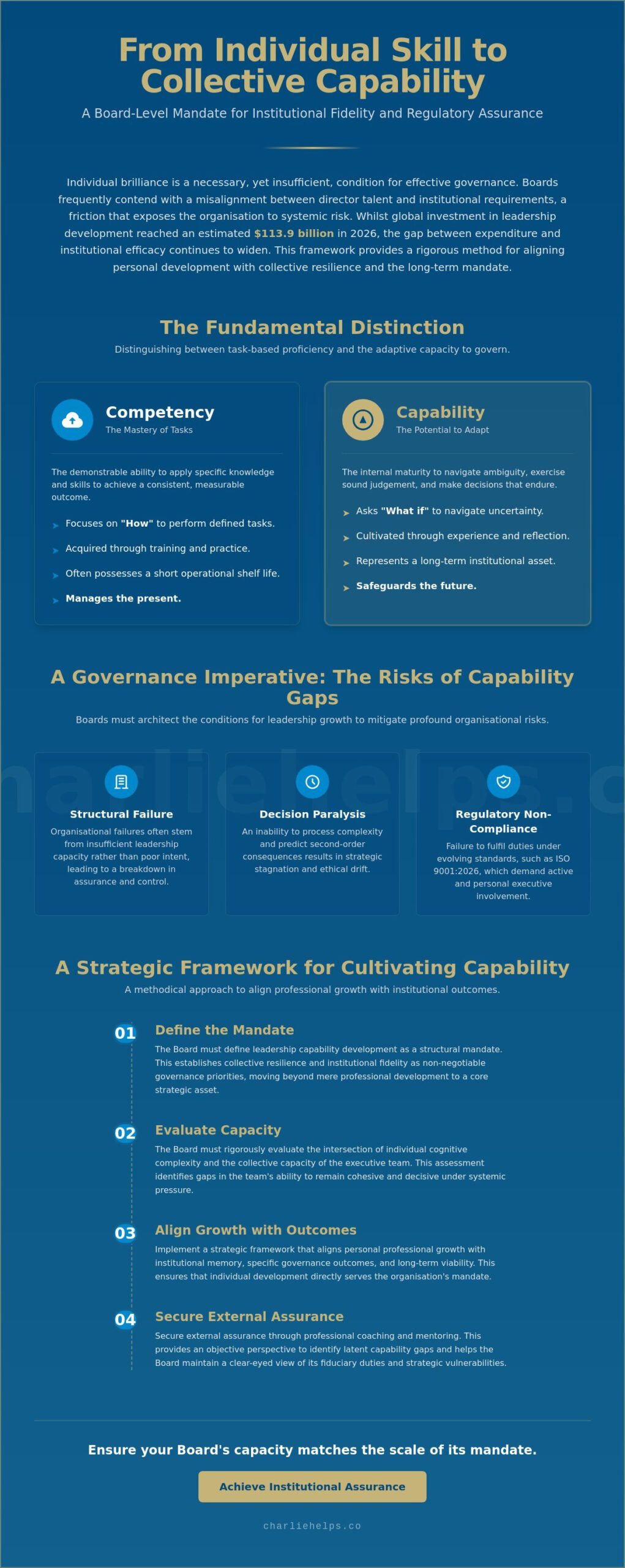
Individual brilliance in the boardroom is a necessary condition, yet it remains insufficient for the rigours of modern governance. Boards often struggle with a persistent misalignment between the specific talents of their directors and the overarching requirements of the institution. Such friction frequently stems from a lack of clarity regarding the distinction between individual skill and collective capability, leading to fragmented approaches to professional growth that fail to serve the long-term mandate. Whilst investment in leadership capability development reached an estimated $113.9 billion globally in 2026, the gap between expenditure and institutional efficacy continues to widen.
Senior leaders likely recognise the weight of this responsibility, especially as new standards like ISO 9001:2026 demand that executives move beyond delegation to active, personal involvement in organisational culture. Our analysis offers a rigorous framework for assessing leadership capacity, ensuring that personal development aligns with institutional memory and regulatory assurance. Strategic cultivation of collective foresight allows Boards and directors to fulfil their mandates, navigate complex environments, and maintain absolute fidelity to the organisation’s purpose.
Key Takeaways
- Define leadership capability development as a structural mandate for the Board to ensure institutional fidelity and collective resilience.
- Distinguish between task-based competency and the adaptive capability required to navigate uncertainty, shifting regulations, and complex governance mandates.
- Evaluate the intersection of individual cognitive complexity and the collective capacity of the executive team to remain cohesive under systemic pressure.
- Implement a strategic framework that aligns personal professional growth with institutional memory, specific governance outcomes, and long-term viability.
- Secure external assurance through coaching and mentoring to identify capability gaps and maintain a clear-eyed view of the Board’s fiduciary duties.
Defining Leadership Capability within the Governance Framework
Leadership capability development represents the deliberate expansion of a director’s potential to navigate complexity, exercise sound judgement, and uphold institutional values. It is a structural asset. The Board must recognise that capability remains a fundamental requirement for the fulfilment of its strategic mandate. Without it, authority becomes a hollow vessel. Whilst skill acquisition focuses on the mastery of specific tools or processes, capability involves the synthesis of ethics, historical resonance, and systemic thinking. Directors should view this development as the foundational layer upon which organisational performance and regulatory compliance are built.
Capability is the quiet engine of institutional survival. It describes the internal maturity required to process information, manage ambiguity, and make decisions that endure. Unlike technical competencies, which often have a short shelf life, capability grows through the integration of experience and reflection. Boards that neglect this cultivation risk placing the institution in the hands of those who can perform tasks but cannot lead through crises. The distinction is subtle yet absolute; it separates those who manage the present from those who safeguard the future.
The Intersection of Authority and Capacity
Authority is granted by the governance framework, but capacity is cultivated through rigorous professional growth. A Board holds the primary responsibility for ensuring that those with delegated authority possess the capability to exercise it with precision. Institutional fidelity requires leaders who understand the historical context and the future trajectory of the organisation. Within the broader context of leadership development, capability focuses on the internal qualities that allow a person to handle increasing levels of cognitive complexity. Authority without capacity invites systemic collapse.
Why Capability is a Board-Level Priority
Capability gaps at the executive level create significant risks to organisational stability and reputation. A board effectiveness review often reveals that structural failures stem from insufficient leadership capacity rather than poor intent. Boards must move beyond passive oversight to actively architecting the conditions for leadership growth. This shift ensures that the organisation can realise its objectives even as regulatory environments become more demanding. When directors fail to prioritise this, they leave the institution vulnerable to decision-making paralysis and ethical drift. The question for any Board is whether its leaders possess the depth to match the scale of their mandate.
The Structural Components of Individual and Collective Capability
Individual capability is the internal architecture of the leader. It encompasses the cognitive complexity and moral depth required to make high-stakes decisions under conditions of extreme uncertainty. A systematic approach to leadership capability development focuses on this architecture, ensuring that directors can synthesise conflicting information into a coherent strategic narrative. This process transcends technical proficiency; it moves instead toward the cultivation of strategic wisdom. Institutional memory serves as a critical component of this growth, ensuring that lessons from the past inform future strategic decisions and prevent the repetition of systemic errors.
Capability is not an isolated attribute. It exists within a web of relationships and systems. The development of these components requires a methodical approach that prioritises the long-term health of the institution over short-term performance metrics. Boards must ensure that their leaders possess the maturity to handle the weight of their fiduciary duties with both precision and humility. Leadership capability development ensures the executive team remains aligned with the overarching governance framework even as market conditions shift.
Cognitive Complexity and Judgement
Judgement is the most critical capability for those tasked with organisational oversight and risk management. It requires the ability to see patterns amongst noise and to predict the second-order consequences of a decision. Whilst federal leadership development programs often emphasise succession management, the Board must determine whether its own programmes encourage deep reflection or merely superficial compliance. True judgement relies on the capacity to question assumptions and maintain intellectual independence in the face of groupthink.
Collective Resilience and Strategic Alignment
Collective capability refers to the ability of the executive team to function as a cohesive unit under pressure. Resilience is not a personality trait; it is a systemic outcome of clear accountabilities, robust controls, and strategic alignment. High-performance teams realise their potential when individual capabilities are harnessed for collective institutional goals rather than personal advancement. If you require assistance in mapping these structural components within your organisation, our advisory services provide the necessary clarity to align leadership behaviour with governance requirements.
Distinguishing Capability from Competency: A Governance Mandate
Competency remains the baseline of professional life. It describes the ability to perform a specific task to a defined standard within a known environment. Whilst necessary, competency is inherently retrospective; it confirms what a leader has already mastered in a stable context. Capability describes the potential to adapt, learn, and lead in an environment of uncertainty and shifting regulation. It is a forward-looking attribute. Leadership capability development addresses this distinction by preparing directors for the unknown rather than the routine. Relying on current competency to predict future capability is a common failure in executive recruitment and promotion. This error assumes that the skills required to manage a department are identical to the capacity needed to govern an institution.
The Board must distinguish between these two concepts to ensure effective leadership succession planning advisory. When directors mistake technical proficiency for strategic maturity, they risk placing the organisation’s future in the hands of specialists who cannot see the whole system. Governance requires a different cognitive load. It demands the ability to weigh competing ethical claims, anticipate regulatory shifts, and maintain institutional fidelity. A director may be a competent financier yet lack the capability to oversee an integrated governance framework. Leadership capability development ensures that the transition to senior oversight is supported by the necessary intellectual and moral growth.
The Limits of Technical Competency
Technical expertise is a prerequisite for management, but it is insufficient for the demands of corporate governance. Boards often promote individuals based on technical success, only to find they lack the capability for strategic oversight. Capability development must focus on the transition from doing to thinking, and from executing to governing. This shift requires the leader to abandon the comfort of the “how” in favour of the complexity of the “why”, the “what”, and the “what if”. It is the movement from operational mastery to moral and strategic stewardship.
Assessing Potential for Strategic Oversight
Assessment frameworks must evaluate a leader’s ability to handle ambiguity and moral complexity. Veracity and accountability are more vital for board-level roles than specific technical certifications. The goal is to identify and cultivate the intellectual force required for long-term institutional survival. This process involves examining the director’s capacity for independent judgement and their appetite for rigorous inquiry. If an individual cannot navigate the grey areas of governance, their technical certifications offer little assurance to shareholders or regulators. Movement toward true capability requires an unsentimental appraisal of one’s own limits and the courage to expand them.
Implementing a Strategic Framework for Capability Growth
Implementation requires more than intention. The Board must first define the specific capabilities required to fulfil the organisation’s long-term mandate. This definition provides the benchmark for all subsequent leadership capability development. Directors should implement a continuous feedback loop that links leadership behaviour to governance outcomes, ensuring that every development initiative remains grounded in reality. Evidence must support these initiatives, demonstrating a clear link to the reduction of institutional risk. Prioritising depth and reflection over the speed of training completion prevents the framework from becoming a superficial exercise.
Strategic coherence demands that capability growth sits at the centre of the organisation’s architecture. Integration into a broader corporate advisory services UK framework ensures that development aligns with the strategic objectives of the institution. This alignment prevents fragmented approaches to executive growth, which often result in misaligned talent and wasted resources. By treating capability as a structural requirement, the Board provides assurance that the leadership team can navigate complex regulatory shifts without losing sight of the institutional purpose. Movement toward excellence is achieved through the disciplined application of these standards.
Architecting Personalised Development Pathways
Development must be tailored to the specific needs of the leader and the requirements of their governance role. Pathways should include a mix of formal education, peer mentoring, and experiential learning to foster genuine intellectual growth. The Board should ensure that these pathways remain rigorous intellectual pursuits rather than mere tick-box exercises. Success in these programmes is measured by the leader’s ability to apply strategic wisdom to real-world governance challenges. Personalised growth ensures that individual potential is harnessed for the long-term benefit of the institution.
The Role of Mentoring in Capability Fulfilment
Professional mentoring provides a private space for leaders to explore complex ethical and strategic challenges. Mentors help to bridge the gap between individual capacity and institutional requirements by offering the perspective of seasoned experience. These programmes must be structured to ensure accountability and the transfer of strategic wisdom across generations of leadership. This transfer is essential for maintaining institutional memory and ensuring that the Board can fulfil its fiduciary duties with confidence. If you wish to implement a structured framework for your senior team, our mentoring services offer a path toward evidenced movement and active control.
Institutional Assurance through Professional Coaching and Mentoring
External coaching provides an unsentimental perspective. Senior leaders often struggle to recognise their own capability gaps within the echo chambers of executive life, where feedback is frequently filtered or softened. By engaging corporate governance consultants UK, the Board can align leadership development with the exacting standards of governance excellence. This alignment ensures that professional growth is not a peripheral activity but a core component of institutional assurance. Assurance is realised when the Board can demonstrate that its directors possess the capacity to navigate foreseeable and unforeseeable challenges with composure, precision, and veracity.
The focus must remain on evidenced movement. It is insufficient to merely state an intention to grow; the Board must show that capability is actually increasing through credible, professional intervention. Leadership capability development serves as the mechanism for this movement. It transforms the abstract potential of the individual into the concrete capacity of the institution. When the Board prioritises this development, it provides a clear signal to regulators and shareholders that the organisation is governed by those who possess the intellectual force required for stewardship. Every coaching session and mentoring engagement must link back to the reduction of risk and the fulfilment of the strategic mandate.
Securing the Future through Capability
Leadership capability development is the ultimate insurance policy against institutional drift and failure. It protects the organisation from the slow decay of purpose that occurs when leaders lack the depth to uphold their mandate. A Board that invests in its leaders’ capacity is a Board that takes its fiduciary duties seriously. They recognise that the strength of the institution is found in the collective wisdom of its directors. The final implication is clear: capability is the engine of institutional fidelity. It is the silent guarantor of the organisation’s long-term viability, ethical standing, and moral resonance.
Next Steps for the Board
Directors should begin with an audit of current leadership capabilities against the strategic governance framework. This assessment identifies the specific gaps that threaten institutional memory, strategic alignment, and regulatory compliance. The Board must then establish a clear mandate for executive development that prioritises judgement, accountability, and ethical depth. This mandate ensures that leadership growth is treated with the same rigour as financial oversight. To begin this process, contact Charlie Helps Associates to organise a consultation regarding bespoke coaching and mentoring. Our advisory services provide the steady hand required to architect a leadership team capable of fulfilling its highest purpose.
Cultivating the Intellectual Force of the Board
Institutional fidelity rests upon the collective capacity of its directors to navigate complexity with precision and moral depth. As we have examined, leadership capability development is not a discretionary pursuit but a structural requirement for the fulfilment of a strategic mandate. Boards must move beyond the safety of technical competency to embrace the adaptive potential required for long-term survival. This transition requires a disciplined framework that prioritises strategic wisdom, historical resonance, and absolute accountability.
Success is realised when the Board can provide assurance that its leaders possess the maturity to handle shifting regulatory landscapes and systemic risks. Through our evidence-based approach, we ensure that professional growth aligns perfectly with the governance framework of the institution. Expert coaching and mentoring for senior fiduciaries provide the unsentimental perspective necessary to identify and close capability gaps. We invite you to architect your leadership capability with Charlie Helps Associates. Strengthening the human element behind the governance system allows your organisation to face the future with quiet confidence and renewed purpose.
Frequently Asked Questions
How does leadership capability development differ from standard management training?
Leadership capability development focuses on the internal architecture of judgement and the capacity to handle cognitive complexity, whereas management training typically addresses specific technical competencies. Whilst training prepares an individual for known tasks in stable environments, capability development prepares them for the unknown and the uncertain. It involves the cultivation of moral depth and strategic wisdom, ensuring that leaders can navigate the grey areas of corporate governance where simple rules no longer apply.
Can a Board be held accountable for the capability gaps of its executive team?
Directors bear the primary responsibility for ensuring that those with delegated authority possess the capacity required to fulfil the organisational mandate. Capability gaps represent a structural risk to the institution and its reputation. If a Board fails to identify or address these gaps, it neglects its fiduciary duty to provide effective oversight and assurance. Accountability is realised when the Board can demonstrate a proactive approach to architecting the collective capacity of its senior leaders.
What is the role of the Nomination Committee in leadership capability development?
The Nomination Committee functions as the architect of the Board’s collective capacity and future resilience. Its role transcends simple recruitment; it must actively identify the specific capabilities required to navigate shifting regulatory environments and long-term strategic challenges. This committee ensures that leadership capability development remains a strategic mandate rather than a reactive necessity, aligning personal growth with the institutional memory and future trajectory of the organisation.
How much time should senior directors dedicate to their own professional growth?
Professional growth should be a continuous feature of a director’s tenure rather than a periodic or isolated event. Whilst specific time requirements vary by sector and complexity, the most effective fiduciaries integrate reflection, peer mentoring, and external coaching into their regular governance cycle. This commitment ensures that their judgement remains sharp, their strategic perspective remains current, and their ability to provide challenge remains robust.
Is it possible to measure the return on investment for leadership capability programmes?
Measuring the return on investment involves tracking evidenced movement in decision quality, risk reduction, and institutional resilience. A Board can observe the value of these programmes through the executive team’s ability to navigate crises, maintain regulatory fidelity, and implement complex strategies without systemic failure. Precise metrics focus on the reduction of governance gaps and the successful fulfilment of the strategic mandate rather than mere participation rates or training hours.
How does institutional memory influence the development of new leaders?
Institutional memory provides the necessary historical resonance for new leaders to understand the organisation’s ethical foundation and past challenges. Without this context, new directors risk repeating systemic errors or drifting from the core purpose of the institution. Capability is strengthened when leaders can synthesise lessons from the past with the requirements of the future, ensuring that their decisions remain consistent with the organisation’s long-term identity.
What happens if a leader’s capability no longer matches the organisational mandate?
The Board must intervene decisively when a leader’s capacity no longer aligns with the institutional requirements or the complexity of the environment. This intervention may include bespoke coaching, a adjustment of delegated authority, or the initiation of formal succession protocols. Allowing a capability gap to persist invites strategic paralysis, ethical drift, and potential regulatory failure. Active control requires the Board to maintain a clear-eyed view of leadership performance at all times.
How can mentoring help to maintain corporate ethics and governance?
Mentoring provides a private, unsentimental space for leaders to test their judgement against the organisation’s ethical framework and governance standards. It allows for the transfer of strategic wisdom between seasoned directors and those rising to new levels of authority. This process ensures that governance remains a lived practice rooted in veracity and accountability, rather than a set of abstract rules to be followed in a tick-box fashion.
Disclaimer
The articles published on CharlieHelps.co are provided for general information, reflection, and commentary. They draw on professional experience, research, and interpretation, but they do not constitute legal, regulatory, financial, clinical, governance, risk, compliance, assurance, or other professional advice. Nothing published on this site should be relied upon as practice guidance, formal instruction, or a substitute for proper professional consultation. Readers should seek advice from suitably qualified advisers before acting on, applying, or relying upon any material in relation to their own organisation, Board, duties, circumstances, or decisions. Although reasonable care is taken to ensure that articles are accurate and current at the time of publication, no warranty is given as to completeness, accuracy, timeliness, or fitness for any particular purpose. Law, regulation, policy, standards, and recognised practice may change, and context matters. References to external sources, organisations, products, services, or third-party materials are included for information only. They do not imply endorsement unless expressly stated. Where an article contains affiliate links, sponsored references, or commercial relationships, these will be disclosed where relevant. The views expressed are those of the author unless otherwise stated. Reading, sharing, or responding to material on this site does not create a client, adviser, fiduciary, or professional relationship with Charlie Helps FRSA, CharlieHelps.co, or any associated entity. Readers remain responsible for their own judgement, decisions, and actions.
