

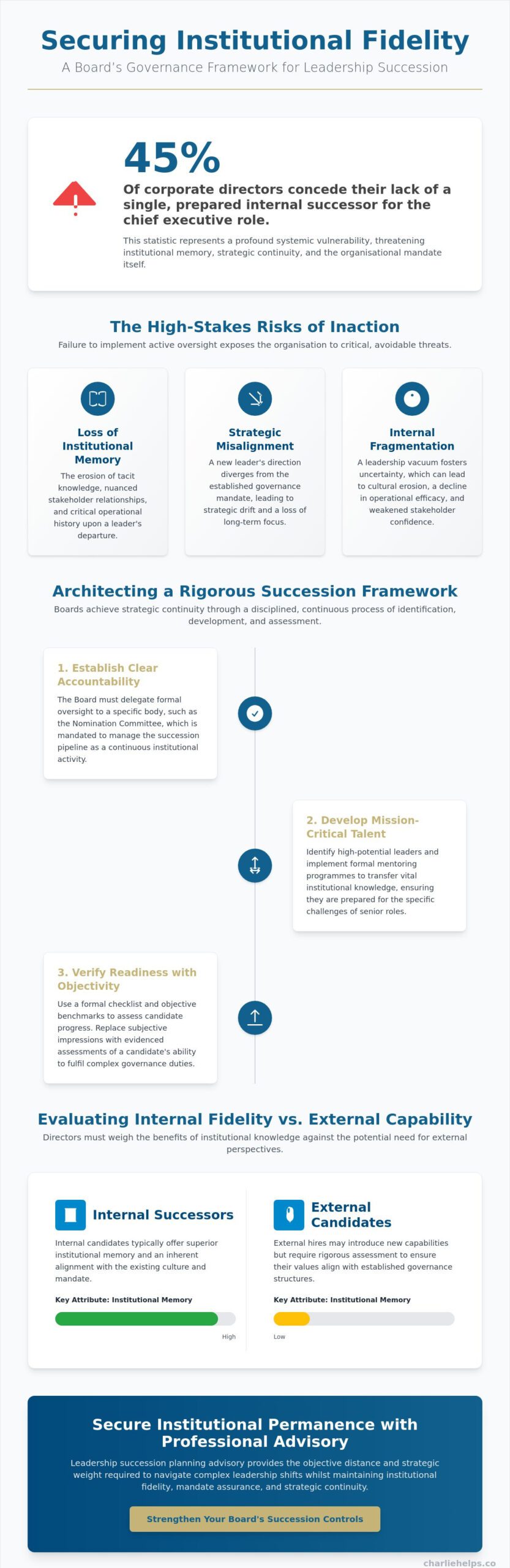
Forty-five per cent of corporate directors now concede they lack a single internal successor prepared to assume the chief executive role, even as they anticipate a transition within the next eighteen months. This statistic reflects a profound systemic vulnerability. Boards often recognise the precarious nature of leadership continuity, yet they struggle to bridge the gap between strategic intent and operational readiness. The threat is not merely the vacancy itself, but the potential erosion of institutional memory and the misalignment of new leadership with established governance mandates.
You understand that a leader’s departure should never jeopardise the organisation’s ability to fulfil its fundamental purpose. This leadership succession planning advisory offers a rigorous framework for Boards to secure institutional fidelity, mitigate transition risk, and realise long-term strategic continuity. By adopting these disciplined controls, directors can ensure the organisation remains resilient, maintains its mandate, and fosters a robust pipeline of mission-critical talent. We will examine the essential components of a governance-led succession strategy, moving from the identification of high-potential candidates to the establishment of clear accountability structures for transition oversight.
Key Takeaways
- Boards must treat leadership transitions as high-stakes risks to the organisational mandate, prioritising institutional permanence, strategic continuity, and the protection of memory.
- A resilient framework requires directors to establish clear lines of accountability, ensuring specific committees oversee the identification, development, and preparation of mission-critical talent.
- Internal successors typically offer superior institutional memory, whereas external candidates require rigorous assessment to ensure their capabilities align with established governance structures.
- Directors should implement a formal checklist to verify that every critical role has an identified successor, supported by mentoring programmes that transfer vital institutional knowledge.
- Professional leadership succession planning advisory provides the objective distance and strategic weight needed to navigate complex leadership shifts whilst maintaining institutional fidelity.
The Governance Mandate for Leadership Succession
Institutional permanence requires more than intent. It demands the rigorous application of governance controls to ensure that the departure of a single executive does not destabilise the collective mission. Boards that don’t prioritise succession fail to recognise its status as a primary strategic risk. A leadership transition is a high-stakes event that tests the integrity of the organisational mandate, the resilience of its culture, and the veracity of its long-term vision.
Fidelity to the mission must always outweigh the charisma of any individual incumbent. Whilst a gifted leader may accelerate progress, the Board’s duty lies in ensuring that the institution survives and thrives beyond any single tenure. This requires a system of active oversight rather than a static list of names. Directors must cultivate an environment where leadership is viewed as a temporary stewardship of a permanent mandate, necessitating a disciplined approach to leadership succession planning advisory.
Defining Succession within Corporate Governance
The Board uses succession as a formal mechanism to ensure the continuity and veracity of leadership. By preparing for the inevitable departure of key personnel, directors maintain authority and protect the organisation from the volatility of unplanned change. This Succession Planning Overview provides a foundational perspective on how these systems function across various sectors. Succession planning represents a non-delegable fiduciary duty of the Board to ensure the sustained fulfilment of the organisational mandate.
The Risk of Postponed Planning
Operational friction and strategic drift often follow leadership vacuums. When directors postpone the identification of successors, they risk the sudden loss of institutional memory and the erosion of stakeholder confidence. A 2026 survey indicates that 45 per cent of corporate directors harbour concerns regarding their lack of a single internal successor ready for a transition within eighteen months. This lack of preparation creates a vulnerability that external pressures or internal crises can easily exploit. Several critical risks emerge when Boards fail to implement active oversight:
- The loss of tacit knowledge, institutional memory, and the nuanced understanding of stakeholder relationships.
- A misalignment between the strategic direction of new leadership and the existing governance mandate.
- The potential for internal fragmentation, cultural erosion, and a decline in operational efficacy.
Assurance is only possible when the Board acts with foresight, implementing leadership succession planning advisory protocols before a crisis necessitates a hurried and potentially flawed appointment. Proactive directors realise that the time to secure the future is whilst the present remains stable, ensuring that the organisation can fulfil its obligations regardless of individual departures. The central question for any Board is not if a transition will occur, but whether the systems are in place to maintain institutional fidelity when it does.
Architecting a Rigorous Succession Framework
Structure creates certainty. Without a defined framework, succession remains a matter of chance rather than a product of disciplined governance. Boards achieve strategic continuity by establishing clear lines of accountability, ensuring that the identification of successors remains a continuous activity rather than a reactive search. Directors must implement specific controls to assess candidate progress against objective benchmarks, providing the assurance that leadership capability remains aligned with the institution’s long-term requirements.
The resilience of this architecture depends upon the Board’s ability to distinguish between raw talent and the specific competencies required to uphold the organisational mandate. Leadership is not a generic quality; it is a contextual performance that must be measured against the strategic challenges of the era. A rigorous leadership succession planning advisory process enables directors to move beyond subjective impressions, replacing them with evidenced assessments of a candidate’s ability to fulfil complex governance duties. Boards that invest in leadership capability development as a strategic mandate ensure that the gap between individual talent and collective institutional capacity is systematically closed before a transition becomes necessary.
The Role of the Nomination Committee
The Nomination Committee holds the specific mandate for talent oversight and the veracity of the leadership pipeline. Its members must perform regular reviews to ensure the executive bench reflects the institution’s evolving needs, priorities, and ethical standards. Transparency in these selection processes protects the integrity of the Board, preventing the perception of patronage whilst reinforcing a culture of meritocracy. By utilising structured resources such as the University of Washington’s Succession Planning Toolkit, committees can adopt standardised assessment methods to evaluate readiness. This rigorous oversight ensures that internal talent development remains a priority, reducing the reliance on external appointments that may lack cultural fidelity.
Aligning Leadership with Strategic Mandates
Capability must match the specific challenges the organisation anticipates. The Board defines the skills required to implement the current governance framework, ensuring that the Chief Executive’s profile reflects the current and future strategic environment. Historical resonance informs these requirements; directors look to past successes, failures, and institutional shifts to determine which leadership traits will best protect the organisational mandate. Effective leadership succession planning advisory assists Boards in translating abstract strategic goals into concrete leadership competencies. Directors who seek to refine their governance architecture often find that an external perspective provides the necessary distance to judge candidate suitability without the bias of proximity. Ultimately, the Board achieves continuity by ensuring that the person holding the office is always capable of realising the office’s mandate.
Evaluating Internal Fidelity vs External Capability
Boards face a fundamental choice between the continuity of internal fidelity and the potential renewal offered by external capability. In 2025, external CEO hires in the S&P 500 nearly doubled to 33 per cent from 18 per cent in 2024, the highest level in eight years. This trend suggest that directors increasingly prioritise external perspectives when they perceive a need for strategic realignment or a shift in the global landscape. However, an unsentimental appraisal of all candidates remains essential to realise a successful transition and protect the organisational mandate.
The Board must weigh the cost of cultural disruption against the benefit of new expertise. Whilst an external hire may possess specific skills that the internal pipeline lacks, they often lack the historical resonance required to navigate complex institutional structures. Effective leadership succession planning advisory enables directors to assess these trade-offs with clarity, ensuring that the chosen successor can fulfil the requirements of the role without eroding the foundations of the organisation. Continuity is not merely about keeping things the same; it is about ensuring that change serves the permanent mission.
The Value of Institutional Memory
Leaders grown from within understand the historical context of Board decisions, the nuances of the organisational culture, and the evolution of the mandate. This deep-seated knowledge allows for a transition that maintains institutional veracity whilst minimising the friction of change. Fidelity to established values reduces the risk of strategic whiplash, ensuring that the organisation remains focused on its primary objectives. Internal promotion reinforces corporate accountability by creating a clear and meritocratic path for those who have consistently upheld the governance standards, ethics, and vision of the institution.
When to Seek External Advisory
Stagnation may necessitate an external search to fulfil a new strategic direction or to address systemic weaknesses that internal candidates cannot resolve. In such instances, the Board must weigh the potential for cultural disruption against the benefit of fresh intellectual force. Professional leadership succession planning advisory services provide the distance required to judge whether internal pipelines are insufficient for the challenges ahead. Directors must ensure that any external hire is immediately integrated into the governance architecture, preventing the new leader from operating outside the established mandate. This integration requires a structured onboarding process that emphasises accountability, reporting lines, and the specific expectations of the Board, ensuring that the external talent serves the institution rather than personal ambition.
Realising a successful transition requires an unsentimental appraisal of all candidates, whether they are internal veterans or external specialists. The Board’s primary loyalty remains with the institution rather than any individual career path. By utilising rigorous advisory frameworks, directors can establish a selection process that prioritises the long-term health of the organisation, ensuring that every appointment strengthens the integrity of the mandate.
The Board’s Checklist for Strategic Continuity
Assurance stems from evidenced movement rather than mere intention. Directors must verify that every mission-critical role has at least one identified successor to protect the institution from sudden vacancies. This requirement extends beyond the Chief Executive, encompassing any position essential for the fulfilment of the organisational mandate. Effective leadership succession planning advisory requires a systematic audit of the plan at least annually, ensuring it reflects current strategic risks and regulatory expectations.
Documentation provides the veracity required to satisfy regulators and stakeholders. By recording the criteria for selection and the progress of candidates, the Board demonstrates a disciplined commitment to institutional fidelity. This record-keeping serves as a safeguard against claims of bias or negligence, reinforcing the integrity of the governance system. Strategic continuity is realised when the Board can prove that the organisation remains capable of its mandate regardless of who occupies the corner office.
Step 1: Identifying Critical Dependencies
The Board must determine which roles are indispensable for corporate oversight and compliance. Directors should assess the impact of a sudden departure on the organisation’s ability to maintain its legal and ethical obligations. Mapping the specific authorities and accountabilities associated with each key position reveals the hidden dependencies that often go unrecognised during periods of stability. This exercise ensures that the governance architecture remains intact even when individual actors leave their posts, maintaining the steady hand of control over operational volatility.
Step 2: Implementing Development and Mentoring
Succession is a process of intellectual and moral preparation. The Board should facilitate board level mentoring services for high-potential leaders to ensure they understand the historical resonance of their future responsibilities. Mentoring provides a formal mechanism for the transfer of institutional memory, allowing successors to grasp the nuances of Board-level decision-making. Regular assessments offer concrete evidence of a candidate’s readiness, allowing directors to make informed judgements based on quantifiable progress rather than subjective assumptions. A structured approach to leadership capability development ensures that these assessments measure collective institutional capacity rather than individual performance in isolation, aligning personal growth with the enduring requirements of the governance mandate.
Step 3: Managing the Transition Period
Transition periods require active control to prevent strategic drift. Directors must define a specific timeline for the handover of authority, ensuring that the outgoing leader provides a comprehensive briefing on unresolved risks and stakeholder sensitivities. The Board maintains its oversight by monitoring the new leader’s adherence to the established governance framework during the initial months of their tenure. If you require a structured approach to these high-stakes transitions, you may consult our advisory team to discuss the implementation of these controls. Clear documentation of this entire process provides the necessary veracity to satisfy both internal audits and external regulators.
Securing Institutional Memory through Advisory
External perspective clarifies internal judgment. Boards often find it difficult to evaluate incumbents and potential successors without the bias of proximity, which can cloud the assessment of leadership veracity. Professional leadership succession planning advisory provides the objective distance required for rigorous oversight, ensuring that directors fulfil their fiduciary duty to protect the organisational mandate. By focusing on the intersection of human behaviour and governance systems, directors can mitigate the emotional volatility often associated with high-stakes transitions.
The resilience of an institution depends upon its ability to transcend the tenure of any single individual. Whilst a Chief Executive may embody the current strategic direction, the Board must ensure that the underlying institutional memory remains intact. Advisors provide the steady hand needed to facilitate this transfer of knowledge, ensuring that the values, historical context, and strategic nuances of the organisation are not lost during a change in leadership. This process requires more than a handover of files; it demands a deep alignment between the new leader’s capability and the established governance architecture.
The Role of the Strategic Advisor
Advisors provide the assurance that the Board is acting with the necessary foresight to secure the future. Charlie Helps Associates provides the strategic weight required to navigate complex leadership shifts, helping directors ask the difficult questions regarding risk, accountability, and cultural fidelity. This work ensures that the organisational mandate remains the central focus of every transition, preventing personal ambitions or temporary trends from distracting the institution from its primary purpose. You can realise a seamless transition by integrating succession into your broader corporate governance consultants UK strategy, ensuring that leadership readiness is viewed as a continuous governance priority rather than a periodic HR task.
Moving from Intention to Action
A plan is merely an intention until directors test, implement, and refine it. Boards must act with resolve to secure the future of the organisation, moving beyond static documentation to establish active systems of assurance. This requires a commitment to transparency, regular audits of the talent pipeline, and the courage to address gaps in leadership capability before they become crises. You may discuss your succession planning requirements with our team to ensure your framework remains resilient against strategic drift and operational friction. The ultimate test of any Board is whether the institution it oversees remains capable of fulfilling its mandate long after the current directors have departed. Will your organisation be defined by the individuals who lead it, or by the enduring strength of the systems you have built to sustain it?
Securing the Future of the Institutional Mandate
Succession represents the ultimate test of a Board’s commitment to institutional permanence. Directors must move beyond the passive identification of talent to implement rigorous systems of active oversight, ensuring that every mission-critical role has a verified successor. This disciplined approach protects institutional memory, maintains the veracity of the organisational mandate, and secures stakeholder confidence during periods of transition. By architecting a framework rooted in accountability and objective assessment, the Board provides the assurance that the institution remains resilient regardless of individual departures.
Charlie Helps Associates brings deep expertise in public sector governance advisory, Integrated Governance Frameworks, and Board Level Mentoring to help you navigate these high-stakes shifts. Our specialists provide the distance required for objective assessment, utilising coaching and mentoring to prepare the next generation of leaders. Realise a transition that strengthens rather than disrupts your organisation by engaging with a professional leadership succession planning advisory service.
Secure your organisation’s future through expert succession advisory and ensure the long-term fidelity of your strategic vision.
Frequently Asked Questions
What is the Board’s primary responsibility in leadership succession planning?
The Board holds the non-delegable fiduciary responsibility to ensure the long-term survival and stability of the organisation. This duty requires directors to oversee the continuous identification and preparation of successors for all mission-critical roles. By establishing these controls, the Board provides assurance that the organisational mandate remains secure regardless of individual tenures. It is a matter of protecting the institution rather than managing individual career paths.
How does succession planning differ from standard executive recruitment?
Standard executive recruitment functions as a reactive search to fill a vacancy, whilst succession planning operates as a proactive governance system. It focuses on the long-term alignment of leadership capability with the strategic mandate. A professional leadership succession planning advisory helps Boards move beyond simple hiring to implement a disciplined framework for institutional fidelity, ensuring that the organisation remains resilient during periods of change.
Why is institutional memory critical during a leadership transition?
Institutional memory prevents strategic whiplash by ensuring that new leaders understand the historical context of existing governance decisions. It preserves the tacit knowledge and stakeholder relationships essential for operational stability. Without this continuity, transitions risk eroding the organisation’s core values and creating a misalignment with its primary mission. Directors must ensure that this knowledge is transferred systematically to maintain institutional veracity and strategic focus.
Can a succession plan mitigate the risks of a sudden executive departure?
A verified succession plan acts as a critical risk control that allows the Board to respond immediately to unplanned vacancies. It ensures that the organisation can continue to fulfil its obligations without strategic drift or loss of stakeholder confidence. By mapping accountabilities in advance, directors maintain active control over the transition even during a crisis, providing the stability required to achieve long-term objectives.
How often should the Nomination Committee review the succession framework?
The Nomination Committee should perform a formal audit of the succession framework at least annually to ensure it reflects the current strategic landscape. These reviews verify the readiness of internal candidates and identify any emerging gaps in the talent pipeline. Regular oversight provides the Board with documented evidence that the leadership bench remains capable of supporting the organisational mandate and responding to global trends.
What role does mentoring play in preparing a successor for a Board-level role?
Mentoring facilitates the transfer of institutional memory and helps candidates grasp the moral depth of Board-level accountabilities. It provides a formal mechanism for high-potential leaders to observe the practical application of governance standards. Through these programmes, the Board ensures that potential successors possess the necessary character and competence to realise the organisation’s long-term vision whilst adhering to established ethical frameworks.
How should an organisation balance internal promotion with external search?
Directors must perform an unsentimental appraisal of internal fidelity versus the need for external capability. Internal promotion typically preserves institutional memory, whereas an external search may be necessary if the Board requires a significant shift in strategic direction. Effective leadership succession planning advisory enables the Board to evaluate these trade-offs with objective clarity, ensuring that every appointment strengthens the integrity of the mandate.
What evidence does a Board need to provide assurance that its succession plan is effective?
Assurance requires documented evidence of readiness assessments, talent mapping, and the progress of internal development programmes. The Board must be able to demonstrate that it has identified successors for every critical role and established clear transition timelines. These records provide regulators and stakeholders with proof that the organisation possesses a resilient plan for leadership continuity and the fulfilment of its governance obligations.
Disclaimer
The articles published on CharlieHelps.co are provided for general information, reflection, and commentary. They draw on professional experience, research, and interpretation, but they do not constitute legal, regulatory, financial, clinical, governance, risk, compliance, assurance, or other professional advice.Nothing published on this site should be relied upon as practice guidance, formal instruction, or a substitute for proper professional consultation. Readers should seek advice from suitably qualified advisers before acting on, applying, or relying upon any material in relation to their own organisation, Board, duties, circumstances, or decisions.Although reasonable care is taken to ensure that articles are accurate and current at the time of publication, no warranty is given as to completeness, accuracy, timeliness, or fitness for any particular purpose. Law, regulation, policy, standards, and recognised practice may change, and context matters.References to external sources, organisations, products, services, or third-party materials are included for information only. They do not imply endorsement unless expressly stated. Where an article contains affiliate links, sponsored references, or commercial relationships, these will be disclosed where relevant.The views expressed are those of the author unless otherwise stated. Reading, sharing, or responding to material on this site does not create a client, adviser, fiduciary, or professional relationship with Charlie Helps FRSA, CharlieHelps.co, or any associated entity.Readers remain responsible for their own judgement, decisions, and actions.
