

Complexity is not an inevitable byproduct of organisational growth; it is the silent residue of a failure to govern the spaces between departments. When Boards permit reporting lines to become opaque and allow technological tools to increase friction rather than reduce it, the institution loses its capacity for precise action. You likely recognise the frustration of duplicated efforts across silos and the exhaustion of managing systems that seem to work against your strategic intent. Directors can reclaim control and streamline business workflows by implementing rigorous governance frameworks designed to ensure clarity, accountability, and purpose.
Operational friction is a drain on both capital and human spirit; systemic waste undermines even the most ambitious strategy. Executives will learn to identify institutional friction, establish clear accountability for every process step, and generate high-fidelity data for board-level assurance. Architecting efficiency through structural discipline allows executives to reduce operational costs and ensure that every action within the firm aligns with its primary mandate.
Key Takeaways
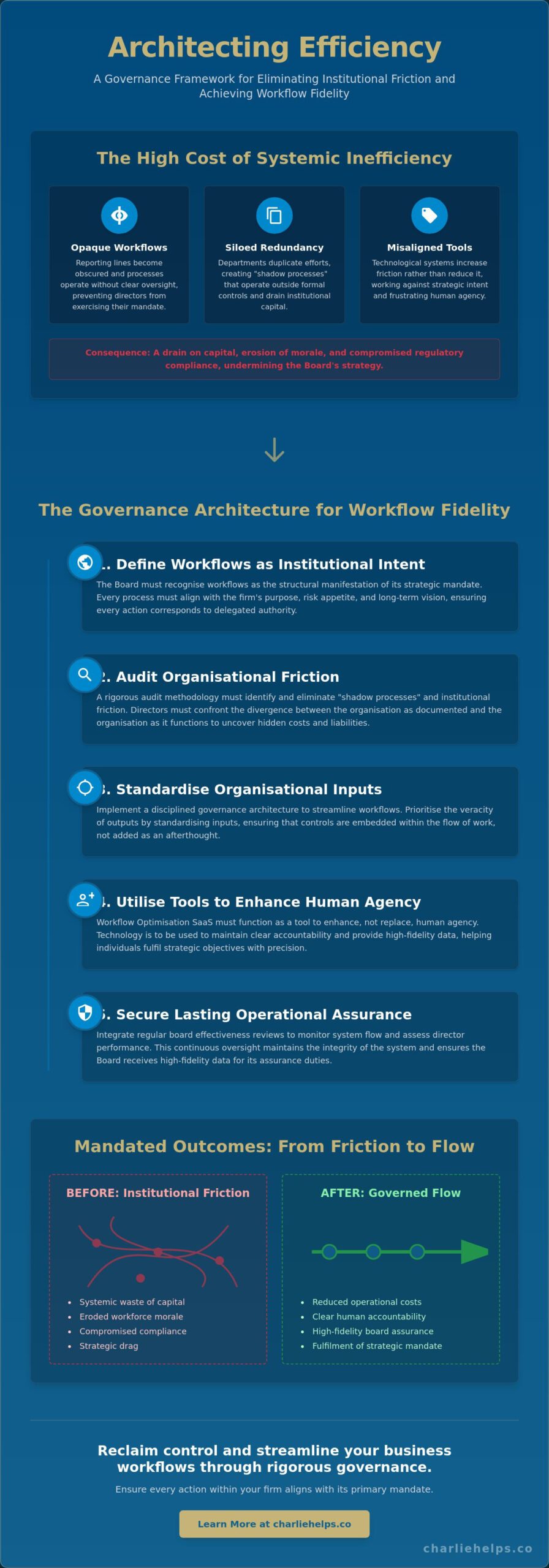
- Recognise business workflows as the structural manifestation of institutional intent, ensuring every process aligns with the Board’s strategic mandate, risk appetite, and long-term vision.
- Identify and eliminate “shadow processes” and institutional friction through a rigorous audit methodology tailored for the United Kingdom corporate context.
- Implement a disciplined governance architecture to streamline business workflows, prioritising the veracity of outputs through the standardisation of organisational inputs.
- Utilise Workflow Optimisation SaaS as a tool to enhance human agency, maintain clear accountability, and fulfil strategic objectives.
- Secure lasting operational assurance by integrating regular board effectiveness reviews to monitor system flow, assess director performance, and maintain high-fidelity data for oversight.
The Strategic Necessity of Workflow Refinement
Business workflows are the structural manifestation of institutional intent. They represent the precise pathways through which a Board’s strategy moves from abstract concept to operational reality. When directors fail to oversee these pathways, the firm develops a form of organisational sclerosis that prevents it from fulfilling its primary mandate. To streamline business workflows is therefore not a mere administrative task; it’s a fundamental exercise in corporate governance. It ensures that every action taken by an employee corresponds directly to the authority delegated by the Board, committees, and senior leadership.
Process clarity provides the foundation for board-level assurance. Directors cannot attest to the veracity of financial reports or the effectiveness of risk controls if the underlying systems are opaque or contradictory. By adopting the principles of Business Process Management, leaders can establish a clear line of sight from the boardroom to the shop floor. This visibility allows oversight bodies to identify where agency is being exercised and where it is being stifled by bureaucratic inertia. Administrative friction in modern UK organisations represents a significant, though often unquantified, loss of institutional capital and intellectual energy.
Governance as the Catalyst for Flow
Flow begins with a clear mandate. When Boards articulate precise objectives, they remove the ambiguity that often leads to hesitation and duplication in lower-level tasks. Accountability frameworks function as the scaffolding for operational speed; they define who holds the authority to move a process forward and who is responsible for its fidelity. Without this structural discipline, attempts to streamline business workflows will inevitably fail, as technology cannot fix a fundamental lack of human accountability. Rigorous process design is a prerequisite for effective risk management, ensuring that controls are embedded within the flow of work rather than added as an afterthought.
The High Stakes of Institutional Friction
Institutional friction does more than slow down operations; it erodes the professional capability and morale of the workforce. Redundant processes and “shadow systems” signal to employees that their time is of little value, which eventually leads to a culture of apathy. Additionally, opaque workflows compromise regulatory compliance by making it impossible to trace the provenance of data or the logic of decisions. The cumulative force of minor inefficiencies often results in a substantial drag on annual performance, as small delays in individual tasks compound across the entire organisation. Directors must recognise that inefficiency is a failure of oversight that requires a grounded, human-centric intervention to rectify.
Auditing Organisational Friction and Redundancy
Formal audit within a UK corporate context requires more than a cursory glance at standard operating procedures. Directors must investigate the “shadow processes” that inevitably emerge when formal systems fail to meet operational needs. These unofficial workarounds operate outside formal controls, creating significant risk and obscuring the Board’s view of actual performance. To effectively streamline business workflows, a Board must first confront the divergence between the organisation as documented and the organisation as it functions. This discrepancy often conceals hidden costs and liability that standard reporting fails to capture. A rigorous audit uncovers the friction that prevents a firm from realising its full potential.
Distinguishing between necessary complexity and artificial complication is a critical skill for any director. High-stakes industries often require complex workflows to manage regulatory risk and ensure the fidelity of outputs. However, complication arises when layers of approval, redundant checks, and conflicting reporting lines are added without a clear strategic purpose. By utilising established process improvement methodologies, committees can strip away these non-value-adding layers whilst preserving the essential rigour required for compliance. Friction is expensive. Complexity is not a virtue.
Mapping the Invisible Organisation
Mapping the actual path of information often reveals that decision-making authority has become diluted across several disparate groups. This fragmentation occurs when the theoretical process fails to account for human behaviour or technical limitations. Leaders should compare the formal process map against the lived experience of the workforce to identify these gaps. This analysis provides the foundation for the Operational Friction Reduction framework, which helps Boards re-align structural intent with daily activity. When the invisible organisation operates at odds with the formal one, risk increases exponentially.
Identifying Agency Failures
Agency failures occur at points where no specific individual or committee holds clear accountability for an outcome. When teams face contradictory process requirements, they often default to the path of least resistance, which may not align with the Board’s risk appetite. This erosion of institutional memory leads to the repetition of past errors and a slow decline in operational veracity. Without a disciplined system to preserve and act upon historical data, the firm remains trapped in a cycle of reactive problem-solving. If your Board requires assistance in identifying these systemic weaknesses, our advisory services can provide the necessary external perspective to restore control.
Architecting a Framework for Process Fidelity
Ad-hoc task management is the enemy of institutional scale. When individuals operate without a unified structure, the firm relies on heroics rather than systems, which creates a fragile and unpredictable environment. To streamline business workflows, directors must transition from reactive problem-solving to a disciplined governance architecture. This shift ensures that every operational activity is a deliberate expression of the Board’s mandate. Architecture provides the boundaries within which agency can be exercised safely and effectively.
Standardising inputs is the only way to ensure the veracity of outputs. If data enters a system in a chaotic or inconsistent manner, the resulting reports will lack the fidelity required for board-level assurance. Directors should insist on rigorous protocols for data entry and process initiation, treating information as a primary asset that requires strict custodial controls. High-fidelity data allows for precise decision-making and reduces the need for constant manual verification, which in turn lowers the cumulative risk of the organisation.
Better design reduces the cognitive load on senior management. When systems function with inherent logic and clear accountability, executives are freed from the minutiae of process policing and can focus on strategic foresight. Well-architected frameworks incorporate feedback loops that permit continuous refinement at the operational level. These loops allow teams to adjust to minor environmental changes without requiring direct board intervention, provided the outcomes remain within established risk appetites. This autonomy, governed by clear parameters, fosters a culture of excellence and professional pride.
The Three Pillars of Workflow Fidelity
Structural fidelity rests upon three essential pillars: authority, transparency, and simplicity. Every step in a process must have a designated owner who holds the authority to act and the accountability for the result. Transparency ensures that the status of any workflow remains visible to relevant stakeholders, preventing the formation of informational silos. Finally, simplicity demands the removal of every step that does not add verifiable value. To streamline business workflows effectively, committees must ruthlessly prune administrative overgrowth that serves no strategic or regulatory purpose.
Designing for Regulatory Compliance
Compliance is most effective when it’s invisible. By integrating compliance checkpoints into the natural flow of work, organisations ensure that regulatory requirements are fulfilled as a matter of course rather than as an external burden. Automating the collection of evidence for audit trails, and board reports, ensures that the Board can provide assurance with absolute confidence in the underlying data. Boards should consult with corporate governance consultants UK to ensure their architecture aligns with current legal mandates and evolving regulatory expectations. This alignment provides a defensive shield against litigation, and reputational damage.
Integrating Digital Tools with Human Agency
Technology often promises a reprieve from administrative burden, yet it frequently introduces a new layer of complexity. Workflow Optimisation SaaS provides the mechanical leverage required to scale a Board’s intent across a global enterprise. However, digitising a flawed process merely creates “automated chaos” at a higher velocity. To streamline business workflows, directors must first ensure that the underlying logic is sound, as software cannot compensate for a fundamental lack of systemic discipline. Technology must serve human agency; it should never be permitted to replace the moral judgement and accountability of a designated leader.
Sophisticated digital tools should prioritise the preservation of institutional memory. When a firm relies on fragmented communication channels, the rationale behind critical decisions often evaporates, leaving the Board without a clear audit trail. By implementing systems that capture the context of every action, leaders ensure that the veracity of organisational data remains intact. This focus on high-fidelity reporting allows committees to provide assurance based on evidenced movement rather than mere intention. If your current systems increase rather than reduce complexity, you may wish to request a consultation on Governance Architecture to realign your digital strategy.
Selecting Sophisticated SaaS Solutions
Boards must evaluate software based on its ability to enforce accountability and controls. Directors should favour platforms that offer integrated governance frameworks rather than isolated, task-based tools. These platforms must demonstrate high interoperability with existing legacy systems to prevent the creation of new informational silos. A tool that cannot communicate with the rest of the organisation is a liability, not an asset. According to 2026 market data, 83% of IT leaders now view workflow automation as essential for digital transformation, yet its success depends entirely on the rigour of the underlying architecture. For organisations seeking to deploy automated workflow solutions UK boards can trust, the governance-first approach ensures that technical implementation aligns with institutional accountability. For organisations looking to integrate sophisticated enterprise platforms, you can find out more about achieving technical excellence through structural discipline.
The Human Element in Digital Transformation
Digital transformation is fundamentally a human endeavour. Organisations must implement training programmes that focus on professional capability, ethics, and the responsible exercise of agency within automated systems. As the EU AI Act reaches full applicability on 2 August 2026, Boards must ensure that AI governance is embedded into every automated workflow to manage regulatory risk. Directors should monitor the behaviour of senior leaders to ensure they utilise the data provided by these tools to inform their judgements. Technology achieves nothing without the active participation and oversight of human leaders who understand the high stakes of their mandate.
Achieving Lasting Operational Assurance
Operational assurance represents the definitive state in which the Board maintains absolute confidence that organisational systems function as intended. It is the culmination of structural discipline and rigorous oversight. Directors must ensure that attempts to streamline business workflows do not merely move paper faster but actually enhance the veracity of every output. Without this assurance, the organisation remains vulnerable to systemic blind spots and agency failures. Assurance requires evidenced movement rather than mere intention.
Regular board effectiveness reviews provide the necessary mechanism to maintain this alignment over time. These evaluations allow the Board to scrutinise the relationship between governance architecture and operational reality. If the flow of information remains sluggish or contradictory, the review provides the mandate for further intervention. Assurance is not a project with a completion date; it is a persistent requirement of responsible leadership that values integrity and purpose.
Measuring What Matters
Metrics for success must move beyond the superficial pursuit of time-saving to focus on the quality of oversight. Leaders should track the reduction in “emergency response” incidents, as better planning and clearer workflows should pre-empt most operational crises. The accuracy and timeliness of management information reaching the board serve as the primary indicators of system health. Additionally, committees must evaluate the speed with which the organisation can implement changes in response to external regulatory shifts, such as the obligations of the EU AI Act which become fully applicable on 2 August 2026. High-fidelity data is the only credible basis for board-level assurance.
The Role of Leadership Coaching
Sustained operational flow depends entirely on the professional capability and ethical clarity of the executive team. Leadership coaching and mentoring provide the necessary support for directors to navigate the cultural shifts inherent in structural refinement. When a firm decides to streamline business workflows, it often challenges established power dynamics and legacy behaviours. Advisory services help leaders manage these transitions without losing strategic momentum. Those seeking to realise their mandate through superior governance should contact Charlie Helps Associates for tailored advisory support.
Continuous development remains the only safeguard against institutional decay. Architecture requires architects who are both deep thinkers and practical problem-solvers. The ultimate implication is clear: the Board must prioritise the human element behind the system to realise lasting excellence. How will your leadership team evolve to meet the demands of a $26.01 billion global automation market whilst maintaining the highest standards of accountability?
Restoring the Authority of Flow
Efficiency is the final expression of a Board that understands its mandate. By removing institutional friction and standardising organisational inputs, directors ensure that every action within the firm serves a strategic purpose. You’ve seen how a disciplined governance architecture allows leaders to streamline business workflows whilst maintaining the high-fidelity data required for board-level assurance. This alignment is not merely about cost reduction; it’s about restoring human agency and professional pride within a complex corporate environment.
Achieving this level of operational flow requires a partner who understands the intersection of human behaviour and structural systems. Expert Corporate Governance Consultants provide UK national coverage, proprietary Workflow Optimisation SaaS for executive oversight, and specialised advisory for AI Governance and Boardroom AI. This expertise provides the steady hand needed to navigate global trends and realise institutional excellence. Contact Charlie Helps Associates to fulfil your strategic mandate and ensure your organisation operates with absolute clarity. The path toward excellence remains open to those willing to lead with purpose.
Frequently Asked Questions
How does streamlining workflows improve board-level governance?
Streamlining workflows improves board-level governance by providing directors with a clear line of sight into operational activity and the veracity of reported data. When a Board removes institutional friction, it ensures that every action taken by employees aligns with the established mandate and risk appetite. This structural clarity allows committees to provide assurance based on evidenced movement rather than mere intention, ensuring that accountability remains fixed at every process step.
What are the primary signs of operational friction in a UK organisation?
Primary signs of operational friction include opaque reporting lines, duplication of effort across silos, and the emergence of shadow processes that bypass formal controls. In a UK corporate context, these inefficiencies often manifest as high staff turnover and a reliance on emergency response measures to fulfil basic obligations. When directors observe that technological tools increase rather than reduce complexity, they are witnessing systemic friction that undermines the Board’s capacity for effective oversight.
Can business process automation reduce the veracity of financial reporting?
Automation can reduce the veracity of financial reporting if the Board digitises flawed logic or fails to implement rigorous custodial controls. Automated systems move data at high velocity; therefore, any initial error compounds rapidly across the organisation. To streamline business workflows without compromising accuracy, directors must insist on the standardisation of inputs and the integration of compliance checkpoints that preserve institutional memory and prevent the creation of automated chaos.
How should a Board oversee the implementation of new workflow software?
A Board should oversee software implementation by ensuring that the technology serves human agency rather than replacing it. Directors must evaluate new platforms based on their ability to enforce accountability and maintain interoperability with legacy systems. Oversight requires the Board to monitor the behaviour of senior leaders during the transition, ensuring that the executive team remains responsible for the fidelity of the system’s outputs and the preservation of ethical standards.
What is the relationship between institutional memory and process optimisation?
Institutional memory provides the evidentiary base required for effective process optimisation. When a firm captures the rationale behind past decisions and the outcomes of previous workflows, it avoids the repetition of historical errors. Optimisation relies on high-fidelity data to identify which steps add verifiable value. Without a disciplined system to preserve this knowledge, the Board cannot realise lasting operational assurance or fulfil its strategic mandate over the long term.
How can senior management ensure that streamlining does not compromise corporate ethics?
Senior management ensures ethical integrity by embedding AI governance and moral checkpoints into every redesigned pathway. Streamlining must never prioritise speed over the Board’s duty of care or regulatory compliance. Leaders must cultivate a culture where employees feel authorised to challenge processes that appear to circumvent established ethics. Accountability frameworks should clearly designate who holds the moral responsibility for the outcomes of automated and manual workflows alike.
Should workflow optimisation be managed by IT or a dedicated governance committee?
A dedicated governance committee should lead workflow optimisation to ensure that structural changes align with the Board’s strategic intent. Whilst IT provides the technical means to streamline business workflows, the Board holds the ultimate responsibility for the resulting organisational architecture. A governance-led approach ensures that process refinement prioritises accountability, risk management, and the veracity of information rather than merely the implementation of new digital tools.
How often should an organisation conduct a rigorous audit of its business workflows?
Organisations should conduct a rigorous audit of business workflows annually or whenever significant regulatory changes occur. Regular audits allow directors to identify new shadow processes and evaluate whether current systems still fulfil the Board’s mandate. These reviews should function as part of a broader board effectiveness review, ensuring that the organisation’s structural pathways remain lucid, elegant, and capable of achieving superior operational flow.
Disclaimer
The articles published on CharlieHelps.co are provided for general information, reflection, and commentary. They draw on professional experience, research, and interpretation, but they do not constitute legal, regulatory, financial, clinical, governance, risk, compliance, assurance, or other professional advice. Nothing published on this site should be relied upon as practice guidance, formal instruction, or a substitute for proper professional consultation. Readers should seek advice from suitably qualified advisers before acting on, applying, or relying upon any material in relation to their own organisation, Board, duties, circumstances, or decisions. Although reasonable care is taken to ensure that articles are accurate and current at the time of publication, no warranty is given as to completeness, accuracy, timeliness, or fitness for any particular purpose. Law, regulation, policy, standards, and recognised practice may change, and context matters. References to external sources, organisations, products, services, or third-party materials are included for information only. They do not imply endorsement unless expressly stated. Where an article contains affiliate links, sponsored references, or commercial relationships, these will be disclosed where relevant. The views expressed are those of the author unless otherwise stated. Reading, sharing, or responding to material on this site does not create a client, adviser, fiduciary, or professional relationship with Charlie Helps FRSA, CharlieHelps.co, or any associated entity. Readers remain responsible for their own judgement, decisions, and actions.
