

Most corporate advisory models fail because they treat legal, financial, and operational structures as isolated silos rather than a singular, living organism. You likely recognise the frustration of a Board-level strategy that dissipates before it reaches the floor, leaving directors to wonder why clear mandates result in operational friction. This disconnect is not a failure of intent, but a failure of architecture.
By examining the evolving landscape of corporate advisory services UK, this article offers a rigorous analysis of how leadership teams bridge the gap between strategic governance and tangible efficiency. We explore the integration of structural governance, digital workflow optimisation, and executive mentoring to ensure that every decision finds its mark. From the implementation of Provision 29 to the nuances of AI governance, you will find a blueprint for realising institutional excellence in 2026. This examination identifies who holds authority, which decisions require immediate attention, and how Boards can foster a culture of sustained accountability.
Key Takeaways
- Identify how the Companies Act 2006 and the UK Corporate Governance Code shape the modern mandate for directors and committees.
- Distinguish between transactional consultancy and governance architecture to ensure Boards maintain accountability during periods of rapid institutional growth.
- Evaluate the landscape of corporate advisory services UK to select a partner whose methodology aligns with your specific Board dynamics and decision-making requirements.
- Recognise the role of digital tools and workflow optimisations in bridging the gap between high-level strategic oversight and operational execution.
- Implement a rigorous selection process for advisors based on evidenced movement and shared institutional values rather than mere statements of intent.
Defining the Scope of Corporate Advisory Services in the UK
Corporate advisory represents the intellectual scaffolding that supports Boards as they navigate the rigorous requirements of the UK Corporate Governance Framework. It is not a collection of tactical interventions. Instead, effective corporate advisory services UK provide the clarity required for directors to fulfil their fiduciary duties under the Companies Act 2006. These services do not function as isolated events or “deal-centric” consultancies; they operate as a continuous cycle of assurance and refinement. Directors utilise these partnerships to manage systemic risk, protect institutional memory, and verify that their mandates are being executed with precision. In 2026, where Provision 29 demands explicit declarations regarding the effectiveness of internal controls, the scope of advisory has expanded to include deep operational oversight.
The Distinction between Management Consultancy and Corporate Advisory
Management consultancy typically addresses specific, time-bound projects. It seeks to solve a defined problem within a department, a product line, or a technical workflow. Corporate advisory focuses on the enduring health of the entire institution. Advisors provide the conceptual framework that allows directors to build long-term strategic decisions. This distinction is vital for UK organisations that prioritise ethical standards and institutional integrity over short-term gains. Advisory work creates a steady hand, ensuring that the Board’s authority remains clear even when external pressures mount. It’s the difference between fixing a broken tool and architecting a resilient workshop.
Identifying the Primary Agents of Governance
Governance is not an abstract force. It does not act, decide, or constrain. Instead, Boards of directors hold the ultimate authority for an organisation’s direction and behaviour. Executive committees then implement the strategies the Board has approved. Advisory services must speak directly to these actors. When an advisor treats “governance” as an agent, they obscure the reality of accountability. A Board requires precise language and evidence-based judgment to exercise its mandate. This focus on the human element behind the structural system ensures that leadership remains both humane and rigorous. Advisors must assist these specific entities in making decisions that are legally sound, financially viable, and operationally realistic.
Defining advisory as a structural necessity rather than a discretionary expense ensures that leadership remains resilient. The goal is not merely to comply with regulation, but to realise institutional excellence through superior decision-making. This requires a commitment to clarity, a rejection of “consultancy theatre”, and a focus on the specific actors who hold the mandate for change.
Distinguishing Governance Architecture from Transactional Consultancy
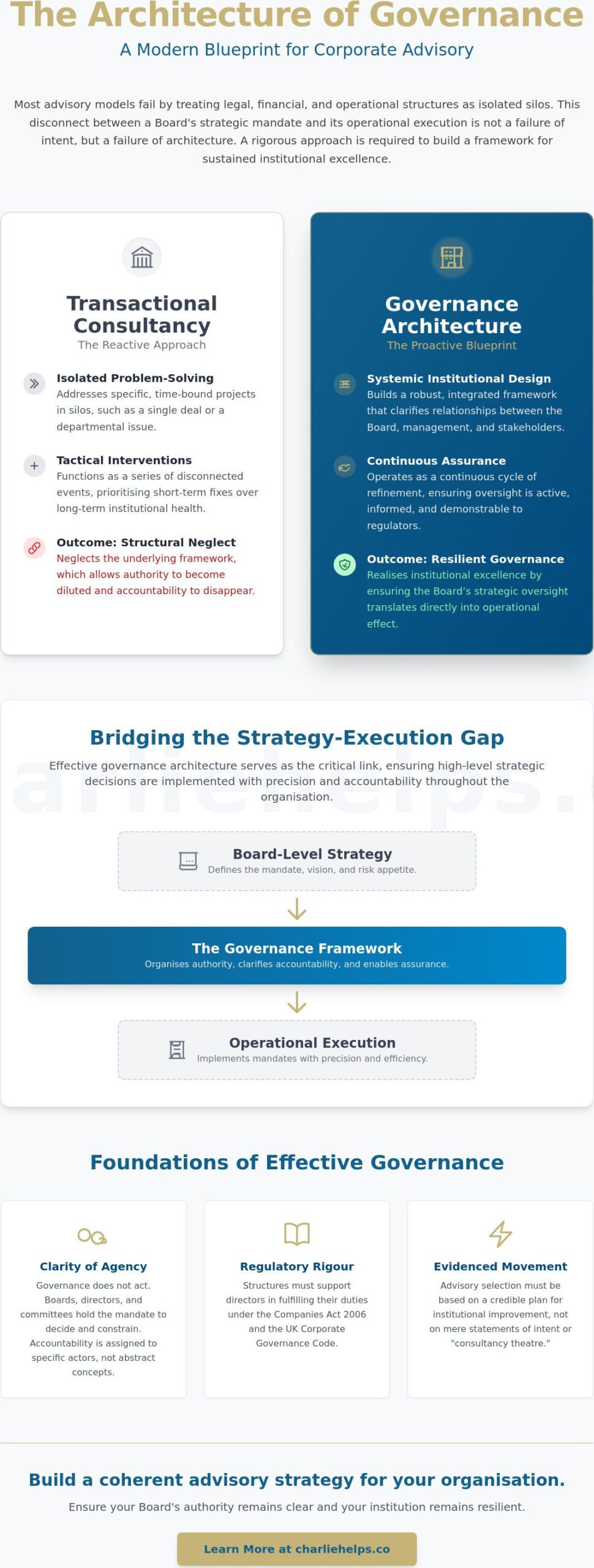
Transactional consultancy prioritises the immediate deal, often neglecting the structural integrity required to sustain that deal once the ink dries. Governance architecture, by contrast, focuses on the system. It builds a robust framework that ensures Boards remain accountable during periods of rapid expansion, market volatility, or unforeseen crisis. This architectural approach to corporate advisory services UK allows directors to move beyond reactive problem-solving toward proactive institutional design. Charlie Helps Associates prioritises the creation of integrated governance frameworks over mere transaction support, recognising that long-term value requires a clear understanding of the specific mandate given to each committee and executive. Without this clarity, authority becomes diluted and accountability disappears.
The Role of Integrated Governance Frameworks
A framework organises the relationships between stakeholders, the Board, and management with surgical precision. It’s the map that defines who decides, who acts, and who observes. UK regulators increasingly look for evidence of “lived” governance rather than static, paper-based compliance. This shift requires Boards to demonstrate that their oversight is active, informed, and continuous. Effective frameworks enable directors to provide meaningful assurance to shareholders, employees, and the public, creating a culture of transparency that survives leadership transitions. To explore how these structures can be tailored to your organisation, you may discuss your framework requirements with our senior advisors.
AI Governance: The New Frontier for UK Boards
Directors must now oversee the ethical and operational risks associated with artificial intelligence, particularly following the Data Protection Act 2018 (Code of Practice on Artificial Intelligence and Automated Decision-Making) Regulations 2026 (SI 2026/425). These regulations, which came into force on 12 May 2026, require the Information Commissioner’s Office to establish a statutory code of practice for automated systems. Advisory services help Boards integrate AI oversight into existing risk management structures without disrupting the core business model. Success requires a delicate balance between technological adoption and human-centric ethics, ensuring that algorithms do not override human judgment or institutional values. Boards must verify the reliability of their AI tools to maintain their mandate for responsible oversight.
Realising institutional excellence depends on these underlying systems. Transactional advice might solve a today’s liquidity issue, but only governance architecture protects the organisation from tomorrow’s systemic failure. Boards must decide whether they seek a temporary fix or a permanent structure for excellence. The choice between a deal-centric view and a system-centric view defines the future of the institution.
Evaluating Advisory Models for Boardroom Effectiveness
Choice defines the Board’s trajectory. When selecting partners to refine their oversight, directors must decide between the expansive, multi-disciplinary resources of global firms and the nuanced, high-touch expertise of specialist boutiques. This decision determines the quality of the intellectual scaffolding available to the institution. Effectiveness is not an abstract concept; it is measured by the absolute clarity of the resulting advice and the subsequent improvement in boardroom dynamics. For many organisations, a professional board effectiveness review acts as the essential catalyst, providing the evidence required to justify specific advisory engagements. When selecting corporate advisory services UK, directors must ensure the chosen model aligns with the institution’s long-term purpose, ethics, and culture.
Financial vs. Governance-Led Advisory Models
Financial advisory models typically prioritise balance sheet strength, capital allocation, and fiscal resilience. Whilst these are necessary for survival, they often overlook the behavioural nuances that drive institutional success. Governance-led models focus instead on the integrity of the decision-making process, the clarity of mandates, and the professional behaviour of individuals. Most UK organisations realise the greatest value through a hybrid approach. This methodology respects fiscal mandates whilst ensuring that ethical standards remain the foundation of every strategic choice. It ensures that the pursuit of profit does not compromise the Board’s fiduciary accountability.
The Value of External Perspective in Boardroom Dynamics
External advisors offer a neutral lens that internal actors often lack. They identify the cognitive biases, skill gaps, and silent conflicts that can paralyse an executive committee or a Board. By providing an objective critique, these consultants help directors foster a culture of constructive challenge and mutual respect. The goal is to move beyond consensus for its own sake, encouraging a rigorous debate that leads to better-informed decisions. This external perspective ensures that institutional memory remains a tool for growth rather than a weight that prevents necessary change. It allows the Board to exercise its authority with a clear view of global trends and internal realities.
Ultimately, the advisory model must support the Board’s mandate and authority. It should provide the assurance directors need to lead with confidence and restraint. The right partnership does not just solve a temporary problem; it strengthens the very fabric of the institution for the years ahead. Directors must ask whether their current advisors provide the depth of insight required to fulfil their institutional promise.
Bridging the Gap between Strategic Oversight and Operational Workflow
Strategic intentions often fail when operational friction and poorly organised workflows obstruct the path from the boardroom to the floor. When directors issue a mandate, they rely on executive committees to translate that vision into reality; however, this translation often falters in the absence of rigorous systems. This disconnect creates a vacuum where accountability dissipates and strategic momentum stalls. Modern corporate advisory services UK must therefore extend their reach beyond high-level counsel to address the digital tools and processes that executives use to realise strategy. By reducing friction at the operational level, advisors free the Board to focus on high-level oversight and the long-term health of the institution.
Integrating SaaS Solutions into Governance Frameworks
Workflow optimisation software provides the empirical data required for accurate Board-level assurance. These digital tools should facilitate, rather than dictate, the professional judgement of management. When committees implement automated reporting, they reduce the administrative burden on executives, allowing for deeper reflection and more precise implementation of Board directives. This integration ensures that the Board’s authority is supported by real-time evidence of progress. In the context of Provision 29, which requires Boards to declare the effectiveness of material internal controls for accounting periods beginning on or after 1 January 2026, such digital scaffolding is a fundamental requirement for institutional integrity.
Leadership Coaching and Mentoring as an Advisory Component
Systems only function effectively when the humans within them possess the requisite capability and moral seriousness. Executive coaching assists leaders in navigating the complexities of the UK regulatory landscape, including the recent shifts in AI oversight and internal control declarations. Mentoring programmes preserve institutional memory whilst encouraging the fresh thinking necessary for growth. These human-centric interventions ensure that directors and executives possess the practical judgment required to fulfil their mandates. A Board that invests in the leadership capability of its executive team creates a more resilient institution, capable of sustaining excellence through periods of significant change.
Realising the full potential of a Board’s vision requires a seamless link between oversight and action. Without this connection, even the most sophisticated strategy remains a mere statement of intent. If you wish to bridge the gap between your strategic vision and operational reality, you may consult our experts on governance architecture and workflow optimisation. This collaborative approach ensures that your organisation moves with purpose, backed by a credible plan for evidenced movement.
Implementing a Coherent Advisory Strategy for UK Organisations
Rigour is the antidote to institutional drift. Boards must approach advisory with the same intellectual discipline they apply to significant capital expenditure. A coherent strategy begins not with a search for a partner, but with a precise definition of the specific decision or outcome required. Too often, organisations procure corporate advisory services UK to provide a veneer of activity rather than a robust mechanism for change. This “consultancy theatre” offers the comfort of intention whilst neglecting the necessity of action. To avoid this, directors must ensure that every engagement is evidence-based and rooted in the institution’s core values. A successful partnership results in a measurable improvement in organisational performance and a heightened sensitivity to risk oversight.
Architecting the Engagement for Long-Term Success
Clear lines of authority and accountability must be established before the advisory project commences. The engagement should not exist in a vacuum; instead, it must integrate with the work of existing professional corporate governance consultants to ensure a unified approach to institutional health. Directors must also demand a credible plan for the transfer of knowledge. The advisor’s value lies not in their permanent presence, but in their ability to equip the internal team with the capability to fulfil their mandates independently. This ensures that institutional memory is strengthened rather than outsourced, allowing the organisation to maintain its trajectory long after the formal engagement concludes.
The Final Test: Authority, Evidence, and Remaining Risk
Every advisory intervention must eventually withstand the scrutiny of practical application. Boards should conclude every engagement by identifying who has the specific authority to act on the provided advice. They must determine what evidence supports their reliance on the advisor’s findings and identify which assumptions remain untested. Finally, directors must identify which risks persist after the intervention and how committees will monitor them. This methodical approach ensures that advisory work leads to evidenced movement through a credible plan. To discuss your organisation’s specific requirements and how to achieve these standards, please contact us for a confidential consultation.
The pursuit of excellence is a continuous discipline. It requires a rejection of vague promises in favour of structural rigour and human capability. Boards that master this integration do more than survive; they architect a legacy of institutional resilience that serves shareholders and the public alike. The question remains: does your current advisory strategy provide the assurance required to lead with absolute confidence?
Securing the Mandate for Institutional Excellence
Leadership teams face a definitive choice: they can settle for transactional advice that addresses immediate crises, or they can architect a system for enduring performance. The integration of governance architecture with operational reality ensures that strategic intentions find their mark rather than dissipating in the vacuum of execution. Boards that prioritise this alignment achieve a measurable reduction in friction, a significant increase in institutional clarity, and a more resilient path toward their objectives.
Specialists at Charlie Helps Associates utilise Integrated Governance Frameworks, a proprietary Workflow Optimisation SaaS Solution, and expert Board-level mentoring to provide the scaffolding required for success. You can Request a Strategic Consultation with Charlie Helps Associates to begin the process of refining your leadership structures. Selecting the right corporate advisory services UK is the first step toward a more accountable future. Your commitment to these standards today defines the legacy of your leadership tomorrow.
Frequently Asked Questions
What are the core components of corporate advisory services in the UK?
Core components include governance architecture, strategic risk oversight, and the refinement of institutional memory. These services ensure that directors possess the intellectual scaffolding required to fulfil their fiduciary duties under the Companies Act 2006, the UK Corporate Governance Code, and relevant sector regulations. Professional advisors focus on the clarity of mandates, the integrity of decision-making processes, and the alignment of executive action with Board-level strategy.
How do corporate advisory services differ from traditional management consultancy?
Management consultancy typically addresses specific, time-bound projects or departmental issues. In contrast, corporate advisory services UK focus on the enduring health and structural integrity of the entire institution. Advisors prioritise the long-term decision-making system and the Board’s authority, ensuring that the organisation remains resilient during periods of rapid growth or significant market volatility.
Is it necessary for a UK Board to engage external governance consultants?
While not every organisation is legally mandated to use external consultants, most premium-listed Boards require them to provide the neutral lens necessary for high-level assurance. External advisors identify cognitive biases and skill gaps that internal actors might overlook. This objective critique helps directors foster a culture of constructive challenge, ensuring that the Board’s mandate is exercised with absolute clarity and restraint.
Can corporate advisory services help with regulatory compliance and assurance?
Advisors provide the specialised expertise required to navigate complex regulatory shifts, such as the 2026 requirements for internal control declarations under Provision 29. They help committees establish the evidence-based frameworks needed to fulfil their reporting obligations. This process ensures that the Board can rely on the data provided by management, reducing the risk of non-compliance or reputational damage.
How does workflow optimisation software fit into a corporate advisory framework?
Software functions as the digital link between boardroom strategy and floor-level execution. It provides the empirical data required for the Board to monitor progress and maintain accountability in real-time. By reducing operational friction, these tools allow executives to implement Board directives more efficiently, ensuring that strategic intentions are realised through evidenced movement rather than mere statements of intent.
What should a Chairperson look for when selecting a corporate advisory partner?
A Chairperson should seek a partner who values intellectual rigour over “consultancy theatre” and offers a methodology rooted in practical judgment. The ideal advisor understands the human element behind the data and demonstrates a deep commitment to the institution’s long-term purpose. They must provide clear, actionable advice that strengthens the Board’s authority and improves institutional performance.
How often should a Board review its corporate advisory requirements?
Boards should conduct a formal review of their advisory needs annually, or immediately following significant regulatory changes such as the Data Protection Act 2018 (Code of Practice on AI) Regulations 2026. Regular reviews ensure that the advisory model remains aligned with current institutional risks and strategic goals. This discipline prevents the organisation from relying on outdated frameworks that no longer serve the Board’s mandate.
What is the relationship between executive coaching and corporate advisory?
Executive coaching ensures that the individuals within the system possess the capability to operate the governance architecture effectively. Whilst advisory provides the structural framework, coaching and mentoring provide the human capability to navigate that structure. This combination ensures that leaders possess the practical judgment and moral seriousness required to achieve the Board’s strategic objectives.
Disclaimer
The articles published on CharlieHelps.co are provided for general information, reflection, and commentary. They draw on professional experience, research, and interpretation, but they do not constitute legal, regulatory, financial, clinical, governance, risk, compliance, assurance, or other professional advice.Nothing published on this site should be relied upon as practice guidance, formal instruction, or a substitute for proper professional consultation. Readers should seek advice from suitably qualified advisers before acting on, applying, or relying upon any material in relation to their own organisation, Board, duties, circumstances, or decisions.Although reasonable care is taken to ensure that articles are accurate and current at the time of publication, no warranty is given as to completeness, accuracy, timeliness, or fitness for any particular purpose. Law, regulation, policy, standards, and recognised practice may change, and context matters.References to external sources, organisations, products, services, or third-party materials are included for information only. They do not imply endorsement unless expressly stated. Where an article contains affiliate links, sponsored references, or commercial relationships, these will be disclosed where relevant.The views expressed are those of the author unless otherwise stated. Reading, sharing, or responding to material on this site does not create a client, adviser, fiduciary, or professional relationship with Charlie Helps FRSA, CharlieHelps.co, or any associated entity.Readers remain responsible for their own judgement, decisions, and actions.
