

Data is not oversight. Directors often operate under the illusion that a high volume of reporting equates to rigorous governance, yet this misconception leaves the Board submerged in fragmented data that obscures the path to strategic fulfilment. You likely recognise the exhaustion of navigating overlapping compliance requirements whilst sensing a growing rift between your strategic intentions and the operational reality of the business. By adopting integrated governance frameworks, directors can bridge this gap; they move beyond reactive compliance towards a proactive architecture of institutional memory and clear mandate.
Synthesising board oversight, executive accountability, and institutional memory into a cohesive framework secures long-term organisational value. The following analysis examines the mechanisms required to clarify decision-making pathways, reduce operational friction, and provide robust assurance for stakeholders and regulators alike. Through the disciplined alignment of authority and evidence, your Board can realise a state of calm expertise in an increasingly complex environment.
Key Takeaways
- Boards must transcend fragmented reporting by adopting integrated governance frameworks that unify risk, audit, and strategy into a single, coherent line of sight.
- Directors should construct a resilient oversight architecture based on the five pillars of authority, mandate, assurance, accountability, and institutional memory.
- Distinguish between mere compliance and rigorous assurance to ensure the Board relies on evidence rather than “consultancy theatre” for strategic decision-making.
- Utilise workflow optimisation tools to automate the collection of assurance data and safeguard institutional memory through periods of executive succession.
- Transition from reactive oversight to a proactive framework that allows the Board to fulfil the organisation’s strategic purpose with integrity and precision.
The Erosion of Strategic Oversight in Fragmented Systems
Structural fragmentation acts as a corrosive force within the boardroom. When risk, audit, and strategy functions operate in isolation, the Board loses its capacity for holistic oversight. An integrated governance framework serves as a unified system through which directors exercise their authority via clear lines of accountability. These governance frameworks are not merely bureaucratic collections of rules; they are the essential architecture that ensures data is synthesised into meaningful assurance. Without this cohesion, fragmented data leads to a severe deficit in institutional memory, leaving the organisation vulnerable to repeating past errors.
Disconnects between intent and action often stem from a failure to align human behaviour with formal organisational structures. Systems alone cannot ensure integrity if the individuals within them lack a clear understanding of their mandate. Boards must recognise that integrated governance frameworks provide the necessary scaffolding for ethical conduct and strategic alignment. A global survey of risk leaders in 2025 revealed that only 7% of organisations have fully integrated their enterprise risk management into strategic decisions. This gap highlights a systemic failure to connect the Board’s vision with the operational reality of the business.
The Distinction Between Governance and Management
Directors must maintain a sharp focus on their specific mandate whilst allowing executives the space to fulfil operational requirements. Integrated frameworks establish the boundaries required to prevent “mission creep”, which is the tendency for Boards to overreach into management tasks. Precise definitions of responsibility are paramount. Directors must clearly delineate their focus on strategy, risk, and oversight, to ensure that the Board remains a governing body rather than an operational committee.
The Cost of Organisational Friction
Disconnected systems impose a heavy administrative burden on senior leadership. This organisational friction often results from poor workflow design and a lack of coherent process management. When executives spend excessive time reconciling overlapping compliance requirements, they have less capacity to implement strategic objectives. Directors must act to resolve these systemic inefficiencies rather than merely noting their existence during quarterly reviews. Effective oversight requires a commitment to reducing friction through structural cohesion and clear decision-making pathways.
Architecting the Pillars of an Integrated Governance Framework
Oversight is a deliberate construction. To secure long-term value, directors must move beyond the perfunctory reading of board packs towards a disciplined interrogation of assurance. A resilient oversight architecture rests upon five specific pillars: Authority, Mandate, Assurance, Accountability, and Institutional Memory. Whilst the Corporate Governance Code provides a necessary baseline for these structures, a framework remains a hollow vessel without the rigour of evidence-based reliance. Directors must ensure that every decision is supported by a clear line of sight from the boardroom to the operational front line.
Structural integrity within integrated governance frameworks requires a shift from passive compliance to active stewardship. This transition involves more than just updating policies; it necessitates a cultural commitment to transparency and intellectual honesty. When directors rely on ISO 37000 as a foundational benchmark, they establish a global standard for purpose-led governance that prioritises value generation and stakeholder engagement. This alignment ensures that the Board acts as a steady hand, guiding the organisation through complexity with a sense of calm expertise.
Authority and the Board Mandate
The Board establishes its mandate through precise terms of reference and clearly defined delegated authorities. These documents must not be static; directors must conduct periodic reviews to ensure the mandate reflects the current risk landscape and strategic priorities. By exercising their authority, directors effectively constrain excessive risk whilst simultaneously enabling the executive team to pursue strategic growth. If your Board requires a bespoke review of its current governance architecture, seeking external counsel can clarify these essential lines of authority.
Assurance and Accountability
Reporting is often a passive transfer of data, whereas assurance is an active validation of truth. Integrated frameworks ensure that accountability is realised through the provision of robust evidence. Executives must provide directors with the substance required for reliance, moving beyond “consultancy theatre” to present a clear-eyed view of performance and risk. This mechanism ensures that when the Board makes a decision, it does so with a full understanding of the evidence, the required actions, and the remaining risks. True accountability is not merely assigned; it’s implemented through a consistent cycle of review, challenge, and verification.
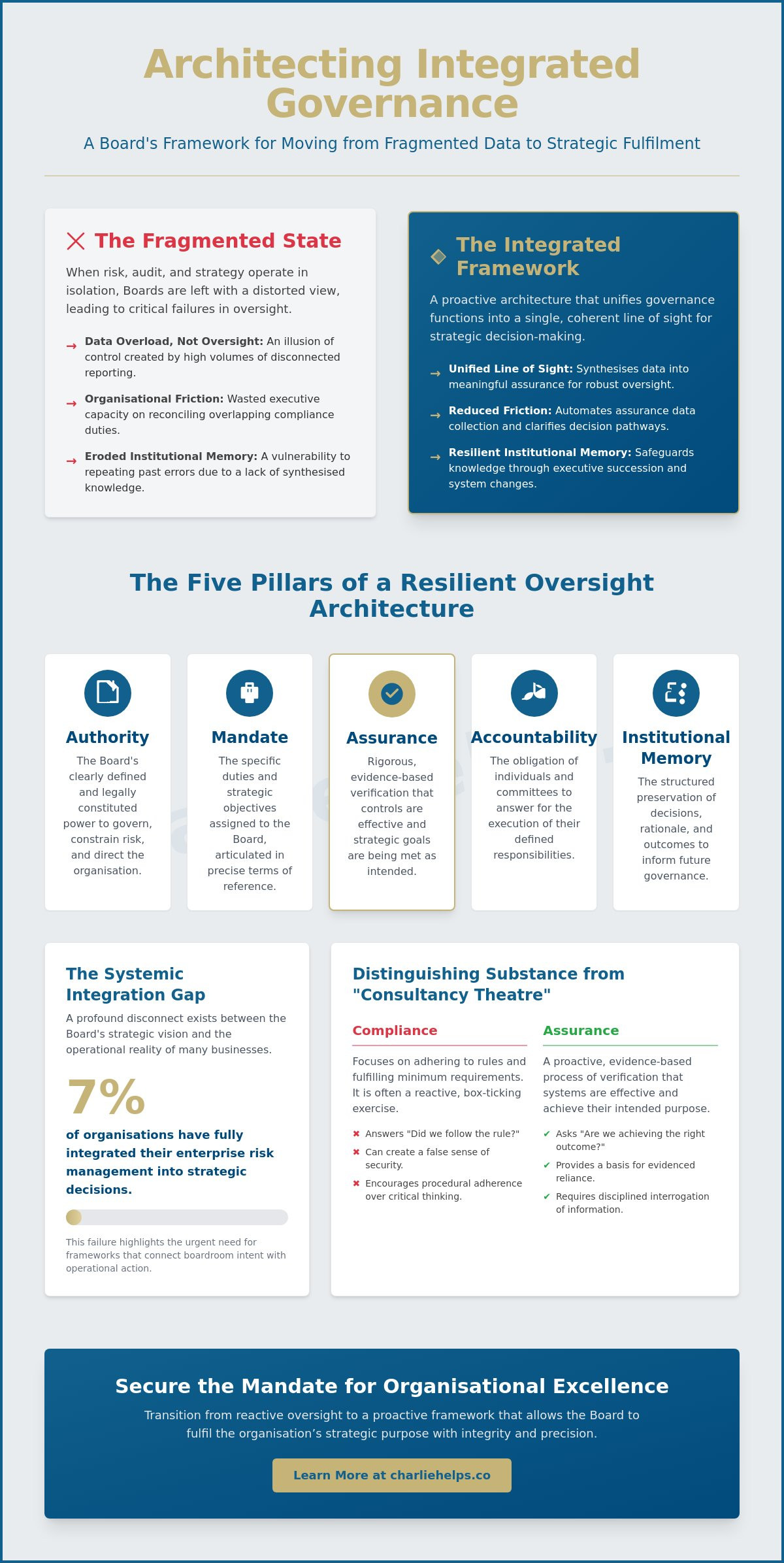
Distinguishing Substance from Consultancy Theatre: Assurance versus Compliance
Performance is not presentation. Too often, Boards find themselves spectators to “consultancy theatre”, a performative display of complex charts and jargon that prioritises aesthetic polish over structural rigour. This spectacle creates a dangerous veneer of control whilst leaving the actual mechanisms of the business unexamined. Directors must look past these superficialities to demand rigorous, evidence-based oversight that identifies specific risks, confirms the efficacy of controls, and validates the integrity of the data. Integrated governance frameworks provide the discipline required to dismantle this theatre, replacing it with a sober assessment of organisational reality.
Compliance represents a minimum threshold of legality, yet it is insufficient for securing long-term value. Whilst compliance asks if a rule was followed, integrated governance asks if the organisation is fulfilling its purpose with integrity. The focus must shift from static reporting to actionable intelligence, a principle emphasised in the COSO 2026 guidance, which advocates for risk management as a tool for strategic decision-making. By moving beyond a “tick-box” mentality, directors can achieve strategic resilience, ensuring the organisation is equipped to withstand shocks rather than merely surviving a regulatory audit.
Board reporting frequently suffers from the use of vague qualifiers and ungrounded futurism. These “weasel words” obscure the reality of operational performance, preventing directors from exercising sound professional judgment. Directors should reject reports that substitute data for slogans or promise success without a credible implementation plan. A Board’s authority is only as effective as the clarity of the information it receives; therefore, reports must be stripped of bombast and returned to a state of lucid, elegant precision.
The Limits of Traditional Compliance
A “tick-box” approach fails to protect institutional value during a crisis because it prioritises procedural adherence over substantive risk assessment. Integrated frameworks move the Board from reactive monitoring to proactive oversight, allowing directors to anticipate challenges before they materialise. This shift requires a culture of corporate accountability where executives understand that their duty transcends mere regulatory adherence. Only through this depth of commitment can a Board truly realise its mandate for organisational excellence.
Evidence-Based Reliance for Directors
For a director to place reliance on a report, they must receive sufficient evidence that is both timely and accurate. An integrated framework provides the necessary audit trail for board decisions, documenting exactly what was decided, what evidence supported the choice, and what risks remain. Boards should demand reporting that prioritises clarity over volume. This ensures that every page contributes to the Board’s understanding of its mandate, allowing for a more focused and effective use of limited boardroom time.
Implementing Structural Cohesion through Institutional Memory and Workflow
Reliance on manual reporting is a strategic vulnerability. When directors depend on fragmented spreadsheets and ad-hoc emails, the Board risks losing the thread of institutional memory during periods of leadership succession. Digital tools provide a stable repository for the wisdom acquired through previous board cycles, ensuring that new directors do not inherit a vacuum of information. By advocating for workflow optimisation software, Boards can automate the collection of assurance data, transforming integrated governance frameworks from static policy documents into dynamic, living systems of oversight.
Institutional memory acts as the conscience of the organisation. It prevents the repetition of past failures and ensures that strategic intent remains consistent even as individual executives move on. Digital process management solutions safeguard this memory by documenting the evidence, the rationale, and the specific risks associated with every major board decision. This structural cohesion allows directors to maintain a steady hand, grounded in a clear-eyed view of the organisation’s historical performance and its future obligations.
Digital Process Management as a Governance Tool
Automated workflow solutions do more than just increase speed; they reduce operational friction and improve the integrity of the data reaching the boardroom. Directors must oversee the implementation of these tools to ensure they align with the Board’s specific assurance requirements. When workflow efficiency is high, executives can focus on strategic fulfilment rather than administrative reconciliation. This alignment between digital process management and governance ensures that the Board receives a lucid, elegant, and accurate reflection of the organisational reality.
The Challenge of AI Governance
Directors must architect specific frameworks to manage the risks and opportunities of AI deployment within the enterprise. It is essential to recognise that AI is a tool for the Board to oversee, not an agent that makes decisions or exercises judgment. As of early 2026, 47% of Fortune 100 companies now cite AI in their director qualifications, reflecting a shift towards informed accountability. Navigating these emerging complexities often requires the expertise of professional corporate governance consultants who can integrate digital ethics into existing risk frameworks.
Implementing structural cohesion within a UK enterprise requires a methodical approach. Directors can follow this five-step plan to achieve a more resilient architecture:
- Define the Mandate: Audit existing lines of authority and delegated powers to ensure they are current and clear.
- Map Assurance Requirements: Identify the specific evidence the Board requires to place reliance on executive reporting.
- Select Workflow Tools: Implement software that automates data collection and preserves institutional memory.
- Embed AI Oversight: Integrate digital governance and AI risk protocols into the core risk management framework.
- Establish Review Cycles: Conduct regular assessments to ensure the framework remains relevant to the strategic purpose.
If your Board is ready to realise a more cohesive governance architecture, our advisory services can help you transition from fragmented oversight to a unified system of assurance.
Securing the Mandate for Organisational Excellence
Cohesion is a choice. The transition from fragmented oversight to a unified system represents a fundamental evolution in how leadership perceives its role. It’s a movement from the passive monitoring of departmental silos to the active stewardship of a coherent architecture. Directors must recognise that the ultimate goal of integrated governance frameworks is not merely the avoidance of regulatory failure; it’s the fulfilment of the organisation’s strategic purpose with absolute integrity. By aligning board authority with robust organisational assurance, directors ensure that every action taken by the executive team is consistent with the Board’s mandate, the organisation’s values, and the long-term interests of its stakeholders.
Reflection is the precursor to systemic change. Directors should ask themselves a final, critical question: is our current assurance mechanism sufficient to support the absolute reliance we place upon it? If the answer is clouded by uncertainty, or if it relies on the performative displays of “consultancy theatre”, the risk of strategic drift remains unacceptably high. Expert advisory support acts as a catalyst for this essential realignment, providing the objective perspective required to architect a bespoke framework that reflects the unique complexities of your specific environment. Through this disciplined approach, Boards can move from a state of reactive concern to one of calm, evidenced expertise.
The Role of Advisory and Mentoring
External coaching and mentoring provide leadership teams with the intellectual space to adopt an integrated mindset. These services help directors move beyond the technicalities of governance to understand the human behaviours that drive structural performance. A board effectiveness review serves as a critical diagnostic tool, identifying specific gaps in current frameworks and offering a clear path towards structural cohesion. Boards that seek professional advisory services are better equipped to architect solutions that are rigorous, practical, and effective, ensuring that oversight remains a value-adding function rather than a bureaucratic burden.
A Call to Action for UK Boards
Directors who recognise the limitations of their current systems must act decisively to secure their organisation’s future resilience. The next steps involve a thorough audit of existing mandates, the implementation of digital workflow tools, and a commitment to evidence-based reliance. Structural cohesion is not an overnight achievement; it’s a methodical process of aligning authority with evidence. To begin this journey, boards should engage with partners who understand the intersection of human behaviour and organisational systems. You can contact Charlie Helps Associates to discuss how we can support your transition towards a more resilient, integrated, and effective governance architecture.
Restoring the Integrity of Boardroom Oversight
Oversight is not a passive observation; it is an active, structural commitment to truth. By dismantling fragmented silos and rejecting the performative allure of consultancy theatre, directors can establish a clear line of sight from the boardroom to the operational front line. The transition to integrated governance frameworks ensures that authority is always matched by evidence, allowing the Board to fulfil its mandate with precision, rigour, and moral seriousness.
Success requires a synthesis of human judgment and technical discipline. Our approach combines specialist UK public sector experience, enterprise expertise, and expert board-level mentoring to help leadership teams navigate these systemic shifts. We utilise a proprietary Workflow Optimisation SaaS solution to safeguard institutional memory, ensuring that your governance architecture remains resilient through periods of complexity. Directors who prioritise these structural alignments don’t just protect value; they create the conditions for enduring organisational excellence. You can architect your integrated governance framework with our expert consultants to begin this essential transformation.
Frequently Asked Questions
What is the primary difference between a traditional governance framework and an integrated one?
Traditional governance often functions through isolated silos where risk, audit, and strategy operate independently. Integrated governance frameworks unify these functions into a single system of assurance. This alignment ensures that directors receive a synthesised view of organisational performance rather than fragmented data sets. By connecting these disparate parts, the Board can exercise its authority with a more complete understanding of how strategic objectives intersect with operational risks.
How does an integrated governance framework improve board-level decision-making?
Decision-making improves when directors have access to lucid, evidence-based assurance rather than high volumes of raw data. A cohesive framework clarifies decision-making pathways by defining exactly what evidence is required to support board reliance. This precision reduces the risk of strategic drift and ensures that the Board’s decisions are grounded in the organisation’s actual capacity to fulfil its mandate, its values, and its long-term objectives.
Who within the organisation is responsible for implementing an integrated framework?
The Board holds ultimate authority for the governance architecture, whilst executives and senior management are responsible for implementing the specific workflows and reporting lines. Directors must set the mandate and oversee the transition to a more unified system. Committees, such as the Audit or Risk Committee, often lead the detailed design phase to ensure that accountability is not just assigned but actively realised through every layer of the organisation.
Can an integrated governance framework be applied to the UK public sector and the NHS?
Integrated governance frameworks are highly effective within the UK public sector and the NHS, where complex regulatory requirements and high stakeholder stakes necessitate rigorous oversight. These frameworks help public bodies align their statutory duties with operational performance. By using these structures, NHS Trusts and other public entities can reduce administrative friction and provide more robust assurance to regulators, ensuring that public resources are used to fulfil the organisation’s purpose with integrity.
What role does digital workflow software play in maintaining integrated governance?
Digital workflow software automates the collection of assurance data and preserves institutional memory during periods of leadership succession. These tools ensure that the evidence required for board reliance is gathered consistently and accurately. By digitising the flow of information, the Board reduces its dependence on manual reporting and creates a permanent, searchable audit trail of how decisions were made, what evidence was considered, and how risks were mitigated.
How often should a Board review its integrated governance and assurance framework?
Directors should conduct a formal review of the governance and assurance framework at least annually, or whenever a significant shift occurs in the risk landscape. Periodic reviews ensure that the Board’s mandate remains relevant and that the lines of authority continue to function effectively. These assessments often involve a board effectiveness review to identify any emerging gaps in the oversight architecture or the quality of the assurance provided by the executive team.
What are the common pitfalls when attempting to integrate governance and risk functions?
Common pitfalls include “consultancy theatre”, where aesthetic reporting masks a lack of structural rigour, and a failure to align human behaviour with formal systems. Organisations often mistake a structural merger of departments for a true integration of governance functions. Without a cultural commitment to transparency and the removal of vague qualifiers from board packs, the framework remains a hollow exercise in compliance rather than a tool for strategic resilience.
Does an integrated framework require a complete overhaul of our existing corporate governance code?
Implementation does not require an overhaul of the existing Corporate Governance Code but rather a more disciplined alignment with its core principles. The framework builds upon existing standards, such as ISO 37000, to make them more actionable and evidence-led. It’s a process of refining how the Board exercises its authority and how it demands accountability, ensuring that the existing code is fulfilled with greater precision, clarity, and practical effect.
Disclaimer
The articles published on CharlieHelps.co are provided for general information, reflection, and commentary. They draw on professional experience, research, and interpretation, but they do not constitute legal, regulatory, financial, clinical, governance, risk, compliance, assurance, or other professional advice.Nothing published on this site should be relied upon as practice guidance, formal instruction, or a substitute for proper professional consultation. Readers should seek advice from suitably qualified advisers before acting on, applying, or relying upon any material in relation to their own organisation, Board, duties, circumstances, or decisions.Although reasonable care is taken to ensure that articles are accurate and current at the time of publication, no warranty is given as to completeness, accuracy, timeliness, or fitness for any particular purpose. Law, regulation, policy, standards, and recognised practice may change, and context matters.References to external sources, organisations, products, services, or third-party materials are included for information only. They do not imply endorsement unless expressly stated. Where an article contains affiliate links, sponsored references, or commercial relationships, these will be disclosed where relevant.The views expressed are those of the author unless otherwise stated. Reading, sharing, or responding to material on this site does not create a client, adviser, fiduciary, or professional relationship with Charlie Helps FRSA, CharlieHelps.co, or any associated entity.Readers remain responsible for their own judgement, decisions, and actions.
