

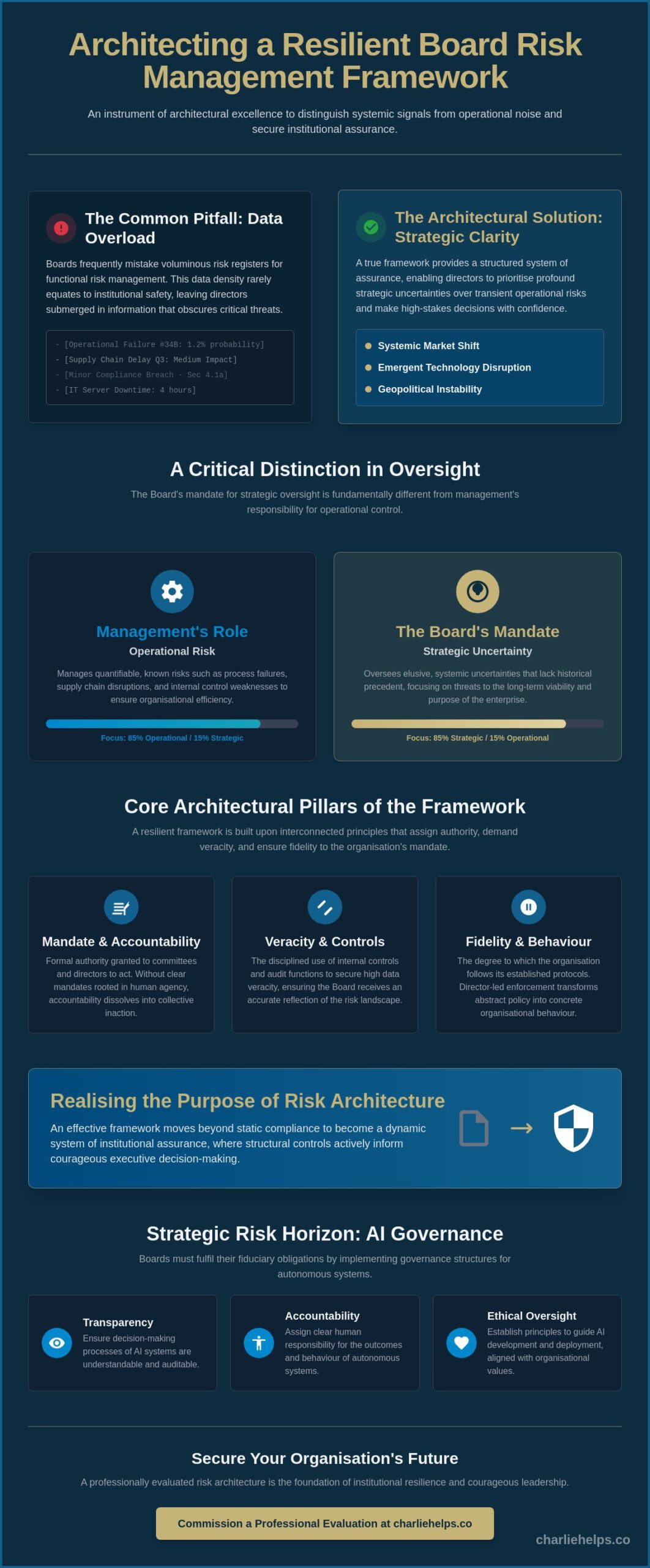
Boards often mistake voluminous risk registers for a functional board risk management framework. Data density rarely equates to institutional safety. Directors frequently find themselves submerged in management-led information overload, struggling to prioritise profound strategic uncertainties over transient operational risks. You likely recognise the frustration of navigating complex reports that obscure, rather than illuminate, the critical path forward. Such ambiguity leaves the organisation vulnerable to systemic blind spots and erodes the collective confidence of the boardroom.
To architect a resilient board risk management framework, boards must examine structures, mandates, and human agency with clinical precision. Directors secure data veracity and clarify individual accountability by using risk oversight to inform courageous strategic decision-making rather than merely documenting historical failures. Such an examination moves beyond theoretical models to address the practical necessity of maintaining institutional memory amidst global complexity. Final insights provide the clarity needed to evolve static compliance into a dynamic system of institutional assurance, grounded in fidelity, veracity, and active control.
Key Takeaways
- Distinguish between management-led operational risk and the Board’s mandate for strategic uncertainty to focus oversight on institutional resilience.
- Architect a board risk management framework that assigns specific accountability to individual directors, ensuring action remains rooted in human agency.
- Secure data veracity and institutional memory through the disciplined use of internal controls, audit committees, and specialised risk committees.
- Realise the true purpose of risk architecture by ensuring that structural controls actively influence executive decision-making and organisational behaviour.
- Fulfil fiduciary obligations by implementing AI governance structures that ensure transparency, accountability, and ethical oversight for autonomous systems.
Defining the Board Risk Management Framework: Architecture and Mandate
Boards often treat risk as a ledger of past failures. A true board risk management framework operates instead as a forward-looking architecture, enabling directors to identify, assess, and monitor strategic uncertainties before they crystallise into crises. It functions as a structured system of institutional assurance, providing the clarity required to make high-stakes decisions with confidence. This framework is not a mere regulatory burden; it is an instrument of architectural excellence that distinguishes between the noise of daily operations and the signals of systemic change.
Management typically manages operational risks, such as process failures or supply chain disruptions. The Board, however, holds a mandate for strategic oversight. This distinction is vital. Whilst executives focus on the efficiency of the machine, directors must focus on whether the machine is heading toward a precipice. By utilising a formal Risk Management Framework (RMF), Boards establish the boundaries within which the organisation operates, ensuring that every action aligns with the long-term vision, ethics, and standards of the enterprise.
The Distinction Between Risk and Uncertainty
Risk is often quantifiable, yet uncertainty remains elusive. Directors must look beyond the probability of known events to address broader systemic shifts that lack historical precedent. This requires a deep reliance on institutional memory to recognise recurring patterns of organisational friction that management might overlook. By prioritising uncertainties that threaten the viability of the enterprise, the Board ensures that strategic decision-making remains grounded in reality rather than optimism. A framework that fails to account for the unknown is merely a record of the obvious.
Mandate, Fidelity, and the Governance Architecture
The mandate represents the formal authority granted to committees and directors to act. Without clear mandates, accountability dissolves into collective inaction. Fidelity, the degree to which the organisation actually follows its established protocols, remains equally critical. Boards require high data veracity to receive an accurate reflection of the risk landscape. Professional corporate governance consultants UK assist Boards in refining these architectures, ensuring that the framework supports, rather than hinders, the realisation of strategic objectives. When directors enforce fidelity, they transform abstract policy into concrete organisational behaviour.
The Board’s Responsibility in Risk Oversight and Accountability
Directors often treat oversight as a passive receipt of reports, yet true accountability requires active agency. A board risk management framework serves as the primary instrument through which the Board enforces its will and maintains institutional fidelity. Action belongs to people, not processes; therefore, directors must interrogate management data to ensure it reflects reality rather than executive optimism. When a Board fails to intervene in the face of escalating uncertainty, it abdicates its fundamental mandate to protect the enterprise.
The Board establishes the boundaries of acceptable risk by setting clear appetite and tolerance levels. These parameters do not merely exist as static figures in a policy document; they function as active controls that guide every strategic decision. By defining these limits, directors provide the executive team with the necessary clarity to pursue objectives without overstepping the organisation’s capacity for loss. If you require assistance in defining these critical thresholds, you may contact our consultants for a professional evaluation of your current architecture.
Active control systems allow directors to intervene with precision when risks exceed agreed thresholds. These systems rely on a culture of veracity, where the Board insists that bad news travels as quickly as good news. Without this transparency, the risk framework becomes a hollow structure of compliance rather than a tool for strategic resilience. Directors must foster an environment where truth is valued above comfort, ensuring that the information reaching the boardroom remains untainted by internal politics or professional preservation.
Setting the Risk Appetite: A Strategic Decision
Defining the amount of risk the organisation is prepared to accept remains a core strategic function of the Board. Directors must align this appetite with the long-term vision of the enterprise, ensuring that the pursuit of growth does not compromise structural stability. As the external landscape shifts, the Board must review and adjust these parameters to reflect new systemic uncertainties. This iterative process ensures that the organisation remains agile whilst staying within the safety of its established guardrails.
Accountability and the Duty of Care
Collective accountability does not absolve individual directors of their duty of care. Every member of the Board carries a legal and ethical responsibility to maintain the integrity of the risk oversight process. The board’s responsibility in risk oversight demands a continuous interrogation of data fidelity and institutional memory. To ensure these standards are met, a regular Board effectiveness review serves as a vital tool for measuring oversight performance and identifying gaps in the governance architecture. Directors who prioritise such reviews demonstrate a commitment to excellence that transcends mere compliance.
Structural Components: Committees, Controls, and Institutional Memory
The architecture of oversight relies upon specific structural pillars to maintain institutional fidelity. A board risk management framework remains inert without the committees and controls designed to animate it. Directors must ensure that the Audit Committee and the Risk Committee maintain distinct yet complementary mandates. Whilst the Audit Committee verifies the veracity of financial statements and internal process adherence, the Risk Committee focuses on the horizon, identifying systemic uncertainties that could destabilise the enterprise.
Internal controls function as the sensory organs of the organisation. They provide directors with objective evidence of compliance and performance, removing the reliance on management’s subjective narratives. Without these controls, the Board operates in a vacuum of speculation. Effective information flow requires management to present data with precision, ensuring that the Board receives exactly what it needs to fulfil its duty of care without being buried under irrelevant detail.
The Role of the Risk Committee
Directors on the Risk Committee hold a specific mandate to identify and evaluate emerging threats. They collaborate closely with the Chief Risk Officer to realise a comprehensive view of the organisational risk profile. This committee must implement reporting requirements that ensure the full Board remains informed of critical shifts in the landscape. By focusing on the intersection of strategy and uncertainty, the committee provides the necessary assurance for the Board to approve high-stakes initiatives.
Preserving Institutional Memory through Systems
Boards often repeat historical errors because they fail to preserve institutional memory. When directors leave or executives rotate, critical knowledge of past failures often vanishes. Digital systems and workflow optimisation software allow organisations to capture, store, and categorise governance data for long-term use. By embedding historical lessons into current risk assessments, the Board ensures that its decisions remain informed by the collective wisdom of its predecessors. This systematic approach to memory prevents the erosion of institutional standards and strengthens the overall governance architecture.
Realising an Effective Framework through Fidelity and Behaviour
Boards achieve the full purpose of a board risk management framework only when it actively shapes human behaviour and decision-making within the organisation. Fidelity represents the degree to which directors and executives adhere to established protocols in the face of pressure or convenience. Many frameworks fail because they lack intellectual force in the boardroom, often reduced to a series of checkboxes rather than a system of active control. When reporting relies on vague qualifiers rather than concrete data, the Board loses its capacity to enforce accountability.
Directors must realise that a framework achieves its purpose only when it influences the quality of boardroom dialogue. A system that produces endless data without prompting a single difficult question has failed. Intellectual force requires directors to move beyond the surface of executive summaries, interrogating the assumptions that underpin management’s risk assessments. By demanding clarity, the Board ensures that the framework supports strategic resilience rather than merely providing the illusion of safety. If your current reporting structures lack this rigour, you should contact our advisory team to discuss a more disciplined approach to governance architecture.
From Paper to Practice: Ensuring Framework Fidelity
A profound gap often exists between the formal framework and the informal behaviours of the executive team. Directors must bridge this divide by conducting periodic “deep dives” into specific risk areas to test the veracity of management assurances. These focused interrogations allow the Board to see past the polished surface of executive summaries and identify systemic friction. To ensure the framework remains a living system of control, the Board must integrate risk oversight into every strategic discussion, preventing risk from becoming an isolated agenda item discussed only as a matter of compliance.
The Human Element in Risk Management
Psychological biases often cloud board judgement, leading to systemic failures of oversight. Groupthink, overconfidence, and confirmation bias can blind even the most experienced directors to emerging threats. Professional executive leadership coaching UK provides directors with the critical thinking skills required to challenge assumptions and identify these blind spots. A serious, humane approach to discussing failure allows the Board to learn from mistakes without succumbing to a culture of blame. When the Board models this behaviour, it encourages honesty and transparency amongst the executive team, further strengthening the veracity of the information flow.
Strategic Risk in 2026: AI Governance and Systemic Resilience
The emergence of autonomous systems in 2026 represents a profound shift in the global risk landscape. Directors must recognise that AI does not merely automate administrative tasks; it fundamentally alters the veracity of organisational data and the speed of decision-making. A modern board risk management framework must now account for algorithmic bias, the erosion of human oversight, and the potential for “Shadow AI” to operate outside formal controls. As of mid-2026, only 29% of organisations have implemented comprehensive AI governance plans, despite the high-risk provisions of the EU AI Act taking effect in August of this year. This gap between deployment and oversight represents a critical failure of institutional assurance.
Systemic resilience is built by anticipating global shifts rather than reacting to them. Boards must move beyond the narrow focus of historical data to evaluate how emerging technologies and geopolitical instabilities threaten the organisation’s long-term viability. This requires a shift in mindset from “just-in-time” efficiency to “just-in-case” resilience, ensuring the enterprise can withstand sudden shocks to its operational or ethical foundations. The Board’s mandate in this digital age remains unchanged: to protect the organisation’s purpose, maintain its ethics, and ensure that every technological advancement serves the human elements of the business.
Architecting AI Governance
AI introduces unique risks that traditional oversight models often fail to capture. Algorithmic bias can lead to systemic discrimination, whilst opaque “black box” models threaten the transparency required for true assurance. Boards must implement a dedicated AI governance framework that integrates seamlessly with their broader risk architecture. By maintaining active control over AI-driven processes, directors ensure that technology remains a tool for excellence rather than a source of unmanaged liability. This involves regular conformity assessments, technical documentation reviews, and the establishment of clear human oversight protocols.
Building Systemic Resilience for the Future
Navigating the complexity of 2026 requires a sophisticated approach to enterprise architecture. Utilising strategic corporate advisory services UK allows directors to refine their oversight mechanisms and align their risk appetite with the realities of a volatile market. Resilience is not a static state but a continuous process of movement, adjustment, and learning. Directors who prioritise institutional memory and data fidelity will find themselves better positioned to lead through uncertainty. Does your current board risk management framework provide the assurance required to lead with confidence in 2026?
Securing Institutional Assurance for the Digital Age
True institutional assurance requires more than acknowledging risk. It demands a functional architecture that enables directors to distinguish between management noise and the signals of systemic change. By enforcing fidelity to established controls, prioritising institutional memory, and interrogating data veracity, Boards ensure that their decisions remain rooted in reality rather than optimism.
Directors must move beyond mere compliance to realise a culture of veracity. Charlie Helps Associates provides expert consultants in corporate governance and board effectiveness to assist UK organisations navigating complex regulatory environments. Using a proprietary methodology for workflow optimisation and institutional assurance, we help you align your governance architecture with the demands of the future. This approach ensures that oversight remains a tool for strategic growth rather than a burden of documentation. Contact Charlie Helps Associates to refine your board risk management framework and secure the strategic resilience of your organisation.
Frequently Asked Questions
How does a board risk management framework differ from an operational risk plan?
A board risk management framework focuses on strategic uncertainty and institutional resilience, whilst an operational risk plan addresses specific process failures and tactical disruptions. The Board uses its framework to establish risk appetite and tolerance, providing the executive team with the boundaries required to pursue organisational objectives safely. Management manages the tactical execution, but the Board maintains the mandate for high-level oversight and long-term viability.
Can a board risk management framework prevent all corporate failures?
No framework provides an absolute guarantee against failure, yet a disciplined architecture ensures the organisation can withstand systemic shocks. It identifies patterns of friction before they crystallise into crises, allowing directors to intervene with precision. Assurance comes from evidenced movement and active control rather than the mere intention of safety, ensuring the organisation remains resilient in the face of the unknown.
Is the Audit Committee solely responsible for risk oversight?
Responsibility for risk oversight belongs to the full Board, though directors often delegate specific mandates to the Audit and Risk Committees. The Audit Committee typically verifies the veracity of financial reporting and internal controls, whilst the Risk Committee focuses on emerging threats and strategic uncertainties. This division of labour ensures comprehensive coverage without diluting the collective accountability of the boardroom.
How often should a board review its risk management framework?
Boards should review their risk architecture annually, or more frequently when the external landscape undergoes a significant systemic shift. Continuous monitoring ensures that the framework remains a living system of control rather than a static document. Regular reviews allow directors to adjust risk appetite levels to reflect new data, changing organisational priorities, and emerging global trends.
What is the role of the Chief Risk Officer (CRO) in board-level governance?
The Chief Risk Officer acts as a primary source of data veracity, providing the Board with the objective information required to fulfil its oversight mandate. This role involves translating complex operational data into strategic insights for the Risk Committee and the full Board. By maintaining a direct line to the boardroom, the CRO ensures that directors receive an accurate reflection of the risk landscape, untainted by executive optimism.
What happens if a board risk management framework is not followed in practice?
Failure to follow the framework in practice leads to an erosion of institutional fidelity and increases the legal liability of individual directors. When a Board allows protocols to be bypassed for convenience, it abdicates its duty of care and loses active control over the enterprise. This gap between policy and behaviour often precedes significant organisational crises and erodes stakeholder trust.
How should boards integrate AI into their existing risk frameworks in 2026?
Directors must integrate AI governance into their broader risk architecture by establishing specific protocols for algorithmic bias and data veracity. With the high-risk provisions of the EU AI Act taking effect in August 2026, Boards carry a legal responsibility to ensure transparency and human oversight in autonomous systems. This requires a dedicated focus on how AI influences strategic decision-making, ethical standards, and institutional memory.
Why is institutional memory critical for effective risk management?
Institutional memory prevents the repetition of historical errors by capturing and preserving lessons from past organisational cycles. Without this continuity, new directors or executives may inadvertently recreate the conditions for previous failures. Effective frameworks use digital systems to store critical governance data, ensuring that the Board remains informed by its collective history and maintains a consistent standard of excellence.
Disclaimer
The articles published on CharlieHelps.co are provided for general information, reflection, and commentary. They draw on professional experience, research, and interpretation, but they do not constitute legal, regulatory, financial, clinical, governance, risk, compliance, assurance, or other professional advice.Nothing published on this site should be relied upon as practice guidance, formal instruction, or a substitute for proper professional consultation. Readers should seek advice from suitably qualified advisers before acting on, applying, or relying upon any material in relation to their own organisation, Board, duties, circumstances, or decisions.Although reasonable care is taken to ensure that articles are accurate and current at the time of publication, no warranty is given as to completeness, accuracy, timeliness, or fitness for any particular purpose. Law, regulation, policy, standards, and recognised practice may change, and context matters.References to external sources, organisations, products, services, or third-party materials are included for information only. They do not imply endorsement unless expressly stated. Where an article contains affiliate links, sponsored references, or commercial relationships, these will be disclosed where relevant.The views expressed are those of the author unless otherwise stated. Reading, sharing, or responding to material on this site does not create a client, adviser, fiduciary, or professional relationship with Charlie Helps FRSA, CharlieHelps.co, or any associated entity.Readers remain responsible for their own judgement, decisions, and actions.
