

Most organisations treat digital evolution as a software procurement exercise rather than a fundamental realignment of authority. Such a narrow perspective frequently results in operational friction, particularly as the global digital transformation market approaches an estimated $3.4 trillion valuation in 2026. A successful digital workflow transition requires more than new tools; the process demands a governance-led mandate that clarifies accountability across every automated system.
Senior leaders often recognise the mounting pressure of regulatory compliance, specifically the EU AI Act’s phase two transparency requirements taking effect on 2 August 2026. Mastering the strategic realignment of organisational processes requires a rigorous governance framework to mitigate these risks and ensure fidelity. Analysis of the methods for achieving board-level oversight, reducing operational costs, and fostering a culture of digital-first accountability provides a reliable basis for institutional decision-making.
Key Takeaways
- Establish a rigorous mandate for your digital workflow transition by auditing manual processes, mapping them to strategic value, and securing board-level oversight.
- Distinguish between process management and automation to ensure that workflow optimisation software functions as a structural engine for institutional efficiency.
- Address the psychological dimensions of change by recognising that successful transitions depend upon human behaviour, leadership, and the mitigation of cultural resistance.
- Utilise the Charlie Helps Workflow Optimisation SaaS alongside professional advisory services to provide the structural backbone required to realise excellence.
- Reframe governance as an active responsibility of the Board to maintain accountability, veracity, and institutional memory throughout the organisational realignment.
Architecting the Digital Workflow Transition in Modern Governance
The systematic migration of manual processes to integrated digital frameworks defines the digital workflow transition. Governance requires an active shift in how people manage information. By 2026, the transition becomes a strategic mandate for Boards. Directors must move beyond legacy systems to meet the transparency requirements of the EU AI Act, which takes effect on 2 August 2026. This regulatory shift necessitates a move from passive reporting to active, governed data management.
High-performing organisations align their digital maturity with their performance objectives. Such alignment reduces systemic operational friction, which often manifests as fragmented data, delayed reporting, and administrative bottlenecks. Boards that prioritise a successful digital workflow transition realise greater efficiency. They replace reactive management with a proactive, governed movement that preserves institutional memory and establishes a reliable basis for executive reliance.
The Shift from Manual Oversight to Digital Transparency
Paper-based filing systems act as the “dinosaurs” of the corporate world. They obscure truth, restrict access, and delay the exercise of oversight. In contrast, real-time digital audit trails provide immediate assurance of operational activity. These trails enhance Board-level visibility, allowing directors to observe daily operations without interfering in management. For UK enterprises, this transparency is the foundation of stakeholder trust. It provides the veracity required for long-term institutional stability, accountability, and veracity. Directors who rely on digital veracity can defend their decisions with documented evidence, thereby fulfilling their fiduciary duties with greater precision.
Aligning Workflow with Your Corporate Governance Framework
Digital processes allow Boards to embed compliance by design. Instead of relying on periodic manual checks, the system enforces rules at the point of action. Leaders must integrate these digital tools into their existing corporate governance framework UK to maintain structural integrity. Automated approvals must mirror the formal delegation of authority established in the Board’s terms of reference. This ensures that every decision remains within its authorised mandate, preventing the drift of power that often accompanies poorly governed digital adoption. By codifying authority within the workflow, the Board establishes a persistent mechanism for organisational discipline.
The Structural Mechanics of Process Optimisation and Automation
Effective governance demands a clear distinction between Business Process Management (BPM) and Business Process Automation (BPA). BPM involves the holistic orchestration and continuous refinement of organisational activity, whilst BPA focuses on the technical execution of individual tasks. A successful digital workflow transition requires Boards to integrate both disciplines. Without the strategic context of BPM, BPA merely accelerates the movement of data without regard for its ultimate purpose. Directors must authorise frameworks that prioritise process health before technical deployment to ensure every automated action aligns with the institutional mandate.
Workflow optimisation software functions as the structural engine of the modern enterprise. It replaces the rigid, linear paths of legacy systems with dynamic, responsive frameworks. Central to this evolution is the transition from folder-based storage to metadata-driven search. Folder structures often mirror the silos of the departments that created them, obscuring the veracity of information. Metadata, conversely, treats data as a fluid asset, enabling directors to access records across disparate systems to maintain a comprehensive institutional memory. This shift supports the fidelity of reporting and allows for more precise board-level oversight.
By 2026, workflow ecosystems will utilise AI for predictive task routing, identifying potential delays before they impact operations. This predictive capacity offers a superior form of assurance, allowing the Board to intervene early when risks emerge. To manage these complex environments, leaders often rely on A Strategic Framework for Executing the Digital Transition. Such frameworks provide the controls necessary to ensure that automated systems adhere to ethical standards and regulatory requirements. Boards must decide which automated functions require human intervention to maintain accountability.
Identifying Candidates for Automation
High-impact candidates for automation typically involve repetitive, time-sensitive approvals or high-volume data entry. Common examples include invoice routing, HR onboarding, and regulatory reporting. Nevertheless, the Board must guard against the “automation of inefficiency.” Technology cannot fix a broken process; it only makes the failure occur faster. Directors should engage advisory services to audit and optimise processes before applying automation, ensuring that every digital step fulfils a specific strategic aim and remains within the authorised delegation of authority.
Reducing Operational Friction through Systemic Design
Operational friction is the cumulative cost of manual hand-offs, fragmented communication, and lost data. It creates an invisible tax on organisational performance. Systemic design removes these barriers, reducing the mental load on senior management. When workflows are streamlined, leaders can focus their energy on high-stakes decisions rather than administrative troubleshooting. This transition from friction to flow enhances leadership capability and establishes a culture of disciplined movement. The resulting clarity provides the Board with the assurance that the organisation is acting with both speed and integrity.
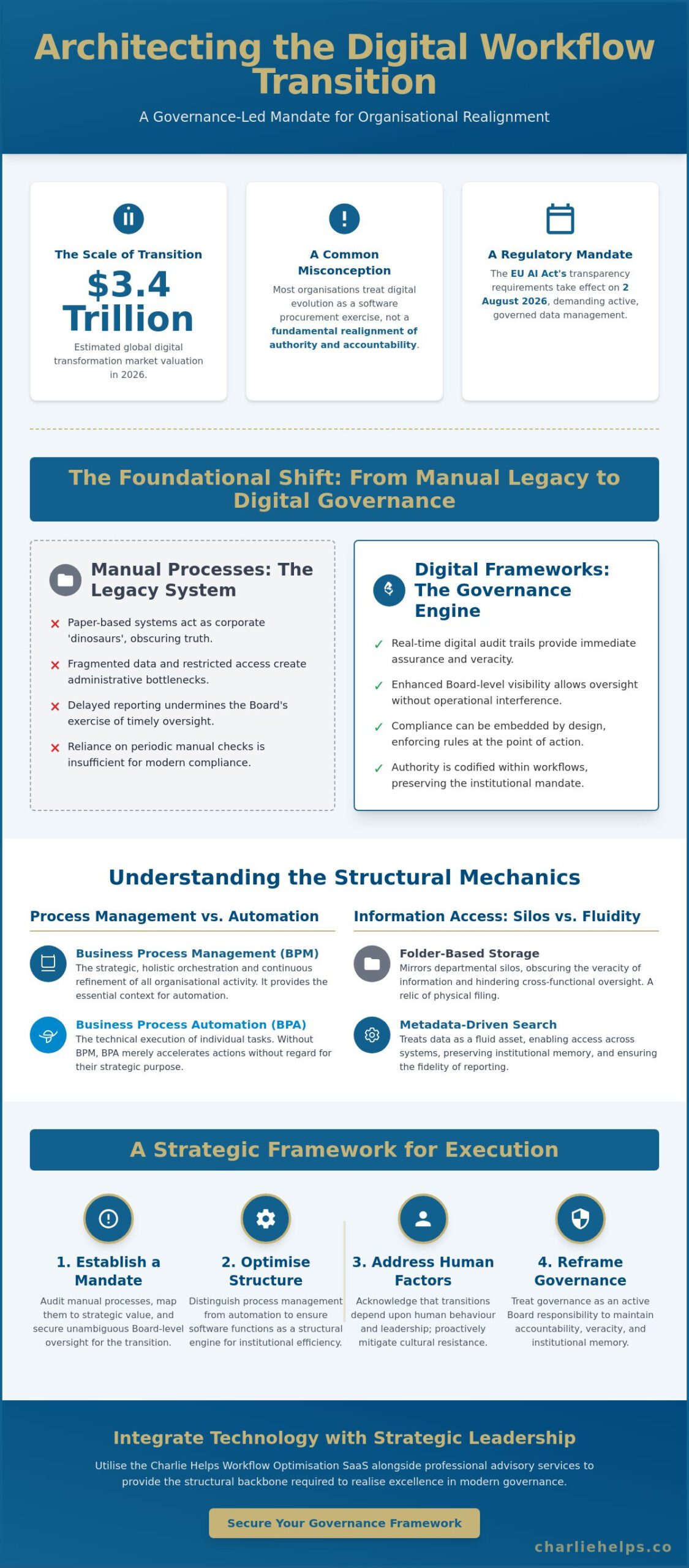
A Strategic Framework for Executing the Digital Transition
Directors begin by authorising a comprehensive audit of the current process landscape. This initial assessment provides the evidence required to identify where manual intervention introduces operational friction or compliance risks. Without this baseline, any subsequent digital workflow transition lacks the grounding necessary for institutional reliance. The Board must decide which processes remain critical to the mandate and which require fundamental redesign before automation occurs.
Mapping the future state involves more than selecting new software; it requires a vision of strategic value creation. Leaders must define how digital frameworks will support the long-term aims of the organisation. This stage requires directors to reconcile the tension between speed and control, ensuring that faster processing does not compromise the veracity of corporate data. A well-defined map serves as the blueprint for accountability, guiding the organisation toward a culture of digital-first discipline.
Mapping the Current Process Landscape
Identifying systemic pain points requires direct engagement with departmental heads. These leaders often manage “shadow workflows” that bypass formal systems to overcome manual bottlenecks. Documenting the flow of information across the entire UK organisation reveals these hidden patterns. The Board uses this data to establish a new, governed path that replaces informal workarounds with authorised digital structures. This documentation preserves institutional memory and provides a clear audit trail for future regulatory scrutiny.
Selecting the Right Workflow Optimisation SaaS
Boards must prioritise workflow automation for business tools that offer granular audit trails and permission-based access. These features allow directors to maintain accountability even when processes are automated. Selection criteria must include the vendor’s commitment to data security and adherence to UK regulatory standards. The chosen SaaS should function as a structural extension of the Board’s existing corporate governance framework, ensuring that automated approvals mirror the formal delegation of authority.
Execution of a pilot phase allows the Board to test governance integrity within a controlled environment. Directors observe how users interact with the new systems, ensuring that every automated action adheres to the established mandate. This evidence-based approach reduces the risk of a failed transition by identifying friction points before the full-scale digital workflow transition occurs. Scaling requires a methodical expansion that preserves the fidelity of the governance framework. Directors must maintain continuous oversight through feedback loops that monitor system performance and user behaviour, ensuring the organisation remains aligned with its strategic goals whilst fulfilling its operational objectives.
Navigating the Human Element and Cultural Resistance
Technical deployment represents only twenty per cent of the challenge. The remaining eighty per cent resides in human behaviour. Boards must recognise that long-tenured staff often view established work patterns as a source of professional identity; changing these patterns triggers psychological resistance. Leaders should frame the digital workflow transition as an opportunity for development, status, and professional growth. Internal champions within departments act as the necessary bridge between strategic intent and operational reality.
Leadership requires the courage to address these anxieties directly. When staff understand that automation removes the drudgery of manual data entry, they can focus on higher-value analysis. This shift creates a path for leadership development across all levels of the organisation. Directors must identify those who embrace the new framework early and empower them to mentor their peers. This peer-to-peer advocacy builds a sense of collective purpose that no top-down directive can match.
Executive Leadership and Mentoring During Change
Directors cannot mandate what they do not practice. To lead a successful transition, senior management must model digital-first behaviour in every board meeting and executive session. Engaging in executive leadership coaching UK provides the personal clarity required to guide others through the ambiguity of change. Mentoring within the C-suite bridges the digital literacy gap, ensuring that every director possesses the technical confidence to exercise their mandate. This commitment to personal growth signals to the entire organisation that the transition is a permanent shift in institutional memory, leadership, and culture.
Building a Culture of Digital Accountability
Accountability requires a fundamental shift from task completion to process ownership. In a manual environment, staff often focus on finishing a single form; in a digital environment, they must understand their role within the wider system. Implementing feedback loops allows staff to contribute to the continuous refinement of workflows, which fosters a sense of agency. Boards should celebrate early wins to build momentum for the broader digital workflow transition. These small successes provide the evidence required to secure long-term commitment from the workforce.
Collaborative Excellence
Realising a digital future requires more than technical skill; it demands a partnership between people and systems. If your organisation faces cultural inertia, our Advisory Services can help you design a transition strategy that respects the human element whilst fulfilling your governance obligations.
Integrating Workflow SaaS with Strategic Executive Leadership
Proprietary technology serves its highest purpose when it mirrors the Board’s strategic intent. The Charlie Helps Workflow Optimisation SaaS provides the structural backbone for this alignment, codifying the rules of engagement and authority into every digital process. By integrating this software, directors establish a persistent mechanism for accountability that transcends individual tenures. This synergy between software and professional advisory services ensures that the digital workflow transition remains grounded in the practical realities of organisational oversight. Technology alone cannot govern; people must use it to exercise their mandate with precision.
Real-time data harvested from digital workflows offers a new dimension to board-level succession planning. Directors can observe how potential leaders manage their authorised mandates, providing objective evidence of leadership capability and procedural fidelity. This veracity allows the Board to make informed decisions about the future of the enterprise, ensuring that institutional memory remains intact during leadership shifts. The software functions not merely as a tool for efficiency, but as a catalyst for sustainable value creation and corporate accountability. It provides the assurance that every action taken within the organisation adheres to the established governance framework. Boards seeking to strengthen individual director capability alongside systemic controls may benefit from executive performance mentoring, which bridges the gap between personal leadership development and institutional accountability.
The Role of Advisory in Continuous Optimisation
Deployment marks the commencement, not the conclusion, of the journey. Boards must authorise ongoing strategic reviews to interpret workflow data and drive organisational performance. Advisory services provide the steady hand required to navigate the complexities of long-term digital evolution. These consultants help directors refine their digital workflow transition by identifying emerging risks and adjusting controls to maintain governance integrity. Continuous optimisation ensures that the organisation remains agile whilst fulfilling its formal obligations to stakeholders. Without this human-centric oversight, digital systems risk becoming rigid and disconnected from the organisation’s evolving purpose.
Next Steps for Your Organisational Performance
Transitioning to digital frameworks is a journey towards a more resilient and disciplined enterprise. Leaders should reflect on their current operational friction points and consider the evidence supporting their existing reliance on manual systems. Achieving excellence requires a commitment to both structural change and behavioural realignment. The move from manual opacity to digital transparency is an act of leadership that preserves the organisation’s integrity for future generations. If you are ready to realise a more transparent and accountable future, we invite you to enquire about our Workflow Optimisation SaaS and Advisory Services. The Board must now decide whether to maintain the status quo or to authorise the movement towards a digital-first governance model.
Realising Organisational Excellence through Governed Movement
Governance requires active participation from those who hold the mandate. Boards must move beyond the passive observation of technical systems to the rigorous enforcement of accountability. A successful digital workflow transition succeeds only when technology serves as a structural extension of the Board’s authority. By prioritising the fidelity of data and the alignment of human behaviour, directors preserve the institutional memory required for future stability.
Charlie Helps Associates provides a steady hand in this complex environment. Our proprietary Workflow Optimisation SaaS serves as the structural backbone for executive oversight, supported by decades of experience in UK corporate governance, strategic advisory, and leadership mentoring. We offer bespoke programmes to align leadership behaviour with your digital strategy, ensuring every automated process remains within its authorised mandate. Discover how Charlie Helps Associates can organise your digital workflow transition.
The path toward a more stable, transparent enterprise begins with a single, governed decision. Leaders who embrace this shift secure the veracity of their organisation for the decades ahead.
Frequently Asked Questions
What is the primary benefit of a digital workflow transition for a UK board?
Enhanced board-level visibility and the veracity of information constitute the primary advantages. A digital workflow transition allows directors to observe operational activity in real time, replacing passive, anecdotal reporting with evidenced truth. The transparency realised through this shift enables the Board to exercise its mandate with greater precision and confidence.
How does digital workflow optimisation impact corporate governance compliance?
Optimisation enforces compliance by design rather than through manual, retrospective checks. By embedding regulatory requirements directly into the automated sequence, the organisation ensures that every action remains within the authorised delegation of authority. The systematic approach reduces the risk of human error and provides a reliable audit trail for regulators.
Can digital workflows be integrated with existing legacy systems?
Integration is achievable through the use of modern APIs and middleware that bridge legacy data with new frameworks. The process preserves institutional memory whilst upgrading the underlying operational structure. Directors must decide which legacy data remains critical for ongoing reliance before authorising the technical link to the new system.
What is the typical timeframe for a full organisational digital transition?
Timeframes typically range from six to eighteen months, depending upon the complexity of the organisational processes. A phased approach allows the Board to test governance integrity within specific departments before scaling the movement across the entire enterprise. Directors must maintain continuous oversight to ensure that each phase fulfils its strategic objectives.
How do we address security concerns when moving sensitive governance data to a SaaS platform?
Security is maintained through the selection of platforms that adhere to UK GDPR and ISO 27001 standards. Granular, permission-based access and encryption provide the necessary controls to protect sensitive information from unauthorised access. The Board must authorise the security framework to ensure it aligns with the organisation’s risk appetite and legal obligations.
What role does executive coaching play in a successful digital transition?
Coaching aligns leadership behaviour with the new digital strategy by addressing the psychological dimensions of change. It helps senior management bridge the digital literacy gap, ensuring every leader possesses the confidence to use the new tools. Leaders who engage in coaching model the digital-first behaviour required to inspire the wider workforce and maintain culture. Organisations that embed executive performance mentoring as a governance tool find that directors develop the disciplined decision-making required to sustain accountability throughout the transition.
How do we measure the ROI of a digital workflow transition?
Measurement focuses on reduced operational costs, improved process velocity, and the mitigation of compliance risks. Boards observe a decrease in administrative friction and an increase in the reliability of institutional data. The quantitative and qualitative gains realised through a digital workflow transition provide the evidence required to justify the initial investment and ongoing advisory fees.
Is digital workflow transition suitable for public sector organisations in the UK?
Public sector organisations find these transitions highly suitable due to the rigorous requirements for transparency and accountability. Digital frameworks support the audit trails required by government regulators and help boards manage public resources with greater fidelity. The transition helps public bodies fulfil their mandates whilst maintaining the trust of the citizens they serve.
Disclaimer
The articles published on CharlieHelps.co are provided for general information, reflection, and commentary. They draw on professional experience, research, and interpretation, but they do not constitute legal, regulatory, financial, clinical, governance, risk, compliance, assurance, or other professional advice.
Nothing published on this site should be relied upon as practice guidance, formal instruction, or a substitute for proper professional consultation. Readers should seek advice from suitably qualified advisers before acting on, applying, or relying upon any material in relation to their own organisation, Board, duties, circumstances, or decisions.
Although reasonable care is taken to ensure that articles are accurate and current at the time of publication, no warranty is given as to completeness, accuracy, timeliness, or fitness for any particular purpose. Law, regulation, policy, standards, and recognised practice may change, and context matters.
References to external sources, organisations, products, services, or third-party materials are included for information only. They do not imply endorsement unless expressly stated. Where an article contains affiliate links, sponsored references, or commercial relationships, these will be disclosed where relevant.
The views expressed are those of the author unless otherwise stated. Reading, sharing, or responding to material on this site does not create a client, adviser, fiduciary, or professional relationship with Charlie Helps FRSA, CharlieHelps.co, or any associated entity.
Readers remain responsible for their own judgement, decisions, and actions.
